Updated for July 2026. This guide reflects current 2026 industry benchmarks, cost data, and best practices verified across recent DianApps client builds.
Quick answer: The best taxi booking app in NYC depends on the ride. For licensed yellow cabs with upfront, no-surge pricing, use Curb or Arro. For the largest fleet and every vehicle type, use Uber or Lyft, both of which can now also match you with a yellow taxi. For premium airport transfers, use Blacklane. Waymo robotaxis are not available in New York City as of November 2026.
New York City is the busiest taxi market in the United States, and 2026 has changed it more than any year since Uber arrived. Lyft started sending riders to yellow cabs, Uber now forwards hundreds of thousands of Manhattan requests to taxis every month, a new licensed ride-hail app launched, and Waymo’s robotaxi tests ended.
This guide covers the top 10 taxi booking apps in NYC for 2026, what each one is best for, how much rides cost, and, if you’re planning to launch your own, what taxi booking app development involves, from licensing to cost.
TL;DR: NYC’s taxi market serves 141,000+ daily yellow cab trips and growing. The top apps range from Uber (76% US market share) to niche players like Curb (no surge pricing) and Gravity (all-electric yellow cabs). Building your own taxi app costs $40,000-$150,000 depending on features, with React Native + Node.js as the recommended stack. Uber hit $52 billion revenue and 202 million MAU in 2025 (Uber IR, 2025).
What Is the Best Taxi Booking App in NYC in 2026?
The best taxi booking app in NYC for most riders is Curb if you want a licensed yellow cab at an upfront price, and Uber if you want the widest choice of vehicles and the shortest wait. Lyft is a strong option in the outer boroughs, and since July 2026 it can also book yellow cabs. Here is how all ten options compare. Taxi apps generated $59.6 billion in revenue in 2024, a 27.6% increase year-over-year (Business of Apps, 2026).
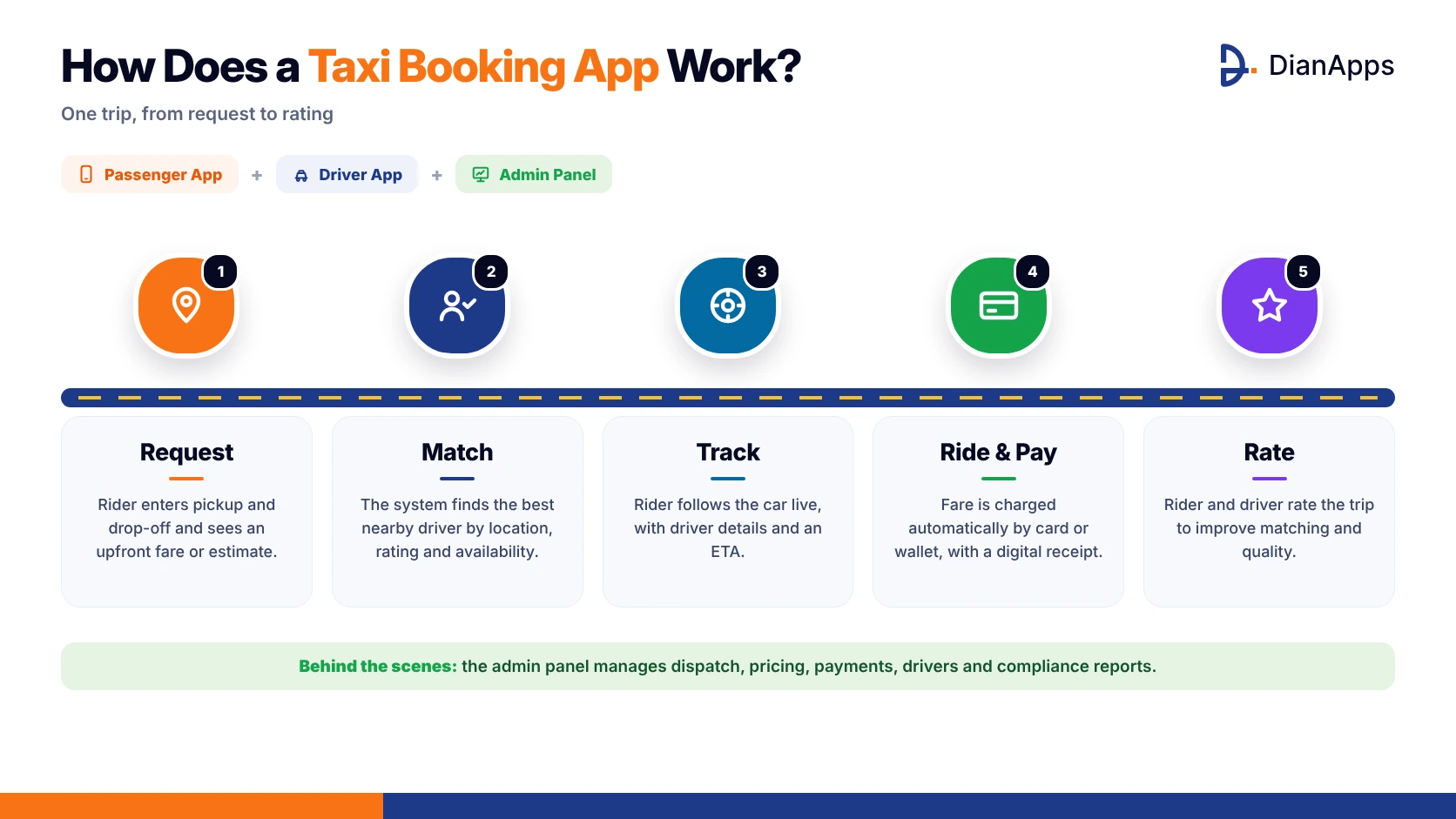
A complete taxi app ecosystem includes three components:
Admin panel, Fleet management, analytics, payment oversight, user management
Modern taxi app development goes beyond basic ride-booking. Today’s platforms incorporate AI-powered driver matching, dynamic pricing algorithms, real-time GPS tracking, and integrated payment systems. If you’re considering building your own taxi app, understanding these components is the first step.
Whether you’re working with an android app development New York firm or a full-service mobile app development company in New York, the architecture remains the same, three apps working together as one smooth system.
Top 10 Taxi Booking Apps in NYC (2026)
NYC’s taxi and ride-hailing market is the most competitive in the United States. Yellow cabs averaged 141,701 daily trips in September 2025, up 17% year-over-year (NYC TLC / AutoMarketplace, 2025). Here are the apps New Yorkers actually use:
1. Uber
Uber is the largest ride-hailing platform in New York and worldwide. In 2025 it generated $52 billion in revenue and completed 13.6 billion trips, with more than 200 million monthly users (Uber investor relations, Feb 2026).
• UberX, UberXL, Comfort, Black and Green options
• Uber Taxi: requests can be sent to yellow cabs through Curb and Arro. NYC TLC reported over 800,000 Manhattan Uber requests forwarded to taxis in a single month.
• Scheduled rides with Uber Reserve
• 2026 status: active. Uber and Lyft are the only two companies holding NYC High-Volume For-Hire licenses.
2. Lyft
Best for: outer-borough trips and riders who want an alternative to Uber.
Lyft reported $6.3 billion in revenue and a record 945.5 million rides in 2025 (Lyft FY2025 results, Feb 2026).
Standard, XL, Preferred and Lux options
Women+ Connect preference and Lyft Pink membership
New in 2026: since July 16, 2026, eligible Lyft riders in NYC can be matched with a licensed yellow taxi through Curb Flow (Lyft and Curb, Business Wire). Riders can opt out in the app settings.
3. Curb
Best for: booking a licensed NYC yellow cab.
Curb is the best-known dedicated taxi app in New York. It connects riders with TLC-licensed yellow cabs and supports the TLC’s Flex Fare upfront pricing on eligible trips.
Book a yellow cab or pay for a cab you hailed on the street
Upfront fares on eligible trips, no surge on metered rides
Its Curb Flow API now powers taxi matching for both Uber and Lyft
Curb connects more than 100,000 drivers across 65+ cities (Curb, July 2026)
4. Arro
Best for: simple yellow-cab hailing and paying from your phone.
Arro is a NYC yellow-cab app built around the city’s licensed taxi fleet.
Upfront price and fare estimates, even before you log in
“I’m already in a taxi” pay-by-code feature
Also one of the channels Uber uses to forward requests to yellow cabs
2026 status: active, app updated June 2026
5. Throo (TADA)
Best for: riders and drivers who want to try a new, TLC-licensed alternative.
Throo is the NYC launch of the ride-hailing company TADA. It soft-launched on June 10, 2026, and NYC TLC reported 2,047 drivers completing 2,547 trips in its first month (NY1, Aug 2026).
• TLC-licensed ride-hail service
• Positions itself as a driver-friendly alternative to Uber and Lyft
• 2026 status: early stage, still building volume
6. Gett
Best for: corporate ground travel.
Gett focuses on business travel management. In New York, rides booked through Gett are fulfilled through partner networks rather than its own fleet.
Central billing and travel policy controls for companies
One account for rides in multiple cities
2026 status: active for corporate accounts
7. Blacklane
Best for: premium airport transfers.
Blacklane is a chauffeur service with fixed, all-inclusive pricing, popular for transfers to and from JFK, LaGuardia and Newark.
Fixed prices with no surge
Flight tracking and free waiting time
Business and first-class vehicles
8. Dial 7
Best for: pre-booked car service to the airports.
Dial 7 is a long-running New York car service base offering pre-booked rides, especially for airport trips, with online and app booking.
Pre-booked black car and sedan rides
Popular for scheduled airport transfers
Fixed quotes on many routes
9. Via
Best for: understanding how NYC’s market has changed.
Via was once one of four high-volume ride-hail companies in NYC. As of 2026, NYC TLC lists only Uber and Lyft as high-volume licensees (NYC TLC, Feb 2026). Via now focuses on transit technology for cities and agencies rather than consumer rides in New York.
10. Waymo (Emerging, Not Yet in NYC)
Best for: watching the future of robotaxis.
Waymo received NYC permits to test eight vehicles with safety drivers in 2025, but its city and state permits expired on March 31, 2026, and testing stopped. TLC rules do not currently allow autonomous vehicles to provide taxi service (THE CITY via Electric Vehicles, April 2026).
Apps that left or changed course:Revel shut down its NYC rideshare service in August 2025 to focus on EV charging (TechCrunch). Juno closed in 2019. Gravity, which launched electric yellow cabs in 2021, is now known mainly for EV charging.
NYC strengths: Fully autonomous, no human driver. Represents the next frontier. Regulatory hurdles remain, but Waymo’s target is 1 million rides per week globally by end of 2026.
Emerging player worth watching: TADA, a blockchain-based Web3 taxi app, announced its NYC launch for June 2026 using smart contracts to connect drivers and riders directly (Fortune, 2025).
NYC Taxi App Comparison Table (2026 Pricing)
App
Type
Books yellow cabs?
Surge pricing?
Upfront price?
Congestion charge per trip
Best for
Uber
Ride-hail + taxi
Yes (via Curb/Arro)
Yes
Yes
$1.50 ($0.75 for taxi trips)
Coverage
Lyft
Ride-hail + taxi
Yes (via Curb, since July 2026)
Yes
Yes
$1.50 ($0.75 for taxi trips)
Outer boroughs
Curb
Taxi
Yes
No
Yes (Flex Fare)
$0.75
Yellow cabs
Arro
Taxi
Yes
No
Yes
$0.75
Simple hailing
Throo
Ride-hail
No
Varies
Yes
$1.50
New alternative
Gett
Corporate
Via partners
Varies
Yes
Varies
Business travel
Blacklane
Chauffeur
No
No
Fixed
Included
Airports
Dial 7
Car service
No
No
Quotes
Varies
Pre-booked airport rides
Pricing note: NYC metered taxi base fare is $3.00 + $3.50/mile + surcharges. Rush hour adds $2.50, overnight adds $1.00, and congestion pricing (below 60th St) adds $0.75 for taxis or $1.50 for rideshare apps, effective since January 2025 (NYC TLC, 2025).
Why Is NYC the Perfect Market for a Taxi App?
NYC congestion pricing launched in January 2025, increasing average speeds in the central business district from 8.2 to 9.7 mph, a 15% improvement, with crosstown travel 20-30% faster (NBER, 2025). This has actually boosted taxi trip volumes and improved the rider experience.
Several factors make NYC a prime market for taxi app development:
Massive daily demand, 141,000+ yellow cab trips per day, plus hundreds of thousands of rideshare trips
Congestion pricing benefits, Faster trips mean more rides per driver per shift
EV transition, NYC’s Green Rides Initiative targets 100% electric taxis by 2030
Tourist traffic, 60+ million visitors annually, most needing rides
Regulatory framework, NYC TLC provides clear licensing and compliance requirements
Limited car ownership, Most Manhattan residents don’t own cars, creating constant ride demand
Any mobile app development company in New York focused on transportation will tell you: the demand ceiling here hasn’t been reached. Similarly, services like London Executive Chauffeurs continue to see growing demand, as more clients seek reliable, luxury, and professional travel options in London If you’re thinking about how to build a taxi app, NYC’s growing market and regulatory clarity make it an ideal starting point.
What Features Does a Taxi App Need?
85% of smartphone users in urban areas have at least one ride-hailing app installed (Grand View Research, 2024). To compete for space on their phones, your app needs the right features from day one.
Rider App Features
User registration/login (social login, phone, email)
Real-time GPS tracking of assigned drivers
Ride booking (immediate and scheduled)
Fare estimation before booking
Multiple payment methods (cards, wallets, Apple Pay, Google Pay)
Ride history and receipts
Driver ratings and reviews
Push notifications (driver arrival, ride updates)
SOS/emergency button
Promo codes and referral system
Driver App Features
Ride request acceptance/rejection
Turn-by-turn navigation
Earnings dashboard
Availability toggle (online/offline)
Ride history and statistics
Document upload (license, insurance, TLC badge)
Heat maps showing high-demand areas
Admin Panel Features
Real-time fleet monitoring
User and driver management
Payment and commission processing
Analytics and reporting dashboard
Surge pricing controls
Dispute resolution tools
Regulatory compliance tracking (critical for NYC TLC)
Our finding: The apps that retain users in NYC’s competitive market share three traits: sub-5-second booking confirmation, fare transparency (no surprise charges), and at least one differentiator (like Revel’s EV-only fleet or Curb’s zero surge pricing). Features alone don’t win, positioning does.
Is It Cheaper to Take a Taxi or Uber in NYC?
For short trips in Manhattan, a yellow taxi is often cheaper than Uber or Lyft. Taxi meters never surge, and taxis pay a lower congestion pricing charge ($0.75 vs $1.50 per trip). Uber and Lyft can be cheaper for longer outer-borough trips or when there’s no surge.
2026 NYC yellow taxi fares (NYC TLC):
Charge
Amount
Initial charge
$3.00
Per 1/5 mile (or per 60 seconds stopped/slow)
$0.70
MTA State Surcharge
$0.50
Improvement Surcharge
$1.00
Overnight surcharge (8pm–6am)
$1.00
Weekday rush hour surcharge (4pm–8pm)
$2.50
NYS Congestion Surcharge (south of 96th St)
$2.50 yellow taxi / $2.75 Uber, Lyft and green cabs
MTA Congestion Relief Zone charge (60th St and below)
$0.75 taxi / $1.50 Uber and Lyft
JFK to Manhattan flat fare
$70 (+$5 on weekdays 4pm–8pm)
Trips to Newark Airport
Metered fare + $20
Trips from LaGuardia
+$5
Can You Book a Yellow Cab on Uber or Lyft?
Yes. NYC’s biggest app trend in 2026 is aggregation: yellow cabs are now bookable inside the largest ride-hail apps.
Uber has forwarded requests to yellow taxis through Curb and Arro since 2022.
Lyft added NYC yellow cabs through Curb’s API, Curb Flow, on July 16, 2026.
Taxis also benefited from congestion pricing. In its first year, taxi trips in the Congestion Relief Zone rose 17%, while Uber and Lyft trips there fell 4.5% (MTA data via NYC TLC).
For a new taxi booking app, this matters. Riders now expect to see taxis and app-based cars side by side, and open APIs are becoming as important as your own fleet.
Why Is NYC Still a Strong Market for a New Taxi Booking App?
NYC remains attractive because demand is huge and still shifting. Uber and Lyft completed more than 22 million trips in December 2025 alone. Trips in the Bronx, Brooklyn, Queens and Staten Island grew 7–9% year over year in January 2026, while Manhattan fell 6.1% (NYC TLC). That leaves room for apps focused on the outer boroughs, airports, accessible rides and EV fleets.
There are real challenges too:
Competition: Uber and Lyft handle the large majority of app-based trips.
Driver supply: new for-hire vehicle licenses are paused except for wheelchair-accessible vehicles, so a new app must recruit drivers who already hold TLC licenses.
The opportunity is in serving a niche better, such as corporate travel, airports, accessible rides or fleet operators, rather than trying to copy Uber city-wide.
What Features Does a Taxi Booking App Need?
Passenger App Features
Sign-up with phone, email or social login
Instant and scheduled bookings
Upfront fare and fare calculator
Real-time GPS tracking and ETA
Multiple payment options (cards, Apple Pay, Google Pay, wallet)
Digital receipts and trip history
Ratings, feedback and support chat
SOS button and trip sharing
Wheelchair-accessible ride requests
Promo codes and referrals
Driver App Features
Document upload and verification, including TLC license checks
Accept or decline ride requests
Turn-by-turn navigation
Earnings dashboard and payouts
Demand heat maps
Availability and shift controls
Admin Panel Features
Live dispatch and fleet monitoring
Pricing rules, surcharges and commissions
Driver and rider management
Dispute and refund handling
Compliance and trip data reporting (required for TLC-licensed apps)
Analytics on demand, revenue and driver performance
White Label Taxi Booking App vs Custom Development vs No-Code Builder
There are three ways to launch a taxi booking app, and the right one depends on your budget, timeline and how much control you need.
Factor
No-code builder
White label taxi booking app
Custom taxi booking app development
What you get
Booking forms, payments, fare estimates
Pre-built passenger, driver and admin apps you rebrand
Platform designed and built for your business
Typical cost
Low monthly subscription
About $5,000–$25,000+ setup (vendor estimates)
About $40,000–$150,000+
Time to launch
Days
2–8 weeks
3–8+ months
Real-time dispatch and tracking
Usually no
Yes
Yes
Customization
Very limited
Limited
Full
NYC TLC data reporting
No
Depends on vendor
Built to your needs
Code ownership
No
Usually licensed
Yes
Best for
Small operators taking pre-booked rides
Testing demand quickly on a budget
Unique pricing, NYC compliance and scale
Our recommendation: use a no-code builder if you only need a booking form for a small fleet. Use a white label taxi booking app to test demand fast. Choose custom taxi booking app development when you need NYC compliance, your own pricing logic or integrations, or a platform you own and can scale. Many businesses start with an MVP and grow from there; see our guide to Uber clone app development for how pre-built and custom approaches compare.
How Much Does Taxi Booking App Development Cost in 2026?
A custom taxi booking app MVP with passenger, driver and admin apps typically costs $40,000–$70,000 and takes 3–4 months. A full-featured platform costs $70,000–$150,000, and enterprise platforms can exceed $150,000–$300,000.
Cost by App Tier
App tier
What’s included
Estimated cost
Timeline
White label
Rebranded pre-built platform
$5,000–$25,000+
2–8 weeks
MVP
Core booking, tracking, payments, basic admin
$40,000–$70,000
3–4 months
Full-featured
Scheduling, promos, analytics, advanced dispatch
$70,000–$150,000
5–8 months
Enterprise
Multi-city, AI matching, corporate accounts, custom integrations
$150,000–$300,000+
8–12+ months
Cost by Developer Location (Hourly Rates)
Region
Typical hourly rate
United States
$100–$240
UK / UAE
$60–$130
Eastern Europe
$30–$70
India / Asia
$20–$60
Rates from public 2026 industry estimates; actual quotes vary by scope.
What Pushes Costs Higher?
Real-time dispatch and AI-based driver matching
Multiple apps (iOS, Android, web) built separately rather than cross-platform
Yellow or green taxis: a TLC E-Hail App Provider License. It has a $500 application fee for a three-year term, requires $5 million per-occurrence commercial general liability insurance, monthly trip data reporting, and dispatch only to TLC-licensed drivers and vehicles.
Black cars, liveries or limousines: an FHV Base License.
More than 10,000 trips a day: a High-Volume For-Hire Service license, currently held only by Uber and Lyft.
Other rules to plan for:
New for-hire vehicle licenses are paused except for wheelchair-accessible vehicles (NYC TLC, Feb 2026).
High-volume apps must meet minimum driver pay rules and the Green Rides requirement to dispatch 25% of trips to electric or wheelchair-accessible vehicles in 2026, rising to 40% in 2027.
Payments must meet PCI DSS standards, and rider data must be protected under US privacy rules.
How to Build a Taxi App: Step-by-Step Process
Building a taxi app that can compete in a market where Uber spent billions requires smart prioritization. Here’s the proven development process used by professional teams:
Step 1: Market Research and Concept Validation (2-3 Weeks)
Identify your target market and niche (city-specific, EV-only, corporate, shared rides)
Analyze competitor strengths and gaps
Define your unique value proposition
Validate demand through surveys or a landing page
Step 2: Define Features and Create an MVP Scope (1-2 Weeks)
List must-have features for launch (rider app, driver app, admin panel)
Separate “nice-to-have” features for post-launch
Create user stories and flow diagrams
Define the technology stack
Step 3: UI/UX Design (3-4 Weeks)
Design wireframes for all three apps
Create high-fidelity mockups
Focus on simplicity, riders should book in under 3 taps
Test designs with real users before development
Step 4: Backend Development (6-8 Weeks)
Set up server infrastructure (AWS recommended)
Build APIs for ride matching, payments, notifications
Implement real-time tracking with Socket.io
Integrate Google Maps Platform
Build the admin dashboard
Step 5: Frontend/Mobile Development (6-8 Weeks, Parallel with Backend)
Develop rider and driver apps (React Native or Flutter recommended)
Implement real-time GPS tracking UI
Integrate payment gateways (Stripe, Apple Pay, Google Pay)
Build push notification system
Step 6: Testing and QA (3-4 Weeks)
Functional testing across iOS and Android
Load testing (simulate thousands of concurrent rides)
Security and penetration testing
Payment flow testing
GPS accuracy testing in real conditions
Step 7: Launch and Iterate (Ongoing)
Deploy to App Store and Google Play
Start with a soft launch in a specific zone
Monitor metrics: booking completion rate, driver response time, crash reports
Gather user feedback and iterate
For a detailed walkthrough with Uber-specific architecture patterns, check out our guide on how to build an app like Uber. An experienced android app development New York partner can handle both platforms from a single React Native codebase.
What Tech Stack Is Best for Taxi Booking App Development?
Layer
Recommended options
Why
Mobile apps
Flutter or React Native
One codebase for iOS and Android
Backend
Node.js
Handles many real-time connections
Real-time updates
Socket.io / WebSockets
Live driver location and trip status
Database
PostgreSQL + Redis
Reliable data plus fast location caching
Maps and routing
Google Maps Platform or Mapbox
Geocoding, routes and ETAs
Payments
Stripe, Apple Pay, Google Pay
PCI DSS-compliant card processing
Notifications
Firebase Cloud Messaging
Ride updates and promotions
Cloud
AWS
Scales with demand
Taxi App Trends Shaping NYC in 2026
Aggregation through APIs: Uber and Lyft now book yellow cabs through Curb’s API.
Upfront pricing everywhere: TLC Flex Fare brings fixed prices to metered taxis.
EV and accessible dispatch rules: Green Rides quotas push apps toward electric and wheelchair-accessible fleets.
Autonomous vehicles on hold: Waymo’s NYC testing ended in March 2026.
Crackdown on unlicensed apps: only TLC-licensed bases and apps appear in official trip data.
DianApps Taxi Booking App Development Services
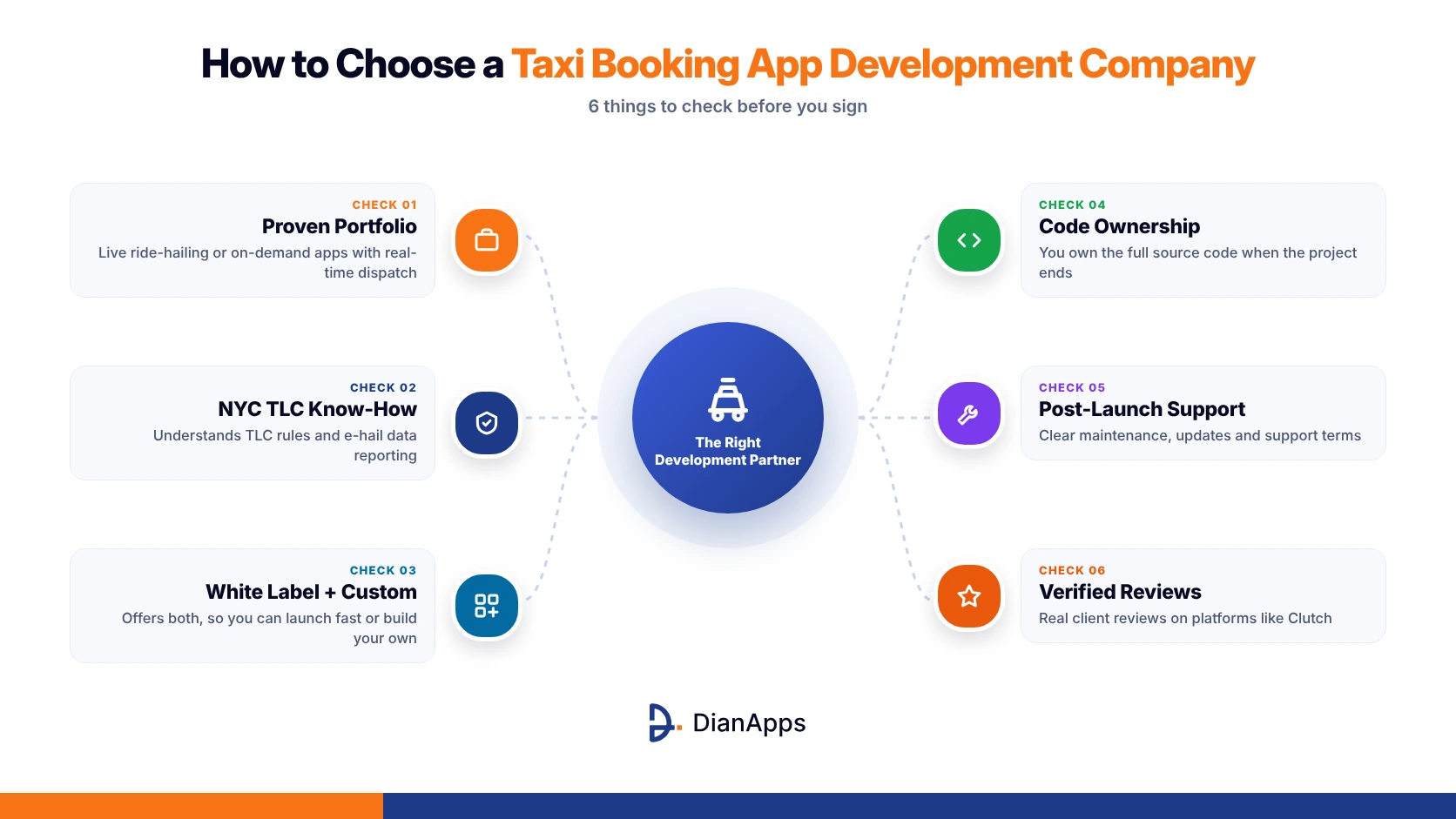
DianApps is a mobile app development company founded in 2017, with more than 150 in-house specialists across India, Australia and the United States, and a 4.8/5 rating from verified client reviews on Clutch. Our taxi booking app development services include:
Passenger, driver and admin apps for iOS, Android and web
White label taxi booking app setup and customization
Custom taxi booking app development for fleets, startups and enterprises
NYC’s taxi app market looks very different in 2026. Curb and Arro remain the best apps for yellow cabs, Uber and Lyft now offer taxis alongside their own cars, Throo is the newest licensed challenger, and Waymo is out of the city for now.
For businesses, the opportunity isn’t another Uber copy. It’s a focused taxi booking app that serves a niche well, meets TLC rules and works with the wider ecosystem. Whether you start with a white label taxi booking app or go fully custom, the right partner makes the difference.
For licensed yellow cabs, Curb and Arro are the dedicated NYC taxi apps and offer upfront pricing with no surge. Uber and Lyft have the largest fleets, and since July 16, 2026 Lyft can also match riders with yellow taxis through Curb.
Yes. Uber forwards requests to yellow taxis through Curb and Arro, and NYC TLC reported over 800,000 Manhattan Uber requests forwarded to taxis in one month. Lyft added Curb’s NYC taxis on July 16, 2026, and riders can opt out in settings.
For short Manhattan trips, a yellow cab is often cheaper. Taxi meters don’t surge, and taxis pay a $0.75 congestion pricing charge versus $1.50 for Uber and Lyft. Metered fares start at $3.00 plus $0.70 per one-fifth mile, plus TLC surcharges.
The TLC flat fare is $70, plus the $0.50 MTA surcharge, $1.00 improvement surcharge, $2.50 New York State congestion surcharge, $0.75 congestion pricing charge where it applies, a $5 surcharge on weekdays from 4pm to 8pm, and tolls and tip.
A custom taxi booking app MVP with passenger, driver and admin apps typically costs $40,000–$70,000 and takes 3–4 months. A full-featured platform runs $70,000–$150,000+. A white label taxi booking app starts at around $5,000–$25,000, with limited customization.
•
0 comments
Deepak Bunkar
Deepak is an experienced digital marketer and guest blogger. He develops effective marketing strategies and creates engaging content that resonates with readers. Deepak stays informed of the latest trends and best practices in the field, committed to helping businesses achieve their goals in today's digital landscape.
Leave a Comment
Your email address will not be published. Required fields are marked *
Get a free Quote
You will receive a reply in 2 min and your idea is completely safe with us.













 0 comments







 0 comments









Your email address will not be published. Required fields are marked *