















 0 comments






Key Takeaways:
- Website development costs in the USA range from around $2,000 for simple sites to $250,000+ for enterprise platforms and web applications.
- Website type, design complexity, features, technology stack, development team, and integrations are major cost drivers.
- US agencies typically charge $100-$250/hour, while offshore teams generally range from $25-$75/hour.
- Hosting, maintenance, content, third-party software, training, and ongoing SEO can add significant costs beyond the initial development quote.
Quick Answer: Website development in the USA can cost anywhere from $2,000 for a simple website to $250,000+ for an enterprise platform or complex web application. Most small business websites fall around $3,000-$15,000, while eCommerce, custom web apps, and enterprise projects can cost substantially more. The final price depends on the website type, design, features, technology, development team, integrations, and ongoing maintenance.
It’s the question every founder, marketing lead, and ops manager asks before a single design file gets opened: What is this actually going to cost?
In a market where over 90% of B2B buyers research a company’s website before making contact, the website isn’t a side project, it’s usually the first real impression a prospect gets, and the pressure to get the budget right (not just low) is real.
The answer is that website development cost USA spans an enormous range. A simple informational website can cost anywhere from $2,000 to $10,000 and a large, enterprise-grade web app or platform can go well over $250,000. A 5-page brochure site for a local service provider and a multi-state eCommerce platform with live updating inventory are both websites-just like a bicycle and a delivery truck are both vehicles.
Asking a single price point to handle both falls apart at the beginning of the conversation.
It helps you understand what you’re being told by doing the math for you, covering, by: Website type, design complexity, who built it and where, and what it looks like after launch. So when you get a quote, you can tell whether it’s a fair, padded, or incomplete quote.
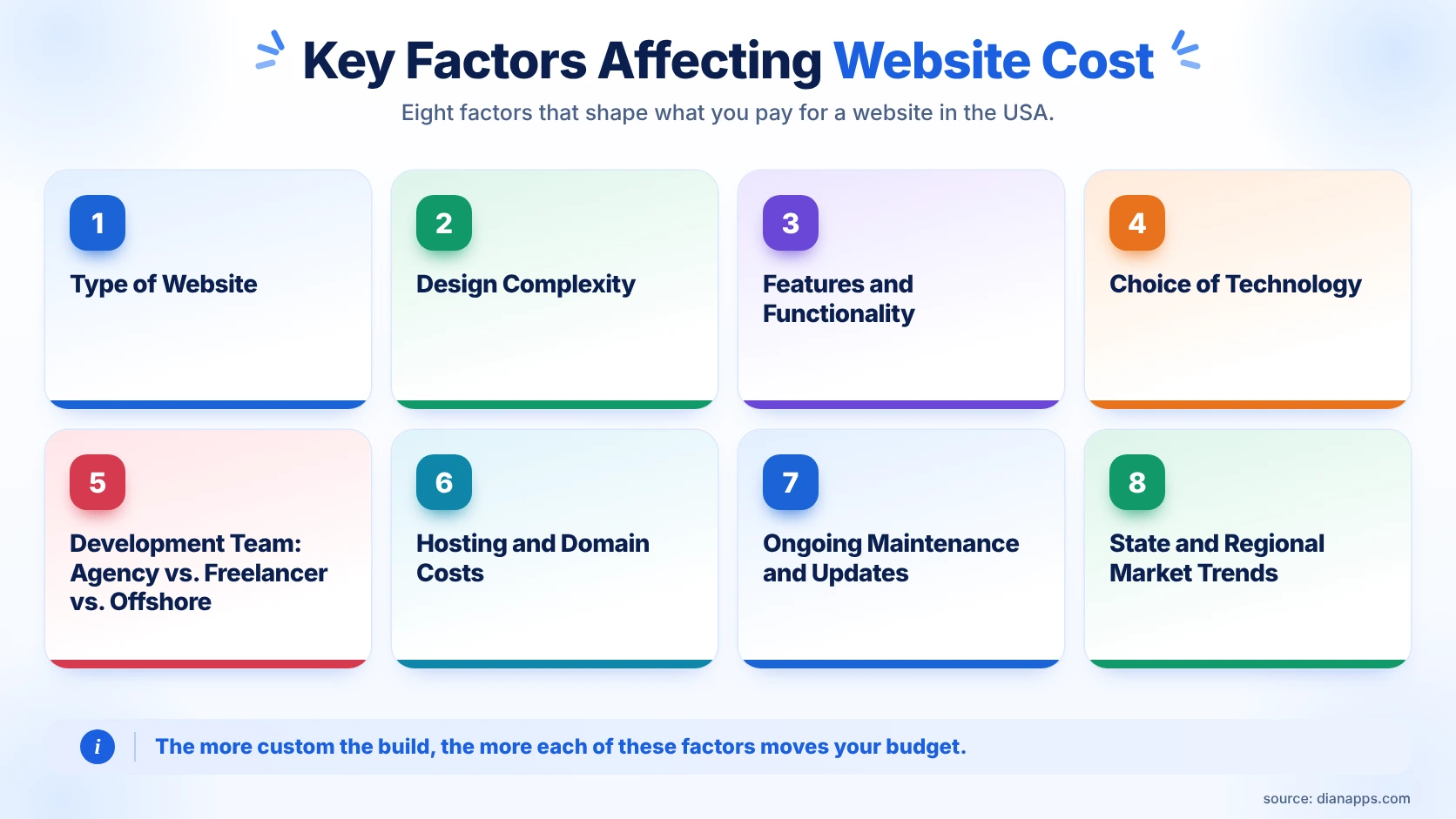
Key Factors Affecting website development cost USA
Two US businesses can request “a professional website” and land quotes $40,000 apart, and both quotes can be completely fair. Here’s what’s actually driving that gap, in the order it usually matters.
1. Type of Website
This is the most significant cost factor, long before we get to features. Everything flowing downstream (hours, team size, timeline) hinges on this. Whether you choose to work with an independent developer or a specialized website development company, the baseline requirements of your chosen format dictate the overall investment.
- Informational / Small Business Sites: Basic, brochure-ware websites highlighting your services, team and contact information. Usually between 5-15 pages. Typical budgets: $3,000-$15,000.
- Online Stores: Product database, payments system, cart & checkout, order processing. Usually $5,000-$60,000 for an off-the-shelf Shopify or WooCommerce store, or $20,000-$150,000+ for a custom build with unique catalog logic, B2B ordering, or other advanced features.
- Portfolio Or Personal Websites: Clean, minimalist and design-led websites for creative people, consultants or personal brands. Usually $2,000-$10,000.
- Typical Web Apps: SaaS products, booking systems, internal tools or portals with actual business logic (not just content) behind them. Usually 25,000 to 500,000+ depending on number of users, amount of data and number of integrations.
- Enterprise And Multi-Region Platforms: Enterprises that have content governance, compliance requirements, multiple teams, and many stakeholders. Generally $40,000-$250,000+.
Do you have any other questions?
Here’s A Quick Good To Go Rule Of Thumb: If the site requires login, takes payments or stores user data aside from a contact form, it’s moving from “website” to “application” category pricing, even if it began as a basic concept.
2. Design Complexity
Design isn’t a flat percentage of the budget. It scales with how much of the visual system is being built from scratch, and how much is configuration. Premium website design and development services ensure that aesthetic appeal aligns perfectly with seamless user navigation and brand strategy.
- Template-Driven: Less expensive, great for small businesses that want to go live quickly and don’t require a truly unique look. Begins at approximately $1,500 – $5,000.
- Custom UI/UX Design: Custom-made visuals, one-of-a-kind page layouts, original set of icons, and a suitable branded design system that extends to future pages. Usually $10,000-$35,000.
- Responsive Design: With around 60% of US web traffic already mobile, a site that’s not truly mobile-first (and not simply “scaled down okay”) is a serious conversion hindrance, not a bonus. Most quotes include this in the package but it doesn’t hurt to explicitly check, as some budget suppliers take “responsive” as an afterthought not a design rule.
- Depth Of A Design System: For a one-pager, you just need a well-formed one. For a 40-page corporate website you need a components library, page templates you can reuse, rules for spacing, type etc. otherwise each additional page is a new design project 6 months after launch.
3. Features and Functionality
The more you require of the site rather than say, the more you will pay, and this is where budgets are most likely to be changed part way through.
- Features of eCommerce: Product search and search filtering, multiple different kinds of payment gateways, inventory synchronization, shipping calculators, discount logic.
- Interactive: Chatbots, appointment/booking system, converter or calculator, such as equipment configurator (+5,000+)
- 3rd-party integrations: CRM (Salesforce, Hub Spot), Analytics, Marketing Automation, Payment processors, eCommerce. Usually 1K-10K per integration, depending on how well-documented the 3rd-party API is, and the amount of custom logic between the two systems.
- Content Management Requirements: Allowing a marketing team to have total self-service editing control (custom fields, reusable content blocks, approval workflows) is more expensive to develop initially, but less expensive each time the content is edited.
- Site Scalability And Performance Needs: If you’re anticipating high or fluctuating traffic levels (a new product launch, a seasonal sale, a media mention), then load testing, cache strategy, and architecture planning are all essential. This isn’t the kind of thing a low-traffic brochure site is going to require.
4. Choice of Technology
The technology stack is not only about technology, it is a decision related to costs and long-term flexibility.
- WordPress Or Comparable CMS Platform: Powerful, mainstream, and affordable at $3,000-$15,000 (or more) based on plugin complexity. The down side is accumulating plugin installation bloat and the constant security issues that you will have to deal with.
Want some examples?
- Custom Frameworks (React, Next.js, Laravel): More speed & scalability long term, from around $20,000. The choice if the site has to do more than present content, or speed and Core Web Vitals are important in your industry.
- No-Code / Low-Code Options (Webflow, Framer): Furlough-able launch for startups and smaller teams, often a fraction of a custom build, but typically also a cost in terms of speed, depth of site customization and flexibility before you hit the limitations of the tool.
- Headless Architecture: The content backend is separate from the front end being displayed. More costly to implement but useful if you operate multiple properties/websites, app and kiosk off a single source of content.
5. Development Team: Agency vs. Freelancer vs. Offshore
Both the general contractor’s price and who is building the job can make the biggest difference to the final bill, and this is the factor that most buyers underweight when they compare estimates. Selecting the right website development company helps ensure you balance expertise, quality assurance, and ongoing strategic support.
- Freelance: Freelance web development rates USA are $45-$150/hr, with the remote median for 2026 at $75/hr. Ideal for a well-defined project that stands on its own, and when you are not looking for ongoing strategic guidance, but execution against a well-defined brief.
- US Agencies: Usually $100-$250/hour. A package of project management, design, development, and QA, not a person’s time. (You pay for redundant structure, not the code itself.)
- Offshore Teams: $25-$75/hr, can often provide the same scope for 40-70% less, with the trade off being the time-zone overlap and the increased process discipline (specs, structured reviews) in order to minimize rework.
- In-house Hire: A salaried on-staff developer costs less per year on paper ($70,000-$130,000 base), but with benefits, payroll tax, equipment, and management time factored in, the effective cost is usually 25-40% higher than the base salary. It is only worth it if you have consistent and continuous development work that requires a dedicated staff.
6. Hosting and Domain Costs
Frequently missed in the original budget, but truly a continuing line item from day one.
- Register A Domain Name: Typical cost is around $10 to $50 a year, more for premium or shorter domains.
- Shared Hosting: $10-$30/month, Okay for small, low traffic sites.
- Managed Or Cloud Hosting: $50-$200/month for most business sites, depending on traffic and number of services running.
- Enterprise Or Dedicated Infrastructure: $200-$2,000+/month, required if uptime and performance impact actual revenue.
7. Ongoing Maintenance and Updates
Launch is the start, not the end, and it’s this expense most first-time buyers forget to inquire about until the bill arrives unexpectedly. Comprehensive website development services frequently include ongoing maintenance, security patches, and performance optimizations to protect your digital asset long-term.
Security patches, content updates, dependency updates, and performance monitoring could cost anywhere from $500-$2,500/month, depending on the size of the site and the degree of hands-on help you need. Neglecting this is one of the more costly mistakes a business can make: a site that doesn’t have ongoing investment to capture new content and freshen existing content can lose 20-35% of organic traffic within 18 months, ever since competitors keep improving the web properties and search engines love everything fast and fresh.
A rough breakdown of what a maintenance budget actually includes:
- Hosting And Domain Renewal: The basic cost of being on-line.
- Update of software and dependencies: CMS core update, plugin update, framework update.
- Security Monitoring And Backups: Malware scans, auto backups, SSL renewal.
- We Start With The Technical: A bulletproof foundation is critical to your business. Nobody wants to lose their data. We approach this as a critical process, be it the virus scanner or the monthly backups and website security updates.
- Content And Small Feature Updates: The ‘can someone update our hours’ requests that come in nonstop after the site is up.
8. State and Regional Market Trends
Even domestically, geography skews the number more than most buyers realize. The mean hourly wage figure for web developers in 2026 shows California at around $58/hour and the District of Columbia at around $59/hour, with the National average nearer $45/hour and some states with a lower cost of living nearer $35-$42/hour.
Remote Is An Even Greater Divergence: The US-remote median for 2026 is about $75/hour, but the median for a freelancer in the Bay Area is $116/hour – close to twice the remote and more than three times the pricing for a similar developer in a lower-cost market. If you’re bringing your team along on remote projects (as most do today), “US-based” and “local” no longer imply the same cost. A developer in Ohio and a developer in Palo Alto are both onshore, English-first, working whatever hours your team needs, and can still be priced quite differently.
Not Sure What Your Website Will Cost?
Tell us what you’re building, and we’ll help you understand the scope, cost, and right development approach.
What Is the Average website development cost in the USA?
| Website / provider type | Typical cost | Hourly rate equivalent |
|---|---|---|
| Small business website | $3,000 - $15,000 | - |
| eCommerce website (Shopify/WooCommerce) | $5,000 - $60,000 | - |
| Custom eCommerce or headless build | $20,000 - $150,000+ | - |
| Custom web application | $25,000 - $500,000+ | - |
| Enterprise / multi-region website | $40,000 - $250,000+ | - |
| Freelancer | $1,500 - $8,000/project | $45 - $150/hr |
| US boutique agency | $6,000 - $35,000+/project | $100 - $250/hr |
| Offshore team | $2,000 - $15,000/project | $25 - $75/hr |
| Enterprise agency | $40,000 - $250,000+/project | $150 - $300/hr |
Per Clutch’s 2026 buyer survey, 61% of small business buyers spent under $10,000 on their most recent website project, down from 68% a few years earlier, as buyers increasingly demand custom design and conversion-focused features rather than settling for a bare-minimum brochure site. That’s the realistic center of the market, not the enterprise headline numbers that tend to dominate agency case studies and portfolio pages.
What $5,000 vs. $25,000 Actually Buys You
Numbers in isolation don’t tell you much. Here’s what the difference typically looks like in practice for a small business site:
At $3,000-$8,000 (freelancer or small studio)
- A clean 5 to 10 page site on a solid CMS framework (WordPress or Webflow).
- Light customization on a proven theme, your brand colors and content dropped in.
- Basic SEO setup, but not a deep technical SEO strategy.
- Limited custom page layouts, mostly variations on a template.
At $8,000-$20,000 (boutique agency)
- Genuinely custom design, not a modified template.
- Information architecture built around your actual sales funnel and user journey.
- Technical SEO foundations built in at development time, not patched on after.
- A proper project manager coordinating design, development, and QA as separate functions.
- Copywriting or content strategy support, depending on the engagement.
At $20,000-$50,000+ (larger agency or enterprise-focused shop)
- Multi-language support, complex approval workflows for content publishing.
- CRM or marketing-stack integration (Salesforce, HubSpot) requires real engineering, not a plugin.
- A/B testing infrastructure and conversion optimization built into the launch plan
- Dedicated post-launch support with a written SLA, not an ad hoc “email us if something breaks”.
Enterprise Website Cost: Why It’s a Different Category Entirely
Enterprise pricing isn’t just “small business pricing, scaled up.” The cost drivers change qualitatively, not just quantitatively.
Each of the cost variables above plays a role in the ultimate expense of your website design project – But, when taking into consideration all of the factors involved with designing an enterprise website in the US, here’s what you’ll typically end up paying. $40,000 – $250,000+
You are able to change these changes on your website’s wp-config.php data files and save those modifications in your neighborhood computer, and after that get clean on your homepage by updating the file through your web hosting console.
- Review: Adherence & security: Accessibility standards (ADA/WCAG), handling of data, policy & security review prior to launch which may include external auditors.
- Multi-Team Approval Workflows: The more on a project, the more approval rounds. And approval rounds just as a matter of simple logistics take up calendar time, even if they don’t drain engineering hours. An 8-week build engineering schedule can very easily turn into a 16-week project with legal, brand and three regional marketing approval teams in the mix.
- Content Governance: Role-based publishing at marketing, legal and regions is not a “nice-to-have” feature, but a real technical requirement (permissions, workflows, audit trails).
For anything where your website project contains “we’ll need legal to review that” or “this needs to go through brand approval in three regions,” budget at or near the high-end enterprise range, and calendar time on top of the engineering estimate, not just budget.
Hourly Rate vs. Fixed Price: Which Should You Choose?
This decision accounts for more of your risk than it does of your total cost and many buyers don’t actually think about this until they’re halfway through their project and something has shifted.
Fixed price is when you settle on a clear scope and fixed price before the work begins. With roughly two-thirds of agencies worldwide now offering a fixed-price option, this tends to be the best choice when you have a rough idea of what you want and you don’t think the scope of work will change substantially. The downside: any alterations you request after the fact requires a formal change order, and fixed price budgets tend to creep up, little by little, in change order after change order.
Hourly (time and materials) means you pay for actual hours worked. It suits genuinely exploratory projects, MVPs where the feature list isn’t fully locked, or situations where you expect to iterate based on early user feedback. The risk: without someone actively tracking hours against progress, “time and materials” can quietly become “time, and more time, and slightly more time.”
Here’s one rule you’ll never see on a pricing page but that you should: For example, a $250/hour senior developer who completes a feature in 6 hours is less expensive than a $95/hour generalist who takes 20 hours to do the same with more bugs. Rate isn’t cost. Delivery is expensive. If a quote looks inexplicably cheap when you look at the headline hourly rate, ask for the estimated number of hours up front, not just the headline rate before assuming it’s the better deal.
Need a Website Developer?
Hire experienced developers to build, customize, and scale your website around your business requirements.
Offshore vs. Onshore Development: Cost and Risk Compared
This is the comparison that generates the most anxiety in budget meetings, and also the most oversimplified advice online. Here’s what the 2026 data actually shows.
| Model | Hourly rate | Typical savings vs. onshore |
|---|---|---|
| Onshore (US) | $100-$250/hr | Baseline |
| Nearshore (Latin America) | $30-$80/hr | 20-35% |
| Offshore (India, Eastern Europe, Southeast Asia) | $20-$75/hr | 40-70% |
The raw savings numbers look dramatic, and they’re real. But hidden costs typically eat 30 to 50% of offshore “savings” when they’re not managed well: more project management time, longer feedback loops across time zones (a same-day question can become a next-day answer), and rework when requirements weren’t specified precisely enough the first time. None of this means offshore is a bad choice, it means offshore savings are net of good process, not automatic.
Onshore makes sense when:
- The project needs constant live collaboration and rapid, same-day iteration
- You’re building a customer-facing product where UX quality is hard to fully validate remotely
- It’s your team’s first time managing an external development partner and you want the lowest-friction learning curve
Offshore or a hybrid model makes sense when:
- The scope is well-documented and doesn’t need daily real-time input
- You have (or are willing to build) a clear specification and structured review process
- Budget efficiency matters more than having a same-timezone call at 9am
The middle path many US companies land on in 2026: a small onshore lead, a product owner or senior architect, paired with an offshore or nearshore delivery team. You get the coordination and quality control of local oversight with most of the cost efficiency of offshore rates. This model has become common enough that it’s less “alternative approach” and more just how a lot of mid-size projects get built now.
Hidden Costs Worth Asking About Before You Sign
A handful of line items that quietly separate a quote that holds from one that grows:
- Content Production: Copywriting, photography, and video are frequently quoted separately, and frequently forgotten in the initial budget conversation entirely.
- Stock Assets And Licensing: Custom photography or licensed stock images can add a few hundred to a few thousand dollars depending on scope.
- Third-Party Software Costs: Booking system fees, chatbot platform subscriptions, premium plugin licenses, these are often billed to you directly, not by the agency.
- Post-Launch Training: If your team needs to learn a new CMS, factor in time (and possibly cost) for training sessions.
- SEO And Content Strategy Beyond Launch: A site can be beautifully built and technically fast and still not rank, because ranking is an ongoing content and link-building effort, not a one-time deliverable.
How to Choose the Right Website Development Partner in the USA
Price is one input, not the whole decision. Finding an established website development company with a solid track record is crucial. Here’s what actually separates a good partner from an expensive mistake, beyond the number on the quote.
1. Understand Your Requirements Clearly
Write down what kind of website, what features you need, what kind of style you like, and the funding and schedule you are expecting, before asking for estimates. Clear scope, get clear estimates: blurred scope, get five different projects masquerading as one number, so nothing is comparable.
2. Look for Experience and Expertise
Key factors to consider:
- Experience in the same kind of site you need, not just “websites” in general
- TECHNICAL SKILLS for the stacks the project needs (React, Next.js, WordPress, or anything else)
- A portfolio with similar design, function, and complexity to your project-not just their most attractive work.
3. Assess Their Process and Approach
Key points to explore:
- Is there actually a real discovery phase before design begins or are they immediately throwing out mockups?
- Are they willing to produce wireframes and prototypes to be reviewed and tested prior to moving on to your final design?
- How do they perform testing and bug fixing during the development process, not just at the end?
- Do they provide any type of support after the site is up and running? What kind of support is that?
4. Evaluate Their Communication and Collaboration
Questions to ask:
- Will you be working with developers directly or via a project manager?
- What platform does he use for tracking his progress (Jira, Trello, Slack, etc)?
- How do they deal with change requests during projects, and what does it cost?
5. Review Their Reputation and Reviews
Review Clutch, Google Reviews and case studies that have a real, named-outcome that can be verified by a client reference, not anonymous testimonials. Awards and third-party validation can be helpful indicators but alone are not a reliable security. Weigh this information with references you can reach out and speak to directly.
6. Consider Their Pricing Model
Key pricing models:
- Fixed price: best for well-defined, smaller projects where scope is unlikely to shift
- Hourly: better for evolving or exploratory projects, rates typically $75-$250+/hour depending on seniority and location
- Retainer: useful for ongoing support and iterative work after the initial launch
7. Location and Time Zone Considerations
Partnering with a US-based website development agency offers same-timezone communication and easier real-time collaboration, which matters more for projects with tight, interdependent timelines. An offshore or hybrid partner, done well, offers meaningful cost savings without necessarily sacrificing quality, the deciding factor is their process discipline and communication structure, not simply their location on a map.
8. Test Their Post-Launch Support
What to look for:
- A defined post-launch support package for bug fixes and updates, with a written SLA rather than a verbal promise
- CMS training so your team isn’t dependent on the agency for every small content change
- A clear approach to security, backups, and ongoing monitoring, not just “we’ll take care of it”
Final Note
There’s no single honest number for “website development cost USA,” because the real question is actually three questions: what type of site, who builds it, and how will you maintain it once it’s live. Get clarity on those three, and every quote you receive afterward gets a lot easier to evaluate, and a lot harder for a vendor to pad without you noticing.
If you’re scoping a project and want a real number instead of a range, our team provides full-spectrum website design and development services to walk through your requirements and offer a phase-wise estimate, not a guess. We work with teams across the USA, Australia, Canada, India, and the UAE, so you can choose the onshore, nearshore, or offshore balance that actually fits your budget and collaboration needs, rather than being locked into a single delivery model before you’ve even scoped the project.
Questions to Ask Before You Start: Should I pay for the project by the hour or with a fixed price?
- Fixed price: Good for projects with a clear scope of work and scope of delivery, where you want to know your upfront costs for a clear scope of work.
- Hourly billing: Useful for experiments or MVPs that are expected to change as they progress, but needs constant monitoring so scope creeps don’t quietly turn into hours.
 0 comments













Leave a Comment
Your email address will not be published. Required fields are marked *