













 0 comments





Key Takeaways:
- Verify AWS credentials, partner tiers, and relevant competencies before signing.
- Confirm the assigned team’s experience with similar AWS projects.
- Review security controls, compliance practices and incident response plans.
- Clarify pricing, AWS cost optimisation and post-launch support.
- Secure ownership of AWS accounts, code, documentation and exit arrangements.
Quick Answer: Before signing with an AWS consulting partner, ask 20 questions covering technical expertise, security, delivery, commercial terms, and exit planning. Verify AWS credentials, review relevant case studies, confirm the assigned team, clarify pricing and ownership, and assess post-launch support. Use a weighted scorecard to compare partners and identify red flags before committing.
Remember the last time you signed with a vendor because the sales call went really well, the deck looked polished, and the proposal seemed to cover everything, only to find out a few months later that the team working on your project was not the team you met, the scope was changing every other week, and the invoices were growing faster than the product? Many businesses moving to AWS are going through exactly this, and the problem is rarely AWS itself; it is the partner that was chosen without asking the right questions. But what questions should you ask an AWS consulting partner before you sign? They go beyond the sales pitch and into the evidence: who is actually doing the work, how your data is protected, what you are really paying for, and what happens when the contract ends.
In this guide, we are covering 20 questions, grouped into technical, security, delivery, commercial, and exit questions. Each and every question comes with an answer key, so you know what a strong answer sounds like and what should be raising a red flag. You can use the whole list as your AWS partner checklist or drop the questions straight into your AWS RFP questions, and at the end you can score each partner/vendor on a simple scorecard, so let’s break it down.
Why AWS Vendor Evaluation Is Extremely Crucial
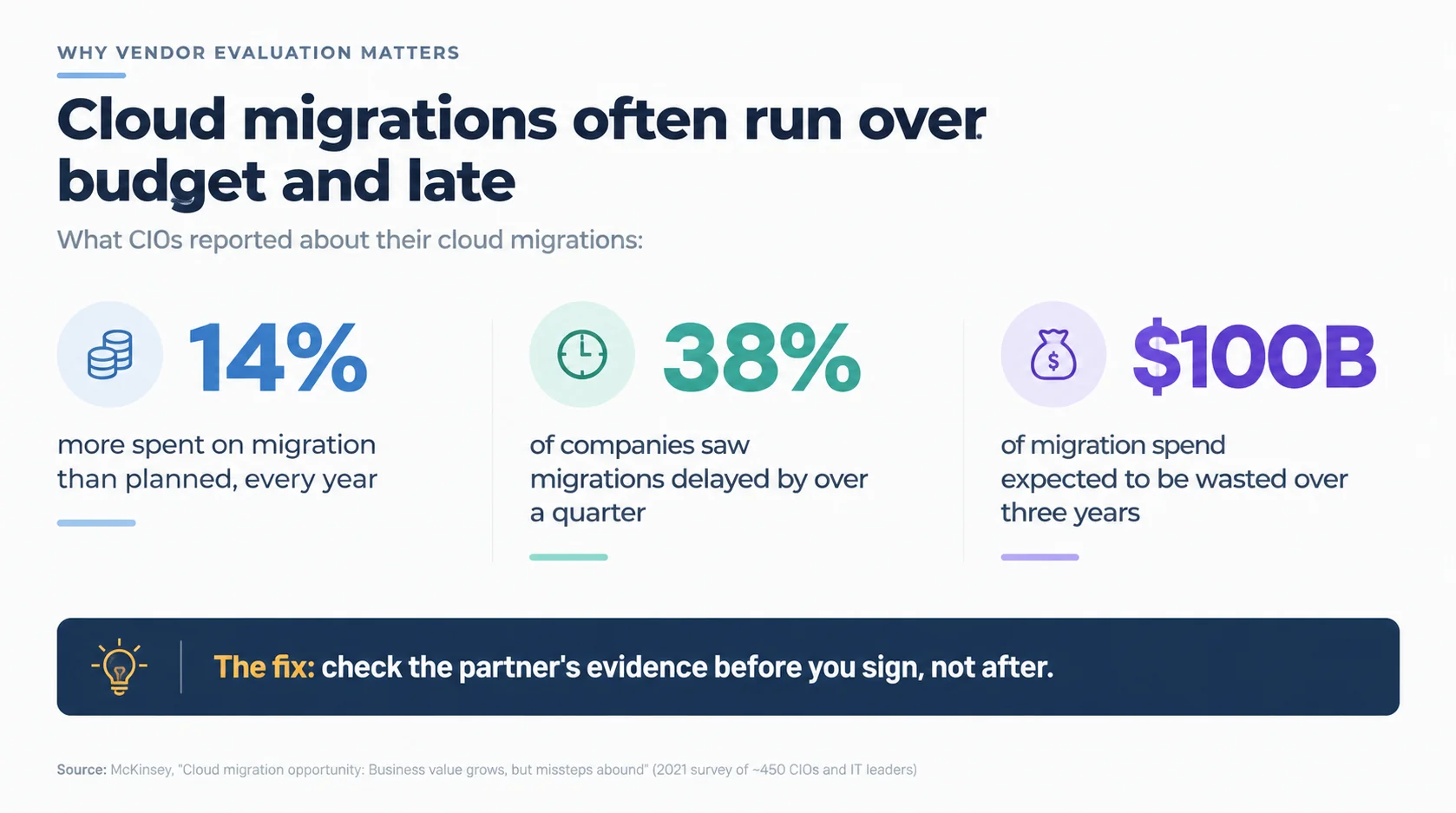
Every partner is telling you that they are experienced, certified, and customer-focused, because that is exactly what a sales call is for, and this is making it really hard for buyers/decision-makers to tell the difference between a partner who has done the work and a partner who is just good at presenting it. A proper AWS vendor evaluation helps you move past these claims and look at the proof, and the reasons are not hard to see when you look at what usually goes wrong after signing, resulting in:
- Teams being swapped after the contract is signed.
- Security being treated as an afterthought.
- Scope changes showing up only on the invoice.
- AWS bills growing without anyone watching them.
- No clear handover when the engagement ends.
Problems like these don’t just delay the project; they also affect the trust between your team and the partner, which is why the first set of questions should start with the technical side, so let’s take a look.
Technical Questions to Ask an AWS Consulting Partner
The technical questions help you understand whether the partner has really been validated by AWS and whether their experience matches what you are actually building.
1. What Is Your AWS Partner Tier, and Can We Verify It?
AWS is recognising its services partners at three tiers, Select, Advanced, and Premier, with each tier requiring more certified people and more customer projects running on AWS. Partners at the Select tier and above are getting a visible listing on AWS’s Find an AWS Partner directory at partners.amazonaws.com. A strong partner is naming their tier and sharing their listing without any hesitation, while a partner who is only saying “we are an AWS partner” with no tier and no listing is definitely a red flag.
2. Which AWS Competencies Match Our Workload?
A tier is only showing the partner’s overall scale, whereas a competency is validating proven expertise in a specific industry, use case or workload such as migration, DevOps, or security, and this is why the competency is often telling you more about your project than the tier. A good answer is pointing to competencies that match your workload along with examples of where they were used, but a long list of badges that has nothing to do with your project is not something you should be relying on.
3. Who Exactly Will Work on Our Project?
Company-level certifications do not mean that the certified people are going to be on your account. This is one of the most important questions to ask an AWS consulting partner, and yet it is also the one most buyers are forgetting. A strong partner is sharing named roles, real profiles, and the AWS certifications each person holds, whereas “we will assign the team after signing” is a clear sign that you are buying a brand and not a team.
4. Can You Walk Us Through a Similar AWS Project?
Ask for a project that matches your workload, industry, or scale, and ask them to explain the architecture, the problems they faced, and how they solved them, because this shows you how they think and not just what they have delivered. A good answer comes with real detail on the challenges and the results, ideally with a client reference you can call, while a reply that only shows logos and generic success statements should make you cautious.
5. How Do You Apply the AWS Well-Architected Framework?
The Well-Architected Framework is AWS’s own set of best practices across six pillars: operational excellence, security, reliability, performance efficiency, cost optimisation and sustainability. A serious partner is using it as a working tool and not just quoting it in proposals. A strong partner is explaining how they are reviewing designs against these pillars and how the findings are being fixed, whereas a partner who mentions it but cannot describe how it is shaping their work is a red flag.
Once you are confident about the technical side, the next thing that is extremely crucial to check is how the partner is handling security, so let’s take a look.
Security Questions to Ask Before You Sign
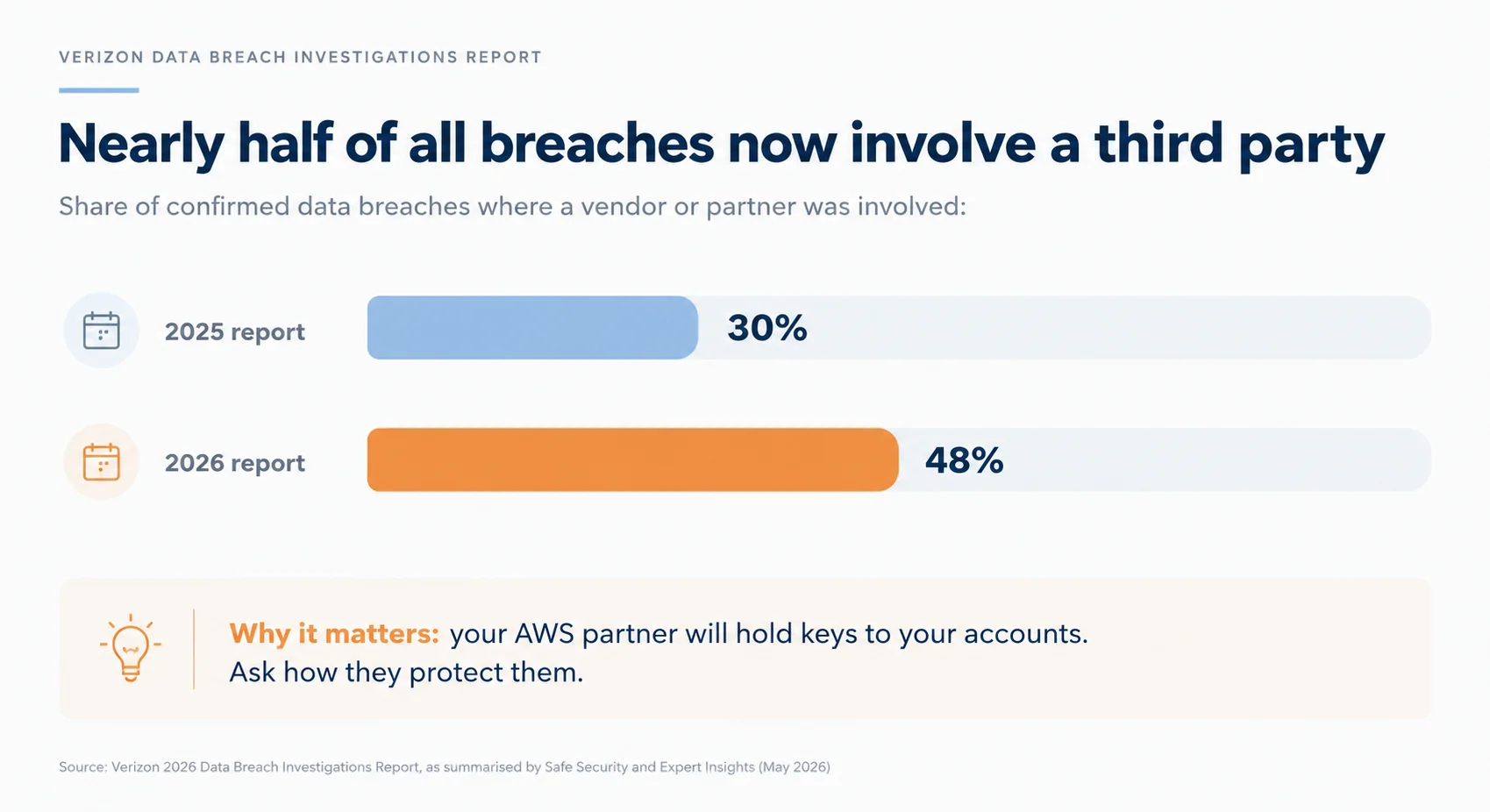
Security questions protect you from the risks that usually show up only after something has gone wrong, and they are especially important if your business is handling customer or financial data.
6. How Are Security Responsibilities Divided Between You, Us, and AWS?
AWS is working on a shared responsibility model, where AWS is securing the cloud itself, and customers are responsible for what they build and run inside it, and when a partner is involved, you need to know exactly which of those responsibilities they are taking on. A good answer is a clear written split of who owns what before and after go-live, while “AWS is handling security” is showing that the partner has not really thought about it.
7. How Will You Access and Manage Our AWS Accounts?
Access is where many security issues are beginning, so ask how access is being granted, who is getting it, and how it is being removed once the work is done. A strong partner is talking about individual IAM roles, least-privilege access, multi-factor authentication, and never using the root account for daily work, whereas a request for shared logins or your root credentials is definitely a red flag.
8. Which Compliance Requirements Have You Built For Before?
If you are working in healthcare, fintech, or any regulated space, frameworks like HIPAA, PCI-DSS, SOC 2 or GDPR are shaping your architecture from day one, not at the end of the project. A good answer is pointing to past projects under the same requirements and explaining how the controls were designed in, while “we can make it compliant later” is not suitable nor suggested for any regulated business.
9. What Happens If There Is a Security Incident?
Incidents are not something you want to be planning for in the middle of one, which is why the response process should be agreed before the contract is signed. A strong partner is sharing a defined incident response process, clear escalation contacts, and response times written into the contract, whereas a partner with no process until something actually goes wrong is leaving your business exposed.
With security covered, the next set of questions focuses on how the work is actually being delivered, so let’s break it down.
Want to See How a Partner Should Answer These?
Put our AWS-certified cloud team through the same questions, and we will walk you through our process, our people, and our past AWS work, openly and in detail.
Delivery Questions That Show How the Work Really Gets Done
Delivery questions show you what working with the partner will really feel like on a day-to-day basis, from beginning until completion.
10. What Does Your Process Look Like From Discovery to Go-Live?
A clear process is helping both sides know what is happening at each stage and who is responsible for it. A good answer describes defined phases, an output for each phase, and clear ownership at every step, while “we are agile” with nothing behind it is not giving you anything you can hold them to.
11. How Will You Report Progress, and How Often?
Communication gaps are one of the most common reasons projects are slipping without anyone noticing until it is too late. A strong partner is offering a fixed cadence of updates and demos, a single named point of contact, and shared tracking tools you can access in real time, whereas updates that only come when you chase them are a red flag.
12. How Do You Handle Scope Changes?
Scope is always going to change on a real project, and what really matters is whether the change process is protecting your budget and timeline. A good answer is a written change-request process where the impact on cost and timeline is shared before any work starts, while scope changes that only show up on the invoice give a poor impression long before the project has even finished.
13. How Do You Handle Testing, Cutover and Rollback?
This is extremely crucial for cloud migration projects, where a poorly planned cutover can mean downtime or even data loss for your users/customers. A strong partner is sharing a test plan, a planned cutover window, and rollback steps defined before any workload moves, whereas a partner with no rollback plan is putting your live business at risk.
Once the delivery side is clear, it is time to look at the money, and this is where the commercial questions come in, so let’s take a look.
Commercial Questions About Pricing, Costs and Support
Commercial questions are about making sure the price you are agreeing to is the price you are actually paying, both for the consulting work and for AWS itself.
14. What Pricing Model Do You Use, and What Is Not Included?
Whether the partner is working on a fixed price, time and materials, or a retainer, the exclusions are often telling you more than the headline number. A good answer is a clear pricing model with everything that is not included listed in writing, while a low headline price with vague “additional charges may apply” wording is definitely something to question.
15. How Will You Help Us Control Our AWS Bill After Launch?
Consulting fees are only one part of the cost, because your AWS bill is running every single month long after the partner has finished the build. A strong partner is talking about cost tagging, rightsizing, autoscaling, Savings Plans or Reserved Instances, and regular cost reviews, whereas a partner who never brings up running costs is leaving that problem for you to discover later.
16. Can You Help Us Access Any AWS Funding?
AWS is offering Partner Opportunity Acceleration (POA) funding for proofs of concept and migrations to partners at Select, Advanced, and Premier tiers, in the form of cash reimbursement or AWS promotional credits. These benefits are subject to eligibility and are not available in all markets. A good answer is an honest view of whether your project might qualify, with no upfront promises, while guaranteed “free AWS credits” used as a sales hook should be raising a red flag.
17. What Does Post-Launch Support Look Like, and What Does It Cost?
Your product is not stopping at go-live, and neither should the clarity around support. A strong partner is defining support hours, response times, and pricing, along with optional cloud managed services for ongoing operations, whereas support that is “to be discussed later” often turns into an expensive surprise.
And that is not all, because the questions most buyers are skipping are the ones about leaving, so let’s take a look at the exit questions.
Exit Questions Most Buyers Forget to Ask
Exit questions protect your ownership and your independence, and they make sure you are never locked into a partner just because they are holding the keys to your own product.
18. Who Owns the Code, Infrastructure-as-Code and AWS Accounts?
Ownership should be settled before the first line of code is written, not when the relationship is ending. A good answer is that you own everything, the AWS accounts are sitting under your organisation, and this is stated clearly in the contract, while accounts or repositories held under the partner’s name are a serious red flag.
19. What Documentation and Knowledge Transfer Will We Get?
Documentation is what allows your own team, or a future partner, to understand and run what was built. A strong partner is providing architecture diagrams, runbooks, infrastructure-as-code, and handover sessions for your team, whereas “our team knows the setup, just call us” is creating a dependency you will definitely regret later.
20. If We End the Contract, How Does the Handover Work?
This is the question nobody really wants to ask during a friendly sales call, but it is also the one that is protecting you the most if things are not working out. A good answer is a defined exit process with a notice period and a full transfer of access, credentials, and documentation, while no exit clause or exit fees that keep you locked in should be a deal-breaker.
Now that you have the full list, you might still be wondering how to put it all together into one decision, and that is exactly what the next section is covering.
How Do I Evaluate a Cloud Consulting Company?
Evaluating a cloud consulting company is really about looking at all the evidence together, instead of judging a partner on one strong answer or one impressive badge. Well, the simplest way is to check a few things side by side, resulting in:
- Verified credentials on the cloud provider’s own partner directory.
- Experience with projects similar to yours.
- A meeting with the actual delivery team.
- Scope, pricing, ownership, and exit terms in writing.
- A conversation with at least one past client.
If you are still unsure after this, a small paid discovery or assessment phase is a low-risk way of seeing how a partner is actually working before you commit to the full project. The scorecard below is helping you compare each partner fairly, so let’s take a look.
Your AWS Partner Scorecard
Once you have asked all 20 questions, score each partner from 1 (weak) to 5 (strong) on every question, average the scores for each category, and then multiply each average by its weight to get a weighted total. The weights below are only a suggested starting point, and you can adjust them to your own priorities, for example, by giving security a higher weight if you are working in a regulated industry.
| Category | Questions | Suggested Weight | Partner A | Partner B |
| Technical | 1 to 5 | 25% | Score /5 | Score /5 |
| Security | 6 to 9 | 25% | Score /5 | Score /5 |
| Delivery | 10 to 13 | 20% | Score /5 | Score /5 |
| Commercial | 14 to 17 | 15% | Score /5 | Score /5 |
| Exit | 18 to 20 | 15% | Score /5 | Score /5 |
| Weighted Total | All | 100% | Total | Total |
A partner scoring below 3 in security or exit questions should be a serious concern even if their overall score is looking strong, because these are the gaps that hurt the most once the project is live.
How DianApps Is Answering These Questions for Clients
At DianApps, we are helping startups, scale-ups and enterprises plan, build, migrate and run their products on AWS, and we are happy to be measured against each and every question on this list. Our AWS cloud services cover consulting, migration, application modernisation, cloud security, managed services, DevOps automation, FinOps cost optimisation and AI/ML workloads on Amazon Bedrock and SageMaker. So whether you are moving an existing product to AWS or building something new, we’ve got you covered.
Our team holds AWS certifications across Cloud Practitioner, AI Practitioner, Solutions Architect, Machine Learning Engineer, Data Engineer, and CloudOps Engineer. With 150+ skilled professionals, 350+ projects delivered, and clients across 25+ countries, we are bringing the same engineers who design your architecture into the actual build. This is also helping our clients get a clean handover at the end, with documentation, ownership, and access fully in their hands.
Start With a Free AWS Assessment
Book a free 45-minute session with our AWS cloud consultants and get a clear diagnosis of your environment along with a prioritised action plan, with no commitment required.
Final Thoughts
Choosing an AWS consulting partner is not something that should be decided on a good presentation alone, because the real test usually comes months later, during a scope change, a security review, or a handover, and by then it is often too late to switch. Asking these 20 questions is helping you see how a partner is thinking, who is actually working on your project, and how well your business is being protected from beginning until completion. The answer keys and the scorecard are making it easier to compare partners fairly and to walk away from the ones avoiding the uncomfortable questions.
And if you are looking for a partner who is ready to answer each and every one of these questions openly, our team at DianApps would definitely love to hear about your project and help you move forward on AWS with confidence.
Ready to Find the Right AWS Partner?
Share your project details with DianApps, and our team will get back to you within 24 hours with honest answers and clear next steps for your AWS journey.
 0 comments










Your email address will not be published. Required fields are marked *