















 0 comments






Key Takeaways:
- Evaluate the agency’s process, relevant experience and technology choices.
- Confirm code, domain and account ownership before signing.
- Check SEO, QA, scope-change and post-launch support processes.
- Verify reviews, references, pricing and industry-specific expertise.
Quick Answer: Choose a website development company by checking its discovery process, relevant portfolio, technology approach, ownership terms, SEO, QA, pricing and post-launch support before signing a contract.
According to industry statistics, almost 70 percent of website redesigns don’t reach the original commercial goals. This isn’t a tiny agency or low-budget problem, it’s what the business goes through when it chooses a vendor solely by their rates or portfolio quality without digging into the details that matter in turning the project into success.
A website development company is a partner for years to come, so it’s wise to think through the choice very carefully not to regret it later. The wrong decision will lead to much more than just wasting budget, it will cause scope creep, for instance (which is responsible for 52 percent of projects according to the Project Management Institute), loss of organic reach due to improper migration that occurs in 35 percent of cases, another useless beautiful brand new site that cannot convert visitors since nobody asked right questions during its design.
Here’s a 12-point checklist for assessing a website development company before signing a contract, listing the important questions that distinguish a trustworthy partner from an expensive mistake, as well as warning signals.
Why This Decision Matters More Than It Looks
Before looking at the checklist, let’s be clear about why this decision is more important than many buyers might think. A website is not an end product that can just be delivered and then ignored. In fact, website development services can support much more than the visual presentation of a business. A website can become critical infrastructure that helps businesses acquire leads, build credibility, gain visibility in search engines, and take care of client management processes.
Most projects fail because people expect too much from their online partners. They think every possible problem can be solved just by hiring an agency with a good reputation. They know how to get a project off the ground, but their agency lacks experience, expertise, and the necessary tools to deliver results. The checklist presented here aims to identify such shortcomings before you sign the agreement and not half a year later when it is too late to back out of the deal.
The 12-Point Checklist
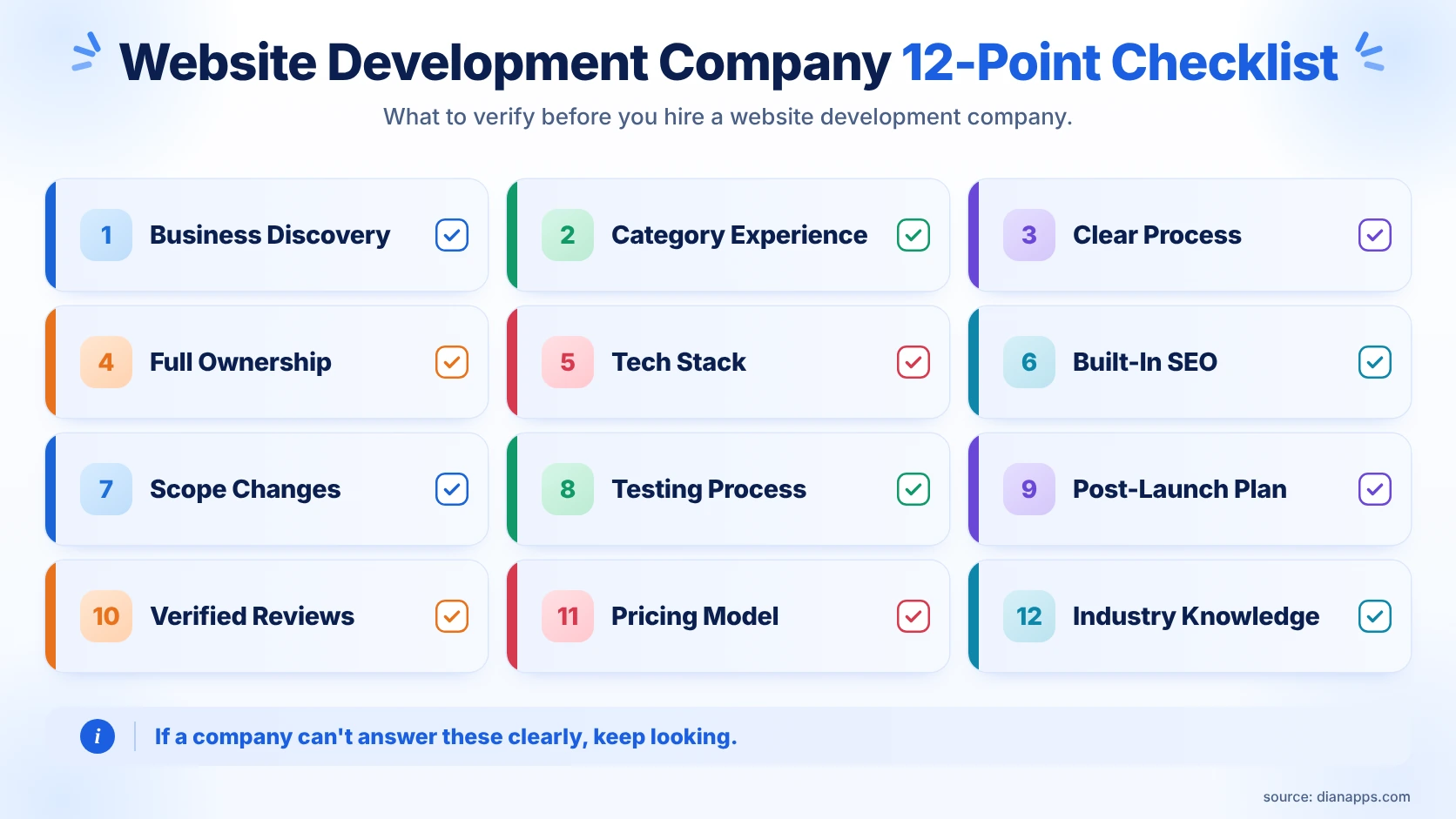
1. Do They Ask About Your Business Before Talking About Your Website?
In order to determine whether a web design and development firm is worth hiring, it is important to know just how much time it invests on understanding your business, your customers and your objectives before coming up with a sitemap or a proposal. If the first discussion does not go beyond the amount of pages and money, it is a good sign that the future cooperation will be limited to basic execution, with no strategic input.
- Ask: “Can you please explain your process for conducting research? What are the things you would like to know about my business before you can properly scope the work?”
- Red Flag: Getting a quote right after the first short phone call with no questions asked about customers, market competition, or business goals.
2. Can They Show Work in Your Specific Category?
Just because a website development company has a beautiful eCommerce portfolio doesn’t mean they can put together a HIPAA-compliant healthcare portal and vice versa. Different project types impose different technical and compliance needs.
- Ask: “Can I see two or three examples of projects that are the closest to the one I am starting?”
- Red flag: Portfolio has only one type of site (all restaurant sites, all single-page flyers) while your project requires a completely different structure, and there’s no understanding of that distinction.
3. Do They Explain Their Process, Not Just Their Output?
A website development agency should describe how a project proceeds step by step from kickoff to launch: discovery, wireframes, design, development, testing, and handover. If the responses are unclear, it is likely that the agency has an ad-hoc process.
- Ask: “What does a typical timeline look like week-to-week? What do I need to validate and approve at each stage of the process?”
- Red Flag: An answer that goes straight from “we start” to “we deliver” without any points in between.
4. Who Actually Owns the Code, the Domain, and the Accounts?
You should not be asking this question after the invoice is already cleared. There are often cases in which companies charge unbelievably low prices but do not transfer the intellectual property associated with the project, meaning that they remain the owners of the coding and serve as an obstacle on your path to utilizing the project as your own.
- Ask: “Do I own the code, domain registration, and hosting account as soon as the project is completed?”
- Red Flag: If the answer is not a clear “yes,” then something is wrong.
Have a Website Project in Mind?
Talk to our team about your goals, requirements, timeline, and budget.
5. What Technology Are They Building On, and Why?
It’s essential for a web development company to justify the selection of their technology stack concerning the specific project rather than referring to their normal stack every time. It’s not true that every project requires its own unique technology stack, and at the same time, it’s not always wise to rely on template technology.
- Ask: “What makes you feel that this technology choice is the most suitable one for my project rather than relying on your technology stack?”
- Red Flag: Generic answers that don’t refer to the project’s characteristics and goals won’t do.
6. Is SEO Built In, or Bolted On Afterward?
Technical SEO, structured HTML, good URL structure, schema, image optimizations, and speed are extremely inexpensive and more effective when integrated into website development services as part of the original build rather than being added as an afterthought.
- Ask: “Which specific technical SEO tasks are included in the original build and which will need to be purchased afterwards?”
- Red Flag: If SEO is positioned purely as an add-on cost, and there are no SEO elements included in the original quote of the site.
7. How Do They Handle Scope Changes?
The truth is that there are few projects that don’t go through changes in their development. What distinguishes a legitimate web development agency with an effective working process is the ability to document these changes
- Ask: “In case I need to make changes, what will be the process
- Red Flag: If a contractor provides no written procedure or simply states that “we will figure things out during development”, stay away from this company.
8. What Does Testing Actually Involve?
The phrase “We’ve tested everything” can mean a lot, but without specific details, it does not have much substance. Serious QA involves much more than performing just a simple visual inspection. QA checks for such qualities as cross-browser compatibility, mobile testing, form functionality, page load speed, basic access checks, and security check.
- Ask: “What are your QA processes and can you show me one example?”
- Red Flag: There is no organized testing process or the testing is described as the client’s responsibility.
9. What Happens in the First 30, 60, and 90 Days After Launch?
The launch represents the beginning, not the end of the initiative. A reputable web development firm already has solid responses regarding what aspect of the post-launch support can be expected, what signals will call for a maintenance retainer, and how to deal with bugs and other issues after the launch phase.
- Ask: “What guarantees do you offer in terms of support post-launch, how long is your guarantee valid, and what will happen if some problems occur after two months of functioning?”
- Red Flag: There is no clear timeline for post-launch support, and it is possible to get help only by sending emails.
10. Are Their Reviews and Case Studies Independently Verifiable?
Testimonials that come from an agency’s own website are very easy to gather from third-party platforms, such as Clutch reports or Google Reviews or GoodFirms pages etc. Because the reviews that appear on those sites are associated with genuine projects and most of the time, there is a documentation trail behind them.
- Ask: “Do you have a past client who would be available for a reference call?”
- Red Flag: hesitation to give any references or the only reviews that can be found come from the company’s own site.
11. How Do They Price, and Does the Model Fit Your Project?
The pricing model a website development agency uses, whether fixed-price or hourly, comes with a different risk profile. One is not inherently better than the other. Rather, one must look at the level of certainty related to a given project. For instance, fixed-price is good for a clear cut project while hourly best suits more fluid explorative jobs.
- Ask: Why does this pricing model make sense for my project specifically, and what consequences would arise related to project costs if my project specifications change?
- Red Flag: A single rate with no details shared about the entire scope of work as well as the logic of the pricing model.
12. Do They Understand Your Industry’s Specific Requirements?
There are distinct differences in the prerequisites and responsibilities toward trust, safety, and transparency for a financial service operation compared with those of a restaurant. In the same way, a healthcare website will have requirements that a marketing agency unfamiliar with the healthcare industry may not even be aware of. It is not essential to have detailed knowledge of the industry, but it is important to appreciate the fact that some knowledge may be useful.
- Ask: “How much do you already know about the compliance, security, and trust requirements of my business? How will you deal with the knowledge gaps?”
- Red flag: No acknowledgement of specific requirements in the project based on industry and treating every project generically.
Ready to Build a Better Website?
Get a website built for performance, SEO, scalability, and long-term growth.
Quick Reference: The 12-Point Checklist
- Is there any proper research done prior to making an estimate?
- Are they able to provide samples of their past work that is similar to yours?
- Can they describe the procedure they already have in mind for your project?
- Will there be any ownership of the intellectual property involved?
- Are they able to explain their technology selection for your project?
- Is the basic structure of the SEO strategy covered in the original plan?
- Is there any written documentation for the process of change-order?
- Do they have a specific system for QA?
- Is there any description provided for post-launch support?
- Can the clients verify the quality of the recommendations made by the company?
- Is the pricing of their services suitable for your project?
- Do they have a clear understanding of the specifics of the industry you operate in?
Red Flags Worth Repeating
A couple of warning signs are strong enough on their own to need mentioning apart from the above-provided checklist:
- No Breakdown In The Estimated Costs: Designing, developing, creating the content, testing, and implementing should all be outlined separately rather than quote a single number that has no use for negotiations.
- Pressure To Sign Right Away: A reputable vendor will let you take their proposal with you to weigh it against other offers, but won’t force you to sign immediately.
- No Indication About Who You Will Be Working With: Everything may look nice with great salespeople trying to convince you to work with their company, but eventually you may be working with someone junior, unnamed, and inexperienced.
- Vague Answers Regarding Copyrights: The point abovementioned is one of the few ones in this list to have an answer that should not be vague.
- Refusal To Give References: A good company will be happy to put you in touch with their previous clients.
Final Note
The list above isn’t trying to find the ideal vendor, no vendor will have a perfect 12 out of 12 score on every item. It’s about knowing which answers matter enough to accept nothing less than the ideal, and which items are tolerable tradeoffs depending on your budget and where you are in the project.
Take this list to your next 2 or 3 vendor conversations, ask the questions, and observe not only what their answers are but how willing they are to answer them. This approach also helps you compare website development services based on process, expertise, ownership, and long-term support rather than price alone. A vendor that can handle tough questions is just as revealing as the answers they give you.
 0 comments












Your email address will not be published. Required fields are marked *