












 0 comments
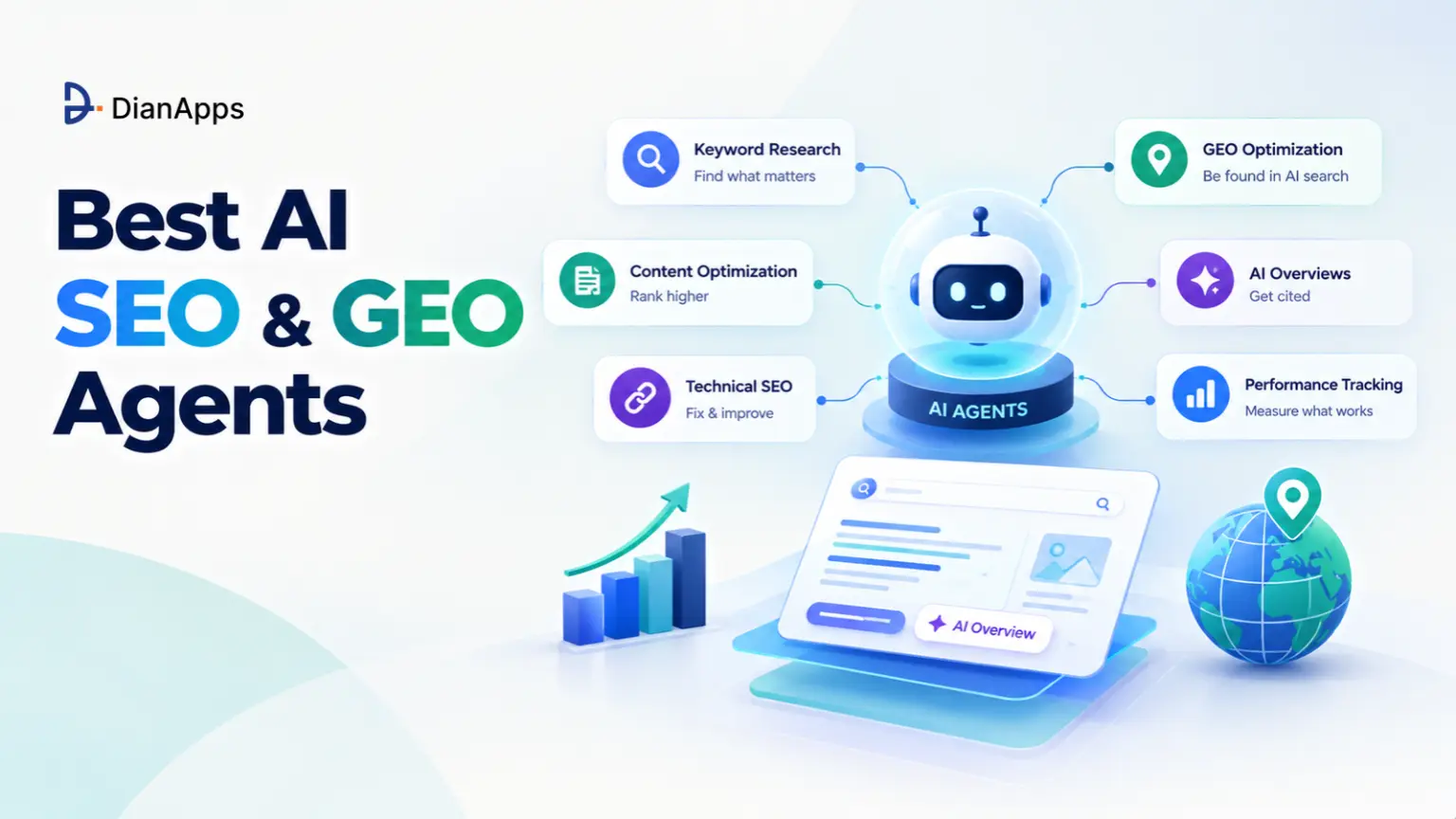




Quick Answer: The best AI SEO agents in 2026 are Search Atlas OTTO SEO (best for automated execution), Ahrefs Letaido (best for research and reporting), Profound (best enterprise GEO platform) and Semrush AI Visibility Toolkit (best for existing Semrush users). Budget teams can start with Otterly.ai at $29 per month. Teams with unique workflows often get more value from AI agent development services that connect their own data.
10 Best AI SEO & GEO Agents in 2026, Ranked and Priced
Search is splitting into two channels, and most marketing teams are only measuring one of them. Ranking on page one is still mattering, but buyers are increasingly getting their answer from ChatGPT, Perplexity, Gemini or a Google AI Overview before they ever click.
AI SEO agents are closing that gap by doing the work, not just reporting it, they fix pages, track citations across AI engines and draft content built to be quoted. This guide is ranking the 10 best AI SEO agents and GEO tools of 2026 by what they automate, what they cost and what results are actually published.
What Is the Difference Between SEO and GEO?
SEO (Search Engine Optimization) is improving how your pages rank in traditional search results, while GEO (Generative Engine Optimization) is improving how often AI models like ChatGPT, Gemini and Perplexity cite, mention or recommend your brand in their answers. You need both, because they reward overlapping but different signals.
The term GEO comes from a 2023 research paper by Princeton, Georgia Tech, the Allen Institute for AI and IIT Delhi, later presented at KDD 2024. The researchers found that adding citations, quotations and statistics to content raised its visibility in generative engine answers by up to 40% (Aggarwal et al., KDD 2024).
You will also see AEO (Answer Engine Optimization) used for much the same idea. Here is how the two disciplines compare in practice.
| Factor | Traditional SEO | GEO (AI Search Optimization) |
|---|---|---|
| Goal | Rank in the top 10 blue links | Get cited or recommended inside AI answers |
| Main surfaces | Google, Bing results pages | ChatGPT, Perplexity, Gemini, Claude, Copilot, AI Overviews, AI Mode |
| Unit of success | Keyword position and clicks | Citation share, brand mentions, sentiment |
| Content signals | Relevance, backlinks, technical health | Direct answers, verifiable stats, entity clarity, third-party mentions |
| How you measure | Rank trackers, Search Console | Prompt tracking across multiple AI engines |
| Time to signal | Weeks to months | Can shift within days as models refresh sources |
Takeaway: A page can rank first on Google and still be invisible in AI answers. Semrush found ChatGPT search is citing pages that rank 21st or lower almost 90% of the time (Semrush, 2025), which is why the best AI SEO agents in this list are tracking both.
Why Is GEO Becoming Urgent in 2026?
GEO is urgent because AI answers are absorbing clicks that used to go to websites, and the traffic that does arrive from AI platforms is converting better. Three data points are framing the shift:
- Search volume pressure: Gartner predicted traditional search engine volume would drop 25% by 2026 as users move to AI chatbots and virtual agents (Gartner, 2024).
- Fewer clicks at the top: AI Overviews are reducing the top result’s click-through rate by 58% on average (Ahrefs, 2026).
- Higher value visitors: AI search visitors are worth 4.4 times traditional organic visitors, and Semrush projects they could surpass traditional search visitors by early 2028 (Semrush, 2025).
How We Selected the Best AI SEO Agents?
We ranked tools by how much SEO and GEO work they complete on their own, not by feature count, then checked current pricing on each vendor’s own pricing page in October 2026. A dashboard that only shows data did not qualify as an agent.
Each tool was evaluated on five criteria:
- Autonomy level: Does it execute changes, draft fixes for approval or only monitor?
- Engine coverage: Which AI engines does it track, such as ChatGPT, Perplexity, Gemini, Claude, Copilot and AI Overviews?
- SEO plus GEO depth: Does it help with traditional rankings, AI citations or both?
- Published benchmarks: Are there verifiable time-saved or performance results?
- Cost transparency: Is pricing public, and what is the realistic monthly ceiling for a growing team?
What this list is not: It is not a ranking of SEO agencies, and no vendor paid for placement. Prices are changing quickly in this category, so confirm on the vendor’s site before you buy.
Paying for three SEO tools that don’t talk to each other?
We’ll review your current stack and show you which agent covers your biggest gap, or whether one custom agent could replace several subscriptions.
Comparison Table: AI SEO & GEO Agents at a Glance
If you only read one section, read this table, it compares all 10 agents on autonomy, price and best use. Prices are the lowest listed paid tier as of October 2026.
| Rank | Agent | Autonomy Level | Starting Price | AI Engines Tracked | Best For |
|---|---|---|---|---|---|
| 1 | Search Atlas OTTO SEO | Executes changes | $99/mo plan + $99/site OTTO add-on | ChatGPT, Gemini, AI Mode (Perplexity, Copilot on Pro) | Hands-off SEO execution |
| 2 | Ahrefs Letaido | Runs scheduled workflows | $99/mo workspace (reported) | Via Ahrefs Brand Radar data | Research and reporting automation |
| 3 | Profound | Agents plus monitoring | Custom (free trial) | Up to 9 incl. ChatGPT, Claude, Perplexity, Gemini | Enterprise GEO |
| 4 | Semrush AI Visibility Toolkit | Monitors and recommends | $99/mo per domain | ChatGPT, Perplexity, AI Overviews | Existing Semrush users |
| 5 | AthenaHQ | Drafts content fixes | Free tier, Starter $295/mo | 11 models on Starter | Turning citation gaps into content |
| 6 | Peec AI | Recommends actions | ~$95/mo (reported) | Choose 3, up to 13 on Enterprise | Agencies needing unlimited seats |
| 7 | Alli AI | Deploys technical fixes | $249/mo (annual) | Serves pages to AI crawlers | Teams blocked by dev queues |
| 8 | Scrunch AI | Optimizes for AI crawlers | $250/mo (annual) | ChatGPT, Claude, Gemini, Perplexity, AI Overviews, Meta | AI crawler readiness |
| 9 | Surfer SEO | One-click optimization | $49/mo (annual) | AI Search Analytics plan $82/mo | Content teams |
| 10 | Otterly.ai | Monitors and audits | $29/mo | ChatGPT, AI Overviews, Perplexity, Copilot | Budget GEO tracking |
Takeaway: Ranks 1, 2 and 7 are doing the most work on their own, ranks 4, 6 and 10 are the strongest for measurement on a budget.
The 10 Best AI SEO & GEO Agents in 2026
1. Search Atlas OTTO SEO: Best for Automated SEO Execution
OTTO SEO is an AI agent that is running technical fixes, on-page updates, content, link building, digital PR and local SEO, either on autopilot or in an approval mode. It is the closest thing to a full SEO team in one agent, and your edits are staying live even if you cancel.
Search Atlas also includes LLM visibility tracking, so the same platform is covering Google rankings and AI citations. Teams are getting ChatGPT, Gemini and Google AI Mode on every paid plan, with Perplexity and Copilot unlocked on Pro.
Pricing: Starter $99/mo, Growth $199/mo, Pro $399/mo, Agency $999/mo. The OTTO SEO add-on starts at $99 per site per month. 7-day free trial (Search Atlas, 2026).
2. Ahrefs Letaido: Best for Research and Reporting Automation
Letaido is an agent workspace from Ahrefs, launched August 12, 2026, that is running multi-step SEO jobs on a schedule, such as competitor content audits, keyword clustering, AI visibility monitoring and weekly reports. It is drawing directly on Ahrefs data, including a web index of more than 170 trillion pages and over 439 million AI prompts tracked each month (SiliconANGLE, 2026).
Benchmark: Foundation Marketing reportedly cut a 40-hour weekly keyword research and bottom-of-funnel content audit to about 60 minutes (SiliconANGLE, 2026). It is also connecting to Notion, Slack, HubSpot, Google Ads and WordPress.
Pricing: Reported at $99/mo for one workspace with unlimited users, with AI usage billed separately (Rework, 2026).
3. Profound: Best Enterprise GEO Platform
Profound is an enterprise AI visibility platform tracking up to 9 answer engines, including ChatGPT, Perplexity, Google AI Mode, Gemini, Copilot, DeepSeek, Claude, AI Overviews and Exa Search. Its reusable Agents and Profound Sheets are letting teams run optimization workflows at scale.
It also has SSO, API access and data exports, which is making it a common choice for regulated industries and large brands.
Pricing: Free trial with 50 prompts tracked daily for 7 days, Enterprise on custom quote (Profound, 2026).
4. Semrush AI Visibility Toolkit: Best for Existing Semrush Users
Semrush is adding AI visibility tracking for ChatGPT, Perplexity and AI Overviews on top of its full SEO suite, so teams are seeing keyword rankings and AI mentions in one place. It is the lowest-friction option if Semrush is already your main SEO platform.
It is more of a monitoring and recommendation tool than an autonomous agent, so plan for a person to act on its findings.
Pricing: AI Visibility Toolkit $99/mo per domain, with SEO plus AI Search bundles starting around $199/mo (Dupple, 2026).
5. AthenaHQ: Best for Turning Citation Gaps Into Content
AthenaHQ is tracking brand visibility across 11 AI models and using a content optimization agent to draft fixes where competitors are getting cited instead of you. It is also bringing on-page and off-page action recommendations, Shopify and Google Analytics integrations.
Pricing: Essential is free with $25 in credit, Starter is $295/mo with 3,600 credits and Enterprise is custom. The Advanced Content Optimization Agent is an Enterprise feature (AthenaHQ, 2026).
6. Peec AI: Best for Agencies Tracking Many Clients
Peec AI is a GEO tracking platform with unlimited users on every plan, daily prompt tracking and an agent that is generating recommended actions from your data using pre-built and custom skills. You are choosing 3 models on standard plans, with up to 13 on Enterprise.
Pricing: Starter covers 50 prompts, Pro 150 and Advanced 350, with 15% off annual billing. Starter is reported at about $95/mo (Dupple, 2026), confirm in-app as the pricing page does not show figures.
7. Alli AI: Best for Deploying Technical Fixes Without Developers
Alli AI is deploying technical SEO, AEO and GEO optimizations such as titles, meta descriptions, schema and internal links across a site through a script, a WordPress plugin or a tag manager. It is also serving pre-rendered HTML to AI crawlers, which is helping JavaScript-heavy sites get read.
What is making Alli AI stand out is speed, installation is taking under an hour and fixes are going live without a dev ticket.
Pricing: Business $249/mo and Agency $499/mo on annual billing, with a 10-day free trial (Alli AI, 2026).
8. Scrunch AI: Best for AI Crawler Readiness
Scrunch AI is monitoring brand presence across ChatGPT, Claude, Gemini, Perplexity, Google AI Mode, AI Overviews and Meta, and its Agent Experience Platform (AXP) is generating an AI-friendly version of your site. This is useful when AI crawlers are struggling with your current page structure.
Pricing: Starter $250/mo annual or $300/mo monthly, Growth $417/mo annual or $500/mo monthly, Enterprise custom (Scrunch, 2026).
9. Surfer SEO: Best for Content Teams
Surfer is pairing NLP-based content scoring with one-click content optimization and one-click internal linking, plus an AI Search Analytics plan for tracking AI visibility. It is supervised automation, a person is triggering each run, which many content teams are preferring.
Pricing: Discovery $49/mo, Standard $99/mo, Pro $182/mo, Peace of Mind $299/mo on annual billing, AI Search Analytics $82/mo (Surfer, 2026).
10. Otterly.ai: Best Budget GEO Monitoring
Otterly.ai is the most affordable way to start tracking AI search visibility, covering ChatGPT, Google AI Overviews, Perplexity and Copilot on every plan, with a GEO audit for your URLs. Gemini, AI Mode and Claude are available as paid add-ons.
Pricing: Lite $29/mo (15 prompts), Standard $189/mo (100 prompts), Premium $489/mo (400 prompts), Enterprise custom (Otterly.ai, 2026).
Honorable mention: Botify is a strong fit for enterprise sites with tens of thousands of URLs, with SpeedWorkers delivering content to AI crawlers, but pricing is quote-only.
Find out where your brand stands in AI search
Book a free 30-minute call. We’ll check how visible you are in ChatGPT, Gemini and AI Overviews, and map the agent setup that fits your team and budget.
What Benchmarks Should You Expect From an AI SEO Agent?
Expect time savings first and traffic gains later, published benchmarks today are mostly about hours removed from research, reporting and fixes, while citation and ranking gains are taking weeks to show. Treat vendor claims as a starting point, not a promise.
| Benchmark | Published Result | Source |
|---|---|---|
| Research and audit time | 40 hours per week reduced to ~60 minutes | Ahrefs Letaido customer, SiliconANGLE, 2026 |
| AI citation growth | 200% growth in AI citations on existing content | HubSpot’s own results, via Dupple, 2026 |
| Visibility from content edits | Up to 40% higher visibility in AI answers from adding citations, quotes and stats | Aggarwal et al., KDD 2024 |
| AI visitor value | 4.4x the conversion value of organic visitors | Semrush, 2025 |
Takeaway: Measure each agent against your own baseline for 60 to 90 days, tracking hours saved, AI citation share, AI referral sessions and conversions.
What Should an AI SEO Agent Cost?
Most growing teams are spending between $100 and $500 per month per tool, and enterprise GEO platforms are moving into custom pricing. Use these cost ceilings as a guide:
- Solo marketers and startups: $29 to $150 per month, for example Otterly.ai Lite or Surfer Discovery plus one visibility tracker.
- Growing in-house teams: $200 to $500 per month, for example Search Atlas Growth with OTTO, or AthenaHQ Starter.
- Agencies: $500 to $1,000+ per month, for example Search Atlas Agency or Peec AI Advanced.
- Enterprise: Custom pricing, for example Profound, Botify or Scrunch Enterprise.
Watch the credit model, many tools are charging one credit per prompt per AI engine per refresh, so tracking 100 prompts across 3 engines daily is using roughly 9,000 credits a month.
How Do You Choose the Right AI SEO Agent?
Choose based on the gap you need to close, execution, measurement or content, then pick the tool whose autonomy matches how much control you want to keep. Use these five checks:
- Match the bottleneck: If fixes are stuck in a dev queue, pick Alli AI or OTTO SEO. If you do not know where you stand in AI answers, start with a tracker like Otterly.ai or Peec AI.
- Check engine coverage: Confirm the engines your buyers actually use are included, not sold as add-ons.
- Demand approval controls: Any agent that edits live pages should offer an approval mode and a rollback.
- Read the credit math: Calculate prompts times engines times refresh frequency before you commit.
- Test against a baseline: Run a 60 to 90 day pilot on one site section and compare against an untouched control section.
What Are SEO Teams Actually Asking About GEO Agents?
Discussions in SEO communities and practitioner write-ups are raising the same concerns again and again. Here is what teams are asking, paraphrased, with honest answers.
“Are AI visibility scores even reliable when AI answers change every time?” AI answers are varying between runs, by location and by account, so a single snapshot can mislead. Trust trends across many prompts tracked daily, not one screenshot. This is why tools tracking larger prompt sets on a fixed schedule are producing more useful data.
“Knowing I am invisible in ChatGPT does not fix it, so what does?” This is the most common criticism of monitoring-only tools. Visibility is improving through content that gives direct answers, verifiable data and clear entities, plus third-party mentions on sites AI engines already cite. Choose a tool that is drafting or deploying fixes, or pair a tracker with a content process.
“If I rank well on Google, do I still need GEO?” Usually yes. Semrush found ChatGPT is citing pages ranking 21st or lower almost 90% of the time (Semrush, 2025), so strong rankings are not guaranteeing AI citations. Good SEO is the foundation, GEO is the layer that gets you quoted.
When Should You Build a Custom AI SEO Agent?
Build a custom AI SEO agent when your workflow spans several data sources, such as Search Console, GA4, your CMS, your CRM and a rank tracker, and no single tool is connecting them the way your team works. Buy off the shelf when one platform already covers your bottleneck.
Off-the-shelf agents are great for standard jobs. A custom agent is making more sense when you need to:
- Combine your own data: Join Search Console, GA4, CRM revenue data and AI visibility data into one decision loop.
- Publish at scale safely: Generate and update programmatic pages with your own brand rules, fact checks and approval steps.
- Use MCP connections: Semrush, Ahrefs and Surfer are now offering MCP (Model Context Protocol) or API access, so a custom agent built on Claude or GPT can pull their data directly.
- Control costs: Replace several overlapping subscriptions with one agent tuned to the tasks you actually run.
For a deeper look at the trade-offs, read our guide on custom vs off-the-shelf AI agents.
How DianApps Builds Custom AI SEO & GEO Agents?
DianApps, a mobile and AI app development company, is building custom AI agents for marketing, operations and product teams, with 150+ engineers, 350+ clients across 25+ countries and U.S. delivery presence. The team is rated 4.8/5 on Clutch across 81+ reviews and holds Premier Verified status.
What is making DianApps a strong partner here is full-cycle delivery, the agent, the dashboards, the CMS integrations and the cloud infrastructure are all built by one team. For SEO and GEO, that is meaning agents that pull Search Console and GA4 data, monitor AI citations, draft content to your style guide and route every live change through approval.
Our AI development services are covering LLM development, generative AI, AI agents and multi-agent systems, conversational AI, NLP, computer vision and machine learning. We have used the same approach for operational agents, such as the ones covered in our guide to AI agents in transportation.
We are honest about fit too. If one of the 10 tools above is already solving your bottleneck, we will tell you, a custom agent is worth it only when it is connecting data or workflows that off-the-shelf tools cannot.
Buy when a single platform already covers your main bottleneck, such as tracking or technical fixes. Build a custom agent when you need to combine several data sources, enforce your own approval rules or replace overlapping subscriptions. Working with an AI agent development company lets you pilot one workflow before scaling.
Conclusion
Search in 2026 is no longer one channel. AI Overviews are taking clicks from the top result, AI visitors are converting at higher value and AI engines are citing pages that traditional rankings often miss.
The teams winning are not choosing between SEO and GEO, they are using AI SEO agents to handle both and measuring results against a real baseline. Start with the bottleneck that is costing you the most, execution, visibility or content, and pick the agent that closes it.
If your workflow needs an agent that connects your own data, DianApps can scope, build and integrate it with your CMS, analytics and approval process.
 0 comments








Leave a Comment
Your email address will not be published. Required fields are marked *