















 0 comments





Key Takeaways:
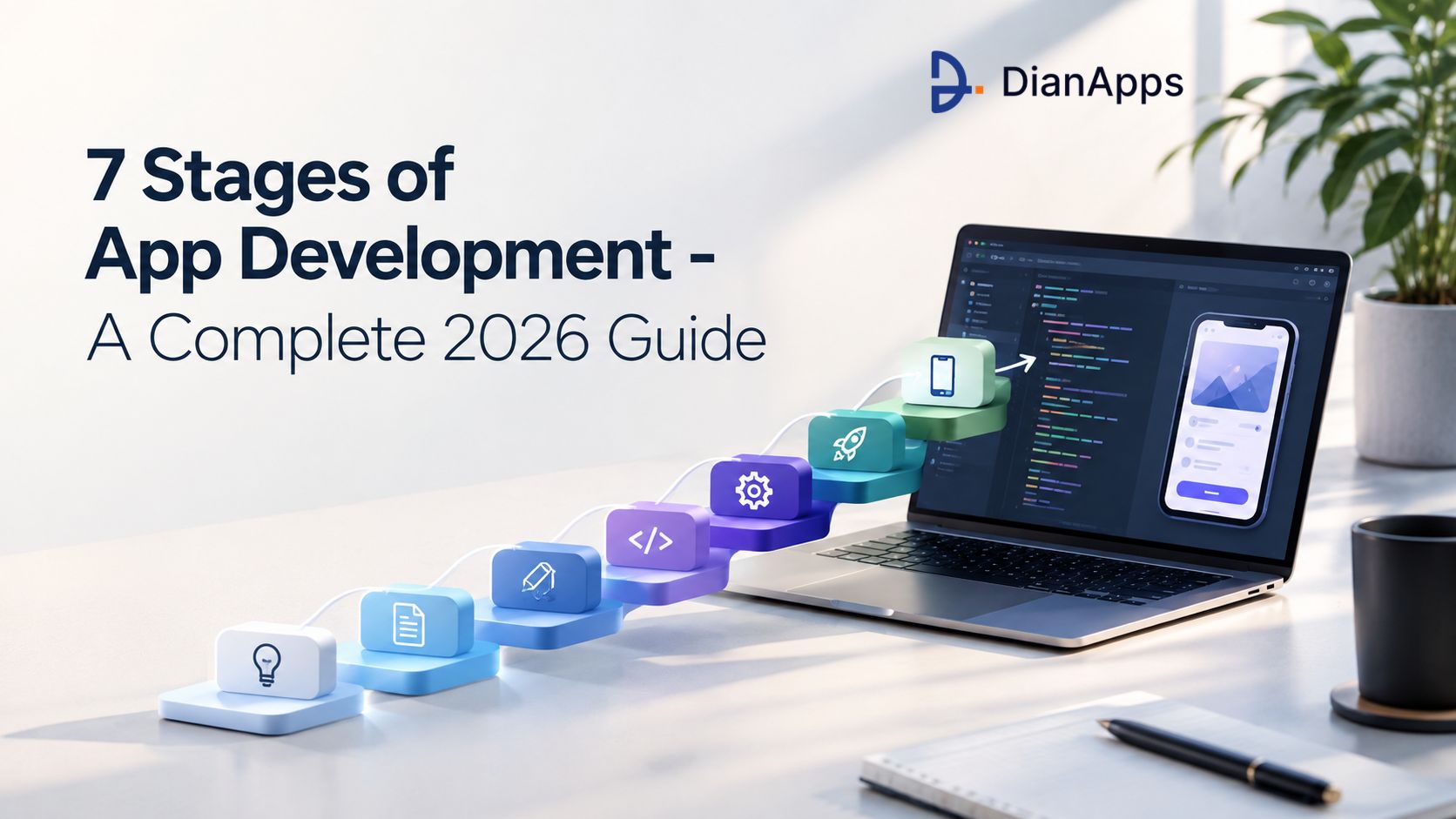
- The seven stages of app development are idea validation, planning, UI/UX design, development, testing, deployment and post‑launch maintenance.
- Idea validation and market research help confirm demand understand competitors and assess feasibility before app development begins.
- Planning defines the MVP scope, technology stack, budget, timeline and team structure for app development.
- UI/UX design covers wireframes, prototypes, visual design and early usability testing for app development.
- App development includes frontend, backend, APIs, databases, authentication and third‑party integrations.
- Testing should cover functionality, performance, security, device compatibility and usability for app development.
- Deployment involves preparing app store listings submitting the app for review and setting up analytics and crash reporting for app development.
- Post‑launch support includes bug fixes OS updates, security patches, monitoring and feature improvements, for app development.
- Most apps move through all seven stages of app development in around four to nine months depending on complexity, platforms and team size.
- The stages do not always happen in a sequence. Agile teams may overlap design, development and testing for app development.
Quick Answer: The 7 stages of app development are: (1) Idea Validation & Market Research, (2) Planning & Strategy (3) UI/UX Design, (4) App Development, (5) Testing & Quality Assurance (6) Deployment & Launch and (7) Post-Launch Maintenance & Support. Most mobile apps go through all seven stages of app development in 4 to 9 months depending on how complex the app’s how many platforms it covers and how big the team is.
Understanding the Stages of App Development
If you are a start-up founder or even a project lead, its is important to understand the different stages of mobile app development in order to build products that is completed on time instead of getting caught on something that drifts unnecessarily for months without a proper finish line. Every successful app, say it be a simple utility to an enterprise platform, moves from the same processes of developing an app even if the requirements are different.
Today, we are breaking down the 7 stages of app development which includes what happens, who is involved, how much will it cost and the mistakes that we need to avoid for a successful project completion. Keep reading to know what are the stages of app development, you are in the right place.
The 7 Stages of App Development at a Glance
| # | Stage | What Happens |
| 1 | Idea Validation & Market Research | Testing the app idea against real demand, competitors and feasibility |
| 2 | Planning & Strategy | Defining scope, tech stack, roadmap, budget and team structure |
| 3 | UI/UX Design | Wireframes, prototypes and a tested user experience |
| 4 | App Development | Writing the frontend, backend and integrating APIs |
| 5 | Testing & QA | Functional, performance, security and device testing |
| 6 | Deployment & Launch | App store submission, compliance checks and go-live |
| 7 | Post-Launch Maintenance | Bug fixes, OS updates, monitoring and feature iteration |
For a better understanding on how these stages fit into a full project timeline, you must see our companion guide on the mobile app development process.
Need Flutter Developers for Your App?
Build for multiple platforms with experienced Flutter developers who can help turn your product roadmap into a production-ready app.
Stage 1: Idea Validation & Market Research
Every app starts as an idea but not every idea is worth building, the first of the stages of mobile app development is about pressure-testing that idea before a single line of code is written.
What happens in this stage
- Defining the core problem the app solves and for whom
- Researching competitors already solving this problem and identifying the gap
- Validating demand through surveys, landing pages or early user interviews
- Assessing technical feasibility and rough budget range
Common mistakes
- Skipping competitor research and assuming there’s no existing solution
- Building for a broad, undefined audience instead of a specific first user
- Treating personal enthusiasm for the idea as a substitute for market validation
Stage 2: Planning & Strategy
Once an idea is validated, this stage of app development turns it into an actionable plan — scope, technology choices, budget and team structure all get defined here.
What happens in this stage
- Defining the feature list for an MVP versus a full-scale release
- Choosing the technology stack — native iOS/Android or cross-platform frameworks like Flutter or React Native
- Setting a realistic budget and timeline based on scope
- Deciding on a build model: in-house team, dedicated development team or full outsourcing
If you’re still scoping budget at this stage, our 2026 mobile app development cost guide breaks down pricing by complexity and platform.
Stage 3: UI/UX Design
This stage of developing an app translates the plan into something users will actually see and interact with — and it’s where most of an app’s long-term usability is decided.
What happens in this stage
- Wireframing the core user flows before any visual design begins
- Building a clickable prototype to test navigation and usability
- Designing the final UI — typography, color system, components and platform-specific guidelines (Human Interface Guidelines for iOS, Material Design for Android)
- Running early usability testing with a small group of target users
Why this stage matters more than it seems
A weak design stage is one of the most common reasons apps get rebuilt within their first year. Time invested here in testing real user flows — not just making screens look polished — saves significantly more time and cost later in development and QA.
Stage 4: App Development (Frontend & Backend)
This is the stage most people picture when they think about app development — but by the time it starts, roughly half the project’s critical decisions are already made in stages 1 through 3.
What happens in this stage
- Frontend development — building the UI in code across chosen platforms
- Backend development — APIs, databases, authentication and server infrastructure
- Third-party integrations — payment gateways, maps, push notifications, analytics SDKs
- Ongoing internal QA as features are built not only at the end
Native vs. cross-platform at this stage
Whether this stage runs as one shared codebase or two separate native builds significantly affects timeline and cost. See our comparison of native vs. cross-platform app development for a full breakdown of when each approach makes sense.
Stage 5: Testing & Quality Assurance
No stage of mobile app development should be treated as optional — but testing is the one most frequently compressed under deadline pressure and it’s the one that costs the most to skip.
What gets tested
- Functional testing — does every feature work as intended?
- Performance testing — load times, memory usage, battery drain
- Security testing — data encryption, secure authentication, API vulnerabilities
- Device and OS compatibility testing across the range of devices your users actually have
- Usability testing with real users before public launch
Security testing in particular has grown more important as breaches make headlines regularly — see our guide on building secure apps in the age of rising data breaches for what a thorough security testing pass should include.
Stage 6: Deployment & Launch
Getting an app into the App Store and Google Play involves more than uploading a build — this stage of app development has its own set of requirements and missing them is one of the most common causes of launch delays.
What happens in this stage
- Preparing app store listings — screenshots, descriptions, keywords, privacy disclosures
- Submitting for App Store and Google Play review (Apple’s review typically takes 24–48 hours; Google Play is often faster but both can flag issues that require resubmission)
- Setting up crash reporting and analytics before go-live not after
- Planning a phased or regional rollout for high-traffic launches to catch issues early
Stage 7: Post-Launch Maintenance & Support
This is the stage of app development most often left out of the plan entirely — and it’s the one that determines whether an app survives past its first year. Launch is not the finish line; it’s the start of the app’s real lifecycle.
What happens in this stage
- Monitoring crash reports and fixing bugs surfaced by real usage
- Updating the app for new iOS and Android releases
- Patching security vulnerabilities as they’re discovered
- Shipping feature improvements based on user feedback and analytics
As a general benchmark, ongoing maintenance typically costs 15–20% of the original development cost per year. Skipping this stage is one of the most common reasons well-built apps lose users within 12–18 months of launch.
Build Your App From Idea to Launch
Turn your validated idea into a reliable, scalable mobile app with a team that can handle development, integrations, testing and launch.
How Long Does Each Stage of App Development Take?
| Stage | Typical Duration | Simple App vs. Complex App |
| Idea Validation & Research | 1–3 weeks | Similar for both |
| Planning & Strategy | 1–2 weeks | Longer for enterprise apps |
| UI/UX Design | 2–5 weeks | Scales with screen count |
| App Development | 8–20 weeks | Largest variance by complexity |
| Testing & QA | 2–4 weeks | Runs partly parallel to development |
| Deployment & Launch | 1–2 weeks | Plus app store review time |
| Post-Launch Maintenance | Ongoing | Continuous after launch |
Common Mistakes That Derail App Development Stages
- Jumping into development before validating the idea or finishing the design stage
- Treating testing as a single phase at the end instead of an ongoing process
- Underestimating app store review time when planning a launch date
- Having no plan — or budget — for the post-launch maintenance stage
- Changing core requirements mid-development without adjusting timeline or budget.
Why Work With DianApps Through Every Stage of App Development
DianApps is a Mobile App Development Company that manages every one of these seven stages under one roof — so nothing falls through the cracks between design, development and long-term support. Our mobile application development team has guided 350+ apps across all seven stages, from idea validation through post-launch scaling.
Whatever stage you’re at right now, our team can help:
- Full-cycle custom mobile app development from idea to launch
- Dedicated mobile app developers for teams that need to scale delivery
- Specialized android app development and android application development expertise for device- and OS-fragmentation challenges
- Application development services covering design, backend, QA and post-launch maintenance as one continuous engagement
Explore our full mobile app development services or hire mobile app developers directly from our team to take your project through every stage, from idea to post-launch support.
Looking for a partner rather than a full rebuild? Our guide on choosing the right development partner walks through what to evaluate before you commit.
Read: The complete guide to choosing the right mobile app development partner
Have an App Idea in Mind?
Get expert guidance on your app’s scope, technology, timeline and development requirements before you commit to the build.
Final Thoughts
Understanding the different stages of app development isn’t just background knowledge — it’s what lets you plan a realistic budget, set an honest timeline and know what to expect from a development partner at every step. Treat all seven stages as equally essential, including the ones that happen before development starts and after launch ends and your app has a far better chance of surviving past its first year.
Ready to move through all seven stages with an experienced team? Explore DianApps’ mobile app development services or get in touch to scope your project.
Frequently Asked Questions
What are the 7 stages of app development?
The 7 stages of app development are idea validation and market research, planning and strategy, UI/UX design, app development, testing and quality assurance, deployment and launch and post-launch maintenance and support.
How long does it take to go through all the stages of mobile app development?
Most apps move through all seven stages in 4 to 9 months. Simple apps with a narrow feature set can move faster; complex or enterprise apps with multiple integrations often take longer.
Which stage of app development is most important?
Every stage matters but idea validation and testing are the two most commonly under-invested in — skipping validation risks building something no one needs and skipping thorough testing risks shipping something that doesn’t work reliably.
Do the stages of app development happen in strict order?
Not always. Teams using agile development methodologies often overlap stages — design and development frequently run in parallel and testing happens continuously rather than only at the end.
What happens after the last stage of app development?
The final stage, post-launch maintenance, doesn’t have an end date. It continues for as long as the app is live, covering bug fixes, OS compatibility updates, security patches and new feature development.
 0 comments











Leave a Comment
Your email address will not be published. Required fields are marked *