















 0 comments
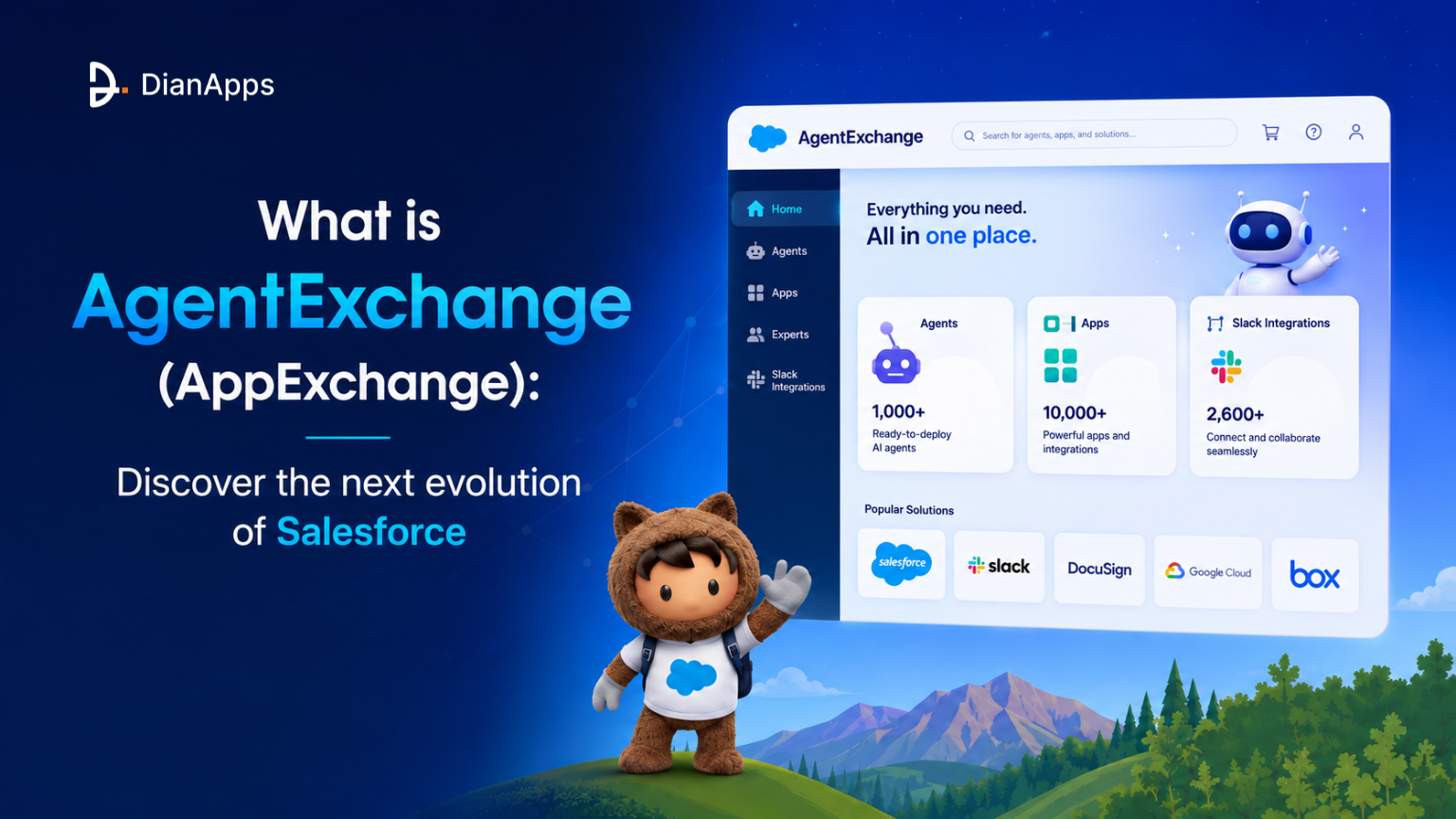
Salesforce just rebranded its AppExchange marketplace into AgentExchange. What is AgentExchange? Is it any different from AppExchange? Let us break it down in the simplest way: The marketplace is still considered the same platform, although it’s been expanded to a wider scope.
To define correctly, AgentExchange is Salesforce’s unified marketplace for discovering, buying, activating, and managing agents, apps, and tools across Salesforce and Slack. It’s the place to discover, buy, activate, and manage trusted solutions across Salesforce and Slack, plus 1,000+ agents and skills.
So, basically, it is a much-trusted marketplace of agents, apps, and experts to help you find, try, and buy solutions across Salesforce and Slack.
Let’s understand the evolution of Salesforce AppExchange to AgentExchange in detail in this blog post.

The Complete Breakdown of the Evolution of Salesforce AgentExchange
Phase 1: AgentExchange Launches Alongside AppExchange (March 4, 2025)
Rather than rebranding immediately, Salesforce development services first launched AgentExchange as a separate, purpose-built companion marketplace specifically for the agentic era. At this point:
- It had 200+ launch partners (Google Cloud, DocuSign, Box, and others) building trusted Agentforce solutions.
- It focused narrowly on agent components: prebuilt partner actions, topics, and templates that developers could plug into Agentforce, Salesforce’s new “digital labor platform.”
- Salesforce framed it as tapping into a $6 trillion digital labor market, distinctly separate messaging from AppExchange’s app-economy pitch.
- AppExchange kept its original job, hosting managed packages and traditional apps, while AgentExchange was purpose-built for the agentic era: prebuilt agent actions, topics, prompt templates, and full agent templates.
So for about a year, these were two parallel marketplaces serving different needs: AppExchange for apps, AgentExchange for agent-building components.
Phase 2: AgentExchange Matures – From “Parts Bin” to “Deployable Catalog” (early 2026)
Salesforce updated AgentExchange as part of its broader shift toward “agentic customer experience.”
The key shift here was conceptual: this update has shifted from a builder marketplace of components to a usable catalog of deployable AI agents, meaning early AgentExchange was more like a hardware store (buy individual actions/topics to assemble your own agent), while the updated version lets enterprises browse and deploy complete, ready-to-use agents directly into service, sales, and engagement workflows.
This mattered for CX/ops teams specifically: instead of assembling an agent from parts, they could deploy pre-built agents with tested workflows for case handling, summarization, and routine service tasks.
Phase 3: The Full Merger – AppExchange Becomes AgentExchange (TrailblazerDX 2026)
At TrailblazerDX (TDX) 2026, Salesforce made the final structural move: it officially renamed Salesforce AppExchange to AgentExchange, folding three previously separate destinations into one:
- AppExchange (traditional apps/packages)
- Slack Marketplace (Slack apps/integrations)
- Agentforce ecosystem (the agent marketplace from Phase 1-2)
The stated problem this solved was navigation friction: in the past, contextual blindness forced users to navigate fragmented sites, jumping between AppExchange, AgentExchange, and Slack to find the tools they needed, and even after finding the right solution, buying often meant weeks-long procurement, manual contracting, and separate vendor invoices.
What the merger delivered:
- Unified navigation: a persistent nav bar to toggle instantly between Salesforce apps, agents, and Slack Marketplace integrations, all in the same tab, same identity, no URL juggling.
- Semantic search: powered by Data 360, understanding user intent rather than exact keywords.
- In-flow/contextual discovery: Agentforce Builder now surfaces personalized recommendations based on the specific agent being built, so tools find the developer rather than the other way around.
- Private Offers: simplified procurement with unified billing handled directly through Salesforce as the billing agent, regardless of which vendor or service.
- Massive combined scale: 10,000+ apps, 1,000+ agents, and 2,600+ Slack apps/integrations, all security-reviewed with deep-dive technical audits and vulnerability scans.
Why Salesforce Did This
The renaming reflects Salesforce’s positioning that the “agent economy” may eventually surpass the app economy.
Brian Landsman (EVP, Global Business Development & Partnerships, later named CEO of AgentExchange) has framed it as extending the AppExchange playbook (prebuilt apps → partner business models) into agentic AI.
So partners get access to Salesforce’s entire install base plus better tools to build, manage, and scale distribution.
Quick Summary Table
| Phase | Timing | State |
|---|---|---|
| AppExchange origin | 2005–2006 | Standalone app marketplace |
| AgentExchange launch | March 2025 | Separate, agent-component-only marketplace (parallel to AppExchange) |
| AgentExchange update | Early 2026 | Shifted from components to deployable full agents |
| Full rebrand/merger | TDX 2026 | AppExchange + Slack Marketplace + Agentforce ecosystem unified under "AgentExchange" name |
Two Ways to Scale With Salesforce AgentExchange in 2026
1. If You’re Building/Selling on AgentExchange (Partner/ISV/Agency angle)
Tap the $50M Builders Initiative
Salesforce is backing the platform with a $50 million AgentExchange Builders Initiative aimed at helping ISV partners build and monetize AI solutions, combining capital, technical guidance, Slack resources, and go-to-market support.
Build agent-ready, not just app-ready
The rename wasn’t cosmetic; it signals a fundamental shift in what Salesforce expects apps to do: not just extend the platform, but participate in it as intelligent, agent-ready components.
Concretely: Agentforce readiness is now a procurement filter; buyers evaluate apps as components of an agent strategy, not standalone tools, and apps without a defined agent action get deprioritized in evaluations happening at scale.
Compress time-to-value
Time-to-value has compressed from months to days. If onboarding requires a kickoff call before showing value, you’ll lose trials to lighter competitors who demonstrate value in 10 minutes.
Use the four monetizable component types
AgentExchange introduces new agentic components partners can build, list, and monetize: Actions, Topics, Prompt Templates, and Agent Templates, each a different packaging/pricing surface.
Leverage Private Offers + Go-to-Market App
The new AgentExchange Go-to-Market App allows for private offers, unified billing, and automated provisioning, shaving weeks off contract negotiations. This matters for scale because it removes the traditional enterprise procurement bottleneck.
My competitor gaps for product-market fit
A practical tactic: mine 3- and 4-star competitor reviews on AgentExchange; these are buyers who tried and were disappointed, and that gap is your product opportunity.
The scale equation, per industry analysis:
Success on AgentExchange is product excellence + platform alignment + GTM execution + genuine user adoption, all four, not just one.
2. If You’re an Enterprise Deploying Agents at Scale (Customer angle)
Use in-flow, intent-based discovery instead of manual search
Agentforce Builder surfaces relevant agents, sub-agents, and tools automatically based on what you’re building, reducing the discovery-to-deployment friction that used to require IT tickets and vendor calls.
Consolidate governance and billing
Automated provisioning gives immediate access once an offer is accepted, ensuring the right people get the right permissions at the right time, letting IT/admin teams scale deployment without per-vendor onboarding overhead.
Watch for fall/winter 2026 rollouts
Two features are coming that specifically aid scale: a streamlined Agentforce Builder installer (fall 2026) and contextual Slackbot discovery letting teams surface vetted recommendations in natural language (winter 2026), plus conversational search allowing follow-up questions to refine and compare solutions side by side.
Market Context Worth Knowing
AgentExchange has become genuinely the fastest-growing organic product in Salesforce’s history, with $800M ARR (up 169% year-over-year) and 18,500 customers as of Q4 FY2026, and pricing has evolved to three tiers, Conversations ($2/conversation), Flex Credits, and Per-User ($125/user/month), reflecting how enterprises are actually consuming agents at scale versus the simpler original model.
What Are the Top AgentExchange Features & Capabilities?
Based on the priority order, we have bifurcated the features list into 4 tiers. Let’s read them all below:

Tier 1: Core Infrastructure (Everything Else Depends On These)
1. Unified Marketplace Consolidation
The single biggest structural feature: AppExchange, Slack Marketplace, and the Agentforce ecosystem merged into one governed distribution layer with over 10,000 Salesforce apps, 2,600+ Slack apps/agents, and 1,000+ Agentforce agents, sub-agents, tools, and MCP servers in one searchable catalog. This is ranked #1 because every other feature (search, discovery, billing) only works because this consolidation happened first.
2. Security Review & Trust Governance
Every AgentExchange solution undergoes a rigorous security review, including deep-dive technical audits and vulnerability scans.
This is high priority because, unlike traditional apps, agents take actions on live business data; buyers need a structured evaluation framework covering manifest, audit trail, supply chain, and runtime isolation, since malicious marketplace agents are already in the wild.
Trust is the precondition for enterprise adoption at scale.
Tier 2: Discovery & Purchasing (Drive Adoption Velocity)
3. Semantic Search (powered by Data 360)
Matches customers to solutions based on business intent rather than keywords, critical because it directly shortens the “I don’t know what I need” phase of the buying journey.
4. In-Flow / Contextual Discovery in Agentforce Builder
Agentforce Builder surfaces relevant agents, sub-agents, and tools automatically based on what a developer is currently building, no need to leave the development environment.
One case study cited an 80% in-product discovery rate for an agent using this pattern, which signals it’s becoming the dominant acquisition channel over outbound sales.
5. Private Offers & Go-to-Market App
Enables tailored pricing, unified billing, and automated provisioning, cutting weeks off contract negotiations. High priority because enterprise procurement friction was historically the biggest bottleneck between “found the right agent” and “actually using it.”
6. Automated Provisioning
Gives immediate access once an offer is accepted, ensuring the right people get the right Salesforce CRM permissions at the right time, this is what makes the Private Offers feature actually deliver value rather than just simplify paperwork.
Tier 3: Ecosystem Expansion (Coming/Rolling Out)
7. Conversational Search (Fall 2026)
Let customers ask follow-up questions to refine results and compare solutions side-by-side.
8. Streamlined Agentforce Builder Installer (Fall 2026)
Reduces friction in the actual install/activation step.
9. Contextual Slackbot Discovery (Winter 2026)
Let teams surface vetted, contextual recommendations in natural language based on their team, existing workflows, and the challenge at hand, extending discovery into the tool where many teams already work.
10. Add to Slack (One-Click) (June 2026, waitlist)
Brings agents into Slack with a single click, lower priority than the above because it’s a convenience layer on top of discovery/purchasing that already work.
Tier 4: Partner/Builder Enablement
11. $50M AgentExchange Builders Initiative
Capital, technical guidance, Slack resources, and go-to-market support for ISV partners. Important for ecosystem health in the long term, but it’s an input to feature growth rather than a feature customers use directly.
12. Four Agentic Component Types (Actions, Topics, Prompt Templates, Agent Templates)
The packaging structure that lets partners build and monetize modular pieces rather than full agents is foundational for partners, but end customers mostly experience these bundled into agent templates rather than as standalone choices.
Why Use AgentExchange: The Core Case
1. One marketplace instead of three
No more jumping between AppExchange, Slack Marketplace, and the Agentforce ecosystem; everything (10,000+ apps, 2,600+ Slack integrations, 1,000+ agents/tools/MCP servers) lives in one searchable, governed catalog.
Also read: Salesforce unveils agentforce 3
2. It finds you, not the other way around
Agentforce Builder surfaces relevant agents and tools automatically based on what you’re actively building; one case study cited an 80% in-product discovery rate, meaning most users find what they need without ever leaving their workflow.
3. Search understands intent, not just keywords
Semantic search (Data 360) matches you to solutions based on business intent; you don’t need to know an exact product name to find the right fit.
4. Trust is engineered in, not assumed
Every listing goes through rigorous security review, deep technical audits, and vulnerability scans, which matter because agents, unlike static apps, take real actions on your live business data.
5. Procurement friction is mostly gone
Private offers with unified billing and automated provisioning cut what used to be weeks of contract negotiation down dramatically; you get access the moment an offer is accepted, with the right permissions already in place.
6. It’s not a bet on an unproven idea: the numbers back it
$800M ARR, up 169% year-over-year, with 18,500 customers, it’s the fastest-growing organic product in Salesforce’s history, which de-risks adoption for enterprises that worry about betting on immature platforms.
7. Governance stays centralized as usage scales
For CX and IT leaders specifically, it offers a controlled way to scale AI across the org while maintaining security, compliance, and standardization, critical once dozens of teams start deploying agents independently.
8. Two-sided value, not just a buyer’s tool
Partners get direct access to Salesforce’s massive install base plus a $50M Builders Initiative to help monetize their expertise, so the catalog itself keeps growing with better solutions, which in turn benefits buyers.
9. It’s built for where the market is actually heading
Buyers are already evaluating apps as components of an agent strategy, not standalone tools, meaning solutions on AgentExchange are pressure-tested to fit into agentic workflows rather than being legacy apps repackaged with an “AI” label.
How to Get Started With Salesforce AgentExchange?
Step 1: Access AgentExchange

Go to agentexchange.salesforce.com directly, or log into your Salesforce org and find AgentExchange from the Setup menu / App Launcher. If you’re an existing AppExchange user, no bookmarks need updating; the old AppExchange URL now redirects straight to AgentExchange, so nothing breaks for existing users.
You’ll land on the unified homepage where Salesforce apps, Agentforce agents, and Slack integrations all live together in one catalog.
Step 2: Choose Your Discovery Mode–Salesforce or Slack

Right at the top of the interface, there’s a toggle to switch between Salesforce and Slack views, letting you discover Agentforce apps, AI agents, Slack apps, and agents depending on where you want to deploy the solution.
Decision point: if you’re solving a CRM/workflow problem, stay in Salesforce view; if you want something usable inside team chat, switch to Slack view.
Step 3: Search With Intent, Not Just Keywords
Type what you’re trying to accomplish rather than a product name; semantic search (powered by Data 360) matches you to solutions based on business intent, not just exact keyword matches.
For example, searching “help my sales reps schedule follow-ups automatically” will surface relevant agent actions even if none of those exact words appear in a listing title.
Use the category filters (Actions, Topics, Prompt Templates, Agent Templates, or full third-party agents) to narrow down which type of component fits your needs: a full ready-to-deploy agent vs. a smaller building block.
Step 4: Evaluate the Listing

Before installing anything, check:
- Security review status: every listing undergoes a rigorous security review, including deep-dive technical audits and vulnerability scans
- Reviews and ratings: especially 3-4 star reviews, which often reveal real limitations
- Data/API scope: what permissions and data access the agent is requesting
- Pricing model: free, freemium, paid, usage-based, or custom, since AgentExchange supports diverse pricing options
Step 5: Discover In-Context via Agentforce Builder (Alternative Entry Point)

Instead of browsing the marketplace separately, you can also work directly in Agentforce Builder; it automatically surfaces relevant agents, sub-agents, and tools based on the specific agent you’re actively building, so recommendations appear inside your build flow rather than requiring a separate search.
Step 6: Request or Accept a Private Offer (For Paid/Enterprise Solutions)
If you need enterprise pricing or custom terms, partners can send tailored pricing and terms directly to your My Account page inside Salesforce, replacing the old back-and-forth email/vendor-onboarding process.
You review and accept it from a single interface, whether you’re buying an AI agent or a document tool.
Billing note: Salesforce acts as the billing agent regardless of which partner built the solution, so you get one consistent billing experience across every vendor.
Step 7: Automated Provisioning–Activation
Once an offer is accepted (or a free listing is installed), automated provisioning gives immediate access and ensures the right people on your team get the right permissions right away, no separate IT ticket needed for basic activation.
Step 8: Configure Permissions & Data Boundaries
As an admin, go into your org’s permission sets and confirm:
- Which users/profiles can access the new agent or app
- What data boundaries and API scopes the agent is authorized for (admins maintain granular control here, agents only access what’s explicitly authorized)
Step 9: Test in Sandbox First

Before rolling out org-wide, always test in a sandbox environment. AgentExchange’s try-before-you-buy model still applies, so validate behavior on non-production data first.
Step 10: Deploy, Monitor, and Track Versions
Roll out to production, then use the built-in version control functionality to track updates and new releases of the app/agent over time, useful for coordinating changes with your team and staying current as partners ship updates.
What are the Limitations of Salesforce AgentExchange
- Reliability risk: hallucination/reliability management is the #1 adoption concern industry-wide
- Data quality dependency: messy Salesforce data leads to inaccurate agent outputs
- Struggles with nuance: rigid templates often need manual overrides for non-standard cases
- Governance gap: most enterprises lack mature frameworks to manage multiple agents safely
- Salesforce lock-in: value drops sharply if you’re not already deep in the Salesforce ecosystem
- Pricing complexity: Conversations vs. Flex Credits vs. Per-User makes cost estimation hard
- Steep learning curve: needs real admin/developer expertise, not plug-and-play
- Still maturing: key features (conversational search, Slackbot discovery, etc.) roll out through late 2026
- Scale-proof risk: security review speed and purchasing flow are still unproven at high volume
- Speed vs. trust tension: balancing fast consumer-style discovery with enterprise-grade trust is unresolved
DianApps Take on AgentExchange
The opportunity is real, but it’s a positioning play, not just a distribution play.
For an AI-first app development agency like DianApps, AgentExchange matters less as “another marketplace to list on” and more as a signal of where client demand is heading.
Buyers are already evaluating apps as components of an agent strategy, not standalone tools, which means every client conversation DianApps has about a new build, integration, or Salesforce-adjacent project should now include the question:
Does this need an Agent Action, or will it get deprioritized by buyers evaluating agent-readiness?
Concluding Thoughts
AgentExchange is a well-engineered distribution layer for a technology (autonomous agents) that’s still earning enterprise trust; it’s the right infrastructure at a slightly early moment, which makes it worth watching closely and adopting selectively rather than betting the farm on immediately.
See you in the next, even bigger updates on Salesforce.
 0 comments











Leave a Comment
Your email address will not be published. Required fields are marked *