















 0 comments
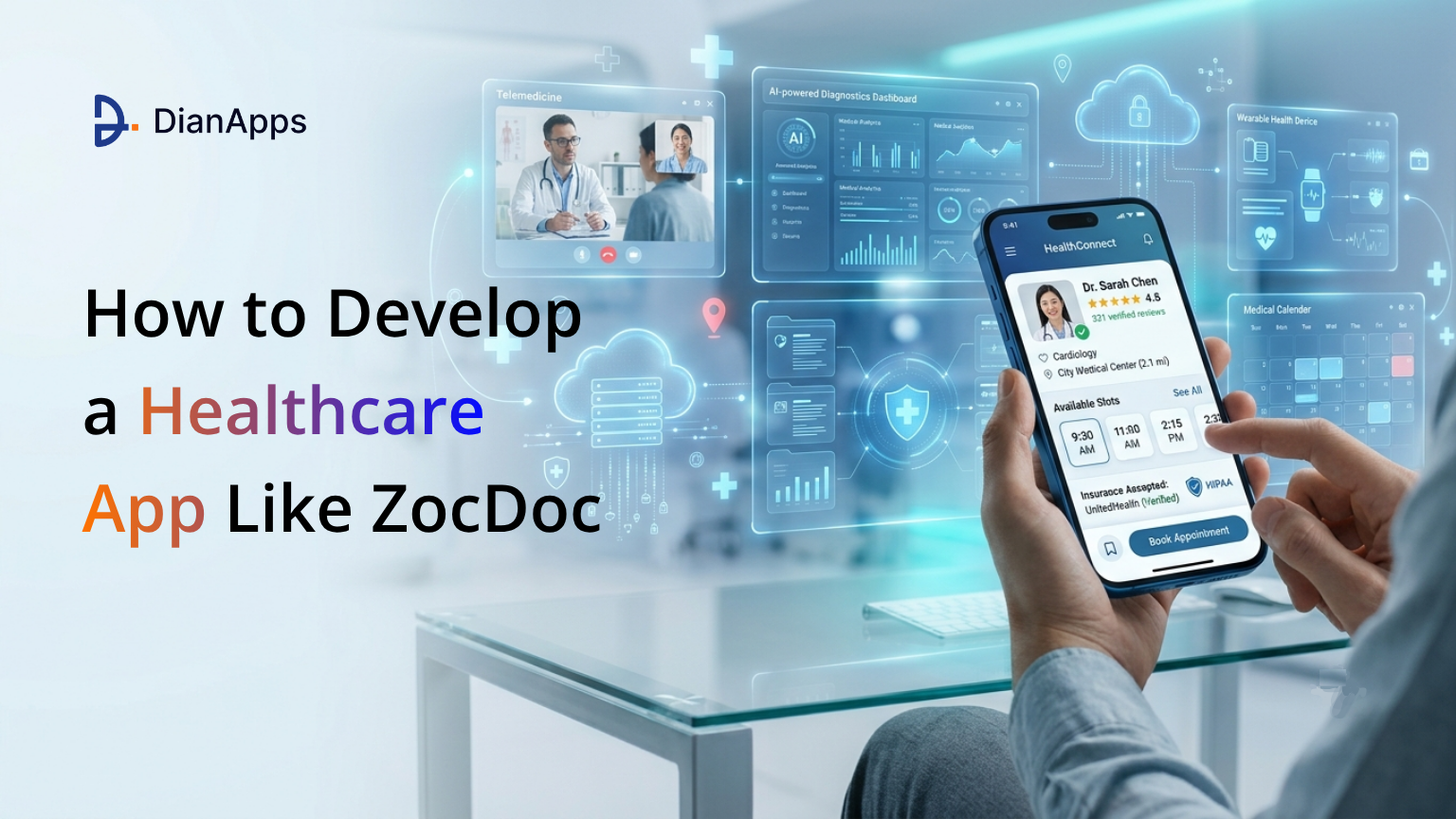





Nearly 6 million patients use ZocDoc every month to find and book appointments with one of the platform’s 100,000+ providers across every U.S. state and roughly 200 specialties.
That scale didn’t happen overnight; it took ZocDoc close to a decade of provider-by-provider onboarding to build the network density that makes the platform useful.
But the problem it solves is more relevant today than it was in 2007: U.S. patients are still waiting an average of 31 days for a new-patient physician appointment, up from 26 days just two years ago, according to AMN Healthcare/Merritt Hawkins data cited in ZocDoc’s own 2025 patient research.
That gap between patient demand and provider access is exactly the opportunity founders, hospital groups, and any healthcare app development company are chasing when they ask, How do I build something like ZocDoc?
This guide walks through the real answer, grounded in current market data, actual 2026 development costs, and the compliance requirements that separate a healthcare app from a standard consumer marketplace.
The U.S. Market Opportunity in 2026
Before scoping a single feature, it’s worth understanding why this category continues to attract serious investment.
- The U.S. mHealth app market alone is valued between $14.4 billion and $16.5 billion in 2026, with multiple research firms projecting it to more than double by the early 2030s.
- The global digital health market is estimated at roughly $420–$492 billion in 2026, depending on how each research firm defines the category, and is growing at double-digit rates across every major forecast.
- North America holds the largest regional share of the mHealth market, around 38-42% of global revenue, driven by high chronic disease prevalence, strong telehealth adoption, and reimbursement support under CMS policy updates.
- U.S. digital health startups raised $14.2 billion in 2025, up 35% from the year before, with AI-focused companies capturing more than half of that funding.
- On the demand side, ZocDoc’s own late-2025 patient research found that 1 in 3 Americans now use AI tools like ChatGPT weekly for healthcare-related questions, but still book their actual care with a human provider, reinforcing that AI is becoming a front door to care, not a replacement for it.
The takeaway for founders: the appetite for digital front doors into healthcare, search, scheduling, triage, and follow-up is still expanding, and investors are actively funding this category. But the bar for entry has moved.
In 2026, patients and providers expect real-time booking, verified reviews, and insurance transparency as baseline features, not differentiators.
How ZocDoc Actually Makes Money
A lot of “build an app like X” guides skip the business model, but this is the part that determines your entire technical architecture and go-to-market plan.
ZocDoc runs a free-for-patients, pay-per-booking model for providers:
- Patients never pay to search or book; this keeps the demand side of the marketplace frictionless and growing.
- Providers pay a one-time fee per new-patient booking, not a flat subscription. There’s no charge for returning patients booking again, and providers can pause or cap monthly spend.
- Bookings originating from a provider’s own website, Google Business Profile, or partner platforms (Yelp is a recent 2026 integration partner) are typically free, which incentivizes providers to plug into ZocDoc’s infrastructure everywhere patients search.
- ZocDoc also runs a sponsored placement/auction model, where providers can bid for enhanced visibility in search results, similar to paid search advertising.
- According to ZocDoc’s own provider-facing data, practices that adopt the platform see roughly an 8x return on ad spend from new patient bookings, and providers with 10+ verified reviews get roughly 3x the monthly bookings of providers with none.
This model works because it aligns incentives: ZocDoc only gets paid when it actually delivers a new patient, which is what makes providers willing to open up their real-time calendars in the first place. Any team building a similar product should treat this alignment, not the UI, as the actual product.
Also, read the Complete guide on the healthcare app software development
Core Features You Need to Build
Patient-Facing Features
| Feature | Why It Matters |
|---|---|
| Provider search & filtering | Filter by specialty, insurance, location, language, gender, and availability. This is the core discovery engine |
| Real-time appointment booking | Must sync live with the provider's actual calendar, not a request-and-wait queue |
| Insurance verification | ZocDoc data shows 83% of its bookings come from commercially insured patients, and insurance filtering is a top decision factor, not an add-on |
| Verified patient reviews | Post-visit, verified reviews are the trust layer the entire marketplace depends on |
| Appointment reminders | SMS/push/email reminders directly reduce no-show rates, which is a top provider pain point |
| Telehealth/video visits | Providers offering both in-person and telehealth options get 51% more bookings than in-person-only providers, and 217% more than telehealth-only providers, per ZocDoc's own platform data |
| Digital intake forms | Pre-visit paperwork completed from home reduces friction and waiting-room time |
| In-app payments & billing | Copay collection, claim status, and digital receipts |
Provider-Facing Features
- Practice management dashboard with calendar and staff scheduling
- EHR/EMR integration (Epic, Cerner, Athenahealth), typically the hardest and most expensive technical piece
- Secure patient messaging and follow-up scheduling
- Analytics on no-show rates, booking sources, and patient acquisition
- Multi-location support for group practices and health systems
- Credentialing and license verification workflows
Admin/Backend Features
- Provider onboarding and credential verification
- Review moderation and fraud detection
- Marketplace-wide analytics and revenue reporting
- Support tooling for dispute resolution and refunds
HIPAA Compliance: The Non-Negotiable Layer
This is where a healthcare app diverges completely from a standard marketplace build, and it’s the single biggest reason healthcare app budgets and timelines run longer than founders expect.
Why it matters financially, not just legally:
- HIPAA violation penalties in 2026 range from $145 per violation up to over $2.19 million per violation category, per year, according to HHS Office for Civil Rights enforcement data updated for 2026 cost-of-living adjustments.
- The average healthcare data breach now costs $7.42 million per incident (IBM Security, 2025), the highest of any industry.
- Retrofitting compliance into an app that was built without it costs 3- 5x more than designing it in from the start and can add $30,000–$80,000 in rework alone.
What compliance actually requires, technically:
- End-to-end encryption for data at rest and in transit (AES-256 + TLS 1.2 minimum)
- Role-based access control (RBAC) and multi-factor authentication
- Tamper-proof audit logs for anyone who touches PHI (protected health information)
- Signed Business Associate Agreements (BAAs) with every third-party vendor that touches PHI, cloud hosting, SMS providers, analytics tools, and video infrastructure
- Annual HIPAA risk assessments, typically costing $5,000–$15,000 per audit
- HL7/FHIR data standards if you’re integrating with EHR systems, which is required for true real-time interoperability
Also read: How to innovate the Healthcare industry with a custom software development company.
If you’re targeting a national U.S. audience and eventually plan to integrate with EHR systems, HIPAA compliance isn’t a phase; it’s an architectural decision that shapes your database schema, cloud provider choice, and even how your customer support team is allowed to view records.
Recommended Tech Stack
| Layer | Common 2026 Choices |
|---|---|
| Mobile frontend | React Native or Flutter (cross-platform); Swift/Kotlin for native |
| Web frontend | React or Next.js |
| Backend | Node.js, Python (Django), or Ruby on Rails |
| Database | PostgreSQL for structured patient/provider data; MongoDB for unstructured content |
| Cloud hosting | AWS, Google Cloud, and Azure all offer HIPAA-eligible services and will sign a BAA |
| EHR integration | HL7/FHIR standards; Epic, Cerner, and Athenahealth each have their own certification process |
| Video/telehealth | Twilio, Vonage, or another HIPAA-compliant WebRTC provider |
| Payments | Stripe, configured for healthcare-compliant data handling |
| Notifications | Twilio (SMS), Firebase Cloud Messaging (push) |
| Auth & identity | Auth0 or similar, for secure authentication and MFA |
Cross-platform frameworks like React Native or Flutter are worth defaulting to unless you have a strong reason not to; several 2026 industry cost breakdowns note they cut iOS + Android + web development costs by 30-40% versus three separate native builds, which matters more in healthcare than most categories, given how much of the budget compliance already consumes.
Step-by-Step Development Roadmap
- Market and competitor research: identify your wedge: a geography, specialty, or underserved patient segment (mental health, dental, women’s health, and multi-specialty telehealth are all active 2026 growth areas).
- Define a lean, compliant MVP; resist building every feature above at once. A strong MVP is typically: provider search, real-time booking, and basic verified profiles, nothing more.
- Compliance and legal groundwork: engage healthcare compliance counsel and map your PHI data flow before writing a line of production code.
- UX/UI design: healthcare users span every age group and tech-comfort level; design for clarity, large touch targets, and minimal cognitive load over visual cleverness.
- Backend and integration architecture: build the data model with HIPAA and FHIR requirements baked in from day one, not bolted on later.
- MVP development: realistically 4–6 months for a lean, compliant MVP with core booking functionality.
- Provider onboarding pilot, launch with a small set of real providers in one city or specialty before expanding; ZocDoc’s own growth took years precisely because provider trust doesn’t scale instantly.
- Iterate on liquidity; the marketplace only becomes genuinely useful once both patient demand and provider density exist in the same market simultaneously.
Real 2026 -Healthcare App Development Costs
Cost estimates below are synthesized from multiple 2026 healthcare software development cost reports, which converge on similar ranges despite differing methodologies:
| App Complexity | Estimated Cost (USD) | What's Included |
|---|---|---|
| Lean HIPAA-compliant MVP | $35,000 – $80,000 | Search, real-time booking, basic profiles, HIPAA-compliant storage |
| Mid-tier telemedicine/booking platform | $80,000 – $200,000 | Video consultations, EHR integration, patient/provider dashboards |
| Enterprise-grade platform | $200,000 – $500,000+ | AI triage, multi-specialty support, full EHR interoperability, multi-platform |
Cost factors that consistently move the number:
- HIPAA-specific engineering (encryption, audit logging, RBAC, BAA negotiation, penetration testing) typically adds $15,000–$40,000, or roughly 15–30% on top of the base build.
- Each EHR integration (Epic, Cerner, Allscripts) adds $20,000–$40,000 depending on the vendor’s certification requirements.
- Developer location swings cost significantly: U.S.-based teams run $120–$250/hour, while offshore teams with genuine HIPAA experience run $25–$80/hour, a 40–60% cost difference for comparable output, provided the offshore partner has an actual healthcare compliance track record.
- Ongoing maintenance, security patches, compliance re-audits, OS updates, and cloud hosting typically run 15–20% of the initial build cost annually.
The practical implication: a $60,000 quote that doesn’t mention HIPAA infrastructure isn’t a cheaper option; it’s a deferred cost that resurfaces later, usually at 30–50% of the original budget, once compliance gets added retroactively.
Monetization Models That Work
- Pay-per-booking fees, charge providers only when a new patient actually books, mirroring ZocDoc’s core model and keeping the patient side free
- Sponsored placement / auction-based visibility, providers bid for enhanced search placement, similar to paid search advertising
- Telehealth consultation fees, a percentage cut of virtual visit charges
- Premium provider subscriptions, optional tiers for advanced analytics, multi-location management, or priority support
- Aggregated, anonymized data products and insights are sold to health systems or researchers, approached carefully and only with full compliance review
Pay-per-booking tends to outperform flat subscription models for early-stage marketplaces because it removes the biggest provider objection, why would I pay before I see results?, which matters enormously when you’re trying to build density from zero.
2026 Trends Shaping Healthcare Apps
- AI is a pre-care tool, not a replacement. ZocDoc’s own 2026 forecasting suggests AI will keep growing as the entry point for symptom checks and navigation, but human providers remain the expectation for anything high-stakes.
- In-network transparency becomes mandatory; rising healthcare costs mean patients are filtering harder on insurance status upfront rather than discovering it during checkout.
- Blended care expectations: A strong majority of both patients and providers now prefer hybrid in-person/telehealth models over either extreme.
- Consolidation of booking surfaces, partnerships like ZocDoc’s 2026 integration with Yelp, show the direction of the market: booking needs to happen wherever the patient is already searching, not just inside a single app.
Common Mistakes to Avoid
- Treating EHR integration as a late-stage add-on instead of a core architecture decision
- Underestimating provider onboarding friction, providers are far more risk-averse adopters than patients, and trust has to be earned market by market
- Expanding into too many cities or specialties before reaching liquidity in one
- Delaying compliance review until after MVP development is already underway
- Ignoring the no-show problem, it’s often the actual value driver providers care about most, more than the booking volume itself
 0 comments










Leave a Comment
Your email address will not be published. Required fields are marked *