















 0 comments





What Changed in 2026
The market landscape shifted meaningfully in the last twelve months. Here are the verified data points that shape the guidance below:
- Global mobile app market projected to hit $633.71 billion in 2026 (Statista App Market Forecast).
- Over 80% of mobile apps will integrate AI features by end of 2026 (Sensor Tower State of Mobile 2026).
- Average data breach cost is $4.88 million globally in 2025 (IBM Cost of a Data Breach Report 2025).
- DianApps 2026 project data shows AI-integrated builds add 15-25% to standard cost (DianApps client benchmarks).
Related Reading From Our 2026 Guides
For deeper context, see these companion guides:
Salesforce and ServiceNow used to sit in completely different corners of the org chart. Salesforce was where the sales team lived, and ServiceNow was where IT logged its tickets.
That division still mostly holds, but it won’t help you decide which one to buy, because both companies have spent the last few years muscling into each other’s work. Salesforce sells workflow automation and AI agents now.
ServiceNow sells customer service and AI agents of its own. They compete for the same deals, pitched to the same executives, which is likely why you’re comparing them at all.
Here’s where things actually stand. Salesforce is still the biggest name in CRM, holding roughly 20.7% of the global market and, according to IDC, the number one spot for twelve years straight.
ServiceNow is smaller but growing fast, past $13 billion in annual revenue with growth that’s stayed above 20% a year as companies modernize how work moves through IT, HR, customer service, and operations.
The thing that’s really shifted the conversation, though, is AI. Salesforce’s Agentforce business has already crossed $1.2 billion in annual recurring revenue.
ServiceNow expects its Now Assist portfolio to pass $1.5 billion in annual contract value by the end of 2026.
Neither company treats AI as a bolt-on feature anymore, and that changes what you’re actually buying. (If you want the current picture on Salesforce’s agent platform, the Agentforce 3 release is worth a read.)
Read about the latest Salesforce Agentforce 3 release to stay ahead of the game.
So instead of a tidy front-office-versus-back-office split, you’ve got two platforms both trying to become the place where your work, your customer data, and your AI all live.
That’s what makes this comparison harder, and more useful, than it was a few years ago.
Below, I’ll walk through how they stack up on CRM, ITSM, customer service, AI, workflow automation, integrations, pricing, implementation, and careers, so you can figure out which one fits what you’re actually trying to do. This raises a question many buyers ask: is Salesforce an ERP, and our breakdown shows where Salesforce covers ERP functions natively versus where it does not.
What Is Salesforce?
Salesforce is the world’s largest CRM platform. The whole point of it is to help you manage how your company interacts with customers, across sales, marketing, commerce, service, and revenue operations, from one connected place.
It’s been around since 1999, and it basically invented the modern SaaS model along the way. Today, it serves more than 150,000 customers and, per IDC, still leads the CRM market with that 20.7% share, which is how it’s held the top position for over a decade.
At its core, Salesforce centralizes your customer information, tracks deals, automates marketing, supports your service teams, and turns all of that data into something you can act on. Over the years, it’s grown well past plain CRM into AI, analytics, workflow automation, app development, and data management.
Salesforce’s Core Product Portfolio
Salesforce development services offer a broad suite of cloud-based applications, including:
- Sales Cloud for lead, account, opportunity, and pipeline management
- Service Cloud for customer support and case management
- Marketing Cloud for campaign automation and customer engagement
- Commerce Cloud for digital commerce experiences
- Data Cloud for customer data unification and activation
- Agentforce for AI-powered agents and workflow automation
- Slack for enterprise collaboration and productivity
Together, these solutions form Salesforce’s Customer 360 ecosystem, which aims to provide a unified view of customers across every touchpoint.
Why Enterprises Choose Salesforce?
Salesforce’s biggest strength lies in helping organizations drive revenue growth and improve customer experiences. Its extensive ecosystem, low-code capabilities, thousands of third-party integrations, and mature partner network make it one of the most versatile enterprise platforms available today.
The platform is particularly popular among sales-driven organizations that need advanced pipeline management, forecasting, customer engagement, and marketing automation capabilities. It is widely adopted across industries such as SaaS, financial services, healthcare, retail, manufacturing, and telecommunications.
Salesforce’s Strategic Shift Toward AI
While Salesforce is still best known for CRM, its recent growth strategy centers on becoming an AI-powered enterprise platform.
The company has invested heavily in Data Cloud, Einstein AI, and Agentforce to help businesses move beyond data storage and into autonomous workflow execution. As enterprises increasingly prioritize AI-driven productivity, Salesforce is positioning itself as a platform that can connect customer data, business processes, and AI agents within a single ecosystem.
This evolution is one of the key reasons Salesforce is increasingly being compared with ServiceNow. What was once primarily a CRM platform is now competing more directly in areas such as workflow automation, service management, low-code development, and enterprise AI.
Know the latest trends of CRM here in this detailed blog.
What Is ServiceNow?
ServiceNow is a cloud-based enterprise workflow platform that helps organizations automate, manage, and optimize business processes across IT, customer service, human resources, security, and operations.
Founded in 2004, ServiceNow initially gained recognition as an IT Service Management (ITSM) solution that modernized how enterprises handled incidents, service requests, change management, and IT operations. Over the past decade, however, the platform has evolved far beyond its IT roots.
Today, ServiceNow serves more than 8,400 enterprise customers worldwide, including approximately 85% of the Fortune 500. The company has emerged as one of the fastest-growing enterprise software vendors, generating over $13 billion in annual revenue while expanding its footprint across multiple business functions.
At its core, ServiceNow acts as a system of action, a centralized platform that connects people, processes, systems, and data through automated workflows. Instead of focusing primarily on customer relationships like Salesforce, ServiceNow focuses on streamlining how work gets done across the enterprise.
ServiceNow’s Core Product Portfolio
ServiceNow’s platform consists of several workflow-focused solutions, including:
- IT Service Management (ITSM) for incident, problem, change, and request management
- IT Operations Management (ITOM) for infrastructure visibility, monitoring, and operational resilience
- Customer Service Management (CSM) for customer support and service workflows
- HR Service Delivery (HRSD) for employee onboarding, case management, and HR operations
- Security Operations (SecOps) for vulnerability and incident response workflows
- Strategic Portfolio Management (SPM) for project and resource planning
- App Engine for low-code application development
- Now Assist for generative AI-powered workflow automation
These solutions run on the company’s unified Now Platform, enabling organizations to automate processes across departments without relying on disconnected tools.
Why Enterprises Choose ServiceNow
ServiceNow’s primary strength lies in workflow orchestration. The platform is designed to eliminate manual processes, reduce operational bottlenecks, and create smooth experiences for employees and customers alike.
Large enterprises often choose ServiceNow because it provides a centralized layer for managing complex business operations. Whether it’s resolving IT incidents, onboarding employees, handling customer requests, or coordinating security responses, ServiceNow helps standardize and automate workflows at scale.
The platform is particularly popular among organizations with large IT environments, complex service operations, and digital transformation initiatives.
Industries such as banking, healthcare, telecommunications, government, manufacturing, and insurance are among its strongest adopters.
ServiceNow’s Strategic Shift Toward Enterprise AI
Like Salesforce, ServiceNow is investing heavily in artificial intelligence. However, its AI strategy is centered on workflow intelligence rather than customer engagement.
Through products such as Now Assist and AI Agents, ServiceNow enables organizations to automate ticket resolution, summarize cases, generate knowledge articles, recommend next actions, and streamline operational workflows.
The company’s AI business has grown rapidly as enterprises increasingly seek to reduce manual effort and improve productivity across service teams.
This AI-first approach is one of the main reasons ServiceNow is increasingly being compared with Salesforce.
While Salesforce focuses on customer-facing processes and revenue operations, ServiceNow is building an AI-powered platform for enterprise operations and workflow automation.
As both companies expand beyond their traditional markets, the distinction between CRM software and workflow platforms is becoming less defined, making the ServiceNow vs Salesforce comparison more relevant than ever.
ServiceNow vs Salesforce: Quick Comparison For 2026
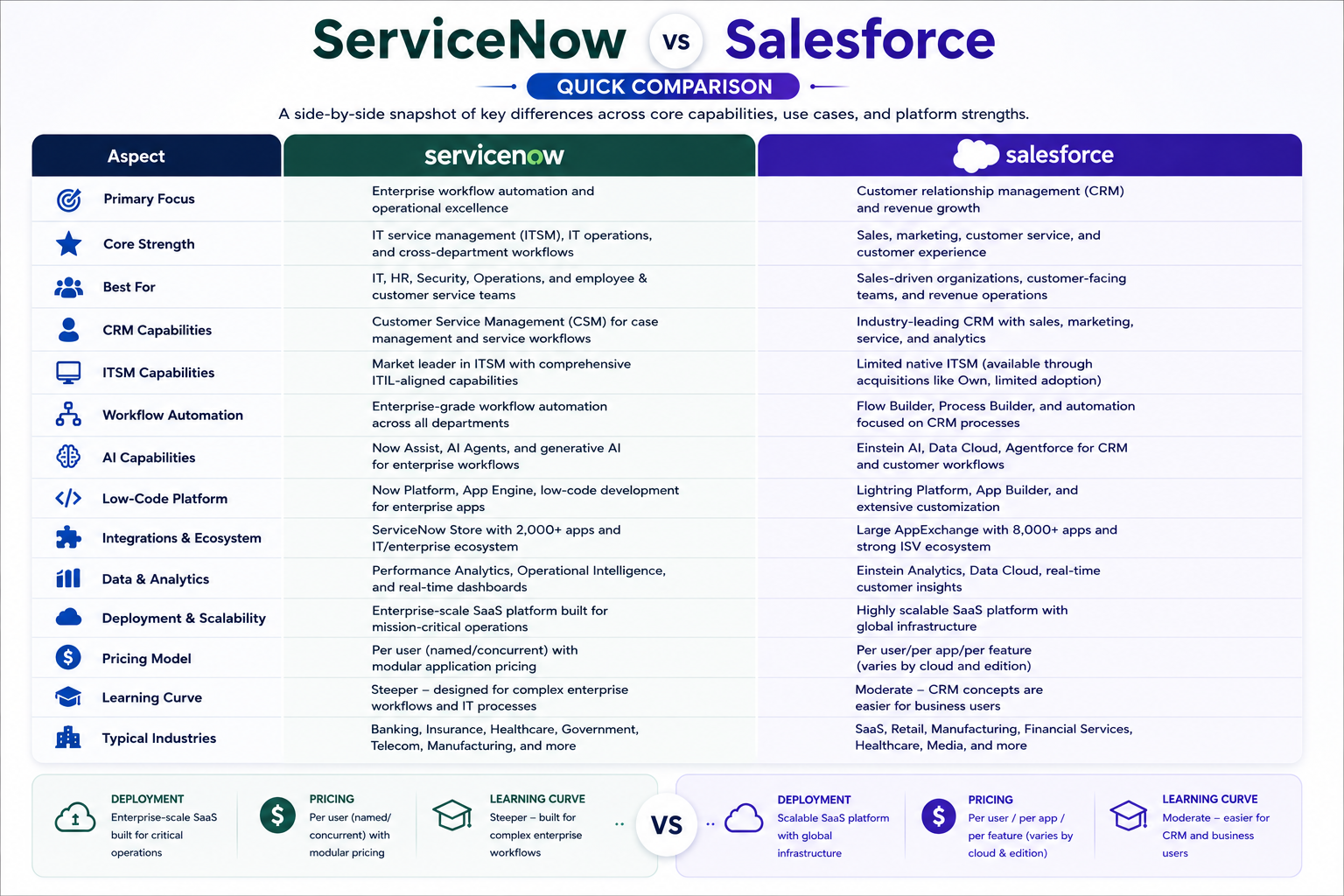
ServiceNow vs Salesforce: Core Differences
Underneath all the platform-expansion talk, these two were built to do different jobs. Salesforce exists to help you find customers and keep them.
ServiceNow exists to help you actually run the company once those customers are signed: the IT, the HR, the security, the hundred internal processes nobody outside the building ever sees.
Get that one distinction, and most of the rest makes sense, right down to who ends up signing the contract.
If you want a single frame to hang everything on, use the front office and the back office. Salesforce is the front office. It runs the parts of the business that touch a customer, sales and marketing, and support and revenue.
ServiceNow is the back office, the machinery behind those moments: the service desk, employee onboarding, infrastructure, and security response. That’s the whole reason so much of the Fortune 500 quietly pays for both.
When a customer gets promised something, Salesforce is usually where the promise is made, and ServiceNow is where it gets kept.
People buy them for opposite reasons, too, which is easy to miss. Salesforce is a growth purchase. You bring it in because you want more pipeline, more closed deals, a better read on which accounts are about to walk.
ServiceNow is the other instinct entirely: a company buys it to stop the bleed, to kill manual handoffs, cut resolution times, and make processes that run the same way on a bad day as on a good one. Growth on one side of the house, efficiency on the other.
You can read it off the org chart, too. Salesforce deals get pushed by the CRO or the VP of sales.
On the ServiceNow side, it’s the CIO, or whoever ends up responsible for keeping IT and operations running. Those used to be two separate conversations with two separate budgets.
They aren’t anymore, largely because everyone is trying to buy fewer platforms, and that overlap is the real reason this comparison keeps getting harder.
So don’t walk in asking “which one’s better.” Ask the more useful (and slightly more annoying) question: do you most need to grow the customer side, fix the operational side, or both? Whatever you land on shapes basically everything below.
Front Office vs Back Office
Another way to understand the difference is through the front-office versus back-office lens.
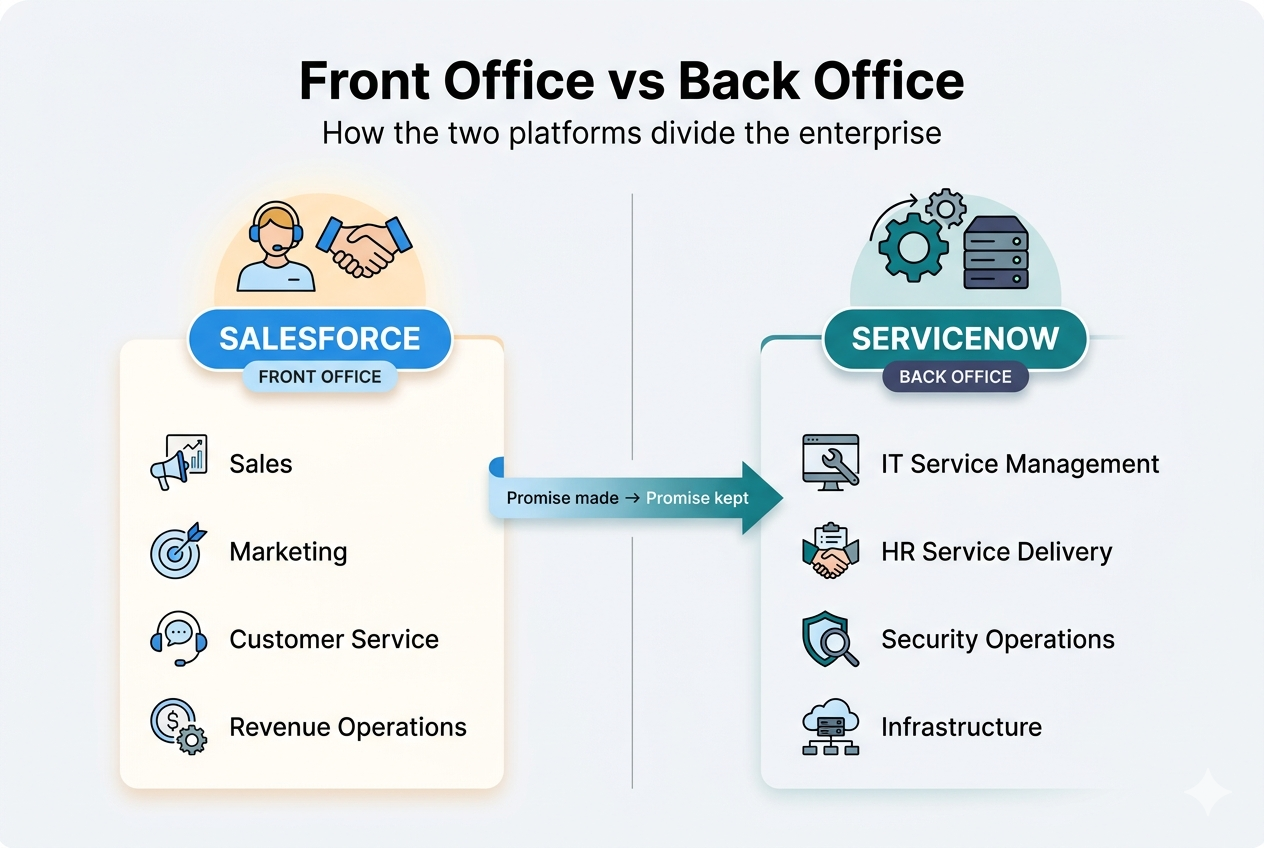
Salesforce primarily powers customer-facing functions such as:
- Sales
- Marketing
- Customer service
- Partner management
- Revenue operations
ServiceNow primarily powers operational functions such as:
- IT service management
- Employee service delivery
- Security operations
- Infrastructure operations
- Enterprise workflow management
This is one reason many Fortune 500 organizations use both platforms. Salesforce manages customer interactions, while ServiceNow manages the processes that support those interactions behind the scenes.
CRM Platform vs Enterprise Workflow Platform
Salesforce remains first and foremost a CRM platform. Its strongest capabilities include:
- Lead management
- Opportunity tracking
- Customer 360 profiles
- Revenue forecasting
- Marketing automation
- Customer engagement
ServiceNow, meanwhile, is best viewed as an enterprise workflow platform.
Its strongest capabilities include:
- Incident management
- Change management
- Asset management
- Workflow automation
- Service delivery
- Process orchestration
While ServiceNow has expanded into customer service and Salesforce has expanded into workflow automation, their areas of expertise remain distinct.
Revenue Growth vs Operational Efficiency
Organizations often choose Salesforce and ServiceNow based on different business objectives.
Companies investing in Salesforce are typically looking to:
- Increase revenue
- Improve sales productivity
- Enhance customer engagement
- Generate better customer insights
- Strengthen customer retention
Companies investing in ServiceNow are typically looking to:
- Reduce operational costs
- Improve service delivery
- Eliminate manual processes
- Increase employee productivity
- Standardize enterprise workflows
One platform is primarily optimized for growth, while the other is optimized for operational excellence.
AI for Customers vs AI for Workflows
Artificial intelligence is another area where the platforms differ significantly.
Salesforce’s AI strategy revolves around customer-facing intelligence. Through Einstein AI, Data Cloud, and Agentforce, the company focuses on helping sales teams, marketers, and service agents make smarter decisions and automate customer interactions.
ServiceNow’s AI strategy focuses on workflow intelligence. Through Now Assist and AI Agents, the platform helps organizations automate ticket resolution, summarize cases, recommend next actions, and streamline operational processes across departments.
While both vendors are heavily investing in generative AI, their use cases remain largely aligned with their historical strengths.
Ecosystem and Buyer Personas
The platforms also attract different decision-makers.
Salesforce initiatives are typically led by:
- Chief Revenue Officers (CROs)
- Sales leaders
- Marketing leaders
- Customer experience teams
ServiceNow initiatives are often driven by:
- CIOs
- IT leaders
- Operations teams
- Digital transformation leaders
As enterprise software purchasing increasingly shifts toward platform consolidation, these buying groups are beginning to overlap. This convergence is one of the biggest reasons the ServiceNow vs Salesforce comparison has become more relevant than ever.
Salesforce and ServiceNow are not direct substitutes in most enterprise environments.
That’s the heart of it. Salesforce grows the customer side of the business; ServiceNow runs the operational side. So the question worth asking isn’t which one is better in the abstract, it’s which of those problems is actually yours to solve: growth, efficiency, or both.
Shopping for help on the Salesforce side? Here’s our rundown of the top Salesforce AI consulting partners for 2026.
CRM capabilities
If there’s one category where these two aren’t close, it’s CRM. Salesforce was a CRM before it was anything else. ServiceNow came at customers sideways, starting in IT service management and only later adding customer service and customer-ops workflows. So if your reason for buying is winning deals and managing relationships, Salesforce is the clear front-runner, and here’s where you actually see it.
Leads and opportunities
This is Salesforce’s home turf, and it shows. Inside Sales Cloud, reps can pull leads in from just about any channel, follow every move a prospect makes, run deals through stages they’ve defined themselves, route leads automatically, score them with AI, and watch the forecast update as they go.
None of it is bolted on; it’s the part of the product Salesforce has spent twenty-plus years sharpening.
ServiceNow doesn’t really play here. You can wire up custom workflows around customer interactions if you want, but there’s no native pipeline to speak of, and nothing close to the lead management, deal tracking, and forecasting a sales team would lean on day to day.
Customer data
A real CRM has to do more than store contact details. It has to pull together one coherent picture of each customer across sales, marketing, service, and commerce, which is exactly the job Customer 360 and Data Cloud are built for.
They consolidate data from scattered systems into a single source of truth, and that’s what makes the good stuff possible: personalized experiences, real-time insight, visibility across teams, sharper segmentation, and AI recommendations that have real data behind them.
ServiceNow holds customer records too, through CSM, but it’s built for service delivery, not for running the full customer lifecycle. If a true 360-degree view is what you’re after, Salesforce is the more mature and scalable place to get it.
Sales Forecasting and Revenue Intelligence
Revenue forecasting is one of the most critical functions for sales leaders.
Salesforce provides advanced forecasting capabilities that allow organizations to:
- Track pipeline health
- Analyze deal progression
- Predict revenue outcomes
- Identify at-risk opportunities
- Monitor quota attainment
Combined with Einstein AI, Salesforce can surface insights that help sales teams prioritize deals and improve conversion rates.
ServiceNow does not position itself as a revenue intelligence platform and lacks many of the forecasting tools that enterprise sales teams expect.
For sales-driven organizations, this distinction is often a deciding factor.
Marketing Automation
Salesforce extends beyond CRM into marketing automation through Salesforce Marketing Cloud Services and Account Engagement (formerly Pardot).
These solutions support:
- Email marketing
- Customer journey orchestration
- Lead nurturing
- Campaign management
- Audience segmentation
- Performance analytics
This creates a tightly integrated ecosystem where marketing and sales teams operate from the same customer data foundation.
ServiceNow offers customer communication capabilities through service workflows, but it is not designed to compete directly with enterprise marketing automation platforms.
Customer Service and Case Management
This is where the comparison becomes more balanced. Salesforce Service Cloud enables organizations to manage customer support through:
- Omnichannel service
- Case management
- Knowledge bases
- Self-service portals
- AI-powered support
ServiceNow Customer Service Management (CSM) provides many of the same capabilities while adding deep workflow automation and back-office process orchestration.
For example, ServiceNow can automatically connect customer issues with IT incidents, operations workflows, and internal service teams without requiring agents to manually coordinate across departments.
This makes ServiceNow particularly attractive for organizations where customer service is closely tied to operational processes.
AI-Powered CRM Capabilities
Both vendors are investing heavily in AI, but their approaches differ.
Salesforce uses Einstein AI, Data Cloud, and Agentforce to enhance customer-facing activities such as:
- Lead scoring
- Sales recommendations
- Customer engagement
- Opportunity insights
- Automated service responses
ServiceNow focuses on AI-driven workflow execution, helping organizations automate service requests, summarize cases, recommend actions, and streamline issue resolution.
For CRM-specific AI use cases, Salesforce currently offers broader functionality and deeper integration across the customer lifecycle.
Read the quick comparison between Agentforce vs Einstein to understand the difference.
Ecosystem and Third-Party Integrations
One of Salesforce’s biggest advantages is its ecosystem. AppExchange provides access to thousands of CRM-focused applications covering:
- Sales enablement
- Marketing automation
- Revenue intelligence
- Customer success
- Data enrichment
- Analytics
This extensive partner network enables organizations to extend Salesforce without extensive custom development.
ServiceNow also offers a strong ecosystem through the ServiceNow Store, but its marketplace is more heavily focused on operational workflows, IT management, and enterprise services.
CRM Comparison Scorecard
| Capability | Salesforce | ServiceNow |
|---|---|---|
| Lead Management | ✅ | ❌ |
| Opportunity Management | ✅ | ❌ |
| Revenue Forecasting | ✅ | ❌ |
| Customer 360 | ✅ | Limited |
| Marketing Automation | ✅ | ❌ |
| Customer Service | ✅ | ✅ |
| AI-Powered CRM | ✅ | Limited |
| CRM Ecosystem | ✅ | Limited |
Verdict: Salesforce Leads CRM
If your primary objective is managing customer relationships, driving revenue, improving sales performance, or running sophisticated marketing campaigns, Salesforce is the stronger platform by a considerable margin.
ServiceNow’s CRM-related capabilities are most effective when customer service is tightly integrated with operational workflows, IT processes, or enterprise service management initiatives.
For most organizations evaluating CRM software, Salesforce remains the clear winner. However, for businesses looking to connect customer support with complex internal operations, ServiceNow’s workflow-centric approach offers advantages that traditional CRM platforms often struggle to replicate.
ITSM Comparison
IT Service Management (ITSM) is one of the biggest differentiators between ServiceNow and Salesforce.
While Salesforce originated as a CRM platform and later expanded into service management capabilities, ServiceNow was built specifically to modernize IT operations. As a result, the two platforms approach ITSM from very different perspectives.
Organizations evaluating ServiceNow vs Salesforce for ITSM should look beyond ticket management and assess capabilities such as incident resolution, change management, asset tracking, configuration management, automation, and operational visibility.
Incident Management
Incident management forms the foundation of any ITSM strategy.
ServiceNow provides a comprehensive framework for managing the entire incident lifecycle, from issue reporting and prioritization to escalation and resolution. Its ITIL-aligned architecture helps organizations standardize processes, automate ticket routing, and improve service delivery across large IT environments.
Salesforce supports incident-like workflows through Service Cloud and case management features. Support teams can track issues, collaborate internally, and resolve customer-reported problems. However, the platform was primarily designed for customer service scenarios rather than enterprise IT operations.
For organizations managing large-scale internal IT services, ServiceNow offers more specialized capabilities for handling incidents across infrastructure, applications, and business services.
Change Management
Managing change without disrupting business operations is a critical ITSM requirement.
ServiceNow includes reliable change management capabilities that help organizations plan, assess, approve, implement, and monitor changes through structured workflows. Teams can evaluate risk, automate approvals, maintain audit trails, and ensure compliance with governance requirements.
Salesforce supports workflow automation and approval processes, but does not offer the same depth of native change management functionality. Many organizations often rely on custom configurations or third-party integrations when attempting to replicate enterprise-grade IT change processes.
For highly regulated industries such as banking, healthcare, and government, this distinction can significantly impact operational efficiency and compliance efforts.
Configuration Management Database (CMDB)
A Configuration Management Database (CMDB) serves as the backbone of modern IT operations by mapping relationships between applications, infrastructure, devices, and business services.
ServiceNow’s CMDB is widely regarded as one of its most valuable capabilities. It provides a centralized repository of IT assets and dependencies, enabling organizations to understand how systems interact and how incidents or changes may affect business services.
This visibility supports:
- Impact analysis
- Root cause investigation
- Change planning
- Service mapping
- Infrastructure optimization
Salesforce does not provide a native CMDB designed for enterprise IT environments. While custom asset-tracking solutions can be built on the platform, they typically lack the depth required for complex infrastructure management.
Service Catalog and Request Management
Modern IT teams must manage thousands of employee requests ranging from software access and hardware procurement to onboarding and password resets.
ServiceNow enables organizations to create self-service portals and service catalogs that automate request fulfillment across departments. Employees can submit requests through a unified interface while workflows automatically route tasks to the appropriate teams.
This approach helps reduce manual effort, improve service consistency, and accelerate response times.
Salesforce can support request management through custom workflows and Service Cloud implementations, but the functionality is generally centered around customer support use cases rather than internal service delivery.
IT Asset Management
As IT environments become increasingly complex, organizations need visibility into hardware, software, cloud resources, and licensing usage.
ServiceNow offers dedicated IT Asset Management (ITAM) capabilities that help organizations:
- Track hardware assets
- Manage software licenses
- Monitor asset lifecycles
- Reduce compliance risks
- Optimize technology spending
Because these capabilities are integrated with the CMDB and broader ITSM ecosystem, teams gain end-to-end visibility into their technology landscape.
Salesforce can store asset information through custom objects and integrations, but it is not commonly used as a primary IT asset management platform.
IT Operations Management (ITOM)
One of ServiceNow’s most significant advantages is its ability to extend beyond traditional ITSM into IT Operations Management (ITOM).
Using capabilities such as:
- Discovery
- Service Mapping
- Event Management
- Operational Intelligence
- Cloud Observability
Organizations can proactively monitor infrastructure and identify issues before they impact end users.
This creates a bridge between service management and operational resilience, allowing IT teams to move from reactive support to proactive service delivery.
Salesforce’s strengths remain concentrated in customer-facing processes rather than infrastructure and operational monitoring.
Automation and AI in ITSM
Automation has become a major focus for enterprise IT teams.
ServiceNow leverages workflow automation and generative AI through Now Assist to streamline repetitive tasks such as:
- Ticket classification
- Incident summarization
- Knowledge article generation
- Resolution recommendations
- Request fulfillment
These capabilities help reduce manual workloads while improving service desk efficiency.
Salesforce incorporates AI through Einstein and Agentforce, but these tools are primarily optimized for customer service, sales productivity, and customer engagement workflows rather than enterprise IT operations.
Enterprise ITSM Use Cases
The differences between the platforms become particularly apparent in real-world deployments.
Organizations typically use ServiceNow for:
- IT service management
- Enterprise service management
- Change governance
- Asset management
- Infrastructure operations
- Employee service delivery
Organizations using Salesforce for service management are more commonly focused on:
- Customer support
- Case management
- Omnichannel service
- Customer self-service
- Field service operations
This distinction highlights a broader trend in the enterprise software market: ServiceNow focuses on managing internal operational workflows, while Salesforce focuses on managing external customer interactions.
Although both platforms support service-related workflows, their approaches to ITSM differ significantly.
ServiceNow delivers a purpose-built ITSM ecosystem that combines incident management, change management, CMDB, asset management, request fulfillment, and IT operations within a single platform.
Salesforce approaches service management from a customer service perspective, extending CRM capabilities into support workflows rather than enterprise IT operations.
For organizations evaluating ITSM solutions, understanding this difference is often more important than comparing individual features.
Customer Service Comparison
Customer service is one of the few areas where ServiceNow and Salesforce directly compete.
Both platforms offer reliable solutions for managing customer inquiries, support requests, case resolution, self-service experiences, and agent productivity. However, their approaches differ significantly.
Salesforce views customer service as an extension of the customer relationship, focusing on engagement, personalization, and customer experience. ServiceNow approaches customer service from a workflow perspective, emphasizing operational efficiency, issue resolution, and cross-functional collaboration.
As organizations increasingly prioritize customer experience (CX) alongside operational excellence, understanding these differences becomes critical.
Customer Service Architecture
Salesforce delivers customer support through Service Cloud, a platform designed to provide a unified view of customers across sales, marketing, commerce, and service interactions.
This customer-centric architecture enables support agents to access:
- Customer history
- Previous interactions
- Purchase information
- Marketing engagement data
- Account details
Because all customer data resides within the broader Customer 360 ecosystem, agents can personalize interactions and deliver more contextual support experiences.
ServiceNow delivers customer support through Customer Service Management (CSM), which focuses on connecting customer-facing teams with back-office operations.
Instead of simply managing customer interactions, ServiceNow is designed to resolve the underlying operational issues that impact customers.
For example, a customer issue can automatically trigger workflows across IT, engineering, field service, or operations teams without requiring manual coordination.
Read the best 7 Salesforce Service Cloud solutions that are easy to implement.
Case Management Capabilities
Case management is a core capability of both platforms.
Salesforce Service Cloud enables support teams to create, prioritize, route, and resolve cases through configurable workflows and omnichannel support experiences. Agents can manage inquiries from email, chat, phone, social media, and messaging channels within a unified workspace.
ServiceNow CSM also provides comprehensive case management capabilities, but extends beyond traditional customer support by integrating service workflows across multiple departments.
This allows organizations to connect customer issues directly with internal service processes, reducing resolution times and improving operational visibility.
For enterprises handling complex service requests involving multiple teams, this workflow-driven approach can significantly improve coordination.
Omnichannel Customer Support
Modern customers expect support across multiple channels without repeating information.
Salesforce has invested heavily in omnichannel engagement, allowing organizations to support customers through:
- Live chat
- Voice
- SMS
- Social media
- Messaging apps
- Self-service portals
Because these channels are integrated into Customer 360, agents can maintain a consistent customer experience regardless of the communication channel.
ServiceNow also supports omnichannel service experiences through customer portals, virtual agents, chat, and case management workflows. However, its primary emphasis remains on ensuring requests are routed efficiently and resolved through automated workflows.
The distinction often comes down to whether organizations prioritize customer engagement or operational orchestration.
Self-Service and Knowledge Management
Self-service capabilities have become a major priority as organizations look to reduce support volumes and improve customer satisfaction.
Salesforce enables organizations to create branded self-service portals where customers can:
- Access knowledge articles
- Submit cases
- Track requests
- Engage with communities
- Interact with AI-powered assistants
ServiceNow provides similar capabilities through customer portals and knowledge management systems. What differentiates ServiceNow is its ability to connect self-service requests directly with backend workflows and operational systems.
This allows organizations to automate actions behind the scenes rather than simply capturing requests.
AI and Automation in Customer Service
Artificial intelligence is reshaping customer service across both platforms. Salesforce leverages Einstein AI, Data Cloud, and Agentforce to support:
- Intelligent case routing
- Automated responses
- Customer sentiment analysis
- Agent recommendations
- AI-powered service agents
These capabilities are designed to enhance customer interactions while improving agent productivity.
ServiceNow uses Now Assist and AI Agents to automate service workflows and accelerate issue resolution.
Examples include:
- Case summarization
- Automated ticket classification
- Suggested resolutions
- Knowledge article generation
- Workflow recommendations
While both vendors are investing heavily in AI, Salesforce’s focus tends to be customer engagement, whereas ServiceNow’s focus centers on workflow execution and operational efficiency.
Integration with Enterprise Operations
This is where ServiceNow often differentiates itself. Customer service teams rarely operate in isolation. Many customer issues require collaboration with departments such as:
- IT
- Engineering
- Operations
- HR
- Facilities
- Security
ServiceNow’s architecture allows customer cases to trigger workflows across these departments from a single platform.
For example, a service outage reported by a customer can automatically create incidents, launch investigations, notify stakeholders, and track remediation efforts across multiple teams.
Salesforce supports integrations with operational systems, but is primarily designed around customer-facing processes rather than enterprise service management.
Customer Service Use Cases
Organizations commonly choose Salesforce Service Cloud when they need:
- Advanced customer engagement
- Omnichannel support
- Customer-centric service operations
- Personalized support experiences
- Tight alignment between sales, marketing, and service teams
Organizations often adopt ServiceNow CSM when they need:
- Workflow-driven customer service
- Operational issue resolution
- Cross-department collaboration
- Enterprise service management
- Complex support environments involving multiple internal teams
Salesforce focuses on building connected customer experiences through its Customer 360 ecosystem, helping organizations create personalized, omnichannel support journeys.
ServiceNow focuses on connecting customer requests with enterprise workflows, enabling organizations to resolve underlying operational issues through automation and cross-functional collaboration.
As customer service continues to evolve beyond traditional contact centers, the decision increasingly depends on whether an organization prioritizes customer engagement, operational efficiency, or a combination of both.
AI Comparison: Agentforce vs Now Assist
Artificial intelligence is rapidly becoming the new battleground between ServiceNow and Salesforce.
For years, organizations evaluated enterprise platforms based on capabilities such as CRM, IT service management, workflow automation, and analytics.
Today, AI is reshaping those buying decisions. Enterprises are increasingly looking for platforms that can not only store data and automate workflows but also reason, recommend, and take action autonomously.
Both Salesforce and ServiceNow have responded aggressively to this shift.
Salesforce has built its AI strategy around customer engagement and revenue operations through Agentforce, Einstein AI, and Data Cloud. ServiceNow has focused on workflow intelligence and operational automation through Now Assist and AI Agents.
While both platforms leverage generative AI and large language models, their approaches reflect the markets they were originally built to serve.
Understanding Agentforce
Agentforce is Salesforce’s AI-powered digital labor platform designed to create autonomous agents that can perform tasks across sales, service, marketing, commerce, and customer success functions.
Unlike traditional chatbots, Agentforce agents can reason through business processes, retrieve information from enterprise systems, and execute actions on behalf of users.
Common Agentforce use cases include:
- Qualifying inbound leads
- Responding to customer inquiries
- Creating personalized sales recommendations
- Assisting service agents
- Automating customer follow-ups
- Supporting marketing campaigns
What makes Agentforce particularly powerful is its integration with Salesforce’s Customer 360 ecosystem.
Because the platform already contains customer, sales, marketing, and service data, AI agents can operate with a rich understanding of customer context.
This positions Agentforce as a customer-centric AI platform focused on driving revenue growth and improving customer experiences.
Understanding Now Assist
Now Assist is ServiceNow’s generative AI platform embedded across the Now Platform.
Rather than focusing primarily on customer interactions, Now Assist is designed to improve operational efficiency and automate enterprise workflows.
The platform uses generative AI to assist employees, service agents, IT teams, HR professionals, and operations teams through intelligent recommendations and workflow automation.
Common Now Assist use cases include:
- Incident summarization
- Case resolution recommendations
- Knowledge article creation
- Virtual agent interactions
- Employee self-service support
- Workflow automation
- Change management assistance
Because ServiceNow sits at the center of many enterprise workflows, Now Assist is optimized for helping organizations reduce manual effort, improve productivity, and accelerate service delivery.
In many ways, ServiceNow’s AI vision focuses less on customer conversations and more on enterprise execution.
AI Architecture and Data Strategy
One of the biggest differences between the platforms lies in how AI interacts with enterprise data.
Salesforce’s AI ecosystem revolves around Data Cloud, which unifies customer information from multiple sources into a single customer profile. Agentforce then uses this customer context to deliver recommendations, automate interactions, and personalize experiences.
The architecture is designed around questions such as:
- What should sales teams do next?
- Which customers are most likely to convert?
- How can service interactions be improved?
- What actions drive revenue growth?
ServiceNow’s architecture revolves around workflow data rather than customer data.
Its AI models are embedded directly into operational processes across IT, HR, customer service, and enterprise operations. Instead of focusing on customer intelligence, the platform focuses on process intelligence.
This enables AI to answer questions such as:
- How can incidents be resolved faster?
- Which workflows should be automated?
- What actions should service agents take next?
- How can operational bottlenecks be reduced?
The distinction highlights a broader philosophical difference between the two vendors: Salesforce prioritizes customer intelligence, while ServiceNow prioritizes workflow intelligence.
AI Agents and Autonomous Workflows
Both vendors are investing heavily in AI agents, but they are designed for different environments.
Salesforce AI agents are primarily customer-facing and revenue-oriented.
Examples include:
- Sales development agents
- Customer support agents
- Marketing assistants
- Customer success agents
These agents help organizations scale customer engagement while reducing manual workloads for sales and service teams.
ServiceNow AI agents are primarily operational and workflow-driven.
Examples include:
- IT support agents
- HR service agents
- Employee assistance agents
- Operations support agents
- Service desk agents
These agents help organizations automate repetitive tasks and streamline internal processes across departments.
As enterprises move toward autonomous operations, both approaches are likely to coexist rather than compete directly.
Also read: How smart marketers sales faster with AI-powered workflow.
AI Governance and Enterprise Trust
Enterprise AI adoption depends heavily on governance, security, and compliance.
Both Salesforce and ServiceNow have invested significantly in responsible AI frameworks that provide:
- Data security controls
- Role-based access management
- Auditability
- Compliance support
- Human oversight mechanisms
However, their governance models are closely tied to their platform strengths.
Salesforce focuses on protecting customer and revenue-related data, while ServiceNow emphasizes governance across operational workflows and enterprise services.
For regulated industries such as healthcare, financial services, and government, these controls often play a critical role in AI adoption decisions.
Business Impact of AI
The ultimate goal of enterprise AI is not automation alone; it’s business outcomes.
Salesforce’s AI investments are designed to improve:
- Revenue generation
- Customer acquisition
- Customer retention
- Sales productivity
- Customer experience
ServiceNow’s AI investments are designed to improve:
- Operational efficiency
- Employee productivity
- Service delivery
- Process automation
- Enterprise resilience
As a result, organizations often evaluate the platforms based on where they expect AI to create the greatest business value.
The Future of Enterprise AI
The ServiceNow vs Salesforce AI debate reflects a larger shift occurring across enterprise software.
Historically, businesses purchased applications to manage data and workflows. Increasingly, they are investing in platforms that can understand context, make recommendations, automate decisions, and execute actions autonomously.
Salesforce is building an AI-powered customer platform where agents help organizations grow revenue and strengthen customer relationships.
ServiceNow is building an AI-powered workflow platform where agents help organizations streamline operations and automate work across the enterprise.
As AI adoption accelerates, the distinction between customer-facing and operational AI will continue to blur. Organizations evaluating ServiceNow and Salesforce are no longer simply choosing software; they are choosing the foundation for their future AI strategy.
Even when Agentforce and Now Assist are often compared directly, they are designed to solve different business challenges.
Agentforce extends Salesforce’s customer-centric ecosystem by embedding AI across sales, marketing, service, and customer success functions. Now Assist extends ServiceNow’s workflow-centric platform by embedding AI across IT, HR, operations, and enterprise service management.
Understanding this difference is essential for organizations looking to maximize the value of AI investments and align technology decisions with long-term business objectives.
Workflow Automation Comparison
Workflow automation has emerged as one of the most important areas in enterprise software. Organizations are under constant pressure to eliminate manual processes, improve productivity, reduce operational costs, and accelerate service delivery.
As a result, workflow automation is no longer limited to IT teams; it has become a strategic priority across sales, customer service, HR, finance, operations, and security.
This shift has brought ServiceNow and Salesforce into increasingly competitive territory.
While Salesforce approaches workflow automation from a customer and revenue perspective, ServiceNow approaches it from an operational and service delivery perspective. Both platforms offer powerful automation capabilities, but they are designed to automate different parts of the enterprise.
Workflow Philosophy: Customer Journeys vs Enterprise Processes
At a strategic level, Salesforce and ServiceNow were built around different workflow models.
Salesforce workflows are primarily designed to support customer-facing processes. Automation is typically centered around activities such as:
- Lead management
- Opportunity progression
- Customer onboarding
- Case management
- Marketing campaigns
- Customer success operations
The goal is to create smooth customer journeys while reducing administrative work for sales, marketing, and service teams.
ServiceNow workflows are designed to automate work across the enterprise. Rather than focusing solely on customer interactions, ServiceNow connects departments, systems, and teams through automated processes.
Examples include:
- Employee onboarding
- IT request fulfillment
- Change approvals
- Security incident response
- Asset provisioning
- HR case management
The platform’s primary objective is to improve operational efficiency and standardize how work flows across the organization.
Workflow Design and Automation Tools
Both platforms provide low-code tools that allow organizations to create and automate workflows without extensive coding.
Salesforce offers automation through:
- Flow Builder
- Approval Processes
- Agentforce Actions
- Process Automation Tools
- Lightning Platform
These capabilities help organizations automate customer-facing business processes and reduce manual intervention across sales and service operations.
ServiceNow provides workflow automation through:
- Flow Designer
- Integration Hub
- Process Automation Designer
- App Engine
- Workflow Studio
Because these tools are built on the Now Platform, workflows can span multiple departments and systems from a single environment.
The difference often lies in scope. Salesforce automation frequently focuses on customer-related workflows, while ServiceNow automation often extends across enterprise operations.
Cross-Department Workflow Orchestration
One of the biggest challenges enterprises face is coordinating work across multiple teams.
A customer issue, for example, may require involvement from support agents, IT teams, engineering groups, and operations staff. Similarly, employee requests often involve HR, security, facilities, and IT departments.
ServiceNow was designed specifically for these scenarios.
The platform excels at orchestrating complex workflows that span multiple business functions while maintaining visibility into every stage of the process. Teams can automate approvals, trigger actions, escalate issues, and monitor performance from a centralized platform.
Salesforce consulting services can support cross-functional workflows through integrations and custom automation, but its architecture remains more closely aligned with customer-facing business processes.
This distinction becomes particularly important for large enterprises managing thousands of requests and service interactions every day.
Low-Code Application Development
Workflow automation increasingly overlaps with application development.
Organizations no longer want to purchase a separate application for every business process. Instead, they want platforms that allow them to build custom solutions quickly.
Salesforce supports low-code development through the Lightning Platform, enabling organizations to create customer-centric applications that leverage CRM data and business processes.
ServiceNow offers App Engine, which allows teams to build workflow-driven applications without extensive development resources.
Common App Engine use cases include:
- Employee service applications
- Approval management systems
- Compliance workflows
- Internal operations portals
- Department-specific automation tools
For organizations pursuing broader digital transformation initiatives, low-code capabilities have become a significant evaluation criterion.
Integration and Workflow Connectivity
Automation is only as effective as the systems it connects.
Salesforce integrates with thousands of third-party applications through AppExchange, APIs, MuleSoft, and partner integrations. This enables businesses to automate workflows that span CRM, marketing, commerce, and customer support systems.
ServiceNow focuses heavily on enterprise connectivity through Integration Hub and native integrations with IT, HR, security, and operational technologies.
This allows organizations to connect workflows across:
- Enterprise applications
- Infrastructure platforms
- Security tools
- Cloud services
- Collaboration systems
The result is a unified automation layer that helps reduce operational silos and improve process efficiency.
AI-Powered Workflow Automation
Artificial intelligence is rapidly changing how workflow automation platforms operate.
Salesforce combines workflow automation with Agentforce and Einstein AI to automate customer-facing activities such as:
- Lead qualification
- Opportunity management
- Customer engagement
- Service interactions
- Sales recommendations
ServiceNow integrates AI through Now Assist and AI Agents to automate operational processes such as:
- Incident resolution
- Request fulfillment
- Knowledge generation
- Employee support
- Service desk operations
In both cases, AI is evolving workflows from rule-based automation to intelligent automation capable of making recommendations and executing actions autonomously.
Real-World Workflow Automation Use Cases
Organizations commonly use Salesforce workflows to automate:
- Lead routing
- Sales approvals
- Quote generation
- Customer onboarding
- Service case escalation
- Marketing campaign execution
Organizations commonly use ServiceNow workflows to automate:
- Employee onboarding
- IT service requests
- Security response processes
- Change management approvals
- Procurement workflows
- Enterprise service delivery
These examples illustrate how the two platforms often automate different parts of the business, even when using similar technologies.
The Rise of Enterprise Workflow Platforms
The market is increasingly moving toward platform consolidation.
Rather than deploying separate tools for every department, organizations want a centralized platform capable of connecting data, people, systems, and processes.
This trend explains why workflow automation has become a major strategic focus for both ServiceNow and Salesforce. Each vendor is investing heavily in AI, low-code development, integrations, and automation technologies to become the enterprise’s primary system of execution.
Integration Ecosystem Comparison
No enterprise platform operates in isolation.
Whether it’s CRM, IT service management, customer service, HR, finance, or security operations, organizations rely on dozens, or even hundreds, of applications to run their business.
As a result, the ability to connect systems, synchronize data, and automate workflows across technologies has become a critical evaluation factor when comparing ServiceNow and Salesforce.
Both platforms offer mature integration ecosystems, extensive APIs, and low-code integration tools. However, they were designed to solve different connectivity challenges, which influence how organizations typically use them.
Read: Top 10 must-know Low-code platforms
Platform Ecosystem: Breadth vs Operational Depth
One of the most noticeable differences between Salesforce and ServiceNow lies in the nature of their ecosystems.
Salesforce has spent more than two decades building one of the largest enterprise software ecosystems in the world. Its platform extends far beyond CRM and includes sales, marketing, commerce, analytics, customer service, collaboration, and AI applications.
This broad ecosystem enables organizations to connect customer-facing functions through a unified technology stack.
ServiceNow’s ecosystem evolved from enterprise service management and operational workflows. While it has expanded significantly into HR, customer service, security, and low-code development, its ecosystem remains heavily focused on connecting enterprise operations and service delivery processes.
As a result, Salesforce integrations often center around customer data and revenue operations, while ServiceNow integrations frequently focus on operational systems, infrastructure, and enterprise services.
AppExchange vs ServiceNow Store
Both vendors provide dedicated marketplaces that allow organizations to extend platform capabilities without extensive custom development.
Salesforce AppExchange
AppExchange is one of the largest enterprise software marketplaces, offering thousands of applications, integrations, and industry-specific solutions.
Organizations can find solutions for:
- Sales enablement
- Marketing automation
- Customer success
- Revenue intelligence
- Data enrichment
- Analytics
- Productivity
- Industry-specific requirements
Because of Salesforce’s dominant CRM market position, many software vendors prioritize AppExchange integrations as part of their product strategy.
ServiceNow Store
ServiceNow Store provides applications, connectors, workflow solutions, and automation tools designed for operational and service management use cases.
Common categories include:
- IT operations
- Asset management
- Security workflows
- Employee service delivery
- Infrastructure monitoring
- Industry workflows
- Enterprise automation
The marketplace is smaller than AppExchange but often provides deeper integrations for operational and enterprise service environments.
API Capabilities and Developer Flexibility
Modern enterprises require integration frameworks that support both standard and highly customized business requirements.
Salesforce provides a comprehensive API ecosystem that includes:
- REST APIs
- SOAP APIs
- Bulk APIs
- Streaming APIs
- Metadata APIs
- GraphQL APIs
These APIs enable organizations to connect Salesforce with virtually any external application while supporting large-scale data synchronization and workflow automation.
ServiceNow offers a similarly extensive API framework, including:
- REST APIs
- SOAP APIs
- Scripted APIs
- Table APIs
- Integration Hub connectors
- Flow Designer integrations
Because ServiceNow frequently serves as an operational hub, its APIs are often used to connect infrastructure systems, enterprise applications, monitoring tools, and service platforms.
In practice, both platforms provide enterprise-grade integration flexibility, though the types of systems they commonly connect differ significantly.
7 tips for developers to keep in mind when investing in APIs
MuleSoft vs Integration Hub
One of the most significant differences between the two platforms lies in their integration tooling.
Salesforce and MuleSoft
Salesforce strengthened its integration capabilities through the acquisition of MuleSoft, one of the leading enterprise integration platforms.
MuleSoft enables organizations to build APIs, connect applications, synchronize data, and create reusable integration assets across cloud and on-premises environments.
This is particularly valuable for enterprises managing:
- Legacy systems
- ERP platforms
- Data warehouses
- Customer-facing applications
- Multi-cloud environments
MuleSoft effectively positions Salesforce as a central layer for customer data integration across the enterprise.
Also, have a quick comparison between CRM vs ERP, to understand the difference.
ServiceNow Integration Hub
ServiceNow’s Integration Hub is designed to simplify workflow connectivity through low-code automation and prebuilt connectors.
Organizations can integrate workflows with:
- Microsoft 365
- SAP
- Oracle
- Workday
- Jira
- AWS
- Azure
- Google Cloud
- Security platforms
The focus is less on data orchestration and more on enabling workflows to trigger actions across multiple systems.
This aligns closely with ServiceNow’s broader mission of connecting enterprise operations.
Enterprise Workflow Connectivity
Integration capabilities become particularly valuable when workflows span multiple business functions.
For example, A customer issue may require updates across CRM systems, IT service platforms, communication tools, and backend operations.
Salesforce typically connects these processes through customer-centric workflows that originate from sales, marketing, or service interactions.
ServiceNow often acts as an orchestration layer that coordinates actions across operational systems, infrastructure environments, and internal service teams.
This distinction becomes increasingly important as organizations pursue end-to-end process automation.
Industry Integrations and Partner Ecosystems
Both platforms have developed extensive partner networks. Salesforce benefits from a massive ecosystem of:
- ISVs (Independent Software Vendors)
- Consulting partners
- System integrators
- Industry specialists
- Technology providers
This ecosystem makes it easier for organizations to find implementation partners and prebuilt solutions.
ServiceNow has also cultivated a strong enterprise partner network, particularly among:
- IT consulting firms
- Managed service providers
- Digital transformation specialists
- Enterprise workflow consultants
Its ecosystem is especially strong within large-scale transformation initiatives involving IT modernization and service management.
AI-Powered Integrations
Artificial intelligence is beginning to reshape how integrations are built and maintained.
Salesforce is embedding AI into integration and automation workflows through Agentforce and Data Cloud, enabling organizations to connect customer data with intelligent actions across applications.
ServiceNow is incorporating AI into workflow orchestration through Now Assist and AI Agents, allowing automated decision-making and task execution across enterprise systems.
As AI adoption increases, integration strategies are evolving from simple system connectivity toward intelligent orchestration across entire business processes.
Real-World Integration Scenarios
Organizations often use Salesforce integrations to connect:
- Marketing platforms
- Customer support systems
- ERP software
- E-commerce applications
- Customer data platforms
- Analytics tools
Organizations frequently use ServiceNow integrations to connect:
- Monitoring systems
- Infrastructure platforms
- Security tools
- HR applications
- Asset management systems
- Enterprise service applications
These patterns reflect the different roles each platform plays within the enterprise architecture.
Implementation and Learning Curve Comparison
Choosing between ServiceNow and Salesforce isn’t just about features. Implementation complexity, talent availability, training requirements, and long-term maintenance costs often have a greater impact on project success than the platform itself.
Salesforce Implementation
Salesforce implementation services are generally driven by customer-facing processes such as sales automation, customer service, marketing operations, and revenue management.
Organizations benefit from:
- A large global talent pool
- Extensive implementation partner ecosystem
- Mature documentation and training resources
- Thousands of prebuilt integrations
However, complexity increases significantly when organizations deploy multiple clouds, such as Sales Cloud, Service Cloud, Marketing Cloud, Data Cloud, and Agentforce, together.
ServiceNow Implementation
ServiceNow implementations often involve operational transformation initiatives that span IT, HR, security, facilities, and enterprise service management.
As a result, implementations frequently require:
- Process redesign
- Workflow standardization
- Governance planning
- Cross-functional stakeholder alignment
Because ServiceNow often becomes the operational backbone of an organization, implementation projects can involve greater organizational change management.
Learning Curve
Salesforce is generally easier for business users to adopt because most workflows align with familiar sales and customer service processes.
ServiceNow typically requires a deeper understanding of:
- ITSM frameworks
- Service management concepts
- Workflow design
- Enterprise operations
This doesn’t necessarily make ServiceNow harder, but it often requires a more technical mindset.
ServiceNow vs Salesforce Pricing Comparison
Pricing is often one of the most challenging aspects of evaluating ServiceNow and Salesforce because neither platform’s total cost is limited to software licenses.
Implementation, customization, integrations, training, and ongoing administration frequently account for a significant portion of the overall investment.
For most enterprises, the total cost of ownership (TCO) matters more than the initial subscription fee.
Salesforce Pricing
Salesforce follows a user-based pricing model across most of its products. For example, Sales Cloud pricing typically ranges from approximately:
| Plan | Starting Price* |
|---|---|
| Starter Suite | $25/user/month |
| Pro Suite | $100/user/month |
| Enterprise | $165/user/month |
| Unlimited | $330/user/month |
*Pricing may vary based on region, contract terms, and additional products.
Additional costs may include:
- Marketing Cloud
- Data Cloud
- Agentforce
- Slack
- MuleSoft
- Third-party AppExchange applications
For a mid-sized business with 100-500 users, annual licensing costs can quickly reach six figures.
ServiceNow Pricing
ServiceNow does not publicly publish pricing for most enterprise products.
Pricing is generally customized based on:
- Product modules
- Number of users
- Workflow volume
- Service management requirements
- Enterprise scale
Common modules include:
- ITSM
- ITOM
- HRSD
- CSM
- SecOps
- App Engine
Because pricing is quote-based, costs can vary significantly between organizations.
For large enterprises, ServiceNow implementations frequently represent multi-year investments that extend beyond software licensing.
Implementation Costs
Licensing is often only one part of the equation.
Salesforce
Typical implementation expenses include:
- CRM configuration
- Data migration
- Integration setup
- User training
- Process automation
Smaller deployments may cost tens of thousands of dollars, while enterprise transformations can exceed several hundred thousand dollars.
ServiceNow
Implementation costs are often higher due to:
- Workflow redesign
- ITSM process alignment
- CMDB configuration
- Enterprise integrations
- Change management initiatives
Large-scale ServiceNow deployments frequently involve broader operational transformation programs rather than software implementations alone.
Customization and Maintenance Costs
Salesforce generally requires:
- CRM administrators
- Developers
- Consultants
- Marketing operations specialists
ServiceNow often requires:
- Platform administrators
- Workflow developers
- ITSM specialists
- ServiceNow architects
Both platforms offer extensive customization capabilities, but increased customization typically results in higher maintenance costs over time.
Total Cost of Ownership (TCO)
When evaluating long-term investment requirements, organizations should consider:
- Software licensing
- Professional services
- Training
- Integration costs
- AI add-ons
- Platform administration
- Ongoing optimization
In many enterprise environments, implementation and operational expenses over a 3-5 year period can exceed the original licensing costs.
Why Many Enterprises Use Both Platforms
The ServiceNow vs Salesforce debate often assumes organizations must choose one platform over the other. In reality, many of the world’s largest enterprises use both.
This is because Salesforce and ServiceNow were designed to solve different business challenges. While there is growing overlap in areas such as customer service, workflow automation, and AI, each platform still excels in distinct parts of the enterprise technology stack.
For many organizations, the question isn’t ServiceNow or Salesforce? Instead, how can ServiceNow and Salesforce work together?
Salesforce Manages Customer Relationships
Salesforce serves as the primary engagement platform for customer-facing teams.
Organizations use Salesforce to manage:
- Lead generation
- Sales opportunities
- Customer accounts
- Marketing campaigns
- Customer service interactions
- Revenue operations
Because Salesforce acts as the central source of customer data, it provides a comprehensive view of customer relationships across the entire lifecycle.
For sales, marketing, and customer success teams, Salesforce often becomes the platform where customer engagement begins.
ServiceNow Manages Enterprise Operations
ServiceNow serves as the operational backbone of many enterprises.
Organizations rely on ServiceNow to manage:
- IT service management
- Employee service delivery
- Security operations
- Asset management
- Change management
- Enterprise workflows
Rather than focusing on customer relationships, ServiceNow focuses on how work gets done across the organization.
It acts as a system of action that coordinates requests, approvals, incidents, tasks, and services across multiple departments.
The Front Office and Back Office Model
A useful way to understand the relationship between the two platforms is through the front-office and back-office framework.
Salesforce powers the front office.
It helps organizations:
- Acquire customers
- Engage prospects
- Support customers
- Generate revenue
- Improve customer experiences
ServiceNow powers the back office.
It helps organizations:
- Deliver services
- Resolve operational issues
- Manage employees
- Automate workflows
- Maintain infrastructure
Together, they create a connected ecosystem that links customer experiences with operational execution.
A Real-World Example
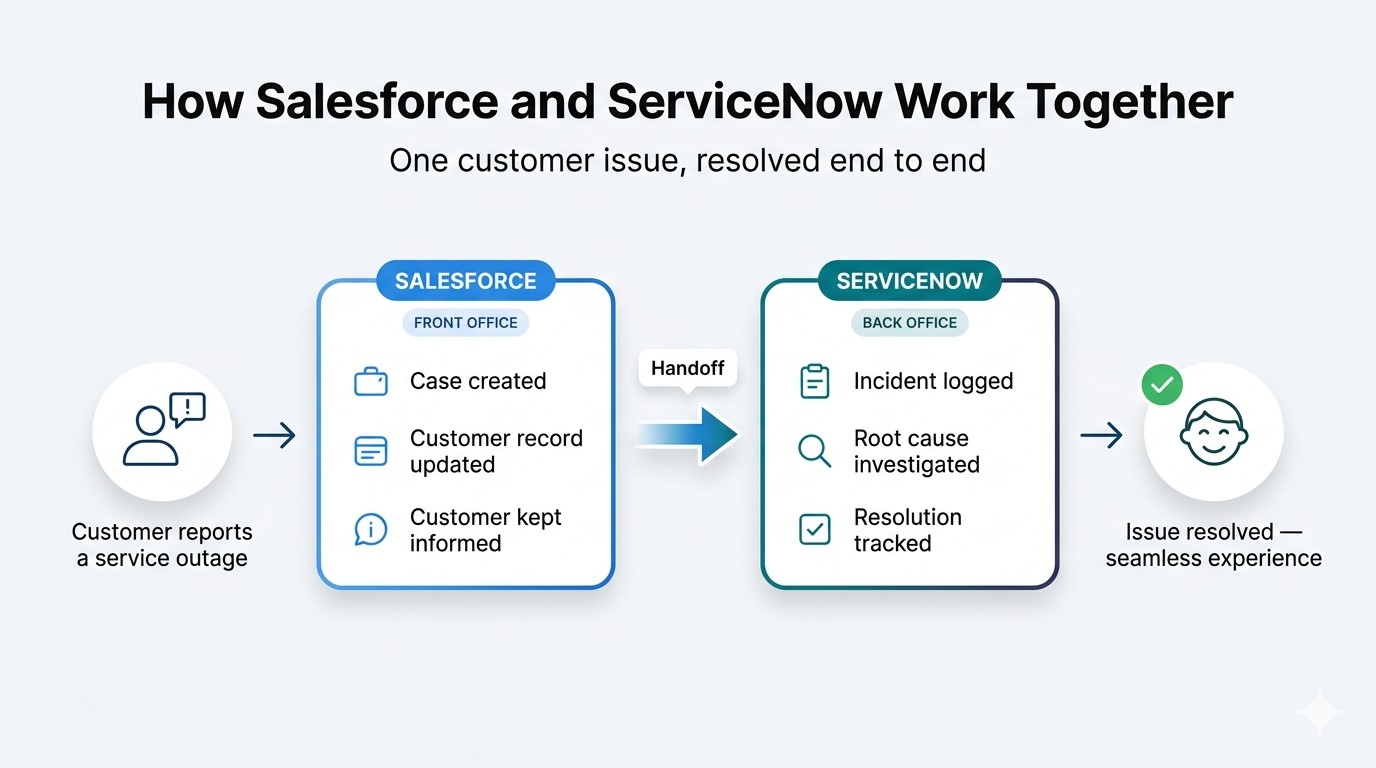
Consider a telecommunications company managing millions of customers. A customer reports a service outage through a support portal.
Salesforce may handle:
- Customer records
- Support interactions
- Case creation
- Customer communications
However, resolving the issue often requires action from internal teams.
ServiceNow may handle:
- Incident creation
- Root cause investigation
- Change approvals
- Engineering workflows
- Resolution tracking
The customer sees a smooth support experience through Salesforce, while ServiceNow coordinates the operational processes needed to fix the problem.
This is a common pattern across industries, including banking, healthcare, manufacturing, retail, and technology.
Shared Data and Workflow Integration
Modern enterprises increasingly integrate Salesforce and ServiceNow to create end-to-end business processes.
Common integration scenarios include:
- Syncing customer cases with IT incidents
- Connecting service requests to operational workflows
- Sharing account information across platforms
- Automating escalations between customer support and IT teams
- Coordinating field service operations
By connecting both platforms, organizations can eliminate data silos and create a more unified experience for employees and customers.
The AI Opportunity
The rise of enterprise AI is creating even stronger reasons to use both platforms together. Salesforce AI solutions such as Agentforce focus on:
- Customer engagement
- Revenue generation
- Sales productivity
- Customer service automation
ServiceNow AI solutions, such as Now Assist, focus on:
- Workflow automation
- Incident resolution
- Employee productivity
- Service delivery optimization
As organizations deploy AI agents across different functions, Salesforce and ServiceNow often address complementary use cases rather than overlapping ones.
Digital Transformation Requires Both Perspectives
Successful digital transformation initiatives require more than customer engagement or operational efficiency alone.
Organizations must simultaneously:
- Improve customer experiences
- Streamline internal operations
- Increase employee productivity
- Reduce service delivery costs
- Accelerate decision-making
Salesforce addresses the customer-facing side of this equation, while ServiceNow addresses the operational side.
Together, they provide a more complete foundation for enterprise transformation.
ServiceNow vs Salesforce Career Comparison
For professionals looking to build a career in enterprise technology, both ServiceNow and Salesforce offer strong opportunities. However, the two ecosystems attract different types of professionals and serve different segments of the enterprise software market.
Salesforce dominates customer-facing business functions such as sales, marketing, customer service, and revenue operations, while ServiceNow is deeply embedded in IT service management, workflow automation, enterprise operations, and digital transformation initiatives.
The right career path ultimately depends on your interests, technical aptitude, and long-term goals.
Market Demand and Job Opportunities
Both Salesforce and ServiceNow continue to experience strong demand across global markets.
Salesforce benefits from one of the largest enterprise software ecosystems in the world. Organizations of all sizes, from startups to Fortune 500 companies, use Salesforce to manage customer relationships and revenue operations. As a result, there is consistent demand for:
- Salesforce Administrators
- Salesforce Developers
- Salesforce Consultants
- Business Analysts
- Solution Architects
- Marketing Cloud Specialists
Also read: How to become a successful Salesforce Administrator
The ServiceNow ecosystem is smaller but highly enterprise-focused. Most ServiceNow opportunities are concentrated within large organizations undergoing IT modernization and workflow transformation initiatives.
Common ServiceNow roles include:
- ServiceNow Administrators
- ServiceNow Developers
- ITSM Consultants
- Platform Engineers
- Solution Architects
- Enterprise Workflow Consultants
While Salesforce generally offers a larger volume of jobs globally, ServiceNow professionals often operate in more specialized enterprise environments.
Learning Curve
Salesforce is often considered more accessible for beginners.
Professionals can start with administrative roles and gradually progress into development, consulting, or architecture positions. The platform also offers extensive learning resources through Trailhead, making it easier for newcomers to gain hands-on experience.
ServiceNow typically requires greater familiarity with:
- IT operations
- Service management concepts
- Workflow automation
- Enterprise processes
- Platform development
Professionals with backgrounds in IT support, infrastructure, enterprise applications, or service management often find the transition to ServiceNow more natural.
Certification Ecosystem
Certifications play an important role in both career paths.
Salesforce Certifications
Popular certifications include:
- Salesforce Certified Administrator
- Salesforce Platform Developer I
- Salesforce Advanced Administrator
- Sales Cloud Consultant
- Service Cloud Consultant
- Application Architect
- System Architect
The certification ecosystem is extensive, offering clear progression paths from entry-level to advanced architecture roles.
ServiceNow Certifications
Popular certifications include:
- Certified System Administrator (CSA)
- Certified Application Developer (CAD)
- Certified Implementation Specialist (CIS)
- Certified Technical Architect (CTA)
ServiceNow certifications are generally more specialized and closely aligned with specific platform capabilities such as ITSM, HRSD, CSM, or SecOps.
Here’s a worthwhile guide on Salesforce certification verification.
Salary Potential
Both ecosystems offer competitive compensation, particularly at the consultant and architect levels.
Factors influencing salary include:
- Geographic location
- Industry
- Years of experience
- Certifications
- Platform specialization
- Consulting expertise
Salesforce professionals often benefit from a larger global market and a broader range of opportunities. ServiceNow professionals frequently command premium compensation due to the platform’s specialized nature and smaller talent pool.
At senior levels, both platforms offer lucrative career paths, especially for architects, consultants, and enterprise transformation specialists.
Developer Career Paths
For developers, the platforms provide different experiences. Salesforce development focuses heavily on:
- Apex
- Lightning Web Components (LWC)
- Flow Builder
- Integrations
- Custom CRM applications
ServiceNow development focuses on:
- JavaScript-based scripting
- Workflow development
- Platform customization
- Service portals
- Enterprise workflow applications
Developers interested in customer-centric applications often gravitate toward Salesforce, while those interested in enterprise operations and process automation may prefer ServiceNow.
Consulting and Architecture Opportunities
One of the most attractive aspects of both ecosystems is the consulting market.
Organizations frequently rely on implementation partners and independent consultants to support:
- Platform implementation
- Process optimization
- Integrations
- Governance
- Digital transformation initiatives
As professionals gain experience, opportunities expand into solution architecture, enterprise architecture, and strategic consulting roles.
These positions often involve influencing business strategy rather than simply configuring software.
AI and Future Career Growth
Artificial intelligence is reshaping both ecosystems. Salesforce professionals are increasingly expected to understand:
- Agentforce
- Einstein AI
- Data Cloud
- Revenue intelligence
- AI-powered customer engagement
ServiceNow professionals are increasingly working with:
- Now Assist
- AI Agents
- Intelligent workflow automation
- Process optimization
- Enterprise AI orchestration
Rather than replacing jobs, AI is expanding the skill sets required for platform professionals. Organizations need experts who can design, govern, and optimize AI-powered workflows within enterprise environments.
What Professionals Say
A recurring theme across industry communities and professional forums is that Salesforce offers broader market opportunities, while ServiceNow offers deeper specialization.
Many practitioners view Salesforce as an excellent entry point into enterprise software because of its large ecosystem and abundance of learning resources. ServiceNow is often seen as a strong option for professionals interested in enterprise operations, workflow automation, and IT transformation.
As one platform focuses on customer engagement and the other focuses on operational excellence, the career paths tend to attract different types of professionals rather than directly competing for the same talent.
ServiceNow vs Salesforce: Which Should You Choose?
After comparing CRM capabilities, ITSM functionality, customer service solutions, workflow automation, AI capabilities, integrations, pricing, and career opportunities, one thing becomes clear: ServiceNow and Salesforce are designed to solve different business challenges.
The right choice depends less on which platform has more features and more on what your organization is trying to achieve.
If your primary objective is to improve customer relationships, accelerate revenue growth, and create connected customer experiences, Salesforce is typically the stronger fit. If your focus is operational excellence, workflow automation, and enterprise service delivery, ServiceNow is often better aligned with those goals.
The decision ultimately comes down to where you want to create business value.
Choose Salesforce If…
Salesforce is a strong choice for organizations that prioritize customer acquisition, customer engagement, and revenue growth.
You should consider Salesforce if your business needs:
- A comprehensive CRM platform
- Advanced sales automation
- Revenue forecasting and pipeline management
- Marketing automation capabilities
- Customer success and account management tools
- Omnichannel customer support
- Customer data unification through Customer 360
- AI-powered sales and service experiences
Salesforce is particularly well-suited for:
- SaaS companies
- Technology firms
- Retail and e-commerce businesses
- B2B sales organizations
- Customer-centric enterprises
For organizations where growth, customer retention, and revenue generation are top priorities, Salesforce often becomes the central system of engagement.
Choose ServiceNow If…
ServiceNow is a strong choice for organizations focused on improving operational efficiency, service delivery, and workflow automation.
You should consider ServiceNow if your business needs:
- Enterprise IT service management
- Workflow automation across departments
- Employee service delivery
- IT operations management
- Asset management and CMDB capabilities
- Security operations workflows
- Change and incident management
- AI-powered operational automation
ServiceNow is particularly well-suited for:
- Large enterprises
- Financial institutions
- Healthcare organizations
- Government agencies
- Manufacturing companies
- IT-intensive businesses
For organizations seeking to modernize internal operations and automate enterprise workflows, ServiceNow often becomes the operational backbone of the business.
Choose Both If…
For many enterprises, the most effective strategy is not choosing one platform over the other.
Instead, organizations use Salesforce and ServiceNow together to create a connected front-office and back-office ecosystem.
A common enterprise architecture looks like this:
| Business Function | Platform |
|---|---|
| Sales | Salesforce |
| Marketing | Salesforce |
| Customer Success | Salesforce |
| Customer Service | Salesforce + ServiceNow |
| IT Operations | ServiceNow |
| HR Service Delivery | ServiceNow |
| Security Operations | ServiceNow |
| Workflow Automation | ServiceNow |
| Enterprise AI | Both |
In this model:
- Salesforce manages customer relationships and revenue operations.
- ServiceNow manages workflows, service delivery, and operational execution.
This approach allows organizations to optimize both customer experiences and internal operations without forcing a single platform to handle every business function.
Decision Matrix
If you’re still evaluating which platform aligns best with your needs, use the following framework:
| If You Need... | Consider |
|---|---|
| CRM and Customer Management | Salesforce |
| Sales Automation | Salesforce |
| Marketing Automation | Salesforce |
| Customer Data Platform | Salesforce |
| IT Service Management (ITSM) | ServiceNow |
| IT Operations Management (ITOM) | ServiceNow |
| Enterprise Workflow Automation | ServiceNow |
| Employee Service Delivery | ServiceNow |
| Security Operations | ServiceNow |
| AI-Powered Customer Engagement | Salesforce |
| AI-Powered Operational Workflows | ServiceNow |
| Enterprise Digital Transformation | Both |
Final Thoughts
The ServiceNow vs Salesforce conversation has evolved significantly over the past few years.
What was once a comparison between a CRM platform and an ITSM platform is now a comparison between two enterprise software giants expanding into AI, workflow automation, service management, and digital transformation.
Salesforce continues to lead in customer engagement, revenue operations, and CRM innovation. ServiceNow continues to lead in enterprise workflows, operational automation, and service management.
Rather than asking which platform is better, organizations should ask a more strategic question:
Where does your business need transformation the most: customer experience, operational efficiency, or both?
The answer to that question will often determine whether Salesforce, ServiceNow, or a combination of both delivers the greatest long-term value.
 0 comments













Leave a Comment
Your email address will not be published. Required fields are marked *