















 0 comments





What Changed in 2026
The market landscape shifted meaningfully in the last twelve months. Here are the verified data points that shape the guidance below:
- Healthcare app downloads grew 27% year over year in 2025-2026 (Sensor Tower Healthcare Report).
- Average healthcare data breach cost is $10.93 million in 2025 (highest of any industry) (IBM Cost of a Data Breach 2025).
- HIPAA compliance audit fees averaged $30K-$85K in 2025 (HHS Compliance Statistics 2025).
- AI symptom checker adoption grew 156% in mobile health apps between 2024-2026 (Digital Health Report 2026).
- DianApps healthcare portfolio includes HIPAA-compliant patient portals and telehealth builds (DianApps case studies).
Related Reading From Our 2026 Guides
For deeper context, see these companion guides:
- Mobile App Development Trends 2026
- HIPAA-Compliant Email for Healthcare Apps
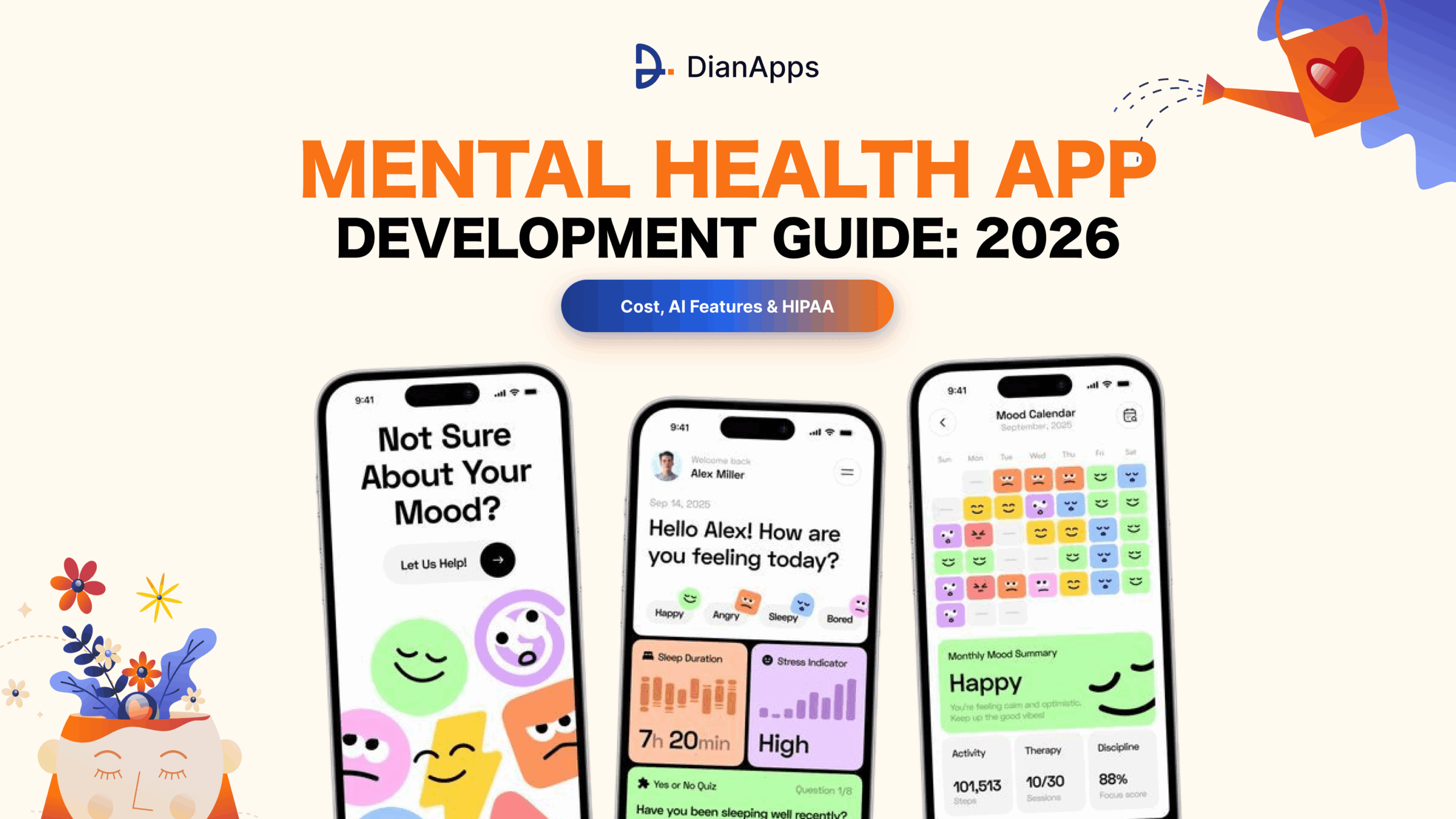
- Mental Health App Development Guide 2026
Key Takeaways
- Mental health app development requires clinical judgment, not just technical skill. Involve licensed mental health professionals before writing the first line of code.
- Define your regulatory category before anything else. Wellness app, digital therapeutic, and telepsychiatry platform have genuinely different development, compliance, and go-to-market requirements.
- HIPAA compliance is an architecture decision, not a launch-time retrofit. Build it in from day one or budget for a significant rebuild later.
- AI works best in mental health apps as a personalization and pattern recognition tool. It should complement clinical care, not position itself as a replacement.
- Crisis resources are a core product feature, not a compliance checkbox. Every user flow should have a clear, immediate path to help when needed.
- The most trusted mental health apps in 2026 measure outcomes rather than engagement alone. Design your success metrics around user wellbeing, not session frequency.
The mental health app market has a trust problem. Hundreds of apps call themselves therapy companions, mental wellness tools, or AI counselors. Very few of them have any clinical validation behind what they do. Some have been found to make mental health worse by introducing compulsive checking behavior, surfacing content poorly calibrated for vulnerable users, or providing guidance that contradicts evidence-based clinical practice.
At the same time, the genuine need is enormous. Approximately 970 million people worldwide live with a mental health condition. Nearly 60% of adults with mental illness do not receive treatment. Wait times for a licensed therapist in the US regularly exceed six weeks. There is a real gap that well-built mental health apps can close, but closing it requires building them with the clinical seriousness the category demands.
This guide covers mental health app development honestly. Not as a category to enter because the market is large, but as a product to build responsibly if you have the clinical relationships, engineering discipline, and design judgment to do it properly.
Direct Answer:
Building a mental health app in 2026 costs $30,000 to $300,000+ depending on AI features, clinical content depth, and compliance requirements. The technical build is not the hard part. The hard parts are establishing clinical credibility, handling HIPAA-regulated data correctly, designing for users in genuine distress, and building AI features that help rather than deceive.
What Separates a Good Mental Health App From a Problematic One?
The FDA’s 2019 Mobile Medical Applications guidance and the 2022 Digital Health Center of Excellence framework both draw a distinction that matters: apps that help users manage documented mental health conditions are different from apps that support general wellness. The former are medical devices. The latter are consumer products. Getting this wrong creates both legal risk and genuine harm to users.
Most mental health app founders are building wellness tools, not clinical platforms. That is a legitimate category with real value. The distinction is worth understanding clearly before any product decisions are made.
| Category | What It Does | Regulatory Status | Example |
|---|---|---|---|
| Mental wellness app | Mood tracking, meditation, stress reduction, journaling | Consumer product, general GDPR/CCPA apply | Calm, Headspace |
| Digital therapeutic (DTx) | Evidence-based CBT, DBT, or other clinical interventions delivered through the app | FDA regulated (510k or De Novo pathway in some cases) | Woebot, Happify Health |
| Telepsychiatry platform | Connecting patients with licensed therapists and psychiatrists through video and messaging | HIPAA required, state licensing laws apply | BetterHelp, Talkspace |
| Mental health EHR / clinical tool | Practice management, patient records, clinical notes for mental health providers | HIPAA required, state regulations | SimplePractice, TherapyNotes |
Knowing which category you are building changes your development requirements, your legal obligations, your clinical partnership needs, and your go-to-market timeline significantly. The future of healthcare app development is increasingly shaped by this distinction, as regulators clarify the line between wellness features and clinical interventions.
Core Features of a Mental Health App: What Actually Matters
Feature decisions in mental health apps are not primarily technical decisions. They are clinical and ethical decisions that have technical implementations. The question to ask about every feature is not “can we build this?” but “does this feature help users or does it exploit their vulnerability to improve engagement metrics?”
The Foundation Layer (Most Mental Health Apps)
| Feature | What It Does | Clinical Basis | Development Complexity |
|---|---|---|---|
| Mood tracking | Users log emotional states with prompts and intensity ratings | Supports emotional awareness, mirrors clinical PHQ-9 style assessment | Low to medium |
| Guided meditation and breathing | Audio-guided mindfulness exercises with session tracking | Evidence base in stress and anxiety reduction from mindfulness research | Medium (requires content production) |
| Journaling | Prompted or free-form reflective writing with optional AI analysis | Expressive writing research supports emotional processing benefits | Low to medium |
| Progress and streak tracking | Visual representation of consistent engagement over time | Supports habit formation, but must avoid punitive streak-loss design | Low |
| Push notification system | Reminders, check-ins, crisis resource surfacing | Timing and tone matter enormously for mental health context | Medium (notification design is deceptively complex) |
| Crisis resources | Immediate access to crisis hotlines and emergency contacts | Non-negotiable in any mental health product, not optional | Low to implement, critical to get right |
Advanced Features (Mid to Enterprise Apps)
| Feature | What It Does | Cost Range to Build |
|---|---|---|
| AI conversational support | LLM-powered conversation that applies CBT or DBT techniques with appropriate clinical limits | $40,000 to $120,000 |
| Therapist matching and scheduling | Intelligent matching based on presenting issues, therapist specialty, and availability | $30,000 to $80,000 |
| Video therapy sessions | HIPAA-compliant encrypted video and messaging between patients and licensed providers | $50,000 to $150,000 |
| Wearable integration | Heart rate variability, sleep patterns, and activity data correlated with mood | $25,000 to $60,000 |
| Personalized content recommendations | ML model that surfaces exercises, resources, and content based on mood history and engagement | $35,000 to $90,000 |
| Progress reports for providers | Structured clinical summaries of user activity that therapists can use in sessions | $20,000 to $50,000 |
AI in Mental Health Apps: Where It Genuinely Helps and Where It Does Not?
AI in mental health apps is one of the most ethically fraught areas in consumer technology. The potential for harm is real and documented. AI systems that claim to provide mental health support without appropriate clinical boundaries have caused users to delay seeking professional help, provided guidance that worsened symptoms, and failed to recognize crisis states that required immediate intervention.
That is not an argument against AI in mental health apps. It is an argument for using AI in the specific roles where it adds value without introducing clinical risk.
Where AI Works Well in Mental Health Apps?
Personalization of non-clinical content. Recommending the right meditation session, the most relevant journaling prompt, or the best-timed check-in based on historical mood patterns. These are tasks where ML performs well and the downside risk of an error is low.
Sentiment analysis on journal entries. Identifying emotional themes and patterns over time gives users insight they could not easily see themselves. This should surface observations to the user, not clinical diagnoses.
Matching users to therapists. Intelligent matching based on presenting issues, therapeutic approach preferences, insurance coverage, and availability can reduce the friction of finding care significantly.
Crisis detection as a safety net. AI monitoring of language patterns and behavioral signals (session abandonment, late-night usage, specific lexical markers) to surface crisis resources proactively. This should always include a human escalation path.
Natural language interfaces for clinical tools. Helping therapists generate clinical notes, search research literature, or prepare session materials through conversational AI. This is a high-value, low-risk application.
Where AI in Mental Health Apps Creates Risk?
Positioning AI as a therapeutic alternative. AI conversations can supplement, not substitute, human clinical relationships. Products that position their AI as a therapist or counselor, even implicitly through naming and tone, create expectations the system cannot safely meet.
Unreliable crisis detection as the only safety net. AI-based crisis detection works at population level but fails at the individual level more often than the precision statistics suggest. It cannot be the only mechanism for identifying and responding to users in crisis.
LLM hallucination in clinical advice. General-purpose LLMs will confidently provide guidance that contradicts clinical best practice. Any AI feature that provides mental health advice needs narrow, verified boundaries and active monitoring of outputs.
The most thoughtful AI mental health app concepts in 2026 treat AI as a personalization and pattern recognition engine rather than a clinical decision-maker. That positioning is both safer and more honest with users.
HIPAA Compliance in Mental Health Apps: What It Actually Means?
If your mental health app collects, stores, or transmits Protected Health Information (PHI), which includes any identifiable health data, HIPAA applies. For a mental health app, PHI is almost everything: mood logs linked to a user identity, therapy session notes, diagnosis records, prescription information, even the fact that a user is seeking mental health support.
HIPAA Requirements That Affect Mental Health App Architecture
| Requirement | What It Means for Your App | Development Impact |
|---|---|---|
| Encryption at rest and in transit | All PHI must be encrypted using AES-256 (at rest) and TLS 1.3 (in transit) | Affects database design, API layer, local storage on device |
| Business Associate Agreements | Every vendor that handles PHI (cloud provider, analytics, AI API) needs a signed BAA | Constrains which analytics, cloud, and AI vendors you can use |
| Access controls | Role-based access, MFA for providers, session timeout, audit logging of all PHI access | Affects auth system, logging infrastructure, provider portal design |
| Breach notification | Breach of unsecured PHI requires notification within 60 days for breaches affecting 500+ users | Requires incident response documentation and monitoring infrastructure |
| Patient rights | Users must be able to access, correct, and request deletion of their PHI | Requires data subject request functionality built into the product |
| Minimum necessary standard | Only collect the PHI necessary for the stated purpose | Affects data model design and feature scoping from day one |
The most expensive HIPAA mistake in mental health app development is retrofitting compliance after the app is built. Data models, access control systems, and encryption architectures built without HIPAA in mind are extremely difficult to bring into compliance after the fact without essentially rebuilding the backend. This is a decision that has to be made at architecture stage, not launch stage.
For a deeper look at how healthcare app compliance affects development costs, see the guide on healthcare app development costs in the USA, which covers HIPAA compliance cost ranges specifically.
Mental Health App Development Costs in 2026
Mental health app costs vary more than most app categories because the compliance requirements, clinical content production, and AI feature depth each add significant budget. Here is an honest breakdown by project type.
| App Type | Cost Range | Timeline | Key Cost Drivers |
|---|---|---|---|
| Wellness app MVP | $30,000 to $60,000 | 3 to 4 months | Mood tracking, basic meditation content, journaling, push notifications |
| Full-featured wellness app | $70,000 to $130,000 | 5 to 7 months | AI personalization, wearable integration, content library, community features |
| HIPAA-compliant therapy platform | $100,000 to $200,000 | 6 to 10 months | Video sessions, provider portal, HIPAA compliance architecture, scheduling |
| AI-powered digital therapeutic | $150,000 to $300,000+ | 8 to 14 months | Custom LLM fine-tuning, clinical validation, FDA pre-submission, provider integration |
| Enterprise mental health benefit platform | $200,000 to $500,000+ | 10 to 18 months | HR integration, SSO, analytics dashboard, clinical network, compliance certification |
What Drives Costs Up Beyond the Base Build?
Clinical content production. Professionally validated guided meditations, CBT worksheets, psychoeducation content, and breathing exercises require licensed clinicians to develop and review. Budget $20,000 to $80,000 for content production depending on depth and volume.
HIPAA compliance infrastructure. Encryption implementation, audit logging, BAA management, and compliance documentation add $20,000 to $50,000 to most healthcare apps if done properly from the start.
AI feature development. A basic recommendation engine for content personalization adds $30,000 to $60,000. A conversational AI system with appropriate clinical boundaries, monitoring, and escalation logic adds $60,000 to $150,000.
Annual maintenance. Mental health apps require 15 to 20% of the original build cost annually for compliance updates, OS compatibility, content refreshes, and AI model retraining.
The mHealth Context: Where Mental Health Apps Sit in the Broader Market
Mental health apps represent one of the most active segments within mHealth. The broader mHealth development landscape shows the direction clearly: apps that connect patients with clinical resources rather than attempting to replace them are growing faster and maintaining user trust longer than apps that position AI as the clinical solution.
The successful models in 2026, the ones with sustained engagement, low churn, and defensible positioning, share a few characteristics:
- They are transparent about what their app is not. A good wellness app tells users explicitly that it is not a substitute for professional care.
- They have clinical advisory relationships. At minimum, a licensed mental health professional has reviewed the clinical content and provided feedback on feature design.
- They treat crisis resources as a product requirement, not a legal checkbox. Every user flow that could surface users in distress has an appropriate path to immediate help.
- They measure outcomes, not just engagement. Mood improvement over time, reduction in self-reported anxiety, or connection to care are meaningful outcomes. Sessions per day is not a meaningful mental health metric on its own.
The integration of telemedicine and mental health services is one of the clearest directions for the category in 2026, as standalone wellness apps increasingly recognize that connecting users to licensed providers when appropriate dramatically improves both outcomes and user trust.
How to Build a Mental Health App: Step-by-Step?
- Define your category precisely. Wellness tool, digital therapeutic, telepsychiatry platform, or clinical decision support. This decision drives everything else.
- Establish clinical partnerships early. Identify licensed mental health professionals who will advise on content, feature design, and AI boundaries before development begins. Not after.
- Determine your regulatory path. If you are building a digital therapeutic with clinical claims, consult with a regulatory affairs specialist about FDA pathway requirements before building anything.
- Design HIPAA compliance into the architecture. If you are handling PHI, make this a day-one architectural decision, not a retrofit. Engage a development partner with healthcare compliance experience.
- Build the crisis resource layer first. Not last. Not as a compliance feature. As a core product feature that every other feature is designed around.
- Define AI scope with clinical input. Get clinical sign-off on what your AI can and cannot say, what situations trigger human escalation, and how the system handles unexpected user inputs.
- Test with real users, including vulnerable populations, with ethical protocols. Mental health UX testing requires careful ethics review, participant screening, and ongoing support for participants.
- Launch with monitoring, not just analytics. Track AI output quality, crisis resource activation rates, and user-reported experience alongside standard engagement metrics.
DianApps Healthcare App Development
Building a Mental Health or Healthcare App? Get the Architecture Right From Day One.
DianApps has delivered HIPAA-compliant healthtech products with AI features across iOS, Android, and cross-platform. We build the compliance infrastructure, the AI layer, and the mobile product together, not in separate sprints.
★ Clutch #1 Premier Verified | 4.9/5 Rating
Monetization Models That Work in Mental Health
Mental health app monetization deserves honest treatment. Some models work better for user outcomes than others, and the ones that work worst tend to be the ones most common in consumer apps generally.
| Model | How It Works | Pros | Honest Caveats |
|---|---|---|---|
| Monthly subscription | $9–$20/month for full feature access | Predictable revenue, aligns with continued use | Churn is high in wellness; long-term value requires ongoing value delivery |
| Annual subscription | $60–$120/year with discount vs. monthly | Better LTV, encourages sustained engagement | Higher upfront commitment barrier |
| B2B / employer benefit | Sold to employers or insurers as a benefit; users access free | High LTV contracts, removes cost barrier for users | Long sales cycles, complex procurement; requires utilization reporting |
| Therapy session fees | Platform takes a percentage of session fees between therapist and client | Aligns revenue with actual care delivery | Requires licensed therapist network, complex regulatory compliance |
| Insurance billing integration | Sessions or outcomes-based billing through insurance providers | Removes cost barrier entirely for covered users | Extremely complex to implement; requires RCM expertise |
The model to be genuinely cautious about is the ad-supported mental health app. Selling advertising against mental health data, or optimizing for session length in a mental health context to maximize ad impressions, creates an incentive structure that directly conflicts with good outcomes for users. It has attracted significant regulatory attention and should be avoided on both ethical and business risk grounds.
Related reading: For a comprehensive look at where mobile apps are headed this year, see our pillar guide on Mobile App Development Trends 2026, covering AI integration, framework choices, and USD cost benchmarks.
Frequently Asked Questions
How much does it cost to build a mental health app in 2026?
A basic wellness app MVP costs $30,000 to $60,000. A HIPAA-compliant therapy platform with video sessions and provider portal ranges from $100,000 to $200,000. AI-powered digital therapeutics with clinical validation requirements can cost $150,000 to $300,000 or more. Annual maintenance adds 15 to 20% of build cost each year for compliance, OS updates, and AI model maintenance.
Do mental health apps need to be HIPAA compliant?
If your app collects, stores, or transmits Protected Health Information linked to identifiable users, HIPAA applies. For therapy platforms, clinical records, and any app handling diagnosis or treatment data, HIPAA compliance is legally required. General wellness apps that collect mood data without linking it to medical records or clinical care may fall outside HIPAA, but often still carry significant privacy obligations under CCPA and GDPR.
Can AI replace human therapists in mental health apps?
No. AI can supplement clinical care by improving access, personalizing wellness content, and supporting between-session engagement. It cannot safely replace human clinical judgment, diagnose mental health conditions, or provide treatment for serious mental illness. Apps that position AI as a therapy replacement are both clinically irresponsible and increasingly facing regulatory scrutiny. AI works best in mental health apps as a personalization and pattern recognition tool.
What is a digital therapeutic (DTx) and how is it different from a wellness app?
A digital therapeutic delivers evidence-based clinical interventions, typically CBT, DBT, or other validated therapeutic modalities, through software. They are intended to treat, manage, or prevent specific medical conditions and may be FDA regulated. A wellness app supports general mental well-being through meditation, mood tracking, and psychoeducation without making clinical treatment claims. The distinction affects regulatory requirements, clinical validation needs, and reimbursement eligibility.
How long does it take to build a mental health app?
A focused wellness MVP takes 3 to 4 months. A full-featured app with AI personalization and wearable integration takes 5 to 7 months. A HIPAA-compliant therapy platform with provider portal takes 6 to 10 months. A digital therapeutic requiring clinical validation and regulatory review takes 10 to 18 months minimum. Timeline depends significantly on how clearly requirements are defined before development begins.
What clinical expertise do I need to build a mental health app?
At minimum, a licensed mental health professional should review your clinical content before launch. If you are building a digital therapeutic, you need a licensed clinician involved in feature design and content development, and ideally a clinical advisory board. For telepsychiatry platforms, you will need relationships with licensed providers across the states you operate in, plus an understanding of state-specific telehealth regulations that vary considerably.
How should crisis resources be handled in a mental health app?
Crisis resources, National Suicide Prevention Lifeline (988), Crisis Text Line, local emergency services, should be accessible from every screen in one tap, not buried in settings or help menus. AI monitoring for crisis signals should surface these resources proactively, but the AI should never be the only safety net. Design a clear protocol for what happens when a user indicates they are in danger, including escalation paths to human support.
What platforms should a mental health app launch on first?
iOS has a higher proportion of mental health app users and typically generates more revenue per user in the wellness category. Android has broader reach and is important for reaching users without access to expensive devices. Most mental health apps launch on iOS first for better review process predictability and monetization characteristics, then expand to Android. Cross-platform development using Flutter reduces the cost of supporting both from launch.
 0 comments










Your email address will not be published. Required fields are marked *