















 0 comments
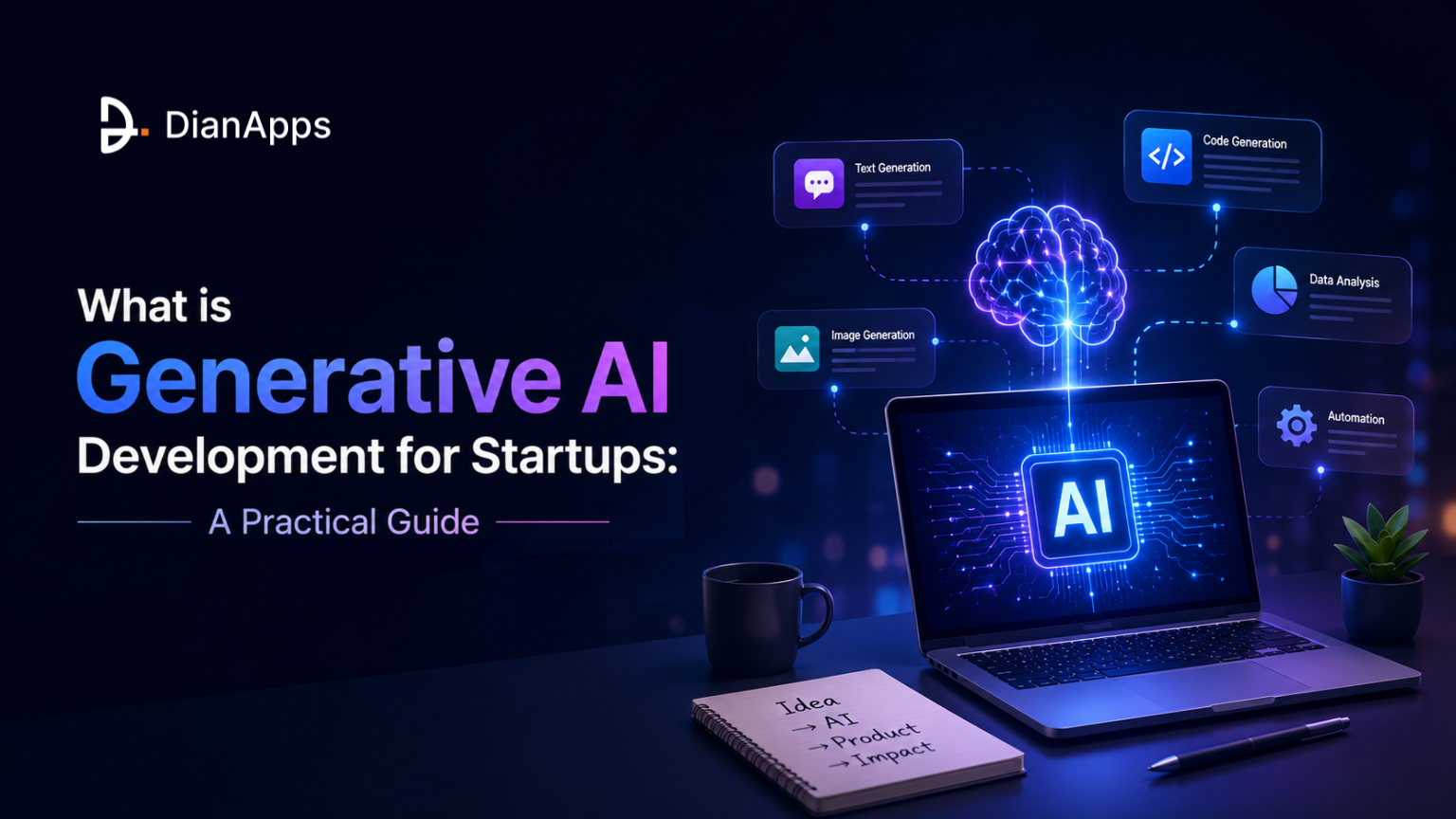





Every startup today faces the same question: Should we build with Generative AI or risk falling behind competitors who already are?
The answer is becoming increasingly clear. From transforming AI-powered copilots and customer support agents to intelligent search, workflow automation, and content generation, Generative AI is redefining how startups build products, acquire customers, and scale operations.
What was once accessible only to tech giants is now available through powerful foundation models and APIs, allowing startups to innovate faster without investing years in AI research.
The opportunity is substantial. According to McKinsey & Company, Generative AI could contribute $2.6-$4.4 trillion in annual economic value across industries, while AI-native startups continue to secure record levels of venture funding as investors prioritize businesses with scalable AI capabilities.
At the same time, launching an AI product has become easier, but building one that is reliable, secure, cost-efficient, and commercially viable remains a significant challenge.
Whether you’re developing an AI SaaS platform, embedding intelligent features into an existing product, or validating your first MVP in software development, success depends on more than choosing the right model.
This guide explores the complete process of Generative AI development for startups, covering technology selection, development strategy, implementation best practices, cost considerations, and the common mistakes that can slow growth.
What is Generative AI?
Generative AI is a branch of artificial intelligence that creates original content, such as text, images, code, audio, videos, and even product designs, by learning patterns from vast amounts of training data.
Unlike traditional AI, which primarily analyzes data to make predictions or automate predefined tasks, Generative AI development services can produce entirely new outputs based on user prompts and contextual understanding.
At the core of this technology are foundation models and Large Language Models (LLMs) that leverage deep learning and transformer architectures to understand context, generate human-like responses, summarize information, write code, and solve complex problems. Today’s startups can integrate these capabilities into their applications through APIs or build customized AI solutions tailored to specific business requirements.
Do give it a read if you want to understand the core differences between public and private LLM model.
Traditional AI vs. Generative AI
While both technologies fall under the AI umbrella, they serve fundamentally different purposes.
| Traditional AI | Generative AI |
|---|---|
| Analyzes existing data to make predictions or decisions | Creates new content, ideas, and outputs from learned patterns |
| Rule-based or predictive in nature | Context-aware and creative in nature |
| Best for classification, forecasting, and automation | Best for content generation, conversational AI, coding assistance, and personalization |
| Requires structured datasets and predefined workflows | Can work with structured and unstructured data using natural language prompts |
| Examples: Fraud detection, recommendation engines, demand forecasting | Examples: AI chatbots, virtual assistants, code generation, image creation, AI copilots |
For startups, the shift from predictive AI to Generative AI means moving beyond automation toward creating intelligent products that actively assist users, accelerate workflows, and enhance customer experiences.
Did you know about the concept of Casual AI vs Traditional AI? No? Go ahead and read now.
How Does Generative AI Work?
Although the underlying technology is highly sophisticated, the development process follows a straightforward workflow:
- Training on Large Datasets: AI models are trained on billions of data points, including text, images, code, and documents, to recognize patterns, language structures, and relationships.
- Understanding User Prompts: When a user submits a prompt, the model interprets the intent, context, and semantics rather than relying solely on keyword matching.
- Generating Contextual Responses: Using probabilistic reasoning and learned patterns, the model predicts and generates the most relevant response, whether it’s text, code, an image, or another type of content.
- Continuous Improvement: Businesses can further enhance performance through prompt engineering, Retrieval-Augmented Generation (RAG), fine-tuning, and user feedback loops to improve accuracy and relevance.
Key Technologies Powering Generative AI
Modern Generative AI applications are built using several foundational technologies:
- Large Language Models (LLMs): Power conversational AI, content generation, coding assistants, and enterprise knowledge systems.
- Transformer Architecture: Enables AI to understand context, long-form conversations, and complex relationships between words.
- Retrieval-Augmented Generation (RAG): Combines LLMs with external knowledge bases to deliver accurate, up-to-date, and domain-specific responses.
- Vector Databases: Store and retrieve semantic information efficiently, enabling intelligent search and contextual recommendations.
- Fine-Tuning & Prompt Engineering: Improve model performance for specific industries, business workflows, or proprietary datasets.
Popular Generative AI Models for Startups
Choosing the right model depends on your product goals, budget, security requirements, and scalability needs. Some of the most widely adopted models include:
- GPT – Ideal for conversational AI, content creation, coding assistance, and enterprise productivity tools.
- Claude – Known for strong reasoning capabilities, long-context processing, and enterprise-focused applications.
- Gemini – Excels at multimodal AI by processing text, images, audio, video, and code within a single model.
- Llama – An open-source model preferred by startups seeking greater customization, privacy, and deployment flexibility.
- Mistral – Offers high performance with lower infrastructure costs, making it suitable for lightweight AI applications.
As Generative AI continues to evolve, startups are no longer limited to experimenting with isolated AI features. They can now build intelligent, scalable products that automate decision-making, personalize user experiences, and create entirely new revenue opportunities, provided they choose the right development strategy from the outset.
Also read: Grok vs LIama vs Gemini vs ChatGPT (which is best)
Why Startups Should Invest in Generative AI
Generative AI is no longer just a productivity tool, it’s becoming the foundation of next-generation digital products. From automating customer interactions and accelerating software development to uncovering actionable insights from unstructured data, AI is enabling startups to achieve more with smaller teams and limited budgets.
Unlike established enterprises burdened by legacy systems, startups have the advantage of building AI-first products from the ground up. This allows them to innovate faster, respond to market demands in real time, and create highly personalized user experiences without the operational overhead of traditional businesses.
Whether you’re building a SaaS platform, fintech solution, healthcare application, or marketplace, integrating Generative AI into your product can significantly improve efficiency, customer engagement, and long-term scalability.
Accelerate Product Development
Speed is a startup’s greatest competitive advantage. Generative AI helps development teams automate repetitive engineering tasks such as code generation, debugging, documentation, testing, and API integration. Developers can spend less time on routine work and more time building features that differentiate the product.
Beyond engineering, AI also streamlines UI copy creation, product documentation, design ideation, and requirement analysis, enabling startups to reduce their time-to-market while maintaining high-quality outputs.
Business Impact:
- Faster MVP launches
- Reduced development cycles
- Increased engineering productivity
- Lower development costs
Deliver Hyper-Personalized Customer Experiences
Modern users expect personalized experiences from the moment they interact with a product. Generative AI enables startups to analyze user behavior, preferences, and historical interactions to deliver contextual recommendations, intelligent search results, dynamic content, and conversational support.
This level of personalization improves customer satisfaction, increases engagement, and encourages long-term retention, critical metrics for early-stage startups focused on sustainable growth.
Examples include:
- AI shopping assistants
- Personalized learning platforms
- Customized financial recommendations
- Intelligent healthcare guidance
- Tailored marketing campaigns
Automate Repetitive Business Operations
Startups often operate with lean teams where every hour matters. Generative AI can automate time-consuming tasks across departments, allowing employees to focus on strategic initiatives rather than manual processes.
Common automation use cases include:
- Customer support chatbots
- Meeting summaries
- Email drafting
- Proposal generation
- Knowledge management
- HR documentation
- Internal workflow automation
By reducing operational bottlenecks, startups can scale efficiently without proportionally increasing headcount.
Reduce Operational Costs
Hiring specialized talent for every business function is rarely feasible for startups. Generative AI acts as a force multiplier by enabling small teams to accomplish enterprise-level workloads.
Instead of expanding teams rapidly, startups can leverage AI to automate support, content creation, coding assistance, and administrative tasks, leading to significant savings in labor costs while maintaining productivity.
Additionally, cloud-based AI APIs eliminate the need for expensive infrastructure investments, making advanced AI capabilities more accessible to startups with limited budgets.
Gain a Competitive Edge
Markets are becoming increasingly saturated, making differentiation essential for startup success. AI-powered features can transform ordinary software into intelligent platforms that solve customer problems more effectively.
Startups integrating capabilities such as AI copilots, predictive recommendations, conversational interfaces, and workflow automation are better positioned to attract customers, secure investor confidence, and establish stronger market positioning.
Rather than competing solely on price or features, AI enables startups to compete on user experience and innovation.
Build Products That Scale with Your Business
Scalability is a key consideration for every startup. Generative AI solutions built on modern cloud infrastructure can adapt to growing user demands without requiring significant architectural changes.
As startups expand, AI can continuously learn from user interactions, improve response quality, and automate increasingly complex workflows. This allows businesses to serve more customers while maintaining operational efficiency and delivering consistent experiences.
By embedding AI into their core products early, startups can create scalable platforms that evolve alongside customer needs and changing market expectations.
Top 5 Real-World Generative AI Use Cases That Are Transforming Startups
The true value of Generative AI isn’t measured by its ability to generate text or images, it’s measured by the business outcomes it creates. Across industries, startups are leveraging AI to solve real operational challenges, improve customer experiences, and access new revenue streams.
Here are five practical applications that demonstrate how Generative AI is delivering measurable business value today.
1. AI Customer Support That Never Sleeps
Business Challenge
Scaling customer support is expensive for startups. Hiring agents around the clock increases operational costs, while traditional chatbots often fail to understand customer intent beyond predefined workflows.
How Generative AI Solves It
Modern AI assistants powered by Large Language Models (LLMs) can understand natural language, access company knowledge bases using Retrieval-Augmented Generation (RAG), and resolve customer queries in real time.
These assistants can:
- Answer product questions
- Troubleshoot issues
- Summarize support tickets
- Escalate complex cases
- Support multiple languages
Real-World Example
Intercom’s Fin AI Agent handles customer conversations using company-specific knowledge, enabling businesses to resolve a significant share of support queries automatically while reducing response times.
Business Value
- 24/7 customer support
- Lower operational costs
- Faster response times
- Higher customer satisfaction
- Improved customer retention
2. AI Coding Assistants That Accelerate Product Development
Business Challenge
Early-stage startups often operate with small engineering teams and aggressive release timelines.
How Generative AI Solves It
AI coding assistants help developers write, review, debug, document, and optimize code directly within their development environments.
Rather than replacing developers, AI increases productivity by automating repetitive coding tasks and accelerating software delivery.
Real-World Example
GitHub Copilot has become one of the most widely adopted AI developer tools, helping engineering teams generate code suggestions, complete functions, write tests, and reduce development time.
Business Value
- Faster MVP development
- Reduced engineering effort
- Improved code quality
- Shorter product release cycles
3. AI-Powered Content Creation & Marketing Automation
Business Challenge
Producing high-quality content consistently is difficult for startups with limited marketing resources.
How Generative AI Solves It
AI enables marketing teams to generate blog articles, SEO metadata, email campaigns, social media posts, ad copy, landing pages, and product descriptions in minutes.
When combined with human editing, AI significantly reduces production time without compromising quality.
Real-World Example
Companies such as Jasper AI help businesses streamline content production while maintaining brand consistency across multiple marketing channels.
Business Value
- Faster campaign execution
- Reduced content production costs
- Increased marketing efficiency
- Better SEO scalability
4. AI Shopping Assistants That Personalize the Customer Journey
Business Challenge
Customers expect personalized shopping experiences, but manually curating recommendations becomes increasingly difficult as product catalogs grow.
How Generative AI Solves It
Generative AI analyzes browsing behavior, purchase history, and customer preferences to deliver intelligent recommendations, answer product-related questions, compare products, and assist buyers throughout their purchasing journey.
Real-World Example
Shopify Magic helps merchants create product descriptions, generate marketing content, and enhance customer interactions using AI-powered capabilities.
Business Value
- Higher conversion rates
- Increased average order value
- Improved customer engagement
- Better customer loyalty
5. AI Knowledge Assistants for Internal Productivity
Business Challenge
As startups grow, employees spend significant time searching through documents, Slack conversations, and internal knowledge bases.
How Generative AI Solves It
Enterprise AI assistants connect with internal documentation and business systems to provide instant, context-aware answers, summarize documents, generate reports, and automate routine administrative work.
Real-World Example
Notion AI enables teams to search organizational knowledge, summarize meeting notes, draft documentation, and improve collaboration from a single workspace.
Business Value
- Faster decision-making
- Reduced administrative work
- Improved knowledge sharing
- Increased employee productivity
Step-by-Step Generative AI Development Process
Developing a successful Generative AI application involves much more than integrating a Large Language Model (LLM) into your product. To build an AI solution that is accurate, scalable, secure, and commercially viable, startups need a structured development process that aligns technology with business objectives.
Whether you’re building an AI chatbot development services, an enterprise copilot, a document intelligence platform, or an AI-powered SaaS product, the following framework outlines the key stages involved in Generative AI development.
Step 1: Define the Business Objective
Every successful AI project begins with a clear business goal, not a technology decision.
Start by identifying the problem your product aims to solve and the outcome you want to achieve. Instead of focusing on “adding AI,” define how AI will improve efficiency, reduce costs, or enhance the customer experience.
Ask questions such as:
- What business challenge are we solving?
- Who are the target users?
- What tasks should AI automate or simplify?
- How will we measure success?
A clearly defined objective ensures that every technical decision supports a measurable business outcome.
Step 2: Identify High-Impact AI Use Cases
Not every feature needs AI. Prioritize workflows where Generative AI can create the greatest value.
Examples include:
- AI-powered customer support
- Intelligent search
- Document summarization
- Code generation
- Personalized recommendations
- Workflow automation
- Knowledge management
Start with one or two high-impact use cases rather than attempting to build an all-in-one AI platform. Best Practice: Launch with a focused feature set, validate user adoption, and expand based on real-world feedback.
Step 3: Collect and Prepare High-Quality Data
The quality of your AI application depends heavily on the quality of the data it can access.
Depending on your product, this may include:
- Product documentation
- Internal knowledge bases
- FAQs
- Customer support conversations
- Technical manuals
- CRM records
- Research papers
- Business reports
Before using this data, ensure it is:
- Accurate
- Up to date
- Well-structured
- Free of duplicates
- Secure and compliant with privacy regulations
Remember: Even the most advanced AI model cannot compensate for poor-quality data.
Step 4: Choose the Right AI Model and Architecture
Once your data strategy is defined, select the AI development services that best supports your use case.
Consider factors such as:
- Performance
- Cost
- Context window
- Security
- Scalability
- API availability
- Deployment flexibility
At this stage, you’ll also determine the architecture, including:
- Foundation model
- Retrieval-Augmented Generation (RAG)
- Vector database
- Prompt orchestration
- Backend services
- Frontend integration
Building the right architecture early minimizes technical debt as your product grows.
Step 5: Develop a Minimum Viable Product (MVP)
Rather than building a feature-rich platform from day one, create an MVP focused on solving a single customer problem exceptionally well.
A typical AI MVP includes:
- User authentication
- Prompt interface
- AI response engine
- Knowledge retrieval
- Feedback mechanism
- Basic analytics
Launching early allows startups to gather real user insights while reducing development risk and costs.
Step 6: Optimize AI Responses with Prompt Engineering and RAG
Many startups assume they need to fine-tune an AI model immediately. In reality, most applications achieve better results by combining prompt engineering with Retrieval-Augmented Generation (RAG).
Prompt engineering helps guide the model with clear instructions, while RAG enables it to retrieve relevant information from trusted internal data sources before generating a response.
This approach offers several advantages:
- More accurate responses
- Reduced hallucinations
- Access to real-time business knowledge
- Lower development costs compared to model fine-tuning
- Easier maintenance as data evolves
For most startups, RAG provides a faster and more scalable path to production-ready AI applications.
Step 7: Integrate AI into Your Product Ecosystem
Once the AI engine is functioning, integrate it smoothly into your existing application and business workflows.
Common integrations include:
- CRM platforms
- ERP systems
- Customer support tools
- Document management systems
- Payment gateways
- Collaboration platforms
- Analytics dashboards
The goal is to make AI a natural extension of your product, not an isolated feature.
Step 8: Test for Accuracy, Security, and Performance
Before deployment, conduct rigorous testing to ensure the application performs reliably under real-world conditions.
Key testing areas include:
- Functional Testing: Verifies that AI features behave as expected.
- Response Quality Testing: Evaluates accuracy, relevance, and consistency of AI-generated outputs.
- Security Testing: Protects sensitive user data and identifies potential vulnerabilities.
- Performance Testing: Measures latency, scalability, and response times under different workloads.
- Bias and Safety Testing: Assesses the model for biased, harmful, or misleading outputs and ensures compliance with responsible AI practices.
Comprehensive testing builds trust with users and reduces the risk of costly issues after launch.
Step 9: Deploy and Monitor the Application
Deployment marks the beginning, not the end, of your AI development journey.
Once the application is live, continuously monitor:
- Response accuracy
- User engagement
- API usage
- Infrastructure costs
- System latency
- Customer feedback
- Model performance
Implement observability tools and dashboards to quickly identify performance issues and optimize the application over time.
Step 10: Continuously Improve the AI Experience
Generative AI systems improve through iteration. As users interact with your application, collect insights that help refine prompts, expand knowledge bases, improve workflows, and introduce new capabilities.
Areas for continuous improvement include:
- Updating knowledge sources
- Refining prompts
- Expanding AI features
- Improving response quality
- Optimizing costs
- Enhancing security
- Adapting to evolving user needs
Treat your AI application as a living product that evolves alongside your business.
Step-by-Step Generative AI Development Workflow
| Development Stage | Primary Objective |
|---|---|
| Define Business Goals | Identify the problem and success metrics |
| Select AI Use Cases | Prioritize high-impact opportunities |
| Prepare Data | Ensure data quality and relevance |
| Choose AI Model | Match the model to the business requirements |
| Build MVP | Validate the product with real users |
| Implement RAG & Prompt Engineering | Improve accuracy and contextual relevance |
| Integrate with Existing Systems | Embed AI into business workflows |
| Test & Validate | Ensure quality, security, and performance |
| Deploy & Monitor | Track usage, costs, and reliability |
| Continuous Optimization | Improve the product based on user feedback |
Future Trends in Generative AI: What’s Next for Startups?
Generative AI is evolving at an unprecedented pace. What began as AI-powered chatbots and content generators has rapidly expanded into intelligent agents capable of reasoning, planning, automating workflows, and collaborating with humans.
For startups, staying ahead of these trends isn’t just about adopting the latest technology; it’s about identifying where future competitive advantages will emerge.
Here are the key trends shaping the next generation of AI-powered businesses.
1. AI Agents Will Replace Single-Purpose Chatbots
The next wave of Generative AI is shifting from reactive chatbots to autonomous AI agents that can independently perform multi-step tasks, make decisions, and interact with various business systems.
Instead of simply answering questions, AI agents will:
- Schedule meetings
- Analyze reports
- Generate presentations
- Manage customer support tickets
- Execute business workflows
- Coordinate across multiple applications
For startups, AI agents represent an opportunity to build products that automate entire business processes rather than isolated tasks.
2. Multimodal AI Will Become the Standard
Future AI applications won’t rely solely on text. Multimodal models can simultaneously understand and generate text, images, audio, video, and code, enabling more intuitive and immersive user experiences.
Imagine a customer uploading a product image, describing an issue using voice, and receiving a visual solution, all within a single AI interaction.
This capability will redefine industries such as healthcare, education, retail, manufacturing, and media.
3. Smaller, Specialized AI Models Will Gain Popularity
While large foundation models continue to improve, many startups are turning to smaller, domain-specific models that offer lower latency, reduced infrastructure costs, and greater deployment flexibility.
These specialized models are particularly valuable for industries requiring:
- Faster inference
- Private deployments
- Industry-specific expertise
- Cost-efficient scaling
Rather than relying on one massive model, businesses will increasingly adopt a combination of specialized AI systems optimized for different tasks.
4. Enterprise AI Will Focus on Security and Responsible AI
As AI adoption accelerates, organizations are placing greater emphasis on governance, transparency, and compliance.
Future AI solutions will prioritize:
- Explainable AI outputs
- Data privacy and encryption
- Regulatory compliance
- Bias detection
- Human oversight
- Secure enterprise deployments
For startups targeting regulated industries such as healthcare, finance, and legal services, responsible AI practices will become a key differentiator.
5. AI Will Become a Core Layer of Every Digital Product
Generative AI is moving beyond being a standalone feature. It is becoming an embedded capability within CRM platforms, productivity tools, SaaS applications, eCommerce solutions, and enterprise software.
Customers will increasingly expect AI-powered search, intelligent recommendations, automated workflows, and contextual assistance as standard functionality rather than premium add-ons.
For startups, the question is no longer whether to adopt AI, but how strategically they can integrate it to create long-term value.
The Future Belongs to AI-First Startups
The next generation of successful startups won’t simply use AI; they’ll build products where AI is fundamental to the customer experience. As technologies such as autonomous agents, multimodal intelligence, and domain-specific models mature, startups that invest early in scalable AI architectures and responsible implementation will be better positioned to innovate, attract investment, and compete globally.
Conclusion
Generative AI has fundamentally changed how startups build products, solve customer challenges, and scale their businesses.
From accelerating software development and automating workflows to delivering intelligent customer experiences and uncovering new growth opportunities, AI is enabling startups to compete with established enterprises more efficiently than ever before.
However, successful Generative AI development requires more than choosing the latest model or integrating an API. It begins with identifying a meaningful business problem, validating market demand, selecting the right AI architecture, and building a solution that is secure, scalable, and aligned with long-term business goals.
Throughout this guide, we’ve explored the complete roadmap, from understanding Generative AI and validating startup ideas to choosing the right models, following a structured development process, and preparing for future industry trends. The common thread across every successful AI product is clear: technology should always serve a measurable business outcome.
As Generative AI continues to evolve, startups that embrace a strategic, customer-centric approach will be best positioned to innovate faster, improve operational efficiency, and access new revenue opportunities. Whether you’re launching your first AI-powered MVP or transforming an existing product with intelligent capabilities, the time to invest in Generative AI is now.
Ready to Build Your AI-Powered Startup?
Turning an AI idea into a successful product requires the right combination of strategy, technology, and execution. At DianApps, we help startups and enterprises design, develop, and scale custom Generative AI solutions tailored to their business goals.
From AI consulting and MVP development to LLM integration, RAG implementation, and enterprise-grade AI applications, our experts guide you through every stage of the development journey.
Let’s build the next generation of AI-powered products together.
 0 comments











Leave a Comment
Your email address will not be published. Required fields are marked *