















 0 comments
What Changed in 2026
The market landscape shifted meaningfully in the last twelve months. Here are the verified data points that shape the guidance below:
- Global mobile app market projected to hit $633.71 billion in 2026 (Statista App Market Forecast).
- MVP mobile app cost in 2026: $25,000-$50,000 over 6-10 weeks (DianApps client benchmark data).
- AI feature integration adds 15-25% to standard build costs (DianApps 2026 project benchmarks).
- Enterprise app builds average $150K-$500K over 6-12 months in 2026 (DianApps enterprise client data).
- Managed services averaging $5K-$25K per month for ongoing 2026 support (DianApps managed services benchmark).
Related Reading From Our 2026 Guides
For deeper context, see these companion guides:
- Mobile App Development Trends 2026
- How Much Does Mobile App Development Cost in 2026
- AI App Development Cost for US Businesses
Something changed in 2026. Crypto AI agents stopped being a whitepaper concept and started being the primary users of DeFi protocols. An estimated 95% of crypto-focused hedge funds adopted agentic AI architectures by April 2026, with AI agents driving approximately 58% of automated investment decisions at institutional desks. The global AI trading platform market hit $13.52 billion in 2025 and is on track to reach $69.95 billion by 2034. The AI crypto sector tripled in market cap from roughly $9 billion at the start of 2025 to $22.6 billion to $27 billion by mid-2026.
This is not speculation about future technology. These agents are running now, trading across 60+ blockchains, managing DeFi positions, participating in DAO governance, and executing multi-step cross-chain strategies without anyone pressing a button.
If you are building in this space, or evaluating whether to build in this space, the question is no longer “will this matter?” It already does. The question is how to build these systems correctly with architecture that handles the unique intersection of autonomous AI reasoning and on-chain transaction execution, security that protects against a threat model most traditional developers have never encountered, and a cost structure that makes sense for your specific use case.
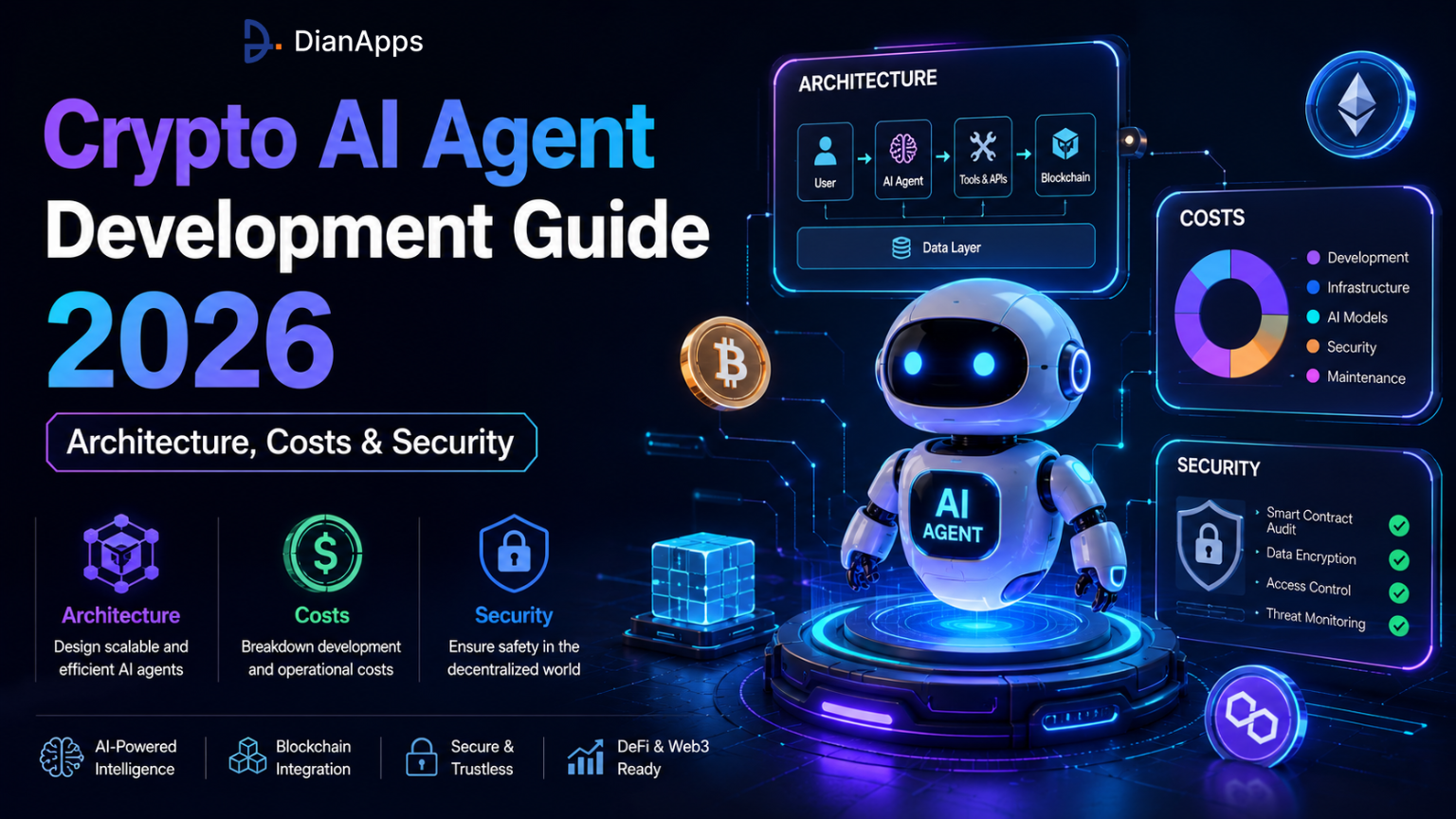
This is a complete technical guide to crypto AI agent development in 2026 covering what these agents actually are, how their architecture works, what the tech stack looks like, how security needs to be designed in from the start, and what it costs to build them across different complexity tiers.
Quick Answer: A crypto AI agent is a software system that combines an AI reasoning model (LLM or ML) with a blockchain wallet, allowing it to perceive market data, make decisions, sign transactions, and execute DeFi operations autonomously without step-by-step human approval. Development costs range from $25,000 for a simple rule-based agent to $350,000+ for multi-agent DeFi systems with custom model training and enterprise security architecture.
What a Crypto AI Agent Actually Is (And How It Differs From a Bot)?
The word “bot” has been in crypto since the beginning. Most people assume they know what it means. They mostly do not because an AI agent and a bot are architecturally different systems with different capabilities and very different development requirements.
A traditional trading bot executes fixed, pre-programmed rules. You define the conditions, the bot follows them mechanically. If price crosses X, buy. If balance drops below Y, stop. The bot has no understanding of context, no ability to reason through novel situations, and no capacity to adapt when market conditions fall outside its programmed parameters.
An AI agent uses a reasoning model to interpret ambiguous goals and adapt its strategy dynamically. It perceives market information, forms a view about what to do, and executes that decision including signing blockchain transactions without a human approving each step. When conditions fall outside the agent’s parameters, it reasons through the novel situation rather than failing or executing blindly.
Crypto AI Agent vs. Traditional Bot: Core Differences
| Dimension | Traditional Bot | Crypto AI Agent |
|---|---|---|
| Decision engine | Fixed rules, if/then logic | LLM or ML model, reasons through goals |
| Novel situations | Fails or executes blindly | Reasons through ambiguity, adapts |
| Goal specification | Explicit rules in code | High-level objective: “maximize yield within these risk parameters” |
| Memory | Stateless, no context across interactions | Short-term and long-term memory systems |
| Multi-step planning | Sequence of fixed steps | Dynamic plan generation and revision |
| Unstructured data | Cannot process | Can process news, social signals, on-chain narratives |
| Agent-to-agent interaction | Not possible | Negotiator agents, swarm intelligence emerging |
Three structural forces converged to make 2026 the year these agents became practical rather than theoretical. First, frontier reasoning models became reliable enough to chain together multi-step tasks without the hallucination and loop failures that made earlier attempts impractical. Second, infrastructure finally caught up: blockchains like Solana and high-performance Layer 2s offer sub-second finality required for real-time trading. Third, new agent frameworks made it safe to delegate financial actions with meaningful security controls rather than full trust.
The result is that building a crypto AI agent is a real and tractable engineering problem in 2026 not an AI research project. The underlying blockchain capabilities that enable autonomous agents to hold wallets, sign transactions, and interact with DeFi protocols without intermediaries are well-established. The AI layer on top of them is what is new.
Architecture: How a Crypto AI Agent Is Structured?
A production crypto AI agent consists of five interdependent layers. Understanding each one is essential before making any technology choices.
Layer 1: Perception / Data Ingestion
The agent has to know what is happening before it can decide what to do. This layer connects the agent to the information it needs:
- On-chain data: Wallet balances, transaction history, gas prices, liquidity pool depths, DEX price feeds
- Market data: Price feeds from centralized and decentralized exchanges, order book data, funding rates for perpetuals
- Off-chain data: News feeds, social sentiment (Twitter/X, Reddit, Telegram), governance proposals, regulatory announcements
- Oracle data: Chainlink and similar oracle networks provide reliable off-chain data to smart contracts, essential for any agent making decisions based on real-world events
Data quality at this layer determines whether downstream reasoning is sound. An agent fed stale or manipulated data will make bad decisions regardless of how good its reasoning model is. This is not a hypothetical risk, hedge funds in 2026 are deliberately executing complex fake transaction patterns specifically to mislead AI agents watching on-chain flows.
Layer 2: Reasoning Engine (The Brain)
This is where the agent decides what to do. Production agents in 2026 typically combine three architectures rather than relying on any single one:
- Deterministic rule engines: Hard-coded conditions that trigger specific actions. Fast, predictable, but brittle outside their programmed parameters. Used for hard risk limits that must never be overridden.
- Supervised ML models: Classifiers or predictors trained on historical data to score incoming signals. More adaptive than rules, but require ongoing retraining as market regimes shift. Used for low-latency signal classification.
- LLM-based planning: Language model inference for complex, multi-step reasoning and unstructured data interpretation. Slower per inference but far more capable at novel situations. Used for strategy-level decisions.
The three-layer multi-agent architecture, a Bull agent, Bear agent, and Risk Supervisor operating in parallel, consistently outperforms single-model LLMs in crypto strategy research tasks according to KuCoin Research. The supervisor layer prevents the bull and bear agents from taking unilateral positions without risk validation.
Layer 3: Memory System
Without memory, an agent treats every interaction as if it has never encountered the market before. Memory systems give the agent context, continuity, and the ability to learn from past decisions.
| Memory Type | What It Stores | Implementation |
|---|---|---|
| Short-term (in-context) | Current session context, recent observations, active reasoning chain | LLM context window |
| Long-term (vector) | Historical decisions and outcomes, market regime context, strategy performance | Vector database (Pinecone, Weaviate, Chroma) |
| Semantic (knowledge) | Protocol documentation, tokenomics, governance rules, market structure knowledge | RAG system + vector DB |
| Episodic (trade log) | Historical transaction records, P&L attribution, error logs | Structured database + blockchain transaction history |
Layer 4: Wallet and Execution Layer
This is where decisions become on-chain actions. The wallet layer is the most technically nuanced component of a crypto AI agent because it has to balance two competing requirements: autonomous execution authority and meaningful security controls.
Ethereum’s EIP-7702 addresses this directly. This upgrade allows a standard account to serve as a smart contract for a single transaction. A human user grants temporary, highly restricted permission to an AI agent. The agent executes a specific trade. The permission expires. Users retain their private keys in secure hardware. The framework supports session keys, agentic wallets grant sub-agents time-limited authority for high-frequency micro-transactions.
Key wallet architecture principles:
- Non-custodial design: The agent should never have direct access to private keys. It operates through programmatic permission systems that allow it to sign specific transaction types within defined parameters.
- Session key scoping: Each agent capability gets its own time-limited, scope-limited session key. A trading agent can execute swaps but cannot withdraw to external wallets without explicit authorization.
- Spend limits: Hard-coded maximum transaction sizes enforced at the smart contract level, not just in the agent’s logic. The agent cannot override these limits regardless of what it reasons.
- Trusted Execution Environments (TEEs): Hardware-isolated environments where the agent’s decision logic runs, ensuring that even the infrastructure operator cannot inspect or tamper with the agent’s reasoning.
Layer 5: Orchestration and Governance
For multi-agent systems, the orchestration layer coordinates communication between specialized agents, manages task allocation, and enforces governance rules. For single agents, it provides the lifecycle management, error handling, retry logic, and human oversight hooks that prevent a malfunctioning agent from causing material damage before intervention.
Tech Stack for Crypto AI Agent Development
Agent Frameworks (2026 Production Standards)
| Framework | Best For | Key Characteristics |
|---|---|---|
| ElizaOS | Most DeFi-focused projects, has become the “WordPress for Agents” | Plugin-based, multi-LLM support, Character Files for personality, Solana Plugin for trading |
| LangGraph | Complex multi-step workflows, stateful agents | Graph-based state management, built for long-running agentic processes |
| CrewAI | Multi-agent collaboration, Bull/Bear/Risk Supervisor architectures | Role-based agents with explicit collaboration protocols |
| AutoGen (Microsoft) | Enterprise multi-agent systems with human-in-the-loop | Conversational agent patterns, strong human oversight mechanisms |
| OpenAI Agents SDK | GPT-based agents with structured tool calling | Best-in-class tool calling for exchange APIs, DeFi protocol interactions |
Blockchain and DeFi Infrastructure
| Component | Tool / Protocol | Purpose |
|---|---|---|
| Primary chains | Ethereum (+ L2s: Base, Arbitrum, Optimism), Solana | Settlement, smart contract execution, DeFi protocol access |
| Smart contracts | Solidity (EVM), Rust/Anchor (Solana) | On-chain logic, agent wallet smart contracts, spending limits |
| Oracle networks | Chainlink, Pyth Network, UMA | Reliable off-chain data, price feeds, event outcomes |
| Wallet architecture | EIP-7702 smart accounts, session keys, Coinbase AgentKit | Scoped transaction authority, non-custodial execution |
| Cross-chain execution | deBridge, Wormhole, LayerZero | Moving assets across chains without manual bridge UI |
| Agent payments | x402 protocol, USDC on Base (via Coinbase/AWS), Stripe | Sub-$1 microtransactions, API-per-request billing without human approval |
AI and Backend Components
| Layer | Technologies |
|---|---|
| LLM (reasoning) | GPT-4o / GPT-5.2, Claude 3.5, Gemini 1.5 Pro, Llama 3 (private deployment) |
| ML models | PyTorch or TensorFlow for custom signal classifiers, time-series prediction |
| Vector database | Pinecone, Weaviate, Chroma (for RAG and semantic memory) |
| Backend runtime | Python (FastAPI), Node.js / TypeScript for exchange integrations |
| Data pipelines | The Graph (on-chain indexing), custom WebSocket feeds, Moralis, Alchemy |
| Infrastructure | AWS / GCP / Azure, Docker, Kubernetes (for always-on agent processes) |
| Monitoring | LangSmith (agent observability), Datadog, custom on-chain transaction logging |
The relationship between the AI layer and the blockchain layer is where most first-time crypto AI agent projects struggle. Teams with strong blockchain experience underestimate the LLM engineering required. Teams with strong AI experience underestimate the on-chain execution complexity. This is why choosing a development partner with genuine expertise in both domains is the highest-leverage early decision in a crypto AI agent project.
Key Use Cases: What Crypto AI Agents Are Actually Doing in 2026?
| Use Case | What the Agent Does | Complexity |
|---|---|---|
| Autonomous DeFi trading | Monitors price signals, executes swaps on DEXs, manages slippage and timing across multiple chains | Medium |
| Yield farming automation | Moves capital between liquidity pools to maximize yield, auto-compounds every hour, adjusts for gas costs | Medium-High |
| Cross-chain arbitrage | Detects price discrepancies across 10+ exchanges simultaneously, executes trades before the window closes | High |
| Portfolio management | Rebalances across chains, harvests yield, adjusts risk exposure based on real-time conditions | High |
| DAO governance | Monitors governance proposals, analyzes against defined criteria, submits votes or delegates based on policy | Medium |
| Market intelligence agent | Analyzes on-chain flows and social sentiment to generate trading signals, no execution, intelligence only | Medium |
| Intent-based execution | User specifies a goal (“execute this trade only when S&P 500 volatility drops below X”); agent manages timing and execution | High |
The Web3 application development landscape has been shaped significantly by these use cases. What started as decentralized exchanges and lending protocols operated by humans is becoming an ecosystem operated increasingly by agents, with human oversight at the strategy level rather than the execution level.
DianApps AI + Blockchain Development
Building a Crypto AI Agent? Get the Architecture Right First.
DianApps combines real AI/ML engineering and blockchain development expertise to build crypto AI agents that work in production, covering LLM orchestration, smart contract wallet architecture, DeFi protocol integration, and security from day one.
★ Clutch #1 Premier Verified | 4.9/5 (79+ reviews)
Security Architecture: The Threat Model Is Different Here
Security for a crypto AI agent is not traditional application security with a crypto wrapper. The threat model is genuinely different in ways that matter at the architecture level, and teams that discover this after deployment face expensive and sometimes irreversible consequences.
The Unique Security Risks of Autonomous On-Chain Agents
| Threat | How It Works | Defense |
|---|---|---|
| Prompt injection via on-chain data | Attacker embeds malicious instructions in NFT metadata, transaction calldata, or token names that the agent reads and processes | Strict input parsing, separate instruction and data channels, output validation before execution |
| Adversarial transaction patterns | Whale deliberately executes costly fake transaction patterns designed to trick AI models into seeing false buy signals, then dumps when retail agents buy in | Anomaly detection on signal sources, multiple independent data confirmations, position size limits |
| Smart contract vulnerabilities | Bugs in the agent’s wallet smart contract or in DeFi protocols it interacts with can be exploited to drain funds | Formal smart contract audits, interaction whitelisting (only pre-approved protocols), staged deployment |
| LLM hallucination causing bad trades | LLM generates a confidently wrong analysis of a protocol or market condition, leading the agent to execute a losing strategy | RAG grounding for factual claims, ML classifier for signal validation, deterministic hard limits at execution layer |
| Private key exposure | Agent execution environment is compromised, exposing the wallet’s private key material | Trusted Execution Environment (TEE), hardware isolation prevents key extraction even if code is compromised |
| Agent goal misalignment | Agent pursues an objective in ways that technically achieve the stated goal but cause unintended side effects (e.g., wash trading to inflate apparent performance) | Behavioral auditing, action logging, human review of unusual execution patterns |
Security Principles That Must Be Designed In, Not Added Later
Principle of least authority (POLA): An agent should have only the minimum permissions necessary for its current task. A yield farming agent should not have withdrawal authority to external wallets. A governance agent should not have any trade execution permissions. Each capability gets its own scoped session key.
Hard limits enforced at the smart contract level: The agent’s logic layer should not be the only thing preventing it from executing a catastrophic trade. Maximum position sizes, maximum daily drawdown, and protocol interaction limits should be enforced by the smart contract wallet itself, code the agent cannot override.
Audit logging at every layer: Every observation, reasoning step, and action should be logged with enough detail to reconstruct exactly what the agent saw and why it made each decision. This is both a security requirement (for incident investigation) and a legal requirement in some jurisdictions.
Multi-signature human override: Production agents should have a multi-sig controlled kill switch that requires multiple humans to agree before the agent can resume after being paused. Single-point-of-failure kill switches create their own security risks.
Smart contract audits before mainnet: Any smart contract in the agent’s execution path, including the wallet contract, any custom protocol integrations, and any governance contracts, requires an independent security audit before handling real capital. The good news is that the smart contract security standards for DeFi applications are well-established and auditable.
Legal and Regulatory Considerations in 2026
The regulatory environment for crypto AI agents is clarifying in 2026, and the direction is significant for anyone building in this space.
The US GENIUS Act (Guidance for Emerging Network Intelligence and User Safety), currently in the implementation phase, places strict liability on the deployer of the agent. If your autonomous agent executes a wash trade, buying and selling to itself to inflate volume, even if you did not explicitly program that behavior, you could be liable for market manipulation.
The SEC evaluates agents acting as investment advisers. An agent executing trades on behalf of users for compensation triggers registration requirements under current frameworks. Developers face potential liability for deploying autonomous systems that manipulate markets.
The European Union’s MiCA regulation requires entities operating crypto assets to comply with strict disclosure and surveillance rules. AI-driven monitoring tools to detect conflicts of interest and insider trading are becoming standard compliance infrastructure.
| Jurisdiction | Key Regulation | Primary Implication for Builders |
|---|---|---|
| United States | GENIUS Act, SEC Investment Adviser Act | Agent deployer bears strict liability for agent actions; IA registration if agent executes trades for others for compensation |
| European Union | MiCA, EU AI Act | Strict disclosure requirements, stablecoin backing requirements, AI high-risk classification for financial agents |
| Global | AML/KYC requirements | Agents must not facilitate money laundering; transaction monitoring and reporting obligations for platforms |
Legal experts consistently advise developers to audit smart contracts before deployment, maintain comprehensive action logs for regulatory review, avoid misleading claims about agent capabilities, and structure agent systems so that human accountability is clear. The blockchain regulatory landscape has been moving in this direction for some time, crypto AI agents represent the newest and fastest-evolving frontier of that regulation.
Crypto AI Agent Development Cost Breakdown
Cost varies enormously based on agent complexity, the sophistication of the reasoning engine, the number of chains and protocols supported, and the security architecture required. Here is an honest breakdown across project tiers.
| Agent Type | Cost Range | Timeline | Key Cost Drivers |
|---|---|---|---|
| Simple rule-based agent | $25,000–$50,000 | 4–8 weeks | Single chain, fixed strategy, basic wallet, limited protocol support |
| LLM-powered trading agent (single chain) | $60,000–$130,000 | 8–14 weeks | LLM reasoning layer, memory system, session key wallet, basic audit logging |
| Multi-chain DeFi agent | $120,000–$220,000 | 12–20 weeks | Cross-chain bridge integration, multi-protocol support, smart contract audit, TEE security |
| Multi-agent portfolio system | $200,000–$350,000 | 18–28 weeks | Bull/Bear/Risk supervisor agents, custom ML models, RAG knowledge system, full security audit |
| Enterprise DeFi platform (agent-native) | $350,000–$700,000+ | 24–40 weeks | Custom model training, institutional-grade security, regulatory compliance, multi-user governance |
Ongoing Infrastructure Costs to Budget For
| Cost Item | Monthly Range |
|---|---|
| LLM API costs (OpenAI, Anthropic, etc.) | $500–$15,000+/month (scales with inference volume) |
| On-chain gas fees | $200–$5,000+/month (depends on chain and frequency) |
| Cloud infrastructure (compute, storage) | $800–$8,000/month |
| Oracle and data feed subscriptions | $300–$3,000/month |
| Security monitoring and incident response | $500–$5,000/month |
The ongoing operational cost is a function of inference volume, trading frequency, and the chains you operate on. Teams that use Layer 2 networks for execution (Base, Arbitrum, Optimism) rather than Ethereum mainnet can reduce gas costs by 90% or more for high-frequency operations.
Step-by-Step Development Process
Step 1: Define the Agent’s Mandate
Before any technical work begins, define the agent’s objective with precision. “Maximize yield” is not a buildable specification. “Auto-compound liquidity positions on Uniswap V4 and Aave V4 across Ethereum mainnet, Base, and Arbitrum, rebalancing when APY differential exceeds 2%, with a maximum position of $50,000 per pool and a hard stop if daily drawdown exceeds 5%” is a buildable specification. The clarity of the mandate determines the complexity of the reasoning engine required and the scope of the security architecture.
Step 2: Choose Your Chain Strategy
Single-chain agents are significantly simpler to build, audit, and secure. Multi-chain agents access more opportunities but add bridge integration complexity, gas abstraction requirements, and a larger attack surface. Start with one chain, validate the agent’s core behavior, then expand cross-chain when the single-chain version is stable.
Step 3: Design the Wallet Architecture
This is the most consequential technical decision in crypto AI agent development. Non-custodial session key architecture with TEE-secured key material and hard contract-level spending limits is the production standard in 2026. Any deviation from this baseline for a production system requires a specific justification, not a cost-cutting rationale.
Step 4: Select and Configure the Reasoning Engine
For most agents, this means selecting an LLM for strategy-level decisions, an ML model for signal classification, and deterministic rules for hard risk limits. Configure the agent framework (ElizaOS, LangGraph, CrewAI), set up the memory system, and build the RAG knowledge base that grounds the agent’s understanding of the protocols it will interact with.
Step 5: Build and Test the Data Pipeline
The perception layer needs real-time, reliable data before the reasoning engine can function usefully. Build WebSocket connections to on-chain data sources, configure oracle integrations, and set up the data normalization layer. Test for data freshness guarantees, stale data in a trading agent causes real losses.
Step 6: Smart Contract Development and Audit
Write and deploy the wallet smart contracts, any custom protocol integrations, and governance contracts. Run a formal security audit from an independent firm before deployment. No exceptions for production systems handling real capital. The cost of a smart contract audit ($20,000–$80,000 depending on scope) is always less than the cost of an exploit.
Step 7: Simulation and Paper Trading
Run the complete agent in a mainnet fork environment, a simulation that uses real market data and real blockchain state without executing actual transactions. Kraken’s paper trading mode for its agent CLI represents the industry standard: full execution simulation before real capital exposure. Run for a minimum of 30 days across different market conditions before mainnet deployment.
Step 8: Staged Mainnet Deployment
Deploy to mainnet with a fraction of the intended capital position, typically 1–5%. Monitor behavior against simulation predictions. Expand capital allocation only after the agent’s real behavior matches its simulated behavior consistently across multiple market conditions.
How DianApps Builds Crypto AI Agents?
At DianApps, crypto AI agent development sits at the intersection of our AI/ML development services and our blockchain engineering practice. These are not separate teams that hand off between stages, they work together from the architecture design through deployment and monitoring.
As a Clutch #1 Premier Verified development company with 200+ engineers across the USA, Australia, UAE, and India, our blockchain and AI practices have delivered production systems in DeFi, fintech, and enterprise Web3 contexts. The generative AI capabilities we bring to enterprise applications translate directly to the LLM orchestration layer of crypto AI agents.
DianApps Crypto AI Agent Capabilities
| Layer | DianApps Capability |
|---|---|
| Agent framework | ElizaOS, LangGraph, CrewAI, framework selection based on agent type and complexity |
| LLM orchestration | Multi-model reasoning, RAG grounding, memory architecture, context management |
| Smart contract development | Solidity (EVM), Rust/Anchor (Solana), session key wallet contracts |
| DeFi protocol integration | Uniswap, Aave, Compound, cross-chain bridges, DEX aggregators |
| Security architecture | TEE configuration, session key scoping, spend limit contracts, prompt injection defense |
| Data pipelines | On-chain indexing (The Graph), real-time market data, oracle integration |
| Monitoring and observability | LangSmith agent tracing, on-chain transaction monitoring, alerting infrastructure |
Clutch #1 Premier Verified | 4.9/5 (79+ reviews) | 200+ Engineers | USA, Australia, UAE, India
Frequently Asked Questions
What is a crypto AI agent?
A crypto AI agent is a software system that combines an AI reasoning model (LLM or ML) with a blockchain wallet, allowing it to perceive market data, make decisions, sign transactions, and execute DeFi operations autonomously without step-by-step human approval. Unlike a traditional trading bot that follows fixed rules, an AI agent can reason through ambiguous situations, adapt its strategy, and handle multi-step workflows across multiple protocols and chains.
How is a crypto AI agent different from a trading bot?
A trading bot executes fixed, pre-programmed rules, if price crosses X, buy. An AI agent uses a reasoning model to interpret goals dynamically, process unstructured data (news, social signals, on-chain narratives), plan multi-step strategies, and adapt when conditions fall outside pre-defined parameters. The critical practical difference: a bot fails or executes blindly when conditions are novel; an agent reasons through them.
How much does it cost to build a crypto AI agent?
Development costs range from $25,000 to $50,000 for a simple rule-based single-chain agent, $60,000 to $130,000 for an LLM-powered single-chain trading agent, $120,000 to $220,000 for a multi-chain DeFi agent, and $200,000 to $350,000 for a multi-agent portfolio management system with custom ML models. Enterprise-grade platforms exceed $350,000. Ongoing operational costs (LLM inference, gas fees, infrastructure, data feeds) add $2,000 to $30,000 per month depending on trading volume and chain selection.
What is the biggest security risk in crypto AI agent development?
The most dangerous risk in 2026 is prompt injection via on-chain data, attackers embedding malicious instructions in NFT metadata, transaction calldata, or token names that the agent reads and inadvertently executes. The second most significant is adversarial transaction patterns from whales deliberately misleading AI agents. Both require architectural defenses (input parsing, separate instruction and data channels, output validation) rather than just code-level fixes.
What blockchain and AI frameworks are used for crypto AI agent development?
ElizaOS is the most widely deployed open-source agent framework in the crypto ecosystem in 2026, modular, multi-LLM support, with specific plugins for Solana and other chains. LangGraph handles complex stateful multi-step workflows. CrewAI enables multi-agent collaboration (Bull/Bear/Risk Supervisor architectures). For the LLM layer, GPT-4o, Claude 3.5, and Gemini 1.5 Pro are the primary production choices. Smart contracts use Solidity for EVM chains and Rust/Anchor for Solana.
What legal and regulatory considerations apply to crypto AI agents?
In the US, the GENIUS Act places strict liability on the agent deployer, you may be liable for actions your agent takes even without explicit programming. The SEC evaluates agents executing trades for compensation as potential investment advisers requiring registration. The EU’s MiCA regulation requires disclosure and compliance for any entity operating crypto assets. Developers should maintain comprehensive audit logs, avoid misleading capability claims, and consult regulatory counsel before deploying agents that trade on behalf of users.
How do I ensure a crypto AI agent is safe to deploy with real capital?
The production-standard checklist is: non-custodial session key wallet architecture (agent never holds private keys directly), hard spending limits enforced at the smart contract level, Trusted Execution Environment for key material, independent smart contract audit before mainnet, minimum 30 days of paper trading on a mainnet fork before real capital deployment, comprehensive audit logging of every observation and action, and a multi-signature human kill switch that requires multiple approvals to pause or resume the agent.
The Bottom Line
Crypto AI agents are not longer an emerging technology waiting for infrastructure to catch up. The infrastructure arrived in 2026, account abstraction, sub-second L2 finality, production-grade agent frameworks, and institutional-grade security patterns. An estimated 95% of crypto-focused hedge funds adopted agentic AI architectures by April 2026. Major exchanges including Kraken and Binance shipped native toolkits for agent developers. AWS built agent payment rails alongside Coinbase and Stripe.
The question for builders is not whether to take this seriously. It is whether you are building with the architecture depth that production systems in this category require. The agents that succeed in production combine a solid data perception layer, a multi-model reasoning engine with appropriate hard limits, a carefully scoped non-custodial wallet architecture, comprehensive security defenses against a genuinely different threat model, and the monitoring infrastructure to know when something is going wrong before it becomes irreversible.
That combination requires genuine expertise in both AI/ML engineering and blockchain development working together from the first architecture conversation. DianApps brings that combination to every crypto AI agent engagement, from system design through mainnet deployment and ongoing monitoring.
 0 comments










Leave a Comment
Your email address will not be published. Required fields are marked *