















 0 comments
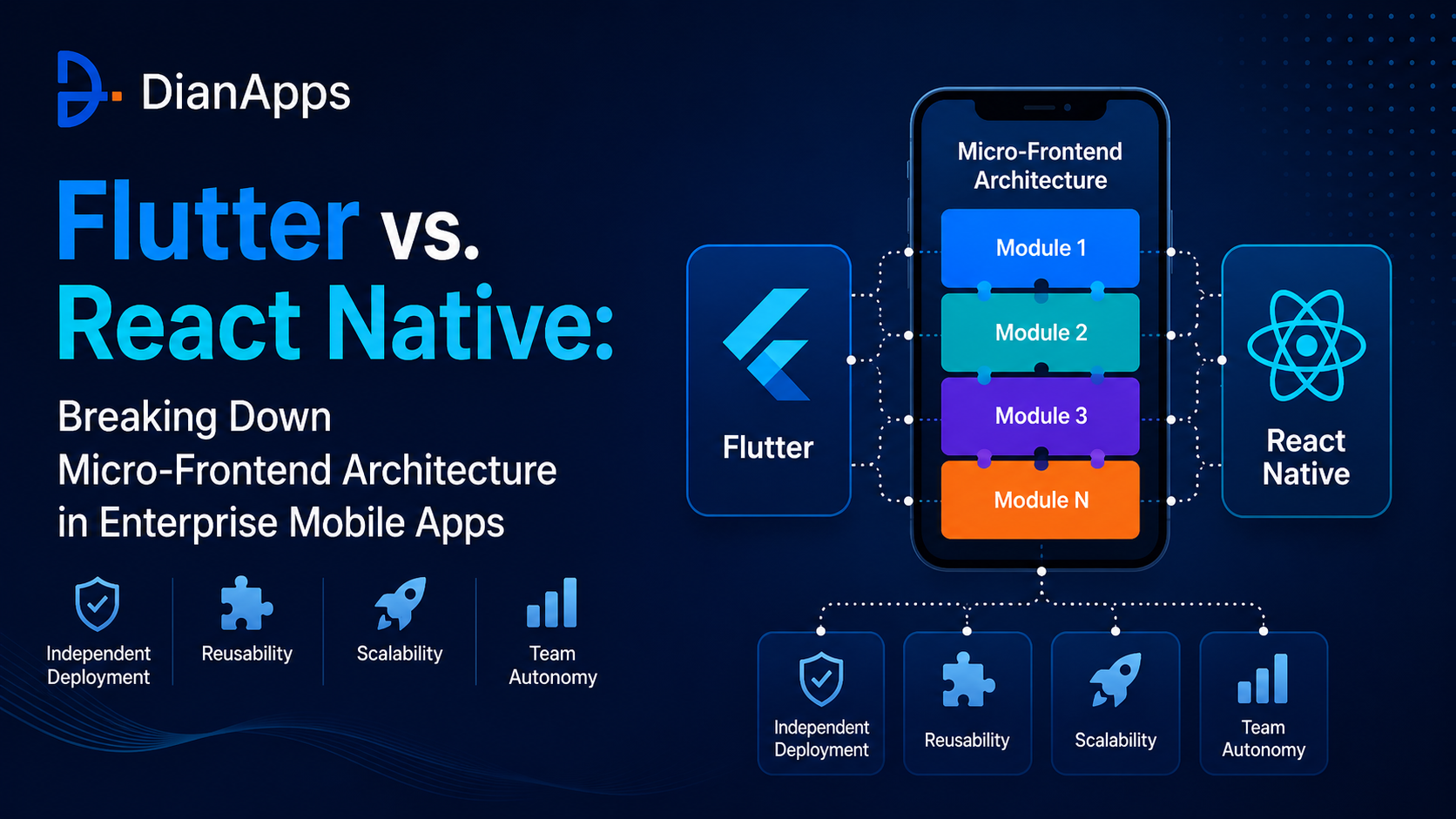





The short answer: For enterprise mobile, the Flutter vs. React Native micro-frontend question isn’t about which framework renders faster. It’s about how each one loads code at runtime. React Native executes JavaScript, so with Module Federation (via Re.Pack) it supports genuinely independent, runtime-composed mini-apps and over-the-air JS updates. Flutter compiles Dart to native machine code ahead of time, so it can’t load new feature code after release, especially on iOS. Its modularity is build-time: packages, add-to-app, and Android-only deferred components. Pick React Native for super-app and independent-squad architectures. Pick Flutter for rendering consistency and animation-heavy UIs shipped as a single binary.
Micro-frontends on mobile aren’t micro-frontends on the web
Most “micro-frontend on mobile” advice quietly assumes the web model still holds. It doesn’t. On the web, a host page stitches together independently deployed bundles served from different origins, and the browser executes whatever JavaScript arrives. There’s no gatekeeper between your remote bundle and the user.
Mobile has two gatekeepers the web doesn’t: the App Store review process and the native runtime. Apple and Google decide what ships, and both platforms draw a hard line around executable code. That single fact reshapes every architecture decision that follows.
So when an enterprise asks for “micro-frontends” on mobile, what they usually want is one of three things: independent feature teams that can deploy without blocking each other, a super-app shell that loads mini-apps (often built by external partners), or an update cadence that doesn’t wait on a 48-hour store review. Each goal has a different answer depending on the framework. Which one are you actually solving for?
The honest framing is this. React Native can compose code at runtime because it interprets JavaScript. Flutter cannot, because it runs ahead-of-time compiled machine code. Everything else in this comparison is downstream of that line.
Also Read- Flutter vs Native: When Cross-Platform Actually Makes Sense?
How React Native composes features at runtime?
React Native is the only one of the two that supports a web-style micro-frontend pattern in production, and that capability rests on two pillars: the New Architecture and Module Federation.
The New Architecture: Why removing the bridge matters?
React Native’s New Architecture has been the default since version 0.76, and from 0.78 onward the legacy bridge is gone entirely from new projects (React Native docs). This isn’t a cosmetic version bump. The old bridge serialized every JS-to-native call into JSON and shipped it across an asynchronous boundary, which is where the infamous bridge congestion and animation stutter came from.
The replacement is JSI (JavaScript Interface), which lets JavaScript call native code synchronously without serialization. Fabric, the new C++ renderer, brings concurrent rendering and React 18 features. TurboModules load native modules lazily and generate type-safe bindings at compile time through Codegen (Re.Pack / Callstack).
Why does this matter for micro-frontends specifically? Because when you compose multiple independently built mini-apps into one shell, those mini-apps share state, call native capabilities, and cross thread boundaries constantly. On the old bridge, that cross-module chatter was a latency tax. With JSI and a bridgeless runtime, federated modules talk to native code with far less overhead, which is the difference between a super-app that feels native and one that feels like a wrapper.
Module Federation with Re.Pack
True runtime composition in React Native runs on Module Federation, delivered through Re.Pack, Callstack’s Webpack and Rspack-based bundler that replaces Metro for this use case. The pattern is microservices for the frontend: a host app and independently built remote mini-apps that fetch each other’s code at runtime, with shared dependencies like react and react-native loaded once as singletons.
Here’s the part teams underestimate. Mobile Module Federation is more constrained than its web cousin, and the constraints come straight from the platform. Per Re.Pack’s own documentation, every micro-frontend must use the same React, React Native, and native dependency versions, all native modules must live in the host app that’s submitted to the stores, and you can only dynamically load JavaScript from a remote, not native code (Re.Pack).
Read that again, because it’s the rule that breaks naive designs. A remote mini-app can reference a native module, but that module has to be compiled into the host binary first. Your “independently deployed” feature isn’t fully independent. It’s independent at the JavaScript layer and tightly coupled at the native layer.
Over-the-air updates: React Native’s real advantage
This is where React Native genuinely wins, and it’s often the actual reason enterprises reach for it. Because the framework executes JavaScript, you can push over-the-air updates to JS and assets without a store submission, using tooling like EAS Update. A payments squad can ship a fix at 2pm without waiting on the rest of the app.
The limit is policy, not technology. Apple permits downloaded interpreted code as long as it doesn’t change the app’s primary purpose. Use OTA to fix bugs, tune flows, and run experiments. Don’t use it to remote-control core behavior, or you’re inviting a review problem. More on that landmine below.
Suggested Read- How do I choose between native and cross-platform app development?
How Flutter handles modularity: powerful, but build-time?
Flutter’s modularity story is real and mature. It’s just a different kind of modularity, and conflating it with runtime micro-frontends is how architecture reviews go wrong.
Impeller, AOT, and the single-binary model
Flutter compiles Dart ahead of time to native machine code, and it draws every pixel itself through Impeller, the default rendering engine since Flutter 3.27 on iOS and Android API 29 and above (Flutter docs). Impeller precompiles its shaders at build time, which kills the first-run animation jank that plagued the old Skia pipeline and supports 120Hz displays cleanly.
The payoff is pixel-identical rendering across platforms and excellent animation performance. The cost, for our purposes, is rigidity. AOT machine code is fixed at build time. There’s no interpreter sitting in the runtime waiting to execute code you send later.
Deferred components and the Android-only reality
Flutter does support code splitting through deferred components, using Dart’s deferred as imports and loadLibrary() to load feature modules on demand. On Android this hooks into Play Feature Delivery, so your base app stays lean and heavy features download when a user opens them.
The catch is twofold and decisive. First, deferred components are Android-only (Flutter docs). Second, even on Android, they only split apart code that already existed when the binary was built. The Dart API documentation is explicit that you can’t ship feature code created after the app was distributed (Dart API). For location-aware features, our React Native Geolocation service guide walks through installation, permissions, and accurate GPS tracking. You still build and upload the entire app as a single Android App Bundle. There is no code push.
The iOS constraint that decides the architecture
On iOS and macOS, Flutter offers no code splitting at all. You can defer assets using Apple’s On-Demand Resources, but executable code isn’t part of that mechanism. Combining add-to-app with deferred components in one project isn’t officially supported either, and the Flutter team flags full Flutter deferral as an experimental, advanced setup without guarantees.
So if your “micro-frontend” requirement includes delivering or updating feature code at runtime on iOS, Flutter can’t do it. Not because of a missing feature, but because Apple forbids downloaded executable native code and Flutter’s output is native code. That’s the whole ballgame for a lot of enterprise decisions.
Architecture comparison: Flutter vs. React Native for micro-frontends
The table below maps the two frameworks across the dimensions that actually drive enterprise architecture, not the ones that win Twitter arguments.
| Dimension | React Native (New Architecture + Re.Pack) | Flutter (Impeller + AOT) |
|---|---|---|
| Runtime code loading | Yes. JS modules loaded at runtime via Module Federation | No. AOT native code is fixed at build time |
| Over-the-air code updates | Yes for JS and assets, within store policy | No Dart code push. Assets only (ODR on iOS, dynamic modules on Android) |
| Micro-frontend composition | True runtime composition of remote mini-apps | Build-time modular packages; on-demand delivery Android-only |
| Native module model | All native modules must be bundled in the host app | Plugins compiled into the binary; no runtime native loading |
| Dynamic delivery platforms | iOS and Android (JS remotes) | Android only for code; iOS unsupported |
| Version coupling across modules | Strict. Shared React, RN, and native versions must match | Single binary, one toolchain; fewer skew vectors |
| Rendering | Fabric C++ renderer using native components | Impeller draws every pixel; identical across platforms |
| Animation / high refresh rate | Solid after the New Architecture | Strong. 120Hz with precompiled shaders |
| Cold start (directional) | Slightly higher due to the JS runtime | Slightly lower due to AOT; workload-dependent |
| Crash isolation between modules | Achievable with react-native-sandbox runtime isolation |
Shared process; one module’s crash can drop the app |
| Best-fit team topology | Many independent squads, external mini-app partners | One cohesive team owning a single binary |
Treat the cold-start row as directional. Third-party benchmarks tend to give Flutter a modest edge on cold launch and memory footprint thanks to AOT, while React Native’s New Architecture has narrowed the gap considerably (Bolder Apps). Real numbers depend on your module count, native dependencies, and device tier, so benchmark against your own workload before quoting figures to a steering committee.
Real-world edge cases and deployment pitfalls
This is the section that separates a slide deck from a system that survives Black Friday traffic. When our engineering teams at DianApps build super-app and modular architectures for high-transaction products, these are the failures that show up after launch, not before.
Dependency singletons and version skew
In Module Federation, the host and every remote must agree on shared singleton versions. Bump react-native in one remote and forget to align the host, and you don’t get a build error. You get a runtime crash in production, on a fraction of devices, after the remote has already shipped. Version management is the single hardest part of mobile Module Federation, a point Re.Pack’s maintainers make from their own experience.
The fix is governance, not cleverness. Treat the host as the source of truth for all shared singletons, pin versions in a shared manifest, and enforce alignment in CI so a mismatched remote can’t deploy at all.
Native module mismatches and crash blast radius
A remote that references a native module missing from the host will crash at runtime, because the contract between JS and native is only validated when the code actually runs. We’ve traced more than one “works on staging, dies in prod” incident to exactly this gap.
Two defenses matter here. Bundle the full native surface in the host and have remotes declare native dependencies as host-provided, backed by contract tests. Then contain the blast radius: react-native-sandbox lets you run mini-apps in isolated instances with crash containment and per-module native permissions, so one partner’s bad release doesn’t take down checkout.
New Architecture migration gotchas
Migrating an existing app to Fabric and TurboModules is not a config flag, especially with a large native dependency tree. Roughly 15% of popular packages still lag on New Architecture support, setNativeProps is gone, several measurement APIs are now synchronous, and useLayoutEffect timing shifts under Fabric (PkgPulse).
Meta’s own guidance is to start with a feature branch or a smaller internal app before touching production. Profile cold start during the migration too, since assumptions baked around eager native-module loading can regress once TurboModules switch to lazy initialization.
Know More- Top 10 Cross-Platform App Development Companies in Australia
Flutter’s delivery split and review landmines
If you commit to Flutter and still need on-demand features, you’ve signed up for a platform-split delivery strategy. Deferred components cover Android; iOS needs a parallel plan, usually bundling the feature or shipping assets through On-Demand Resources. Design graceful fallbacks for loadLibrary() failures on flaky networks, because a feature that won’t download is a dead screen.
The cross-cutting landmine for React Native teams is store review. OTA code push lives in a policy gray zone: interpreted-code updates that don’t change the app’s primary purpose are fine, but anything that looks like remotely re-skinning core behavior risks rejection or removal. Govern what OTA is allowed to touch the same way you’d govern a feature flag with production blast radius.
Shared state, navigation, and the design system
Across mini-apps, you still need consistent routing, shared auth tokens, and a single design system version. The clean pattern is a thin host-provided shared SDK exposed as a federated singleton, versioned design tokens, and a stable event contract between modules. Skip this and your “independent” teams will quietly diverge into three apps wearing one icon.
Related reading: For a comprehensive look at where mobile apps are headed this year, see our pillar guide on Mobile App Development Trends 2026, covering AI integration, framework choices, and USD cost benchmarks.
FAQ
Can React Native do over-the-air updates without breaking App Store rules?
Yes, within limits. React Native interprets JavaScript, so JS and asset updates can ship over the air without a store submission. Apple allows downloaded interpreted code provided it doesn’t change the app’s primary purpose, so OTA is appropriate for bug fixes and experiments, not for remote-controlling core functionality.
Does Flutter support micro-frontends?
Not in the runtime-composition sense. Flutter supports build-time modularity through packages, add-to-app, and Android-only deferred components, but it can’t load new feature code after release. Deferred components are Android-only and only split apart code that shipped inside the original binary, per Flutter’s documentation.
Which framework is faster for enterprise apps?
It depends on the workload, but the reasons are architectural. Flutter’s AOT compilation and Impeller’s precompiled shaders give it an edge on animation smoothness and consistency, while React Native’s New Architecture closed much of the historic gap by removing the serialization bridge. Benchmark against your own module count and device mix.
When should an enterprise pick React Native over Flutter here?
Choose React Native when you need independently deployed mini-apps, external partner integrations inside one shell, or a release cadence faster than store review allows. Its runtime JS execution and Module Federation support make it the only practical choice for genuine super-app composition.
Where this leaves your architecture decision?
Strip away the framework tribalism and the decision is clean. The micro-frontend question is really a question about how your code ships, and the two frameworks answer it differently on purpose.
| Choose React Native when | Choose Flutter when |
|---|---|
| You need true runtime-composed mini-apps | You ship a single binary owned by one team |
| Multiple squads or partners deploy independently | Rendering consistency and animation quality are top priority |
| OTA updates and fast iteration are non-negotiable | Build-time modularity (packages, add-to-app) is enough |
| A super-app shell loads third-party features | iOS feature delivery at runtime isn’t a requirement |
Neither choice is wrong. The expensive mistake is picking React Native for its rendering and then fighting it, or picking Flutter for its modularity and discovering at the App Store that runtime code delivery was never on the table for iOS.
That gap between the architecture on the whiteboard and the constraints in production is where most enterprise mobile programs lose a quarter. DianApps works with teams on exactly this decision, scaling modular and super-app architectures for high-transaction fintech and commerce products built for millions of users, including work behind apps like Khatabook, CaratLane, and Assembly. If you’re weighing Flutter against React Native for a micro-frontend or super-app build, our architecture and engineering teams can pressure-test your design against the failure modes above before you write the first line of the host app. Talk to our team about an architecture review.
 0 comments













Leave a Comment
Your email address will not be published. Required fields are marked *