














 0 comments
Quick Summary:
- Salesforce offers a free 2-user plan and a Starter Suite at $25/user/month, making it more accessible to small teams than most people think.
- It combines sales, marketing, service, and commerce in one platform, so you’re not duct-taping five different tools together.
- The learning curve is real, and getting the most out of Salesforce often requires proper setup, which is why partnering with a Salesforce development services provider matters.
- It scales with you. A small business using Salesforce today won’t outgrow it at 50 or 500 employees.
- It’s not the cheapest CRM on the market, but for businesses serious about customer relationships and growth, the ROI is hard to argue with.
- If customization, automation, and AI-powered insights are on your roadmap, Salesforce is built for exactly that.
Here’s the thing most small business owners hear: “Salesforce” and immediately think: that’s for the big companies, guys. The enterprise companies have dedicated IT teams and six-figure software budgets.
And honestly? That assumption made sense five years ago. But Salesforce has changed. A lot.
Today, a two-person team can get started on Salesforce for free; all you need is to get Salesforce development services to do a proper setup. A growing 10-person business can be up and running on a full CRM suite for $25 per user per month. And a scaling company can expand into AI-powered automation, custom workflows, and advanced analytics, all without ever switching platforms.
So the real question isn’t “Is Salesforce too big for us?” The real question is: “Does Salesforce actually solve the problems we have right now?”
That’s exactly what this blog breaks down: no jargon, no sales pitch, just a straight answer to whether Salesforce CRM for small businesses makes sense in 2026.
What does Salesforce for small businesses actually mean?
When someone says “Salesforce,” they’re usually talking about the world’s most widely used CRM (Customer Relationship Management) platform. But Salesforce isn’t just a contact list with a fancy interface; it’s an entire ecosystem.
For small businesses specifically, Salesforce means having one central place to:
- Track every lead, deal, and customer interaction
- Send and automate marketing emails
- Handle customer support and service tickets
- Run reports that actually tell you what’s working
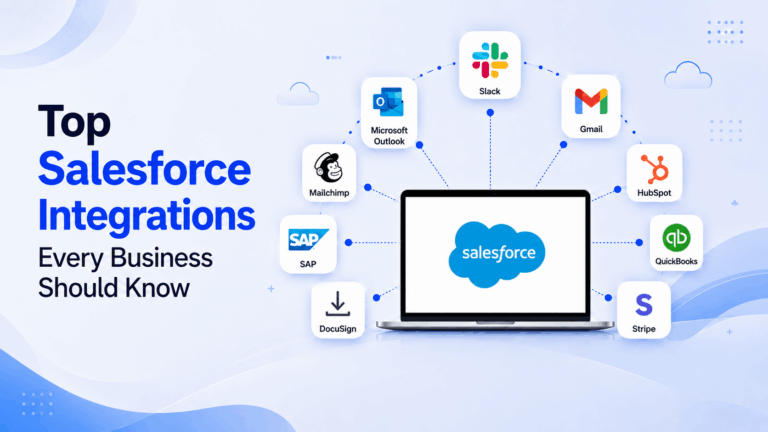
- Connect with tools you already use, Gmail, Outlook, Slack, WhatsApp, and hundreds more
The important distinction is this: Salesforce for small businesses isn’t a stripped-down version of the enterprise product. It’s the same powerful platform, just packaged in entry-level plans that are designed for smaller teams who need to move fast without hiring a full IT department.
Whether you’re a five-person sales team, a growing e-commerce brand, or a service-based business trying to stop losing leads in your inbox, Salesforce has been deliberately building for you in recent years.
Recommended Read: Salesforce CRM Development: Key Features and Customizations for Your Business
Salesforce CRM for small businesses features that actually matter
Let’s skip the feature dump. Instead, here are the capabilities that small businesses actually use and why they matter day to day.
1. Contact and Lead Management
Every customer interaction, call note, email thread, and deal stage lives in one place. No more hunting through email chains or sticky notes. Your entire team sees the same real-time picture of every relationship, which means fewer dropped balls and faster follow-ups.
2. Sales Pipeline Visibility
You can see exactly where every deal stands, what’s stuck, what’s close to closing, and what needs attention today. Salesforce’s drag-and-drop pipeline makes it easy to manage your entire funnel without needing a spreadsheet the size of a small country.
3. Email Marketing and Automation
The Starter Suite includes basic email marketing tools so you can nurture leads, send follow-up sequences, and run campaigns all from inside your CRM. No separate email platform needed at the entry level.
Recommended Read: Build and Manage Amazing Experiences With Salesforce Marketing Cloud
4. Reports and Dashboards
Real-time dashboards show you sales performance, lead sources, team activity, and revenue forecasts at a glance. For small business owners who make decisions on gut feel, this is genuinely eye-opening data.
5. Mobile App
Salesforce’s mobile app means your team isn’t tied to a desk. Log a call from a parking lot, update a deal from a coffee meeting, check pipeline numbers from anywhere. For field sales teams and service businesses, this is a genuine breakthrough.
6. AppExchange Integrations
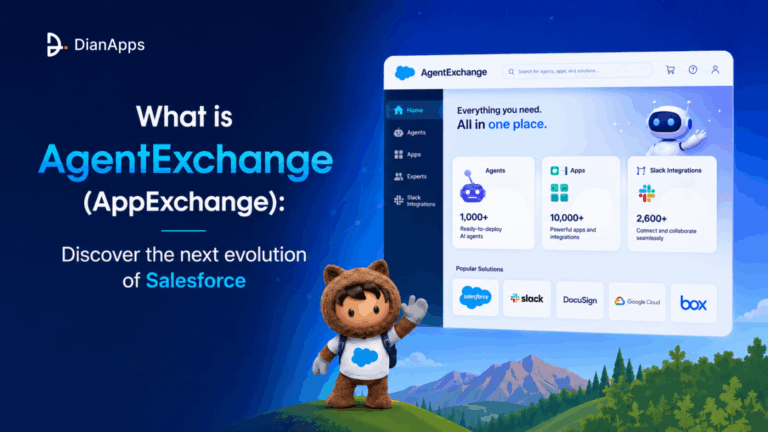
Salesforce’s AppExchange has over 7,000 apps and integrations from accounting tools like QuickBooks, to project management, e-commerce, and HR software. The platform plugs into almost everything a small business already uses.
7. AI-Powered Insights (Agentforce)
Even at the entry level, Salesforce is bringing AI into the picture through Agentforce, its AI layer that can answer customer queries automatically, surface next-best-action recommendations for sales reps, and handle routine service tasks without human intervention. This used to be enterprise-only territory. Not anymore.
Is It Good to Select Salesforce for Small Businesses
Short answer: it depends on what kind of small business you are. Let’s be honest about both sides.
Where Salesforce Genuinely Shines for Small Businesses
- You’re planning to grow: Salesforce scales from 2 users to 2,000 without you ever having to migrate to a new platform. If growth is part of the plan, starting on Salesforce now saves a painful platform switch later.
- You have a sales team: Even a 3-person sales team benefits enormously from shared pipeline visibility, automated follow-ups, and performance tracking. The ROI shows up fast.
- Customer relationships are your business: Service businesses, agencies, consultants, anyone whose revenue depends on managing client relationships well will find Salesforce genuinely useful from day one.
- You need your tools to talk to each other: Salesforce integrates with almost everything. If you’re tired of copy-pasting data between your CRM, email tool, and accounting software, the integration ecosystem is a major selling point.
Where You Should Think Twice
- You’re a solo founder just getting started: If you’re pre-revenue or managing fewer than 50 contacts, a free tool like HubSpot CRM might serve you better right now. Salesforce’s power can feel like overkill at the very earliest stage.
- Budget is extremely tight: The Starter Suite at $25/user/month is reasonable, but implementation, customization, and add-ons can add up. Going in without a budget for proper setup often leads to underutilizing the platform.
- Your team isn’t ready for a learning curve: Salesforce isn’t difficult once you know it, but it does take time to learn. Without proper onboarding or training, adoption suffers, and the investment doesn’t pay off.
Recommended Read: Salesforce CRM Challenges: Navigating Strategy Shifts for Future Success
The honest truth: Salesforce is not a plug-and-play tool for everyone. But for small businesses that are serious about growth, customer experience, and operational efficiency, it’s one of the most powerful investments you can make in your infrastructure.
Why choose Salesforce for small businesses?
There are dozens of CRM tools out there. Here’s why Salesforce keeps winning even against cheaper alternatives.
It’s the Industry Standard
When your sales hire has already used Salesforce at their last job, onboarding takes days instead of weeks. When your investors ask about your CRM setup, Salesforce signals operational maturity. The market familiarity alone has real business value.
One Platform Instead of Five
Most small businesses run on a patchwork of tools, one for email marketing, one for customer support, one for sales tracking, and one for analytics. Salesforce brings all of that under one roof. Less context-switching, less data inconsistency, and a single source of truth for your customer data.
It Grows With You
This is genuinely underrated. The Salesforce you start with at 5 employees is the same platform a 500-person company runs on. You’re not going to outgrow it. You upgrade plans, add clouds, and expand capabilities without ever starting over.
AI That Actually Works
Salesforce’s Agentforce AI is not a gimmick. It’s being used right now by businesses of all sizes to handle first-line customer service, predict which leads are most likely to close, and automate repetitive tasks that eat up hours every week. As AI becomes a business necessity rather than a nice-to-have, being on a platform that’s built AI natively is a significant competitive advantage.
World-Class Support and Community
Trailhead, Salesforce’s free learning platform, has millions of users and covers everything from beginner CRM basics to advanced development. The community of certified partners, consultants, and developers is enormous, which means help is always available when you need it.
Recommended Read: The Future of Salesforce Development in the AI Era
Pricing of Salesforce for Small Businesses
Let’s talk numbers because this is where most blogs either oversimplify or scare people away unnecessarily.
| Plan | Price | Best For | Features |
|---|---|---|---|
| Free Suite | Free (up to 2 users) | Solo founders, tiny teams testing Salesforce | Lead & contact tracking, basic service tools, email marketing, Slack integration |
| Starter Suite | $25/user/month | Small teams needing a full CRM | Sales + service + marketing + commerce in one app, dashboards, mobile app, AppExchange |
| Pro Suite | $100/user/month | Growing businesses need more control | Everything in Starter + forecasting, advanced reporting, customization, and quoting |
| Enterprises | $165/user/month | Scaling businesses with complex needs | Full customization, advanced API access, workflow automation, AI add-ons |
| Unlimited | $330/user/month | Large teams needing maximum support | Everything + 24/7 support, unlimited sandboxes, full AI capabilities |
What People Don’t Tell You About Salesforce Pricing
The listed price per user is just the starting point. Here’s what can affect your actual cost:
- Implementation costs: For most small businesses, getting Salesforce properly set up, including data migration, workflow configuration, and user training, runs between $1,500 and $10,000, depending on complexity. Skipping this step is the most common reason businesses underuse the platform.
- Add-ons and integrations: Advanced marketing automation, field service tools, and AI features can each carry additional costs on top of your base license.
- Annual billing: Salesforce bills annually by default. Monthly billing is available on Starter, but typically comes at a slight premium.
- The good news: A small business on Starter Suite with 5 users is looking at $1,500/year in base license fees, roughly the cost of two months of a single software tool subscription at most competitors’ mid-tier pricing.
Recommended Read: Salesforce CRM Trends in 2026
Final Words
Salesforce isn’t just a CRM; it’s a decision about how seriously you want to take your customer relationships and your company’s growth infrastructure.
For small businesses that are still figuring out the basics, there are simpler tools. But for businesses that are ready to build something real that want a platform their team won’t outgrow, that can automate the repetitive work, and that gives everyone a single source of truth about every customer, Salesforce is hard to beat.
The caveat is this: Salesforce is only as good as how well it’s set up and adopted. A poorly configured Salesforce instance is worse than a well-used spreadsheet. That’s why the businesses that get the most out of the platform are the ones that work with experienced partners who understand both the technology and the business goals behind it.
If you’re serious about implementing Salesforce the right way or if you’re already using it but not getting the results you expected, working with a reliable Salesforce consulting services partner can be the difference between a tool that collects dust and one that genuinely drives growth.
Whether you’re starting from scratch, migrating from another CRM, or looking to extend what Salesforce already does for you with custom development and integrations, the right guidance makes the investment worth every penny.
Salesforce is no longer just for enterprise. With the right plan, the right setup, and the right support, it’s one of the smartest decisions a growing small business can make in 2026.
Frequently Asked Questions
 0 comments






Leave a Comment
Your email address will not be published. Required fields are marked *