















 0 comments
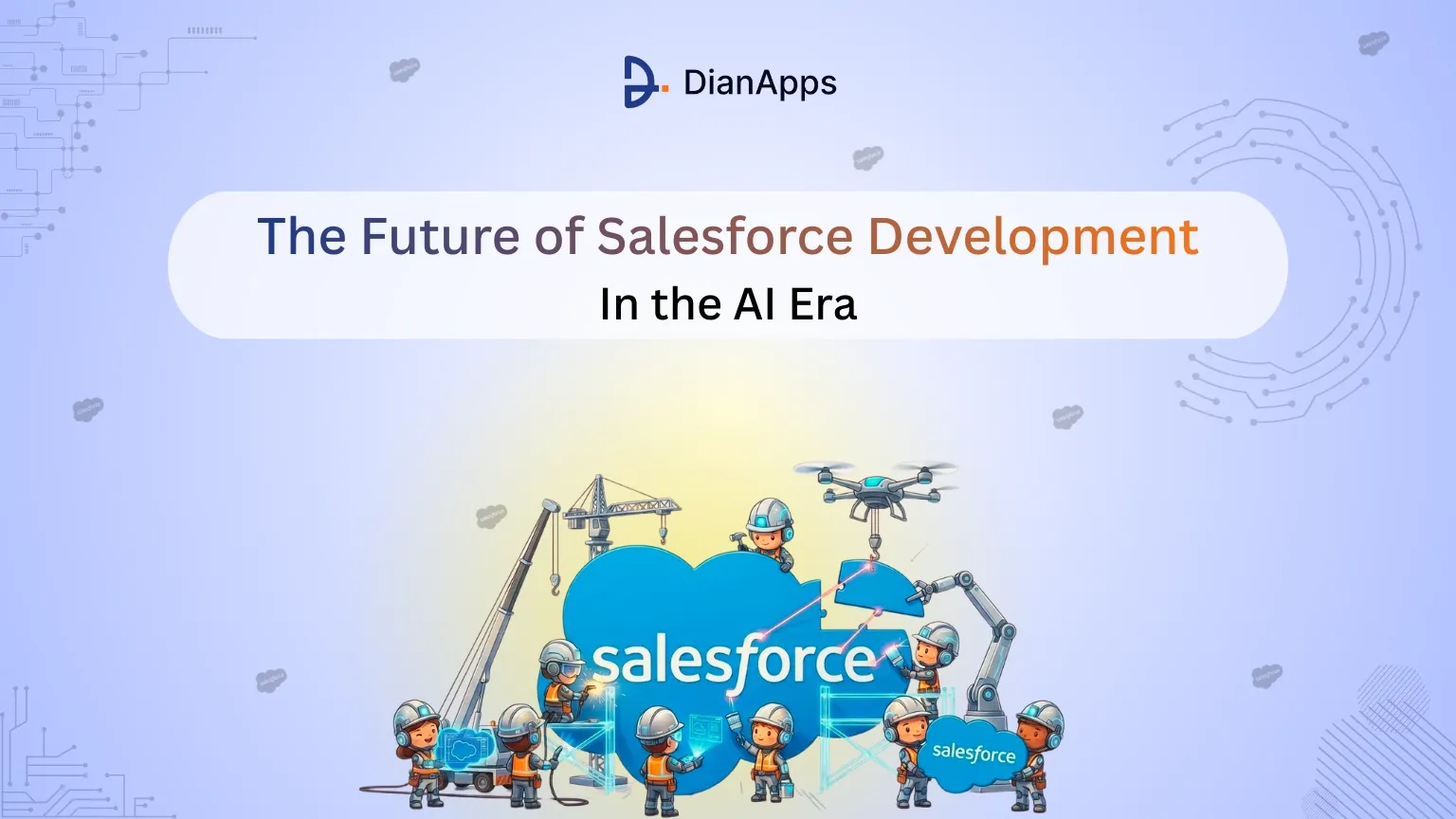





AI Overview:With the evolution of Artificial intelligence Salesforce ecosystem has experienced one of the most dramatic transformations yet. With the number of AI agents expanding by 119% in early 2026, and Agentforce becoming Salesforce’s fastest-growing product with 330% year-over-year revenue growth, we are continuously experiencing a fundamental shift in how businesses approach CRM development. AI isn’t just considered an evolving trend; it has now become a complete transformation of what Salesforce development truly means. Whether you are a business owner, a developer, or simply curious about where this technology is exactly heading, understanding these changes isn’t considered an optional factor now. |
Remember the days when Salesforce was just a CRM platform? Those days feel like ancient history now. We are standing at a midpoint where artificial intelligence isn’t just enhancing Salesforce, but it’s fundamentally rewriting the rules of what’s exactly possible.
Here’s something that might surprise you: developer job postings for Salesforce actually dropped by 12% globally in 2025. Before you start panicking about the job security, there’s more to this story. While traditional coding roles are shifting, the demand for Salesforce developers is continuously increasing, with multiple businesses coming up to get Salesforce development services in the US market alone. We saw multiple companies looking for Salesforce development solutions.
What’s happening is that Salesforce development services are evolving from writing endless lines of Apex code to orchestrating intelligent systems that think, learn, and act. The question isn’t whether AI will change Salesforce development. It’s whether you’re ready to evolve with it.
Evolution of Salesforce Development in 2026
Let’s now talk about how we got to this stage of Salesforce development and where we’re heading in the upcoming days:
From Traditional Coding to AI Orchestration
- Apex, the Visualforce, and Lightning’s elements had to be mastered for Salesforce development five years ago.
- Developers spent weeks building custom solutions for basic workflow automation
- Today’s landscape looks completely different the role has transformed from builder to orchestrator
- Modern developers design intelligent systems, manage agent workflows, and ensure AI behaves predictably
The Autonomous Agent Revolution
- Einstein Analytics started the shift with predictive insights and recommendations
- 2024-2025 brought autonomous agents that handle complete business processes from start to finish
- Companies using Agentforce deployed their AI systems in just 4.8 months versus 75.5 months for DIY solutions
- Customer service conversations with AI agents jumped by 2,199% in six months
- 94% of consumers actually prefer interacting with these AI agents when given the choice
The Low-Code Explosion
- 70% of new commercial applications are now built using low-code/no-code approaches
- The low-code market is expected to exceed thirty billion dollars in 2026
- This democratization hasn’t made developers obsolete it’s elevated their role
- When anyone can build basic apps, value shifts to those who architect complex, AI-powered ecosystems
Expanded Toolkits and Capabilities
- Salesforce AI features now power everything from predictive analytics to autonomous decision-making
- Developers work with hybrid systems combining AI reasoning with deterministic logic
- Integration capabilities span multiple clouds and platforms
- The focus is on solving real business problems, not just writing code
Recommended Read: The Power of Custom Salesforce Development for Scalable Business Growth
Future of Salesforce Development Market in the AI Era
The landscape ahead is both challenging and incredibly opportunity-rich:
The Job Market Reality Check
- Basic developer demand declined 12% globally, a historic first for Salesforce
- However, demand for technical architects and solution architects is skyrocketing
- These specialized roles represent just 1% of the global talent pool but are chronically undersupplied
- Over 32,000 Salesforce-related job openings in the U.S. double the 2024 numbers
The Hybrid Intelligence Model
- 80% of executives expect humans and AI agents to work together
- 72% believe most employees will have an AI agent reporting to them within five years
- This isn’t about replacing humans; it’s about amplifying human capabilities
- The winning formula combines AI reasoning with human creativity and strategic thinking
Massive Investment and Growth Projections
- Salesforce is investing one billion dollars in Singapore over five years
- 500 million committed to Saudi Arabia with plans to upskill 30,000 citizens by 2030
- 2.5 billion investment in Australia
- The ecosystem is projected to create 11.6 million jobs and two trillion dollars in revenue between 2022-2028
- AI budgets nearly doubled, with 30% now dedicated to agentic AI
Implementation Challenges and Reality
- Early adopters found AI sometimes behaved inconsistently
- Salesforce added Agent Script a rule-based layer for predictable behavior
- Of 5,000 initial Agentforce deals, only 3,000 were paid implementations in Q4 2024
- Companies want proof of value, not just promises
- The future requires combining AI capabilities with enterprise-grade reliability
Market Sophistication
- Businesses are getting selective about the Salesforce development service providers
- Trust, governance, and security matter as much as AI capabilities
- Pure language model approaches haven’t proven reliable for production environments
- Success requires understanding both AI potential and its practical limitations
Recommended Read: How To Learn Salesforce Development In A Few Days
Key Trends to Shape Salesforce in the Artificial Intelligence Market
In this section, you will come across some of the important Salesforce CRM trends based on 2026 market insights.
The Agentic Enterprise Model
Organizations are shifting from application-centric to agent-centric operations. Instead of users navigating screens, autonomous agents handle entire workflows. This changes how we design solutions; the focus moves from user interfaces to agent interfaces, from human workflows to hybrid workflows.
Trust as the Ultimate Differentiator
Data security, privacy, and trustworthiness rank as the top three CIO concerns. Sixty-seven percent of CEOs say implementing agents is critical to compete, but they won’t sacrifice security. Salesforce’s Einstein Trust Layer provides governance that pure AI solutions can’t match.
Multi-Skilled Professionals Win
The days of narrow specialization are ending. Employers seek “admin-adjacent” roles for professionals who wear multiple hats. An admin who understands development. A developer who grasps business analysis. The admin talent pool expanded 47%, but demand only grew 14%, creating fierce competition. Differentiation comes from breadth.
Industry Specialization Matters
Generic Salesforce knowledge isn’t enough. Real value comes from understanding how Salesforce AI features apply to specific industries. Healthcare needs different agent configurations than financial services. Retail differs dramatically from manufacturing.
The Marketplace Revolution
Salesforce’s AgentExchange marketplace opens the six trillion dollar digital labor market to partners and developers. Small innovators can now compete globally, but competition also intensifies. Real results validate this trend; companies like Engine report two million dollars in annual savings with improved customer satisfaction scores.
Recommended Read: AI in Salesforce: A Threat or Opportunity for Developers?
Final Words
AI isn’t eliminating Salesforce development; rather, it is enhancing it. Instead of resisting automation, the experts flourishing in the present moment are learning how to control it.
The marketplace is completely different for companies evaluating Salesforce development services. The suppliers that will propel your company to the top in 2026, as well as thereafter, aren’t just programmers; they’re partners in strategy who see the promise and constraints of AI, who place a high value on governance in addition to creativity, and who gauge success by your business results instead of just technical implementations.
We’re witnessing the most exciting transformation in Salesforce’s history. Agentforce’s 330% revenue growth proves this shift is real and accelerating. The ecosystem will create millions of jobs and trillions in value. The question is whether you’re partnering with a leading Salesforce development company positioned to capture that value for your business.
On final note, the future of automation is already here, and it’s waiting to for you to step into it.
Frequently Asked Questions
 0 comments






Leave a Comment
Your email address will not be published. Required fields are marked *