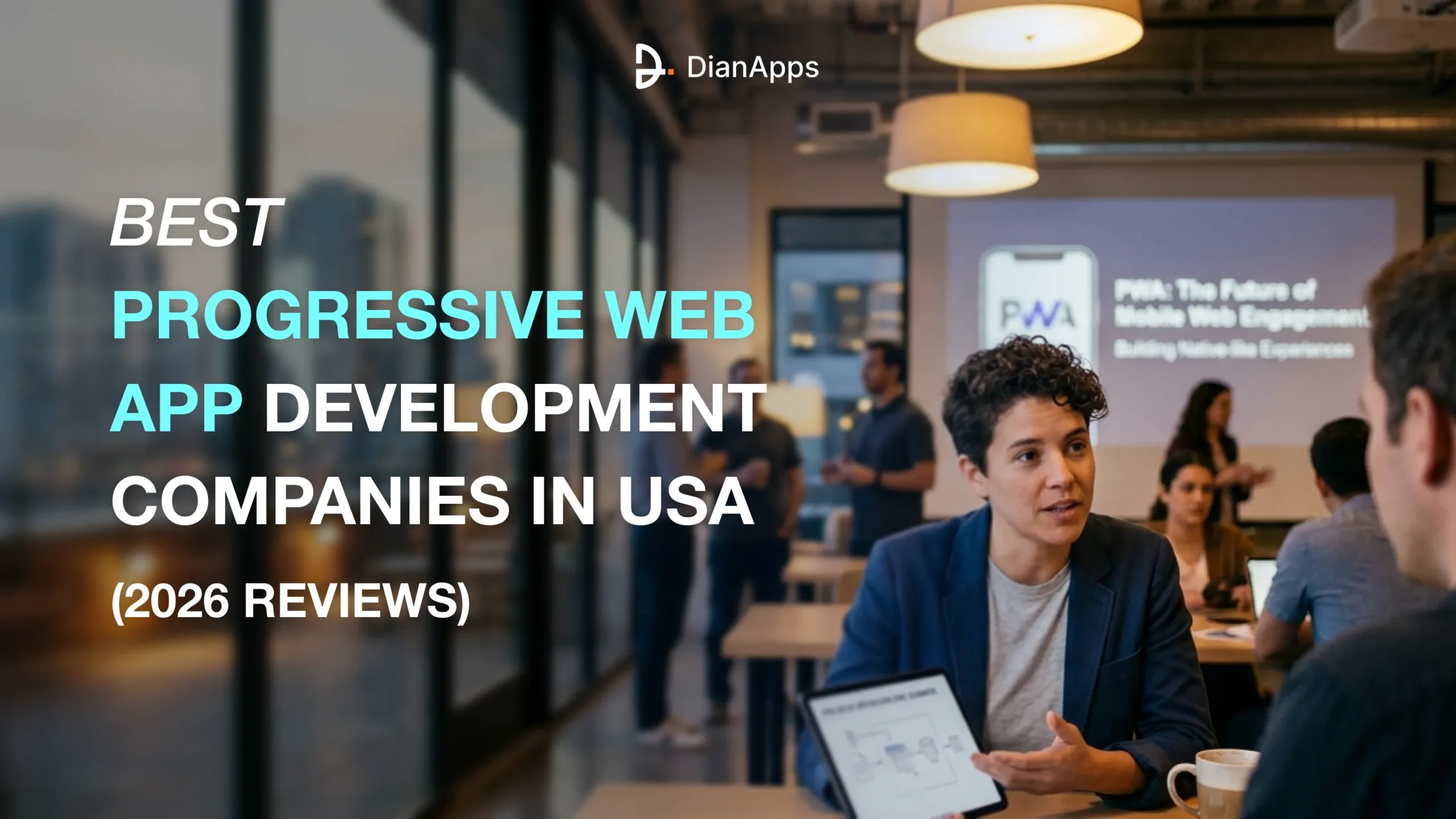
Top Progressive Web App Development Company USA
| Quick Summary:
The global PWA market sits at an estimated $3.14 billion in 2026 (Research Nester), up 27% from $2.47B in 2025. Mobile now accounts for 62–64% of all web traffic worldwide. Companies that have switched to PWAs are reporting conversion lifts between 36% and 76%. If you’re evaluating vendors right now, start with the questions in the hiring section before you touch anyone’s portfolio. |
You search “top Progressive Web App development company,“ and the results are mostly the same recycled list. Same agencies. Same vague descriptions. Half of them aren’t even based in the US; they just have a contact form with a US area code. Meanwhile, the technology itself has moved on.
So let’s do this differently.
This isn’t a sponsored ranking or a list curated with names to hit a round number. These are seven mid-size, USA-headquartered firms that actually know how to build progressive web apps in 2026, not 2022-era PWAs, but build that account for AI-native architecture, edge deployment, and the fact that iOS push notifications finally work properly. We’ll tell you what each company is genuinely good at, who they’re wrong for, and what questions you should be asking before any contract gets signed.
Why Does the PWA Market Matter Right Now?
Okay, fair question. You’ve probably seen PWA hype come and go. So why is 2026 actually different?
Three things have changed since even 18 months ago, and they matter for anyone hiring a developer today.
Mobile traffic passed the point of no return
As of early 2026, mobile accounts for 62–64% of all global web traffic. In the US, it’s around 56.75%. And here’s the uncomfortable number: mobile users convert at just 2.2%, compared to 4.3% on desktop (Quantumrun). That gap isn’t mostly about screen size it’s about load time, checkout friction, and experience quality. Well-built PWAs close most of that gap. Badly-built ones don’t.
iOS finally got proper PWA push support
For years, “PWA” on iPhones meant a degraded experience: no push notifications, awkward install prompts, and inconsistent behavior. iOS 16.4+ changed that. Web push now works properly across both major mobile platforms. That removes the biggest argument businesses had for building a separate native iOS app just to reach iPhone users.
AI has entered the PWA stack at the infrastructure level. This one’s less talked about. WebGPU, WebAssembly SIMD, and the Web Neural Network API (WebNN) now let PWAs run on-device AI inference, meaning image classification, NLP, and personalization can happen client-side without a server round-trip. AI-generated service worker caching strategies can adapt in real time to actual user navigation patterns, producing sub-100ms repeat load times even on patchy 3G. A firm that built great PWAs in 2023 but hasn’t kept up with these changes is building something dated today.
The market reflects this momentum. The global PWA market is projected to grow from $3.14 billion in 2026 to $34.58 billion by 2035 at a 30.2% compound annual growth rate. North America holds 33.1% of that market, driven by US tech infrastructure and the heavy concentration of PWA platform providers domestically (Coherent Market Insights).
Want to understand what features and cost you’re actually looking at before you talk to anyone? The progressive web app development benefits, cost, and features guide lays it out plainly.
What Should You Actually Ask a PWA Development Company Before Hiring?
Most people skip this step and go straight to portfolios. That’s a mistake. Portfolios show what a company has done, not whether they’re going to work well with you or whether their team actually understands the technical problems in your specific project.
Here are the questions worth asking before anything else.
Can you show me Lighthouse scores from a production build in the last 12 months?
Not a staging environment. Not a demo. A live app they built and shipped. You want to see performance, accessibility, best practices, and SEO all clearing 90. Below 85 on performance is a real warning sign in 2026, when Lighthouse benchmarks are well-understood, and most modern frameworks make high scores achievable.
How do you handle service worker updates across browser versions?
This is the question that filters out teams that have only ever built a PWA for launch, not maintained one in production. Cache invalidation, versioning, and rollback strategies are things you only understand if you’ve dealt with them breaking in production. If they can’t walk you through their approach clearly and specifically, move on.
Do you deploy to the edge, and how does that affect your architecture decisions?
Edge deployment Cloudflare Workers, Vercel Edge Functions cuts time-to-first-byte in ways that matter specifically on mobile networks. A team that’s still defaulting to traditional CDN delivery for performance-sensitive PWAs either isn’t current or isn’t building the kind of PWA your business needs.
What does your post-launch support look like, specifically?
Not “we offer support.” Specifically. What’s the SLA? How do browser API changes get tracked? When iOS releases a new version and push notification behavior shifts how do they catch it and how do they fix it? A PWA isn’t a website you hand off and forget. You need a partner who treats maintenance as a real engineering responsibility.
Have you built anything in our industry?
Healthcare, finance, and e-commerce each have compliance requirements that change the architecture. HIPAA, PCI-DSS, and GDPR aren’t checkbox items. A team that’s never navigated them in production will figure it out on your project. Which means you pay for their learning curve.
Building on React? The technical patterns that show up most in production PWA builds, caching, state management, and service worker integration, are covered in this high-performance web app development using React.
The 7 Best Progressive Web App Development Companies in the USA Right Now
These seven companies are all US-headquartered. None of them are the mega-agencies that charge $400/hr and assign you a junior team. None are overseas firms with a US PO box. They’re mid-size shops with real portfolios, honest pricing, and the kind of team size where you can actually get a senior developer’s attention.
1. DianApps
Since: 2018
Team: 100–150 people
Rate: $25–$49/hr
Minimum project: $5,000+
DianApps is an AI-first product development company based in St. Petersburg, Florida. Since 2018, they’ve shipped 450+ projects mobile apps, custom software, UI/UX, and progressive web apps built across React, Angular, Vue, and Node.js. The thing that makes them different from a lot of firms in this price range is the end-to-end ownership: they don’t just write code and hand it over. Discovery, UX strategy, build, testing, launch, post-launch support the whole thing.
Their client list includes Freshworks, CaratLane, Minimalist, and Khatabook. Not household names for most readers, but companies with genuinely high product standards and global user bases. That’s the kind of pressure that builds real engineering discipline.
The price range $25 to $49 per hour works because of their US-headquartered, globally-staffed model. Project minimums start at $5,000 for lean MVPs and go up to $300,000 for enterprise builds. Most of their clients sit somewhere in the middle.
In 2026 specifically, what’s worth noting is their AI integration depth. They’re not just adding chatbots they’re building personalization layers, on-device inference architecture, and AI-informed product flows into web applications. If you want a full stack web application services that can evolve with client-side AI capabilities without a complete rebuild in two years, that matters.
Their Clutch rating sits above 4.8, and client reviews consistently mention communication quality and delivery consistency the two things that most commonly go wrong with offshore or mixed-team development.
Best for: Startups and growth-stage companies that want a full product partner, not just a dev shop that takes tickets.
Not ideal for: Large enterprises that require on-site team presence or strict single-country staffing.
2. SynergyTop
Since: 2014
Team: 50+ people
Rate: $30–$70/hr
Minimum project: $10,000+
SynergyTop was founded in San Diego in 2014 by Jayesh Totla, who has 20+ years of industry experience and still leads projects directly. They’ve built 200+ websites, 50+ mobile apps, and 100+ e-commerce platforms a lot of which use PWA architecture mostly for small and mid-market clients in retail, healthcare, construction, and manufacturing.
What makes them relevant in 2026 is their headless architecture experience. For e-commerce PWAs specifically, decoupling the frontend from the backend is what produces the performance gains that actually show up in conversion data. SynergyTop understands that separation well. They work across React JS, Angular, Node JS, and various cloud environments the standard modern PWA stack.
Client reviews are notably consistent on two things: they respond quickly and they don’t slip timelines. That sounds like low-bar praise until you’ve worked with a firm that doesn’t have those qualities. For SMBs running lean operations, a team that manages itself well is genuinely valuable.
Best for: E-commerce businesses and mid-market companies looking for technically solid PWA work at a price that doesn’t require CFO approval.
Not ideal for: Projects that need heavy compliance documentation or regulated industry experience.
3. Saritasa
Since: 2005
Team: 140+ people
Rate: $100–$149/hr
Minimum project: $25,000+
Saritasa is the most tenured firm on this list by a significant margin founded in Newport Beach in 2005 and now 140+ employees strong. They’ve worked with iHeartMedia, Yamaha, Toyota, Sony, Verizon, and St. Jude Medical. When you’ve shipped projects at that level, you’ve learned to handle complexity that most boutique agencies have never encountered.
Their particular strength is technically demanding integrations IoT, AR/VR, medical devices, industrial hardware, legacy enterprise backends. If your PWA needs to connect to a sensor array, talk to a hospital’s EHR system, or integrate with manufacturing floor equipment, Saritasa has done that kind of work in production. They won Inc.’s 2025 Power Partner Award, which reflects sustained delivery quality across a varied client base.
They’re also one of the more expensive options here. At $100–$149/hr, a mid-complexity PWA project will run $80,000–$200,000. That’s the right budget for complex integration work. It’s too much for a straightforward web app with offline capabilities.
Best for: Life sciences, manufacturing, or high-technology companies where integration complexity is the actual hard problem not the frontend.
Not ideal for: Startups or SMBs with lean budgets and straightforward feature sets.
4. Sidebench
Since: 2012
Team: 40 people
Rate: $150–$199/hr
Focus: Healthcare and enterprise
Sidebench is a Santa Monica-based product strategy and development studio founded in 2012 by Kevin Yamazaki. They’ve worked with Children’s Hospital Los Angeles, UCSF Innovation, American Heart Association, IEHP, Red Bull, Microsoft, NBCUniversal, and Sony Pictures. The LA Business Journal named them 2023 Innovator of the Year.
Here’s what makes Sidebench different from most firms at any price point: their process starts with strategy and UX research before a single line of code is scoped. They audit the problem, map user behavior, figure out where existing solutions fall short, design the experience around actual user needs, then build. For healthcare and enterprise clients where a technically perfect app that nobody actually uses is a very real failure mode that sequence matters enormously.
The price is the highest on this list. At $150-$199/hr, you’re not looking at small-budget work. And honestly, this level of engagement only makes sense if you have a clearly defined product problem, an established user base, and the organizational capacity to act on what their research surfaces. If you’re still figuring out what you’re building, Sidebench will help you figure it out and you’ll pay accordingly.
Best for: Digital health companies, HIPAA-compliant platforms, and enterprise product teams that need systems integration depth alongside first-principles UX.
Not ideal for: Early-stage startups that don’t yet have product-market fit.
5. Neetable
Since: 2015
Team: 50–100 people
Rate: $25–$49/hr
Neetable is an Austin-based web and mobile development company with US-based project management and a distributed development team. React and Angular web applications are their bread and butter, with real PWA work across e-commerce and enterprise software verticals.
Their model solves a specific problem: you want US-based accountability without paying US-only rates for every hour of engineering work. Project managers are domestic and reachable during normal business hours. Development runs globally but is closely supervised. For clients who’ve burned by pure offshore engagements before communication gaps, quality inconsistencies, timezone delays Neetable’s hybrid structure is a genuine alternative.
They also handle on-demand web app development well, where the scope evolves iteratively based on user feedback rather than being locked in at the start. If you don’t have a complete spec (and most realistic early-stage projects don’t), that adaptability matters. The on-demand web app development tips and costs breakdown explains how that model differs from fixed-scope development.
Best for: Companies that need domestic accountability and competitive pricing particularly those with evolving or incomplete requirements at the start.
Not ideal for: Projects with strict regulatory compliance or complex hardware integrations.
6. ITRex Group
Since: 2009
Team: 100–200 people
Rate: $50–$99/hr
ITRex Group has been building enterprise and mid-market software from Boca Raton, Florida since 2009. They’ve delivered 500+ solutions across retail, healthcare, entertainment, and education long enough to have navigated real production complexity across a lot of different technical environments.
What stands out in 2026 specifically is their AI and IoT integration depth. These aren’t capabilities they bolt on as afterthoughts they’re core to how ITRex approaches web application architecture. If you’re building a PWA that needs predictive caching, AI-personalized push notifications, client-side ML inference, or real-time sensor data integration, ITRex has shipped that kind of work in production. Most firms on any list at this price point haven’t.
They’re also genuinely framework-agnostic. React, Angular, Vue, vanilla web components the choice is driven by what the project requires, not what their team prefers. For businesses evaluating how different frameworks hold up under production PWA demands, the leading frameworks for web application development comparison is worth a read before that conversation.
Best for: Data-intensive, AI-integrated, or IoT-connected progressive web apps where the technical differentiation comes from the data layer, not just the UI.
Not ideal for: Design-led projects where the competitive advantage is primarily visual experience quality.
7. Fireart Studio
Since: 2015
Team: 50–100 people
Rate: $50–$99/hr
Fireart Studio is a Chicago-based design-led development firm with documented work for Google, Dropbox, and Ring. That client history matters not because of the names themselves though those are real quality signals but because of what you learn building products for companies whose users have 50 competing apps on their phone and zero tolerance for a janky first session.
Their focus is SaaS products and consumer digital tools, where the UX has to feel genuinely native, not “pretty good for a web app.” They design before they build not as a handoff process, but as an integrated part of development, where UI and interaction decisions are made with engineering constraints in the room. That prevents the expensive back-and-forth that happens when design gets thrown over the fence to developers.
In 2026, for any PWA that competes directly with native apps in the consumer or SaaS space, first impressions determine retention. A PWA that feels even slightly off in its first session loses users before they give it a second chance. Fireart’s strength is making that first session feel earned. For a broader view of the framework choices that typically support this kind of design-quality PWA work at scale, the AI and PWA development frameworks overview covers what’s being adopted globally.
Best for: SaaS companies and consumer product teams where the design experience is the core competitive differentiator.
Not ideal for: Enterprise projects where compliance and integration architecture dominate over UX design.
What Does PWA Development Actually Cost in 2026?
The honest answer is that costs have changed from what you’ll find in most guides in both directions.
At the simple end, AI-assisted development has reduced hours for boilerplate and routine implementation. 84% of developers now use AI coding tools, and roughly 41% of code written in 2025 was AI-generated. For straightforward PWA builds, you may see lower estimates from firms that have integrated these tools into their workflow. The savings are real.
At the complex end, costs have held steady or risen slightly, because the hard parts architectural decisions, integration logic, compliance requirements, data migration are still engineering problems that AI tools don’t reliably solve.
Here’s a realistic breakdown for 2026:
Basic PWA: $10,000 to $35,000
You’re getting proper service worker implementation, HTTPS, a web app manifest, offline fallback, Lighthouse scores above 90, browser/device testing, and a basic support period. This covers most straightforward informational or lead-gen applications. Timeline: 6–10 weeks.
Mid-complexity PWA: $40,000 to $120,000
Custom backend integration, push notifications, real-time data sync, authentication flows, multi-device responsive design, performance optimization for mobile networks. This is where most serious business applications land the kind of thing that actually competes with native apps. Timeline: 3–5 months.
Enterprise PWA: $150,000 and up
Complex API ecosystems, regulatory compliance (HIPAA, PCI, GDPR), IoT or AI feature integration, edge-deployed architecture, custom analytics, and multi-environment testing. These projects are rarely finished in under 9 months. Some run 12–18 months when deep compliance work is involved.
One thing worth knowing: the biggest cost driver in 2026 is rarely the PWA build itself. It’s the integrations legacy backends, third-party APIs, compliance requirements, and data migration. Any firm that gives you a hard number without a discovery conversation first is quoting a different project than the one you’ll actually need to build.
What Does the 2026 PWA Tech Stack Look Like?
This section is for people who want to evaluate a vendor’s technical current-ness without being a developer themselves. Ask about these you’ll be able to tell whether they’re current by how they respond.
Frameworks
Next.js 15/16 and Astro lead new builds for performance reasons. React is still the most common underlying library and isn’t going anywhere. Angular is solid for enterprise teams that want strong typing and opinionated architecture. The choice should be driven by project requirements and team expertise, not trends.
Service worker tooling
Workbox remains the standard. But watch for firms mentioning AI-augmented caching strategies where user navigation patterns inform cache policies automatically rather than through hand-authored rules. That’s a 2025-2026 development and it meaningfully affects performance on complex apps.
Deployment
Edge deployment via Cloudflare Workers, Vercel Edge, or Deno Deploy is the current performance default for PWAs. If a team isn’t mentioning edge deployment in the context of mobile performance, they’re probably not current.
Push notification
Both iOS (16.4+) and Android now support web push at feature parity. The historical iOS limitation is gone. Any business that was holding off on PWA investment because of iPhone push support can stop holding off.
AI capabilities
WebNN, WebGPU, and WASM SIMD are the hooks for on-device AI in PWAs. You don’t necessarily need them today, but an architecture that doesn’t account for them will need a significant rework when you do.
Final Words
The companies profiled here DianApps, SynergyTop, Saritasa, Sidebench, Neetable, ITRex Group, and Fireart Studio cover a meaningful range of specializations, price points, and team sizes. All are US-headquartered. None are the massive agencies that assign junior teams to clients who expected senior attention.
DianApps for end-to-end AI-first product development. SynergyTop for e-commerce and mid-market reliability. Saritasa for complex hardware and enterprise integrations. Sidebench for health tech and UX-first product strategy. Neetable for hybrid-model flexibility at competitive rates. ITRex for AI-integrated and data-intensive builds. Fireart for design-led SaaS and consumer products.
Before you contact any of them, pull your current mobile traffic data, your conversion rate on mobile versus desktop, and your Lighthouse score if you have one. Those numbers will anchor your first conversation and help you get a useful scope estimate instead of a generic proposal.
That’s a better first step than any sales call.
 0
0