















 0 comments






Most businesses don’t go looking for custom software development. They arrive at it, usually on a Friday afternoon, after someone has spent three hours reconciling a spreadsheet with two systems that were supposed to talk to each other. The subscription tool does most of what you need; it’s the gap between “most” and “all” that costs you every week.
That gap is why custom software development has grown into a market worth around $50 billion a year, growing at roughly 17 percent annually, and why a custom software development company now sits on the shortlist of businesses that would never have considered building their own software five years ago. The tools got cheaper, cloud made hosting simple, and AI-assisted engineering shortened the mechanical parts of a build. What didn’t change is the reason to do it: software that fits the way you actually work beats software you have to work around.
This guide covers what custom software development is, why a business should consider it, the benefits that hold up in practice, what it costs in 2026 (with figures for Australia, where we have an office, as well as global rates), best practices, and how to choose a partner.
What is Custom Software Development?
Custom software development involves the design, development, testing and maintenance of software that is tailor-made for a particular company based on its business processes, In essence, custom software development will involve many different forms of applications such as a simple application used to replace three spreadsheets. What they share is that nobody else has exactly this software, because nobody else has exactly your process.
It’s usually delivered by custom software development services from an external partner, a software development agency or a custom software development company with the engineers, designers and project managers to run the full lifecycle. An in-house team can do it too, but most businesses don’t have one, and building one for a single project rarely makes sense.
It’s usually delivered by custom software development services from an external partner, a software development agency or a custom software development company with the engineers, designers and project managers to run the full lifecycle. An in-house team can do it too, but most businesses don’t have one, and building one for a single project rarely makes sense.
Two things are now the default assumption in 2026 rather than extras: most custom software is cloud-based (well over half of new projects), and a growing share includes AI features such as document processing, recommendations or assistants where they earn their place.
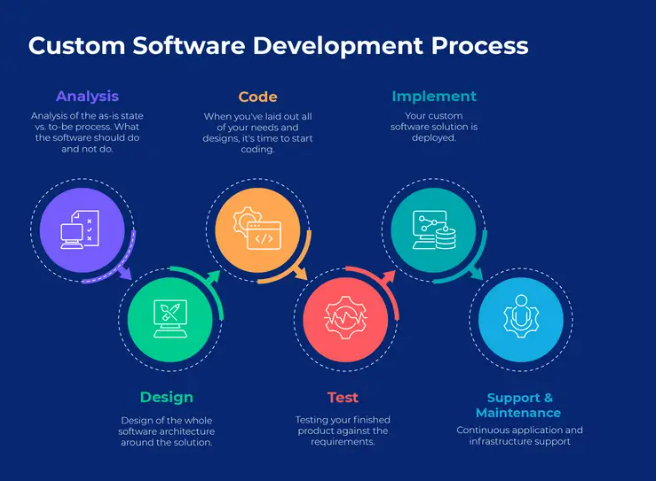
Custom Software Development Process :
Every serious custom software project runs through the same six stages, and the first two decide whether the rest goes to plan.
- Discovery and planning. Define the business goal and the metric the software should move. Map the current process, including the workarounds nobody wrote down. Agree what’s in scope for launch and what waits.
- Requirements and architecture. Turn needs into functional, non-functional and integration requirements. Choose the stack, data model and hosting. Plan data migration and user roles.
- UI/UX design. User flows, wireframes, a clickable prototype tested with the people who’ll use it daily, then final screens. Adoption is decided here, not at launch.
- Two-week sprints with a working build on staging after each. Integrations built alongside features, not after them.
- Unit, integration and end-to-end tests throughout; user acceptance, load, security and accessibility testing before launch.
- Launch and support. Deployment, data migration, training, documentation, then a warranty period and a defined maintenance plan.
Why Should a Business Use Custom Software Development?
If any of the above situations exist, the business needs to consider custom software development in order to avoid workarounds, incompatibility with the systems that the company uses, pay-by-seat cost model for unused functionalities, the inability to satisfy compliance requirements, and if the software itself is the company’s product. Otherwise, a properly configured subscription tool will be a cheaper option. Moreover, a good custom software development firm will point this out during the initial meeting.
The rule of thumb here is simple: if you spend several hours a week entering the same information manually in order to work around an issue in software, custom software development will pay for itself in 2-3 years. If it’s close to zero, keep the subscription.
Benefits of Custom Software Development
The benefits below are the ones that show up in real projects, not the ones in vendor brochures.
-
Improved Flexibility & Scalability
Custom software is built around your process, so it includes what you need and leaves out what you don’t. When the business changes, a new region, a new product line, a new integration, an AI feature, a well-architected system takes it in stride. A subscription product takes it on the vendor’s roadmap, if at all.
Scalability works the same way. Cloud-native custom software can be scaled up for a seasonal peak or a new market and back down again, without renegotiating a licence tier.
-
Custom Software is Cost-Effective
Custom software costs more in year one and, for most growing businesses, less by year three or four. Off-the-shelf tools look cheaper at signing, but per-seat licences, paid add-ons, integration middleware and the labour cost of workarounds add up quietly. You also pay for features you never open.
With custom software you pay for what you use, own what you pay for, and stop renting the same capability every month. Businesses in Australia doing genuinely new development can also offset a meaningful share of eligible costs through the R&D Tax Incentive, which is worth raising with your accountant before you scope a project.
-
Fast Software Integration
Most businesses already run an ERP, a CRM, a payment gateway, an identity provider and a handful of specialist tools. Packaged software connects to the systems its vendor chose. Custom software connects to yours, through documented APIs designed for the job, so data flows once and is re-keyed nowhere.
The practical benefit is one system of record. A referral, an order or an approval doesn’t live in three tools, and the person who used to reconcile them gets their Friday afternoon back.
-
High Reliability and Security
Off-the-shelf software is a bigger target because its vulnerabilities are public and shared by every customer. Custom software has a smaller attack surface, and its security can be designed for your regulatory environment from the first sprint: encryption at rest and in transit, role-based access, audit logs, and the controls your industry requires, whether that’s HIPAA, PCI DSS, GDPR or the Australian Privacy Act.
That last one matters more in 2026. The Privacy Act small business exemption is being removed through this year’s reforms, bringing most Australian businesses that handle personal data under full privacy obligations, and WCAG 2.2 AA is now the expected accessibility standard for public-facing software. Custom software built by a partner who knows those rules meets them by design rather than by audit.
Reliability follows from the same discipline: the software is tested against your requirements, load-tested against your traffic, and monitored in production, because it was built for you rather than for an average customer who doesn’t exist.
-
Continuous Support & Maintenance
Package software manufacturers cease supporting their product line, remove capabilities and manage their support via queues. Custom software comes with a partner who made it, understands it, and is committed to maintaining it: a warranty period followed by maintenance services including security updates, library dependency management, minor features implementation and incident resolution.
Allocate 15 to 20 percent of the development budget every year for this purpose. Software without a maintenance strategy ages poorly, and those who choose not to invest in one rebuild it in eighteen months.
Not sure whether custom software is the right call?
A 30-minute discovery call with DianApps will tell you honestly, including when a well-configured off-the-shelf tool is the cheaper answer. No proposal, no pressure, just a clear recommendation.
How Much It Costs to Create Custom Software?
The truth is that it varies depending on your requirements, but not as dramatically that you won’t be able to create a budget. Internal applications that replace some spreadsheets are within the $20,000 to $50,000 price range (USD). Minimum viable product that you can demonstrate to actual users costs between $30,000 and $80,000. Business application with several user roles and reporting is priced starting from $80,000 to $250,000, whereas ERP systems will cost not less than $200,000 and more than $600,000 in some cases.
For development of custom software solution that suits your particular needs, the salary of skilled developers in Australia in 2026 will be between AUD 180 and 260 per hour at boutiques in Sydney and Melbourne, AUD 120 and 200 per hour at mid-size agencies in Brisbane, Adelaide, and Perth, and AUD 60 and 90 if the project involves Australian office but engineering delivered abroad. Internal tool/MVP will cost AUD 20,000 and 120,000 per hour depending on the provider tier; mid-level system – AUD 60,000 and 350,000; enterprise platform – AUD 150,000 and over one million. Remember that there is GST.
Four things drive the number more than anything else:
-
Project Difficulty
Complex logic, unusual integrations, real-time features, compliance requirements and AI components all add engineering time. AI features in particular add both build cost and a running cost for inference that needs to be forecast before launch.
-
Software Size
The number of screens, user roles and workflows. A two-role internal tool and a six-role customer platform are different projects even if the feature list looks similar.
-
The size, knowledge, and location of the team
A senior team costs more per hour and usually less per project, because it finishes faster with fewer bugs. Location sets the rate band: North American and Western European agencies at the top, Australian boutiques close behind, blended and offshore teams well below for comparable senior work. Many businesses now choose a software development company Australia-based but blended, one that pairs a local contact with offshore engineering, which lands rates near the bottom of the band without losing same-timezone accountability.
-
Timeline for delivery
Longer projects cost more, but rushed projects cost most, because skipped testing and integration shortcuts turn into rework after launch. Internal tools and MVPs take two to four months, mid-complexity systems four to six, enterprise platforms six months to a little over a year.
Best Practices for Custom Software Development
A custom software project rewards discipline more than ambition. The practices that make the biggest difference:
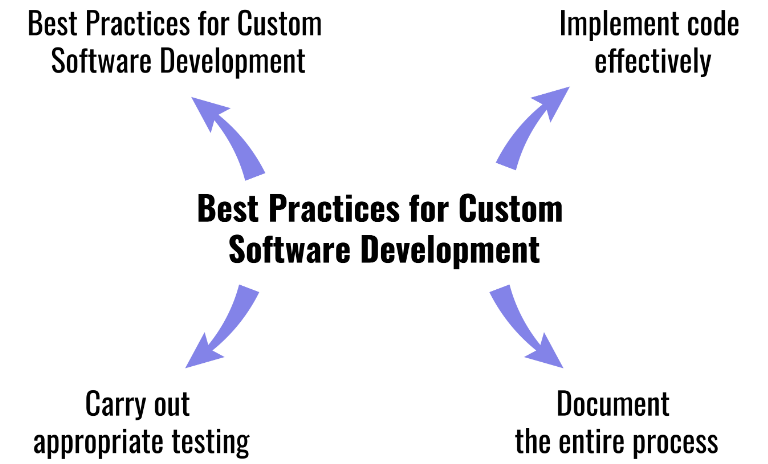
- Start with a metric, not a feature list. Name the number the software should move and the target. Every scope decision gets easier.
- Invest in discovery and architecture before code. The first two stages are cheap; rewriting a data model in month six is not.
- Plan integration and data migration first. The legacy system nobody mentioned at kickoff is the most common reason a launch slips by a quarter.
- Build in sprints and review every one. A working build every two weeks catches misunderstandings while they’re cheap to fix.
- Test continuously, then test with real users. Automated tests through development; user acceptance, load and security testing before launch.
- Document as you go. Architecture, decisions, APIs and runbooks, so the software isn’t dependent on the people who built it.
- Budget for the first year after launch. Warranty, maintenance and the iteration that turns a launched product into a used one.
With all of this in mind, you might wonder if there are already developed solutions that might assist you in creating your software.
Want a real number instead of a range?
Share your requirements and DianApps’ Australian team will send a phase-wise estimate within two business days, with GST, timeline and what you’ll own at handover spelled out.
Build your Custom Software With DianApps
DianApps is a custom software development company with more than eight years and 350-plus delivered projects behind it, and a software development company Australia clients can reach locally, working from offices in Australia (Mindarie, Western Australia), the USA, Canada, the UAE and India. For Australian clients that means a local contact who understands GST, the 2026 Privacy Act changes and WCAG 2.2 AA, backed by a 150-plus engineering team that keeps rates in the blended-delivery band.
Our custom software development services cover internal tools and workflow systems, ERP and back-office platforms, SaaS products, customer portals, mobile apps, AI-enabled features, Salesforce development and cloud engineering. The process is the six stages above, run with weekly demos, milestone-based payment and a written change-order process, and you own the code, repositories, cloud accounts and data from day one.
Australian work worth knowing: APIAM, Australia’s largest animal healthcare group, where the platform we built cut operational cost by 75 percent across 50-plus sites; and Data Pig, digitising pig health and production data for the Australian pork industry. Globally, KhataBook (50M+ users), CaratLane and Orby’s enterprise AI platform. Clutch rates DianApps 4.8 out of 5, Premier Verified.
If you’re comparing custom software development companies, we’re glad to be one of the conversations. We’ll scope the project honestly, tell you if off-the-shelf is the better answer, and give you a phase-wise estimate rather than a range.
Final Words
Custom software development in 2026 is less about whether you can afford to build and more about whether you can afford to keep working around tools that don’t fit. The businesses that get it right decide early which processes genuinely need custom software, invest in discovery and architecture before code, budget for integration and maintenance, and choose a software development agency on evidence rather than the pitch.
Whether you’re looking at software development Australia-wide or anywhere else, the same checks apply: verifiable projects in your industry, a process that starts with discovery, a stack they can justify for your project, ownership terms in writing, and a support plan that outlives the launch. Get those right and custom software stops being a cost and starts being the thing your competitors can’t subscribe to.
 0 comments












Leave a Comment
Your email address will not be published. Required fields are marked *