















 0 comments





Key Takeaways:
|
You’ve validated the market, secured the budget and decided that off-the-shelf software won’t work for your business needs something built from scratch, is something which is the right choice for your business. So you open your browser, type in custom software development company, and within minutes you’re staring at a hundred identical websites, all promising agile delivery, dedicated teams, and client-first partnerships.
So, you hire one development company, but three months later, the project is behind. The team leads you met during the sales pitch have been replaced. The software in the first sprint barely resembles what was agreed upon. And every concern you raise is met with a change order.
Sound familiar?
It should because it’s not a rare story. It’s practically a situation for most of the businesses investing in custom software for the first time.
But here’s the thing: it’s entirely preventable. Choosing a custom software development firm is not a strategic exercise. It’s a trust decision made under information asymmetry; the vendor knows far more about the software than you do. Your advantage is knowing what to look for before the contract is signed, and knowing which answers should end the conversation immediately.
This blog doesn’t repeat the generic advice you’ve already read. It gives you a sharp, research-backed framework to evaluate vendors with the confidence of someone who’s seen what works and what doesn’t.
The Market Context: Why Getting This Right Has Never Mattered More
The global custom software development market is currently valued at $50.94 billion in 2026 and is projected to reach $115.95 billion by 2031, growing at a CAGR of nearly 18%. Custom development is expanding almost twice as fast as the broader software market.
What’s fueling this sudden change? Three forces are converging simultaneously:
- AI integration demands that off-the-shelf tools simply can’t accommodate 78% of organizations that are now using AI in at least one business function, and bespoke software is the primary vehicle for meaningful AI adoption.
- Regulatory pressure is mounting globally, with average GDPR fines reaching $2.8 million in 2024, a 30% increase from 2023, making compliance-by-design a non-negotiable for most industries.
- Acute talent shortages are pushing businesses toward outsourced development partners 87% of companies reported current or expected developer shortages in 2025.
The opportunity is enormous. So is the risk. A booming market attracts world-class firms and opportunistic vendors in equal measure. Without the right framework, they look identical on paper.
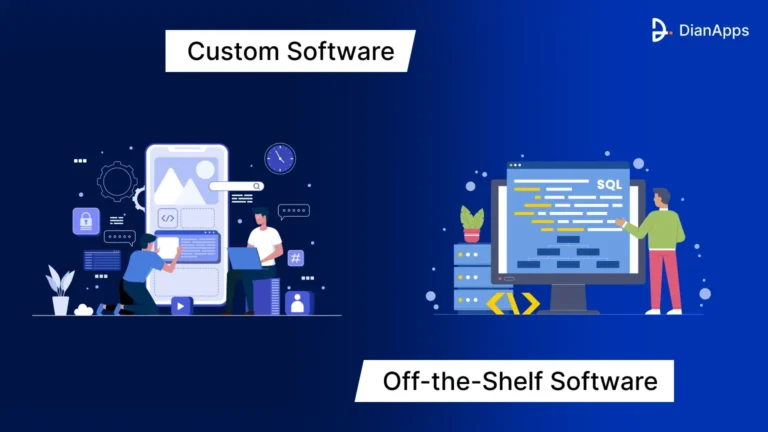
Still analyzing whether custom software is the right path? Read our detailed breakdown on Custom vs. Off-the-Shelf Software: Which Is Right for Your Business?
What to Look for in a Custom Software Development Company
Here are some of the important pointers that will help you in making the right decision while selecting an accurate custom software development services for your business requirements:
1. A Discovery-First Approach: They Ask Before They Propose
The clearest signal of a credible custom software development agency arrives in the first conversation. Do they open with questions or with a price? Any vendor that produces a proposal within 24 hours of an initial call without a structured discovery session is applying a template to your business. That’s not competence. That’s a red flag dressed as efficiency. Genuine partners run discovery sessions before quoting anything, because they understand that the quality of the solution depends entirely on the quality of the problem definition.
What Good Looks Like:
- Structured discovery phase (sometimes a paid engagement) before any proposal
- Phased proposals that account for uncertainty and evolving requirements
- Engineers and product thinkers, not just salespeople, leading the discovery conversation
2. Portfolios Built on Outcomes, Not Just Output
Every custom software development company has a portfolio. What separates a real partner from a polished agency is whether their case studies answer one question: what actually changed for the client? UI screenshots and tech stack badges are aesthetics. You need to see before/after narratives processing time reduced, user adoption rates, revenue impact, and operational cost savings. If a vendor’s portfolio is full of product screens and short on numbers, they’re showing you what they built, not what they delivered.
Questions to Ask:
- Walk me through a project that didn’t go as planned. What did you do?
- What were the measurable outcomes for this client six months post-launch?
- Can I speak directly to the product owner or CTO on this case study?
3. Full Transparency on Who Actually Builds Your Product
The ‘senior team switch’ is one of the most pervasive problems in the software outsourcing world. During sales, you meet senior architects and confident project managers. After signing, your project is quietly transferred to junior developers you’ve never met. Before any engagement, insist on knowing who will build your product. Ask for names, LinkedIn profiles, and a technical interview with the assigned lead developer. A vendor confident in their team will welcome this. A vendor who deflects is telling you something important.
What Good Looks Like:
- Named team members committed at the time of signing
- Direct technical interview with the lead developer or architect
- A documented policy for team stability and mid-project replacement
4. Communication Infrastructure Specific Systems, Not Vague Promises
Software projects rarely fail because of bad code alone. They fail because of communication breakdowns, undocumented decisions, informal scope changes, and blockers escalated too late. ‘We keep you in the loop’ is not a communication model. Ask specifically: what tools are shared (Jira, Linear, Notion)? How frequent are sprint reviews? Who’s the escalation point when something goes wrong? Communication quality during the sales phase previews communication quality during the project. Treat it as data.
The development methodology your vendor uses directly shapes how communication is structured. Read: Agile vs. Waterfall for Custom Software Projects: Which Model Wins?
5. Technical Depth That Actually Matches Your Use Case
A company that excels at consumer mobile apps may be poorly suited to build a HIPAA-compliant healthcare platform or a high-volume enterprise SaaS system. Stack expertise and domain expertise both matter. Look for vendors who’ve built in your industry, made technology choices that are maintainable and free from proprietary lock-in, and are genuinely fluent in modern AI tooling, not just claiming it. According to GitHub research, developers using AI assistance tools are 55% faster. A partner still operating without AI integration in 2026 is operating at a structural disadvantage.
Questions to Ask:
- What tech stack do you recommend for this project and why specifically?
- Have you built in our industry before? Can I see that work?
- How are AI coding tools integrated into your current development workflow?
6. A Clear Post-Launch Support Model
Building software is a beginning, not an ending. The first 30-90 days post-launch are where bugs surface, user behavior surprises you, and integrations show friction. Yet many vendors treat deployment as the finish line handing over the code, collecting the invoice, and disappearing. Before signing anything, clarify: what’s the warranty period for post-launch bugs? What’s the cost structure for ongoing maintenance? Will you receive comprehensive documentation and full IP ownership? A vendor without clear answers here is a vendor who considers their job done when yours is just starting.
What Good Looks Like:
- Defined post-launch support SLA with response time commitments
- Bug warranty period of at least 30–60 days at no additional cost
- Comprehensive documentation and clean knowledge transfer process
- IP ownership explicitly vesting in the client upon full payment
7. Security and Compliance Posture Built for Your Industry
If your software handles user data, healthcare records, or payment information, your vendor’s security posture isn’t optional context it’s a core selection criterion. With average GDPR fines reaching $2.8 million and HIPAA penalties in the millions, one compliance failure can cost more than the software itself. Ask whether they hold ISO 27001 or SOC 2 certifications, how they handle data security during development, and whether they’ve delivered in regulated environments before. A credible custom software development company will answer proactively. A vendor who treats security as an afterthought will answer vaguely.
8. Cultural Fit and Collaborative Philosophy
The best custom software partnerships feel like extensions of your team not transactions with a vendor. The right partner brings product thinking, not just code. Push back on features that won’t serve your users. They tell you when a timeline isn’t realistic. If they seem genuinely curious about your business problem, not just the sprint deliverables. Pay close attention to how a company communicates during the evaluation phase. Responsiveness, intellectual honesty, and curiosity before the contract is signed are accurate predictors of the partnership you’ll experience six months into a complex build.
Ready to go deeper into the full vendor selection process? Read: How to Choose a Custom Software Development Company: Complete Buyer’s Guide.
Red Flags to Watch for When Hiring a Custom Software Development Company
The most dangerous red flags rarely announce themselves. They arrive dressed as enthusiasm, flexibility, and competitive pricing. Here’s what to watch for and why it matters.
Red Flag 1: They Agree to Everything Without Pushback
If a vendor validates every requirement, every timeline, and every budget figure without a single question or concern, they don’t understand the scope they want the contract. Real experts challenge assumptions. They’ll tell you when something won’t work or will blow the budget. A company optimizing for the sale will use scope creep and change orders to recover their margin later.
Red Flag 2: The Estimate Is Dramatically Lower Than Everyone Else’s
If one vendor’s quote is 50-70% below others for the same scope, one of four things is true: they’ve underestimated the scope, they’re planning to recover margin through change orders, the project will be staffed with very junior talent, or they’re quoting for something fundamentally different from what you described. Every outcome is a problem. See our Custom Software Development Cost guide for market-rate benchmarks before evaluating any proposal.
Red Flag 3: No Access to Engineers During the Sales Process
If every conversation is brokered by sales representatives and you cannot speak directly with the engineers building your product that’s a serious signal. You’re not buying a commodity. You’re entering a technical partnership. Evaluating the sales team tells you almost nothing about the engineers writing your code.
Red Flag 4: Vague Intellectual Property Terms in the Contract
Any contract with unclear ownership language around source code, documentation, and deployment rights is a contract written to favor the vendor. Before signing, confirm explicitly: who owns the code from day one? Is there a code escrow protocol? Can you access the repository throughout the engagement? If these questions produce vague answers, walk away.
Red Flag 5: Poor Communication Before You’ve Paid Them Anything
If they’re slow to respond during the sales process late on emails, missing scheduled calls, giving unclear answers to simple questions that pattern will only worsen once you’re locked into a contract. Communication quality during courtship is the best available preview of communication quality during the project.
Red Flag 6: High Developer Attrition Above 20% Annually
High staff churn is one of the most underrated risks in vendor selection. Frequent developer turnover means lost institutional knowledge, velocity resets, and constant retraining all funded by your project budget. Ask directly: ‘What is your 12-month attrition rate, and can you guarantee team stability for the duration of this engagement?’
Red Flag 7: AI Everywhere, Substance Nowhere
In 2026, every development company claims AI capabilities. What matters is whether those claims are backed by concrete architecture, governance models, and domain expertise. If every feature in a proposal is ‘powered by AI’ with no explanation of how, why, or what trade-offs are involved that’s marketing language, not engineering strategy. Press for specifics.
Red Flag 8: Resistance to Signing an NDA
Any reputable custom software development company will sign a Non-Disclosure Agreement before you share sensitive product details. Resistance, delay, or vague excuses around an NDA is an early signal that intellectual property protection is not a genuine priority. That’s the last thing you want from someone building your core technology.
Red Flag 9: Generic, Unverifiable Testimonials
Testimonials without named individuals, verifiable companies, or specific project outcomes are marketing filler. A legitimate custom software development company will provide contact information for real clients you can call. If references are unavailable, unnamed, or suspiciously generic, treat it as a warning sign and investigate further.
Red Flag 10: No Formal Scope Change Management Process
Scope changes are inevitable in custom software development. What matters is whether they’re handled through a documented, transparent process or used as an uncapped revenue mechanism. A vendor with no formal change management protocol will treat every evolving requirement as a billable surprise and you won’t see it coming until the invoices arrive. See our Realistic Timelines guide for what this looks like in practice.
Recommended Read: How To Get Accurate Software Testing Cost Estimation?
Questions to Ask Before You Sign Anything
Use these questions as a structured evaluation protocol across every vendor you’re seriously considering. Consistent questions across vendors mean you’re comparing substance, not charisma.
Process and Approach
- What does your discovery process look like before development begins?
- How do you handle requirements that evolve mid-project formally or informally?
- What project management tools will we both have live visibility into?
- How do you define ‘done’ for a sprint and for the overall project?
Team Composition and Stability
- Who specifically will work on my project, and can I interview them before signing?
- What is your 12-month developer attrition rate?
- How do you handle team member replacement mid-project?
- Can you commit named team members for the full duration of this engagement?
Technical Capability
- What tech stack do you recommend here, and why that choice specifically?
- How do you approach testing, QA, and code quality standards?
- Do you hold ISO 27001, SOC 2, or other relevant security certifications?
- How are AI tools integrated into your current development workflows?
Ownership and Legal Terms
- Who owns the source code upon delivery and is this explicit in the contract?
- Will I have access to the code repository throughout the engagement?
- What does your documentation and knowledge transfer process look like?
- What happens to IP ownership if this engagement is paused or terminated early?
Post-Launch Support
- What does your post-launch support model include and at what cost?
- Is there a bug warranty period included, and how long does it last?
- What does a formal project handover look like with your team?
Vendor Evaluation Scorecard
Use this framework when comparing multiple vendors simultaneously. Rate each criterion Green (strong), Yellow (adequate), or Red (concern) across every firm you’re evaluating. Consistent criteria mean you’re comparing results not impressions.
| Evaluation Criteria | Priority | What to Access |
| Discovery process depth | Critical | Do they ask before they propose? |
| Portfolio with measurable outcomes | Critical | Specific before/after results, not screenshots |
| Team Transparency | Critical | Can you interview the actual developers? |
| Communication Infrastructure | Critical | Tools, cadences, escalation paths |
| Post-launch support model | Critical | Defined SLA, warranty, handover plan |
| IP and Contract Clarity | Critical | Explicit ownership, no vague clauses |
| Technical depth & fit | High | Stack expertise matched to your use case |
| Security & compliance postures | High | Certifications, documented practices |
| Cultural fit | Medium | Collaboration style, intellectual honesty |
| Reference Quality | Critical | Named, contactable, project-relevant |
| Pricing transparency | Medium | Detailed breakdown, change management included |
| AI tooling capability | Medium | Concrete AI integration, not just marketing |
Vendors who score Red on any Critical criterion should be removed from consideration, regardless of other strengths. No portfolio aesthetic or cultural charm compensates for IP ambiguity or team opacity.
What the Best Custom Software Development Companies Actually Look Like
In the interest of balance, here’s what consistently distinguishes the finest development partners from the rest of the market:
- They treat discovery as non-negotiable and won’t rush it, regardless of sales pressure.
- They build for the next engineer, code is clean, documented, and readable by anyone, not just their own team.
- They’ve lived through failure and can talk about it honestly. Companies that only share success stories haven’t been tested or aren’t being candid.
- They measure themselves by your business outcomes, not their sprint velocity metrics.
- They actively resist vendor lock-in, they document everything, and make it easy for you to operate independently of them.
Wondering if your business is genuinely ready for custom software? Read: 10 Signs Your Business Needs Custom Software Development, and also look for the Top 10 Custom Software Development Companies in the US for a vetted starting shortlist.
Final Words
Here’s the truth the industry rarely says plainly: the difference between a successful custom software partnership and an expensive failure is almost always decided before a single line of code is written.
The vendor you choose shapes your product’s architecture, its code quality, its compliance posture, its scalability, and most critically whether it actually solves the business problem it was built to solve. That’s not a small call. It demands a rigorous process.
The businesses that navigate this well share one consistent trait: they evaluate vendors the way they’d evaluate a senior executive hire with structure, diligence, and healthy skepticism. They ask the hard questions, speak to real references. Insist them on meeting actual engineers before signing anything. They know that the right custom software development firm won’t just build what you ask for. They’ll help you figure out what to ask for and why.
Seek that kind of partner. Settle for nothing less.
Frequently Asked Questions
 0 comments












Leave a Comment
Your email address will not be published. Required fields are marked *