















 0 comments





Key Takeaways:
|
When we plan to build custom software, the way we build makes a different impact on the result. So, here a serious problem arises: how to decide between Agile vs waterfall while developing custom software.
A fintech startup spent 14 months building a mobile lending app using Waterfall. Requirements were documented, phases were checked off, and everything was “on track.” Then they handed it to real users and discovered the loan approval flow was so clunky that 73% of applicants dropped off before completing it. The entire UX had to be ripped out and rebuilt. From scratch. Fourteen months of work, largely wasted.
This isn’t a story to represent information about bad developers. It’s about a methodology mismatch, choosing a process built for predictability when the project needed flexibility.
Agile vs Waterfall is one of those debates that seems settled until you’re the one staring at a blown budget and a deadline that’s already passed. So let’s cut through the noise. No buzzwords. No obvious answers. Just a clear breakdown of which model actually works and when. And when you have a clear idea of how you should hire the best custom software development company to implement these practices.
What is Waterfall project management? (And why it made perfect sense once)
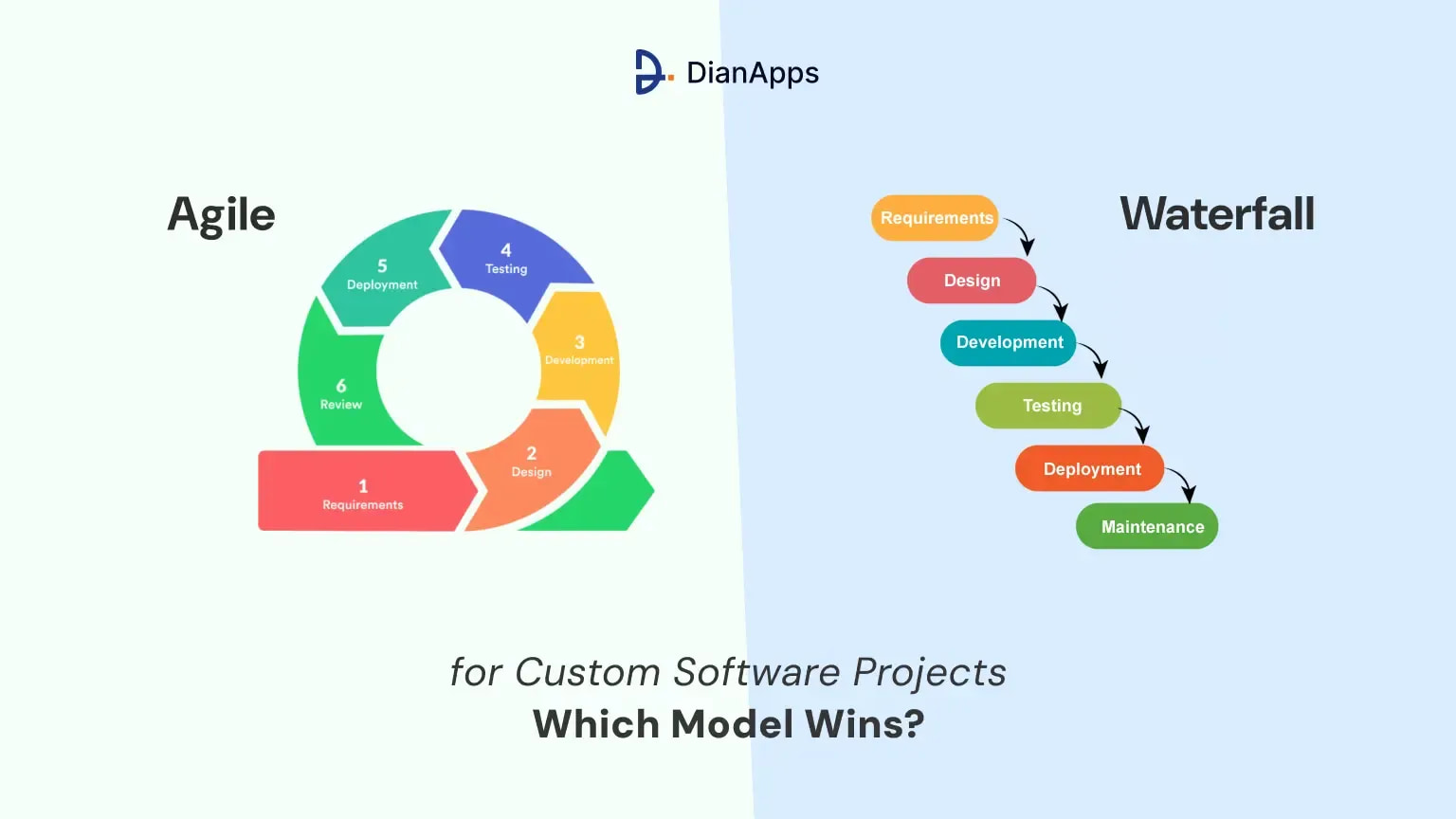
A waterfall is exactly what it sounds like. You start at the top and flow down one phase at a time, in strict sequence. Requirements first, then design, then development, then testing, then deployment. You don’t move to the next stage until the current one is signed off.
It was born out of manufacturing and construction logic. You wouldn’t start pouring concrete before the architect finishes the blueprint. Why would software be different?
The answer, as it turns out, is: because software is different. Requirements change. Users surprise you. Markets shift. What seemed like a clear spec on day one looks very different by month six.
But that doesn’t make Waterfall useless. It still has a home, a very specific one we’ll get to shortly.
What is Agile Project Management?
Agile Project Management is a mindset before it’s a process. The 2001 Agile Manifesto boiled it down to four core ideas: people over processes, working software over documentation, customer collaboration over contract negotiation, and responding to change over following a plan.
In practice, Agile development methodologies mean building in short cycles, usually 2-week sprints, shipping something real, getting feedback, and adjusting. You’re not trying to design everything up front. You’re discovering the best product by actually building it.
Scrum, Kanban, and SAFe are all frameworks that implement Agile principles. They differ in how strictly they structure the process, but the underlying philosophy is the same: ship early, learn fast, iterate constantly.
Agile vs Waterfall Project Management: Here’s the Real Difference
| Dimension | Agile Project Management | Waterfall Project Management |
|---|---|---|
| Project Structure | Linear, sequential phases | Iterative cycles (sprints) |
| Requirements | Locked in before development starts | Evolve throughout the project |
| Client Involvement | Heavy at start, minimal during build | Continuous throughout |
| Delivery Timeline | One final delivery at the end | Working software every sprint |
| Change Tolerance | Expensive and disruptive to change | Changes expected and welcomed |
| Testing cadence | After development is complete | Continuous, within every sprint |
| Documentation | Expensive upfront documentation | Lightweight, just-enough docs |
| Team Structure | Siloed by specialty | Cross-functional collaborative |
| Risk Visibility | Late problems surface near the end | Early issues caught in the sprint |
| Best Team Size | Larger, structured teams | Smaller teams (5–12 people ideal) |
| Cost predictability | Higher upfront predictability | Can vary based on scope changes |
| AI tooling fit | Limited mostly for documentation | High sprint planning, code review, and backlog |
That last row is worth pausing on. AI-assisted development tools GitHub Copilot, Cursor, and Linear’s AI features integrate far more naturally into Agile workflows. Sprint velocity, backlog grooming, and pull request reviews all benefit from AI in ways that rigid Waterfall phases don’t accommodate well.
Real companies, real choices
Here are some of the popular brands whose real choice among agile and waterfall project management strategies is listed below:
Spotify
Used Scrum and Lean from day one. Their “squad model” became a reference for how Agile scales across large product teams.
NASA
Used Waterfall for critical satellite and space shuttle software, where a single undetected bug could be catastrophic, and requirements genuinely don’t change.
Amazon
Famously deploys code every 11.6 seconds on average. Deep Agile culture across micro-teams, each owning their own service end-to-end.
Healthcare EHR vendors
Often use Waterfall for regulated, compliance-heavy systems, then Agile for the patient-facing portals built on top.
Notice something? The highest-stakes, life-or-death software (satellites, aircraft systems, medical devices) leans toward Waterfall. The fastest-moving, user-driven products lean Agile. That pattern isn’t a coincidence; it’s the principle.
When to use Waterfall
Waterfall gets unfairly dismissed by most of the project or custom software developers. The truth is, for specific project profiles, it’s still the right call. Here’s when:
- Requirements are truly fixed: Government contracts, regulatory software, banking core systems, places where the spec is locked by law or client contract.
- Compliance documentation matters: FDA-regulated medical devices, HIPAA-compliant systems, or anything where a paper trail of every decision is mandatory.
- The client is hands-off: Some clients want to define the project, step back, and receive the final product. Agile’s continuous collaboration is a mismatch for this working style.
- Hardware is involved: IoT devices, embedded systems, or any software that must sync perfectly with physical manufacturing timelines can’t afford iterative pivots.
When to use Agile
- You’re building a digital product: Mobile apps, SaaS platforms, e-commerce tools, anything where user behavior shapes the product roadmap.
- Speed to market is critical: A working MVP in 8 weeks beats a “perfect” product in 14 months when market timing matters.
- The market is uncertain: Startups and new product lines rarely know exactly what users want upfront. Agile lets you discover it.
- The team is small and cross-functional: 5–12-person teams with design, dev, and product under one roof thrive in Agile. Large, siloed organizations often struggle.
Recommended Read: Agile Methodology: Prioritizing Initiatives, Improving Productivity
The hybrid model: what nobody tells you
Here’s the thing most people skip over: you don’t actually have to choose. A growing number of successful custom software projects use what’s called a Hybrid model, and it’s not a cop-out. It’s often the most pragmatic answer.
The logic works like this: use Waterfall’s discipline for the things that genuinely need it, and Agile’s flexibility for everything else.
How a hybrid model typically looks in practice
- Phase 1: Waterfall: Gather and lock requirements, define architecture, agree on compliance needs, and get client sign-off on scope boundaries. This is the foundation.
- Phase 2: Agile: Build iteratively within those boundaries. Deliver sprints, collect feedback, and adjust features without renegotiating the core scope.
- Phase 3: Waterfall: Final QA, compliance documentation, security audits, deployment structured and signed off.
This is especially effective for enterprise clients who need contract certainty (Waterfall) but also want a product that doesn’t feel frozen in time (Agile). You give them both.
The biggest mistake teams make with hybrid isn’t the model itself; it’s implementing it without clearly defining which phases are fixed and which are flexible. Without that clarity, you get the worst of both worlds: documentation overhead from Waterfall and scope creep from Agile.
Startup vs. enterprise: Which Model You Should Use Based on Company Size?
Your company size and stage fundamentally change, which model serves you?
Early-stage startups (1–20 people)
Agile almost always wins. You don’t know what your users want yet. Your best strategy is to find out as fast as possible. Waterfall’s rigidity will slow you down at exactly the moment when speed is your only advantage over established players.
Growth-stage companies (50–200 people)
This is where teams often get stuck. Agile works for product development, but cross-team coordination needs more structure. A hybrid with Agile delivery and Waterfall-style quarterly planning tends to work well here.
Enterprise (500+ people)
Pure Agile at scale is genuinely hard. You’re coordinating dozens of teams, compliance needs, legacy integrations, and procurement timelines. Frameworks like SAFe (Scaled Agile Framework) try to solve this, with mixed results. A thoughtful hybrid usually beats either extreme.
- 3× Agile projects are roughly 3x more likely to succeed than Waterfall projects, per the Standish Group Chaos Report, but this gap narrows significantly in large enterprise environments.
- 71% of organizations report using Agile approaches most or all of the time, yet fewer than half say their Agile transformation is “complete,” meaning execution quality varies widely.
That 3× statistic gets cited everywhere without context. It deserves scrutiny: Agile projects in the Standish data skew toward smaller, better-funded, product-led teams, exactly the conditions where Agile excels. Comparing it head-to-head with large government IT Waterfall projects isn’t quite apples to apples.
Recommended Read: Common Misconceptions About Agile Methodology
Agile and Waterfall in 2026: How AI is reshaping both?
Here is something that no one is talking about yet: AI tools are quietly rewriting the economics of both methodologies, but they’re doing it unevenly.
In Agile project management, AI is already changing sprint planning (auto-generating user stories from feature requests), code review (Copilot-style suggestions cutting review time), and backlog grooming (AI flagging duplicate or conflicting requirements). Teams using AI-assisted development are reporting 20-40% faster sprint velocity in early studies.
In Waterfall, the wins are narrower but real: AI is excellent at generating technical documentation, parsing long requirements specs for inconsistencies, and automating test case generation before the QA phase begins.
| The methodology you choose increasingly determines which AI tools you can actually integrate, and that tooling gap will widen as AI matures. |
Remote and distributed teams are also changing the calculus. Agile’s daily standups and sprint ceremonies work fine asynchronously, but they require real discipline to maintain. Some distributed teams are finding that lightweight Waterfall-style planning (clear deliverables per phase, async reviews) actually reduces coordination overhead when the team spans five time zones.
Recommended Read: 10 Signs Your Business Needs Custom Software Development
The human cost: what your team actually experiences
This one barely gets mentioned, but it matters more than people admit.
Agile, done poorly, is exhausting. Continuous sprints with no breathing room, constantly shifting priorities, and the pressure to “always be shipping” are a real burnout risk, especially when teams are managing multiple projects simultaneously. The Agile Manifesto’s emphasis on “sustainable pace” gets ignored surprisingly often in practice.
Waterfall, done poorly, is demoralizing in a different way. Working for months on something you can’t ship, can’t show users, and can’t get feedback on, only to discover it missed the mark, is its own kind of team killer.
Whichever model you choose, the human element needs explicit attention. That means realistic sprint loads in Agile, and genuine milestone check-ins in Waterfall, where the team can flag risks before they become crises.
The decision checklist: pick your model in 5 questions
Answer these honestly before committing to a methodology
- Are your requirements likely to change during development? If yes, then you must consider Agile. And if locked, then you should choose Waterfall.
- How involved will the client be during the build? Weekly feedback, then Agile is the best option. Hands-off until delivery, then you must consider Waterfall.
- Do you have compliance or documentation requirements? Heavy compliance, then you can choose between Waterfall or Hybrid. Light compliance, then you must definitely go with Agile.
- How large and structured is your team? Small cross-functional team, you should consider Agile. Large siloed departments, then Hybrid or Waterfall works best.
- What’s the cost of being wrong? High cost of failure (medical, aerospace), then the Waterfall is the right approach. To find the right answer, you must consider Agile.
Final Words
Building the right product starts with building it the right way
At the end of the day, Agile vs Waterfall isn’t a technical debate; it’s a strategic one. The methodology you choose shapes how your team works, how your client feels, and whether the final product actually solves the problem it set out to solve.
Most projects fail not because of bad code, but because of bad process fit. A rigid methodology applied to a fluid problem. A flexible approach was used where structure was desperately needed. Getting this decision right before a single line of code is written is one of the most valuable things you can do.
If you’re still unsure which model suits your project, the smartest move is to talk to a software development company that has experience across both, one that doesn’t push a one-size-fits-all answer but looks at your specific goals, team, timeline, and constraints before recommending anything.
The best partners won’t ask “Agile or Waterfall?” They’ll ask “what are you really trying to build, and by when?” and then design the process around your answer.
That’s the difference between a vendor and a real software development company that actually gives a damn about your outcome.
 0 comments












Leave a Comment
Your email address will not be published. Required fields are marked *