















 0 comments





| Quick Summary:
Here are the key signs that indicate your business has outgrown off-the-shelf tools and is ready for a custom software solution:
|
Three tools open on one screen. A spreadsheet nobody fully understands, but everyone’s afraid to touch. A project management app that almost works. An invoicing system that doesn’t talk to either of the others.
Nobody plans to end up here. It just happens. A workaround in January, a new subscription in March, an intern who built something in Airtable that somehow became load-bearing, and now your team spends a real chunk of their week managing software instead of doing the work.
According to Precedence Research 2026, the global custom software market hit USD 823.92 billion in 2026 and is growing at 11.60% CAGR through 2035. Not because custom software is having a moment. Because 61% of global enterprises implemented at least one custom solution in 2024, specifically to stop being held back by tools that were never built for them.
So how do you know if you’re there? Here are 10 signs that off-the-shelf software has taken you as far as it can.
What Is Custom Software Development?
Custom software development is the process of building software designed specifically for your business, your workflows, your users, and your goals. Unlike off-the-shelf tools built to work for thousands of different companies, custom software is built around how you actually operate.
The process usually looks like this: you define your requirements, a development team designs and builds the solution, testing happens before launch, and then the software gets deployed and scaled over time as your business changes.
The key difference isn’t just custom software features. It’s ownership. Generic software forces your team to adapt to the tool’s logic. Custom software is built around your team’s logic from day one.
10 Signs Your Business Needs Custom Software Development
Sign 1: You’re Drowning in Manual Processes and Spreadsheets
Your team copies data from one place and pastes it into another. Every week. Someone built a spreadsheet three years ago that nobody fully understands, but everyone is terrified to break. Approvals happen over email threads that are 40 messages deep.
These aren’t just annoyances. They’re expensive. Businesses that implemented custom automation modules reported 41% faster operational cycles afterward. And 49% of global businesses saw measurable double-digit efficiency improvements from custom-built systems.
Think about what your team is worth per hour. Now multiply that by the hours spent on manual work that software could handle. If that number exceeds your development cost, the math isn’t complicated.
Custom software built for your specific workflows eliminates those manual handoffs entirely not by changing how your people work, but by automating the parts that shouldn’t require people at all.
Sign 2: Your Software Tools Don’t Talk to Each Other
Your CRM has customer data. Your billing platform has transaction history. Your support tool has tickets. Your expiry tracker monitors deadlines and renewals. None of them share information automatically, so your team switches context constantly, or worse, re-enters the same data three or four times across multiple systems.
52% of companies now prioritize API-driven custom software specifically to fix siloed data problems like this. Because disconnected systems don’t just waste time they create gaps. A sales rep checking the CRM doesn’t see the open support ticket. An invoice goes out before a complaint gets resolved. Small gaps like these compound into real customer experience problems.
Custom software can bring your existing tools together through integrations, or replace the patchwork entirely with a single system built around your actual data flow. Either way, your team stops living in five tabs and starts working from one source of truth.
Sign 3: Your Business Has Outgrown Off-the-Shelf Software
There’s a moment where a tool you loved at 10 employees starts fighting you at 50. The user limits. The storage caps. The pricing tiers that make no sense at your scale. The features that don’t quite fit anymore.
Generic software is built for the middle of the market the average company with average needs. When you stop being average (in a good way), the tool becomes a constraint.
This is one of the most common reasons businesses eventually move to custom software development. You’re not doing anything wrong. You’ve just grown past what the product was designed for.
Custom software scales with your business rather than against it. There’s no artificial ceiling no tier you have to upgrade to just to unlock a feature you should have had all along.
Sign 4: You’re Paying for Features You Never Use, And Missing the Ones You Need
Pull up your software subscriptions. Count them. Now think honestly about which features your team actually uses day to day.
For most businesses, that answer is: maybe 30% of what they’re paying for.
And there’s still that one thing the software doesn’t do so you buy another tool. Then another. The stack grows, the integrations get shakier, and you’re now spending serious money per month on a collection of tools that collectively still don’t solve the actual problem.
Custom software means you build what you need, own it, and stop paying forever for what you don’t. Over a long enough custom software development timeline, that math usually flips in favor of custom, especially once you factor in the internal hours spent duct-taping tools together.
Sign 5: Your Industry Has Compliance or Regulatory Requirements That Generic Tools Don’t Handle
Healthcare, finance, legal, education, logistics there are entire industries where generic software isn’t just inconvenient, it’s risky. HIPAA requires specific data handling. GDPR mandates how personal information is stored and processed. Finance has its own reporting requirements. Your off-the-shelf tool might have a compliance module, but it wasn’t built with your specific obligations in mind.
When a generic tool’s compliance feature doesn’t quite cover what your regulator expects, the gap becomes your problem not the software vendor’s.
Industry-specific custom software development lets you build compliance into the system from the ground up. Audit trails, access controls, data retention policies, reporting formats all of it is designed around your regulatory environment, not retrofitted into a product built for a different industry.
Sign 6: You Can’t Get the Data Insights Your Business Actually Needs
Your software has a reporting section. It has charts. It looks like data.
But when your operations lead asks “which accounts are quietly going cold,” the dashboard doesn’t know. When someone needs to understand which deal types drag on longest, the export doesn’t have the right fields. When leadership wants a board-ready view of unit economics, somebody ends up rebuilding it manually in a spreadsheet which defeats the entire point.
Off-the-shelf analytics are built for the average question. Your questions aren’t average. They’re specific to how your business actually works.
Custom analytics built into your own software lets your team track what actually matters, surface the numbers they use in real decisions, and stop working around a reporting tool that was built for a different kind of company.
Sign 7: Your Competitors Are Pulling Ahead With Better Technology
78% of enterprises say custom software gives them a measurable competitive advantage. That stat matters because technology has stopped being a back-office function. It’s a customer-facing one.
If your competitor’s product is faster, their team is more responsive, their customer portal is easier to use that gap is visible. Customers notice when one company’s experience feels thoughtfully designed and another’s feels held together with duct tape.
Off-the-shelf tools give you the same capabilities as every other business using the same product. Custom software gives you something your competitor can’t buy off the shelf because it’s built around your specific way of operating.
Technology differentiation is real. And the window to build it before your competition does is not unlimited.
Sign 8: Your Legacy Systems Are Slowing Everything Down
The system was built in 2009. The person who built it left in 2014. Your team works around it rather than with it because touching anything feels like it might set off something nobody knows how to fix. Every new hire spends weeks just learning its quirks before they can be useful.
61% of global enterprises implemented at least one custom software solution in 2024 specifically to replace legacy systems. Because the real software development cost isn’t the system’s slowness. It’s the security exposure sitting in unmaintained code. It’s the institutional knowledge locked in a codebase nobody fully understands. It’s the drag on every new thing you try to build on top of it.
Legacy system modernization doesn’t have to mean tearing everything out at once. A phased approach starting with the highest-pain bottlenecks is usually smarter. But waiting until the system breaks on its own is almost always more expensive than replacing it on your timeline.
Sign 9: You Have Real Data Security or Privacy Concerns
Your software-as-a-service tool stores your customer data on servers you don’t control, governed by a privacy policy you agreed to in 2021 and haven’t read since. You trust the vendor. But if they have a breach, it’s your customers’ data at risk and your company that explains it.
Cloud-based custom development now accounts for 57-58% of all deployments, and data control is a primary reason businesses make the switch. With custom software, you decide where data lives, who can access it, how it’s encrypted, and how long it’s retained.
For businesses handling sensitive financial, health, or personal information or operating in jurisdictions with strict data laws that level of control isn’t optional. It’s a requirement.
Sign 10: Your Customers Are Getting a Frustrating Experience
Your customer portal looks like it was designed for a different era. Your mobile app barely works. Customers have to email your support team for things that should just be self-serve. Every complaint you get that starts with “why can’t I just…” is a sign your software is working against the experience you’re trying to deliver.
Customer-facing software is a direct extension of your brand. When it’s clunky, customers notice. When it’s slow, they blame you not your vendor. When it doesn’t do what they expect, some of them leave.
Custom UX and software development lets you design the customer journey around what your customers actually need, not around what a generic tool happens to offer. That’s a difference your customers feel immediately.
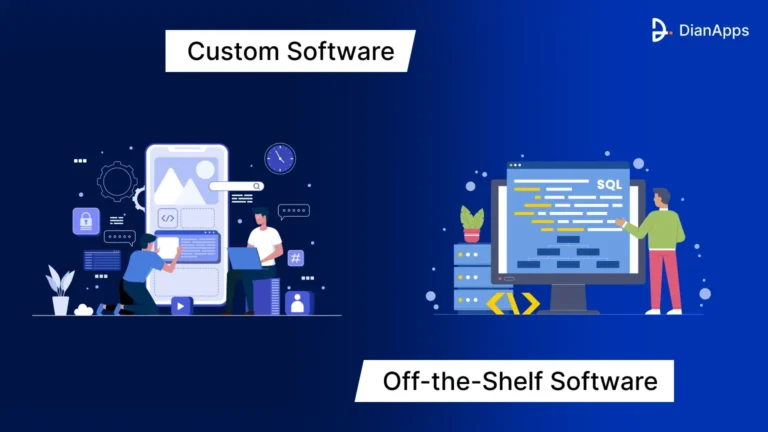
Custom Software vs. Off-the-Shelf: A Quick Comparison
Here is the quick comparison between custom software and off-the-shelf software development.
| Factor | Off-the-Shelf software | Custom Software Development |
|---|---|---|
| Upfront Cost | Low | Medium to High |
| Long-term Cost | Subscription compounds over time | Owned; cost stabilizes |
| Scalability | Limited by product tiers | Built to scale with you |
| Customization | Limited to vendor's roadmap | Built exactly to your needs |
| Integration | Varies; often requires middleware | Designed for your ecosystem |
| Security Control | Shared/vendor-managed | Full control |
| Feature Fit | 70-80% at best | 100% |
| Time to Deploy | Fast | 3-12 months depending on scope |
| Competitive Advantage | Same as every other user | Yours Alone |
| Ownership | Vendor’s | Yours |
What Happens If You Keep Ignoring These Signs?
Nothing catastrophic. At first.
Your team adds another workaround. Someone builds a new spreadsheet. You sign up for one more subscription that kind of solves the problem. And you keep going.
But the cost compounds quietly. Hours lost to manual processes multiplied by your team’s hourly rate, multiplied by 12 months if that number exceeds what custom development would cost, you’ve been paying for the problem longer than the solution would have taken.
Then there’s the harder cost: customer frustration, employee turnover (people leave jobs where the tools make their work harder), security exposure you’re hoping doesn’t become an incident, and a growing gap between where you are technologically and where your competitors are going.
Inaction has a price. It’s just spread out thinly enough that it’s easy to ignore until it isn’t.
How to Get Started With Custom Software Development
If you recognized yourself in three or more of those signs, here’s how to actually move forward:
- Write down your biggest pain points: Not all of them the ones that, if solved, would make the biggest difference to your team or your customers.
- Define what success looks like: How will you know the software is working? Faster processes, fewer errors, better customer retention, reduced subscription costs? Get specific.
- Evaluate build vs. buy vs. customize: Sometimes the answer is a customized integration. Sometimes it’s a net-new build. Knowing your requirements clearly makes this easier to figure out.
- Find a development partner who asks good questions: The right custom software development company will ask about your business before they talk about technology. That’s a good sign.
- Start with an MVP, then scale: You don’t have to build everything at once. Start with the MVP in software development core functionality, get it in use, and build from there.
Final Words
None of the ten signs we’ve covered is complicated to spot once you know what to look for. Spreadsheet dependency. Tools that don’t connect. Paying for features you don’t use while missing the ones you need. Security gaps. Customers are getting a subpar experience. Processes your software simply wasn’t built to handle.
These are all fixable. And the fix doesn’t have to be a massive, multi-year project. Many businesses start with a single custom tool that addresses their biggest pain point and build from there. The important thing is recognizing when your software is no longer working for you, but against you.
If you recognized your business in even a handful of these signs, it’s worth at least having the conversation. Not to commit to a six-figure project but to understand what’s possible and what it would realistically take.
Frequently Asked Questions
 0 comments








Leave a Comment
Your email address will not be published. Required fields are marked *