Custom vs Off-the-Shelf Software: Which Is Right for Your Business?
Quick Summary: Here, for a quick 90-second read, we have covered some of the important pointers to help you understand the difference between custom software and off-the-shelf software. Custom software is built from scratch, for your business only. You own it completely, it fits your exact workflows, and no competitor gets the same thing. Higher upfront cost, but it becomes a long-term asset. Off-the-shelf software is pre-built for everyone. Faster to launch, lower upfront cost, but designed for the average business, not yours. Your competitors use the exact same tools. Build custom when:
Buy off-the-shelf when:
The number most people miss: A $60K custom build looks expensive next to a $500/month SaaS subscription until year three, when you have spent over $40,000 on a tool your team works around daily. Always compare the 3-year total cost, not the first invoice. Bottom Line: If you need software for payroll-related work, then you must go with off-the-shelf, and if you require software for customised business solutions, then custom software is the best practice. |
The real difference between Custom software and off-the-shelf software in 2026 is related to initial cost, time-to-deploy, customisation capabilities, and the owner of the software. However, the real cost difference between the two software is determined in a 3-4 year time gap.
Here’s everything you need to know to complete the clear difference between custom and off-the-shelf software.
Here’s a conversation we have at least three times a week at DianApps.
A founder walks in, funded, focused, ready to build, and says, “We need custom software. We’ve outgrown everything we’ve tried.”
Sometimes they’re right. We start scoping, we start building, and eighteen weeks later, they’re live on a platform that does exactly what their business needs and nothing it doesn’t.
But sometimes, we push back.
Sometimes we sit across from a founder who is convinced they need a bespoke platform built from the ground up, and we have to tell them: “Actually, have you looked at Shopify Plus? Because what you’ve described could go live in two weeks for a fraction of what you’re about to spend with us.”
That doesn’t win us a contract. But it does win us a client for life.
Being a leading Custom software development company, we’ve built 450+ software products over 8 years. We’ve watched businesses waste $200,000 on custom software they didn’t need. We’ve also watched businesses limp along for years on off-the-shelf tools that were quietly controlling their growth because someone told them early on that “there’s an app for that.”
The honest truth is that neither custom nor off-the-shelf software is inherently better. The right answer depends entirely on your specific business situation. And getting this decision wrong in either direction is expensive.
This blog will help you get it right. We’ll break down both options with real numbers, real trade-offs, and a decision framework we’ve developed from 450 actual projects. By the end of it, you’ll know exactly which path fits where your business is today.
Let’s make sure we’re working from the same definitions before we compare them.
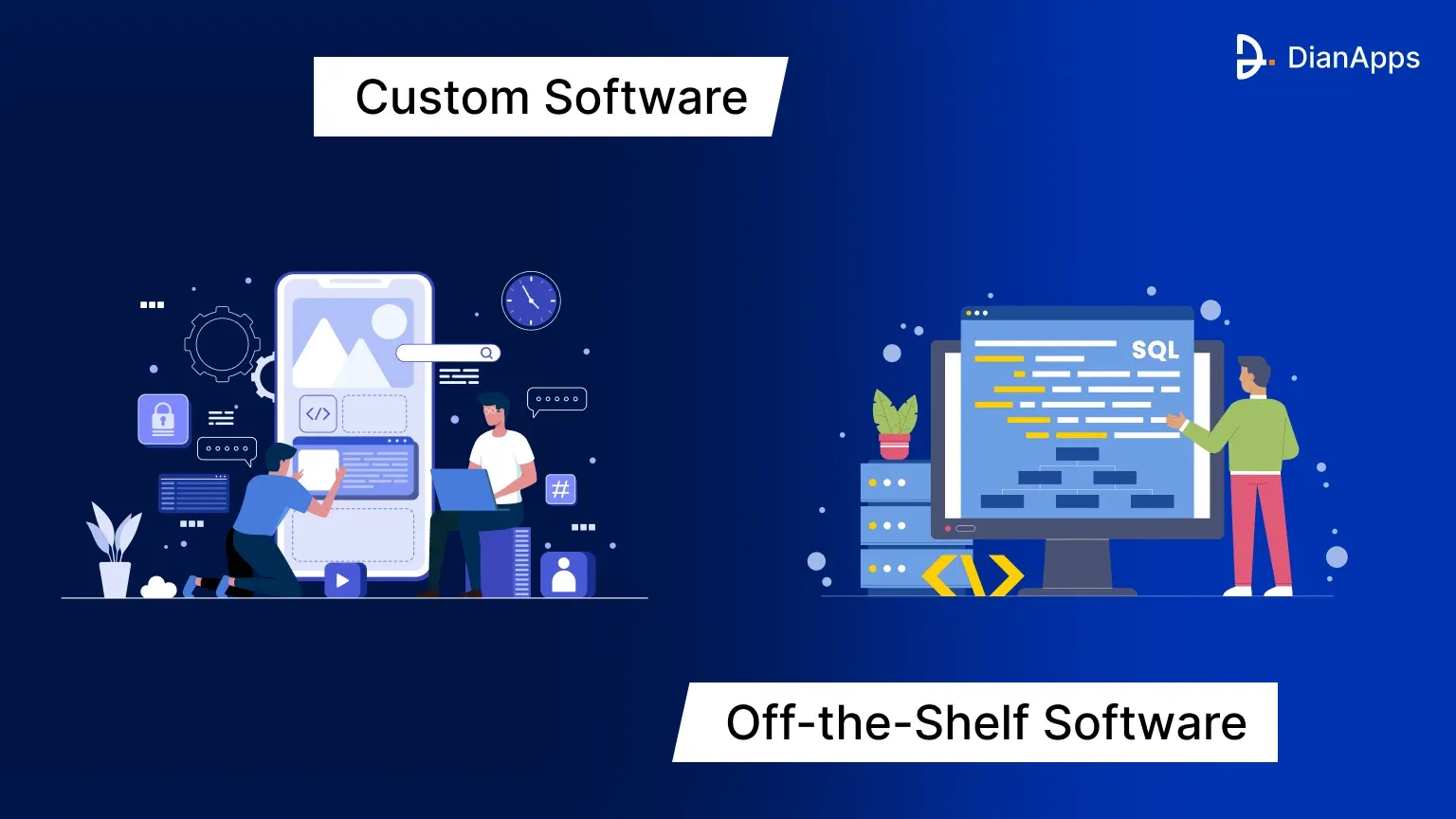
Custom software is built from scratch, specifically for your organisation. Every feature, every workflow, every data model is designed around how your business actually operates, not how a vendor assumes most businesses should operate. You own the source code, you control the roadmap, and nothing about your technology is shared with a competitor who purchased the same licence.
Examples of Custom Software
Various well-known brands have relied on custom software solutions for their business-related operations. Some of the popular names are listed below:
- Tesla: To properly function, Autopilot and self-driving features require most of the Tesla vehicles’ functions to run on highly specialised custom software.
- Amazon: Every function of the Amazon software is highly customised based on the user experience, be it smart inventory management, AI-driven product recommendations, or any other feature.
- Netflix: To deliver a personalised viewing experience to the customer, it leverages custom-built recommendation algorithms.
- Uber: This is the famous taxi booking application that provides multiple customised solutions based on location tracking, driver details tracking, and more.
What Is Off-the-Shelf?
Off-the-shelf software, also known as COTS, commercial off-the-shelf, is pre-built for a broad market base. Think Salesforce, QuickBooks, Shopify, Jira. These tools are mature, well-maintained, and ready to use on day one. The trade-off is that they’re built for the average business in your category, not the specific business you’re trying to grow.
Examples of Off-the-Shelf Software
- Salesforce: Salesforce is the best CRM platform that is used by multiple businesses for different activities like sales, marketing, and more.
- Microsoft Office: It provides us access to Word, Excel, and PowerPoint that can be used for documentation, spreadsheets, and presentation purposes.
- QuickBooks: It is considered one of the most popular tools for small to medium-sized business accounting and tax prep.
- Adobe Creative Cloud: It includes Photoshop (photo editing), Illustrator (graphic design), and Premiere Pro (video editing).
And then here comes a third option that is usually skipped by most of the experts.
The hybrid approach can be considered as a combined approach that uses off-the-shelf tools for the commodity parts of your business, such as accounting, email, standard CRM, and custom software for the parts where your workflows create genuine competitive value. This is the right approach in 2026; that is how the most intelligent, scaling businesses actually operate. Today, the average company runs 254 SaaS applications, but fewer than a third of them are properly integrated. That fragmentation is precisely why understanding when to build and when to buy has never been more consequential.
Custom Software vs Off-the-Shelf: Key Differences Explained
Here’s how the two approaches compare across eight dimensions that actually matter when you’re making this call.
| Dimension | Custom Software | Off-the-Shelf | Hybrid |
| Initial Cost | $25000 – $300,000+ | $50 – $2,000/month | Medium build only what’s unique |
| Ongoing Cost | Infrastructure + Maintenance | Subscription scales with users | Mixed, generally lower |
| Time to Deploy | 12 – 36 weeks | Days to weeks | 6 – 16 weeks |
| Customisation | Complete, you own every decision | Limited by vendor constraints | High on the custom layer |
| Scalability | Scales to your architecture | Scales via pricing tiers | Scales on your terms |
| Security & Compliance | Full control HIPAA< PCI-DSS ready | Shared model, limited control | Controlled where it matters |
| AI Integration | Trained on your data & workflows | Generic vendor AI features | Custom AI where your data has value |
| Competitive Advantage | Technology becomes a strategic moat | Same tools as every competitor | Differentiated where it counts |
The number that shifts most people’s thinking is the long-term cost comparison. A $60,000 custom build in year one looks expensive when it’s sitting next to a $500/month SaaS subscription. But SaaS vendors raise prices 5–15% annually on average. That $500/month becomes $575, then $660, and by year five, you’ve spent close to $40,000 on a tool your team has been working around, manually patching, and complaining about since month three.
The true cost of off-the-shelf software is not the line item on your invoice. It’s the cumulative sum of integration work, workaround labour, productivity ceilings, vendor lock-in penalties, and recurring charges that grow faster than the value they deliver.
The right comparison is always the total cost of ownership over three to five years, never the first bill.
Recommended Read: No-Code vs Custom App Development in the USA (2026 Guide)
Software Development Cost Based on Different Types
Here’s what the numbers look like in practice from DianApps’ eight years and 450+ projects, not from a sales brochure.
Custom Software Development Cost By Project Type
| Project Type | Complexity | Estimated Cost | Typical Timeline |
| MVP / Proof of Concept | Low | $25,000 – $60,000 | 10 -16 weeks |
| Full-featured platform | Medium | $60,000 – $150,000 | 16 – 24 weeks |
| Enterprise system | High | $150,000 – $300,000+ | 24 – 40 weeks |
| AI-integrated platform | High + AI layer | $80,000 – $250,000 | 18 – 30 weeks |
Off-the-Shelf Software Realistic Annual Costs (20-person team)
| Tool Category | Example | Base Annual Cost | Typical Hidden Costs |
| CRM | Salesforce | $18,000 – $36,000 | Integrations: $8,000 – $25,000 |
| ERP | SAP Business One | $30,000 – $80,000 | Customisation: $15,000 – $50,000 |
| Project Management | Jire + Confluence | $4,800 | Add-ons: $3,000 – $8,000 |
| E-commerce Platform | Shopify Plus | $24,000 | Apps + fees: $10,000 – $30,000 |
The ‘inversion point’ where custom software becomes cheaper than the accumulated cost of the off-the-shelf alternative typically arrives between 18 and 30 months. We tell clients this directly. We also tell them when the inversion never comes, which is why the next section exists.
Advantages and Disadvantages of Custom Software Development
Advantages of Custom Software Development:
Here are some of the essentials of custom software development benefits for small, medium, or enterprise-level businesses:
- Fits Your Business Like a Glove: Custom Software is built around your exact workflows and processes, not a generic template. Your team stops adapting to the tool, and the tool starts adapting to them.
- You Completely Own It: No vendor can hike your price, kill the product, or remove a feature overnight. The source code, the IP, and the roadmap all belong to your business permanently.
- Scales Without Surprise Bills: Off-the-shelf software charges you more as you grow. Custom software grows on your infrastructure terms, no per-seat pricing, no tier jumps, no unexpected license cost at renewal.
- Security and Compliance on Your Terms: You decide how data is stored, encrypted, and accessed. For fintech, healthcare, and legal businesses, that level of control is not a preference it is a regulatory requirement.
- Becomes a Competitive Moat Over Time: Your competitors can buy Salesforce. They cannot buy the proprietary platform, algorithm, or workflow your business builds and refines over the years. Custom software stops being a cost and starts being a strategic advantage.
- Integrations That Actually Work: Systems are designed to talk to each other from day one, no third-party connectors, no fragile webhooks. Data flows reliably because integration is part of the architecture, not an afterthought.
Disadvantages of Custom Software Development
- High Upfront Investment: Custom software development starts at $25,000 and can reach $300,000+ depending on scope. You commit that budget before the product exists, making it the wrong move for early-stage or capital-constrained businesses.
- Takes Time to Build: A properly built custom software product takes 12 to 26 weeks minimum. If you need something live next month, this is not your path right now.
- Quality Depends on Who You Hire: Unlike battle-tested off-the-shelf tools, a custom build is only as good as the development team behind it. Choosing the wrong custom software development services is expensive to fix.
- Maintenance Never Stops: Security patches, updates, and bug fixes are your responsibility indefinitely. Budget around 15 to 20 per cent of your build cost per year for ongoing maintenance.
- No Community to Fall Back On: When Salesforce breaks, millions of users and thousands of consultants have seen it before. When your custom platform has an issue, the answer lies with your dev team alone.
Advantages and Disadvantages of Off-the-Shelf Software Development
Advantages of Off-the-Shelf Software
- Live in Days, Not Months: A good off-the-shelf software solution can have your team operational within a week. For businesses that need speed above everything else, this advantage is hard to argue with.
- Low Cost and Low Risk to Start: Subscription pricing means low entry cost and an easy exit if the tool does not fit. You are not betting six figures before you know whether the software solves your problem.
- Battle-Tested at Scale: Mature off-the-shelf platforms have been used, broken, and improved by thousands of businesses before yours. That real-world reliability is something a fresh custom build simply cannot offer on day one.
- Maintenance Is Someone Else’s Problem: Security patches, infrastructure updates, and compliance changes are handled by the vendor automatically. For teams without deep technical capacity, that operational simplicity is genuinely valuable.
- Huge Talent Pool and Ready Ecosystem: Need a Salesforce admin, a HubSpot consultant, or a Shopify developer? Millions exist globally. Implementation help, training, and specialist support are always within reach for major platforms.
- Pre-Built Integrations With Tools You Already Use: Most leading off-the-shelf solutions connect to your existing stack out of the box, no custom integration work needed, no months of engineering to get two systems talking to each other.
Disadvantages of Off-the-Shelf Software
- Built for Everyone, Perfect for No One: Every feature in an off-the-shelf product is a compromise designed for the average business, not yours. Over time, those small workarounds pile up into a real, daily drag on how your team operates.
- Your Competitors Have the Exact Same Tools: Off-the-shelf software is equally available to every business in your market. It cannot give you a technology edge, it is, by definition, the common baseline your whole industry shares.
- The Real Long-Term Cost Is Much Higher: Add up per-seat fees, annual price increases, add-ons, and integration tools, and the total cost of off-the-shelf software over three to five years regularly exceeds what a custom build would have cost.
- Vendor Lock-In Is Real: Once your data, workflows, and team habits are embedded in a platform, leaving is painful. Vendors know this, and it gives them pricing power over you that compounds every renewal cycle.
- You Have No Say in the Roadmap: Features get deprecated. Interfaces change. Pricing tiers shift. The product evolves to serve the vendor’s largest customer segment, which may not be you, and your feedback goes into a queue with thousands of others.
Recommended Read: The Power of Custom Salesforce Development for Scalable Business Growth
5 Signs Your Business Needs Custom Software (And 5 Signs It Doesn’t)
Most development companies skip this section, because honest answers don’t always favour building custom. We’re including it anyway. Here’s the full picture.
When You Genuinely Need Custom Software
1. Your workflow is unique, and no existing tool handles it without painful workarounds.
If your team maintains a spreadsheet that “translates” data between two systems, if daily operations involve exporting from one tool and importing into another, or if completing a single task requires jumping between three different platforms, you’re already paying the cost of custom software. You’re just paying it in staff hours and accumulated errors, not an upfront invoice.
2. You’re running five or more SaaS tools that don’t properly integrate.
Every integration between off-the-shelf tools introduces cost, a potential failure point, and data quality risk. Past a certain threshold, a purpose-built platform is almost always cheaper and significantly more reliable than an increasingly complex patchwork of disconnected subscriptions.
3. Your data is your competitive advantage, and you can’t hand it to a third-party vendor.
Healthcare businesses handling patient data, fintech startups with proprietary fraud detection models, and logistics companies with unique routing algorithms. If your data is the business, you need to own the infrastructure it lives on. Full stop.
4. You’ve started hiring people specifically to work around your software’s limitations.
This is the most expensive and least visible version of the same cost. When someone on your operations team spends the majority of their day making your existing tools work for your actual needs, you’re already running a custom development project. It’s just running at the worst possible efficiency.
5. The software you need to build is your product, not an internal tool.
If you’re building a SaaS platform, a marketplace, a client-facing app, or any technology your end users will interact with directly, there is no off-the-shelf solution that gets you there. You need to own every layer.
When Off-the-Shelf Is the Smarter Choice
1. Your need is standard and well-served by what already exists.
Accounting, basic CRM, email, project tracking, and HR management are categories that have mature, excellent tools. If your accounts payable process looks like every other company’s, there is no competitive reason to build your own solution. Don’t.
2. You need to be operational within weeks, not months.
Off-the-shelf deploys in days. Custom software takes 12–26 weeks minimum. If speed is the constraint that matters most right now, start with what’s available and revisit the build decision when your runway allows for it.
3. You haven’t reached product-market fit yet.
This is the most frequent advice we give early-stage founders who arrive ready to build: you do not yet know exactly what you need. Use off-the-shelf tools to validate your model first. Build custom once you understand precisely what you’re optimising for.
4. Your total budget is under $20,000.
Custom development requires a minimum commitment to do it properly. Below $20,000, architectural shortcuts create technical debt that costs significantly more to correct later than if you had started with an off-the-shelf tool. In this range, off-the-shelf is the genuinely smarter financial choice.
5. Your competitive advantage isn’t technology.
Not every business competes on software. A specialist law firm, a boutique manufacturer, a premium consultancy if your differentiation is expertise, relationships, or craft rather than technology, off-the-shelf keeps your costs manageable without costing you competitive position.
Recommended Read: Top 20 Software Development Trends for 2026
The DianApps Build vs Buy Decision Framework for Custom Software or Off-the-Shelf Software
After 450+ projects across fintech, healthcare, logistics, and enterprise SaaS in India, the USA, the UAE, and Australia, we’ve identified seven criteria that reliably determine whether custom or off-the-shelf software is the right choice for any specific situation. Score yourself on each.
| Criterion | Score (1-3) | What to consider |
| Workflow Uniqueness | 1 = Standard | 3 = Completely unique | How different are your workflows from a standard business in your category? |
| Integration Complexity | 1 = 1–2 systems | 3 = 6+ systems | How many systems need to share data with each other? |
| Data Sensitivity | 1 = Low | 3 = Proprietary / regulated | How critical is it that you own and directly control your data architecture? |
| Scale Ambition | 1 = Stable | 3 = Aggressive growth | How aggressively are you expecting to grow in the next 24 months? |
| Timeline Flexibility | 1 = Need it now | 3 = Flexible | Can your project wait 14–22 weeks, or do you need to launch quickly? |
| Budget Availability | 1 = Under $20K | 3 = $50K+ | Is a meaningful technology investment available and approved? |
| Differentiation Need | 1 = Internal tool only | 3 = Software IS the product | Is the software itself a competitive advantage, or purely operational? |
What your total score means:
| 7 – 11 | Off-the-shelf is the right choice right now. Start with existing tools. Revisit in 12 months. |
| 12 – 16 | Hybrid approach: Build the unique parts, buy the standard parts. This is where most scaling businesses land. |
| 17 – 21 | Custom software is the strategic choice. The economics and the competitive logic both support building. |
How AI Changes This Decision in 2026
There is a variable in the build vs buy equation today that simply didn’t exist three years ago, and it is reshaping how every category of business thinks about this decision.
Off-the-shelf SaaS platforms are now shipping AI features as standard. Predictive analytics, intelligent workflow suggestions, and AI-generated content recommendations are capabilities that arrive automatically with many subscriptions. For standard use cases, this is genuinely valuable and meaningfully changes the off-the-shelf calculus.
But there’s a ceiling to what vendor-supplied AI can do for your business, and it’s lower than most people expect.
Off-the-shelf AI features are trained on generic data, the aggregated patterns of millions of users across thousands of different companies. Custom software in 2026 can integrate AI that is trained specifically on your data, your customers, and your competitive context. For businesses where data is the differentiation, that distinction is enormous.
Here’s a real example. A fintech client came to us after spending two years trying to reduce fraud using an off-the-shelf fraud detection tool. The tool was good, it performed well for the average fintech. But their transaction patterns were specific to a niche market segment that the generic model consistently misread. We built a fraud detection model trained specifically on their historical transaction data. The false positive rate dropped by 40% in the first quarter after deployment. No off-the-shelf product could have achieved that outcome, because the model needed to understand their specific customer behaviour, not an industry aggregate.
If AI is becoming central to how your business competes, and in 2026, it almost certainly is, the question of who controls the model, what it’s trained on, and how it integrates with your specific workflows is no longer a technical question. It is a strategic one.
Recommended Read: How to Choose a Software Development Company for Your Logistics Business
How to Evaluate a Custom Software Development Company
If you’ve scored 14 or above on the framework above, the next decision is who to build with. Here are five evaluation criteria developed from years of conversations on both sides of this table.
1. Ask for industry-specific case studies, not a logo wall.
Any reputable development company can show you a page of recognisable brand names. What you need to see is documented outcomes: what was the specific challenge, what was architected and built, and what measurably changed as a direct result. If they cannot produce this, the logos are decorative.
2. Probe their development process in granular detail.
A serious development partner should walk you through their entire workflow without hesitation: discovery, architecture decisions, sprint cadence, how QA is built in rather than bolted on, and what post-launch support actually includes. Vague or evasive answers here are a meaningful signal.
3. Read verified third-party reviews, not testimonials on their own website.
Clutch and G2 require verified reviewer identities and prevent vendors from editing or removing reviews. These are the only sources of social proof that are structurally difficult to manipulate. Testimonials published on a vendor’s own site are, by definition, curated.
4. Clarify exactly who works on your project.
Some firms win business with senior engineers and deliver with junior teams. Before signing anything, get in writing: who will be assigned to your build, their seniority level, how many projects they’re running simultaneously, and what the continuity plan is if a key team member leaves mid-project.
5. Trust any company that insists on discovery before pricing.
Any development company that quotes a number before a proper discovery conversation is guessing. A credible estimate requires understanding your existing systems, data model, compliance requirements, scalability assumptions, and real deadline. A number without that context is not an estimate; it’s a placeholder that will change.
Final Words
The build vs buy decision is not a technical question. It’s a strategic one, and it deserves a strategic answer, not a reflexive one.
Custom software is not always the right choice. Off-the-shelf is not always the safe choice. The right answer lives in the specific intersection of your workflows, your data, your competitive positioning, your timeline, and your budget. Get that intersection right and you make a decision that compounds in your favour for years. Get it wrong, and you spend the next 18 months undoing it.
Use the framework in this blog to score your situation. If you land between 7 and 11, start with what exists and revisit in a year. If you land between 12 and 16, think hybrid: build the parts that are uniquely yours and buy everything else. If you score 17 or above, the strategic and financial logic both point toward building.
And if you’d like a second opinion from a team that has navigated this specific decision 450+ times across 8 years and four continents, we’re here.
 0
0