

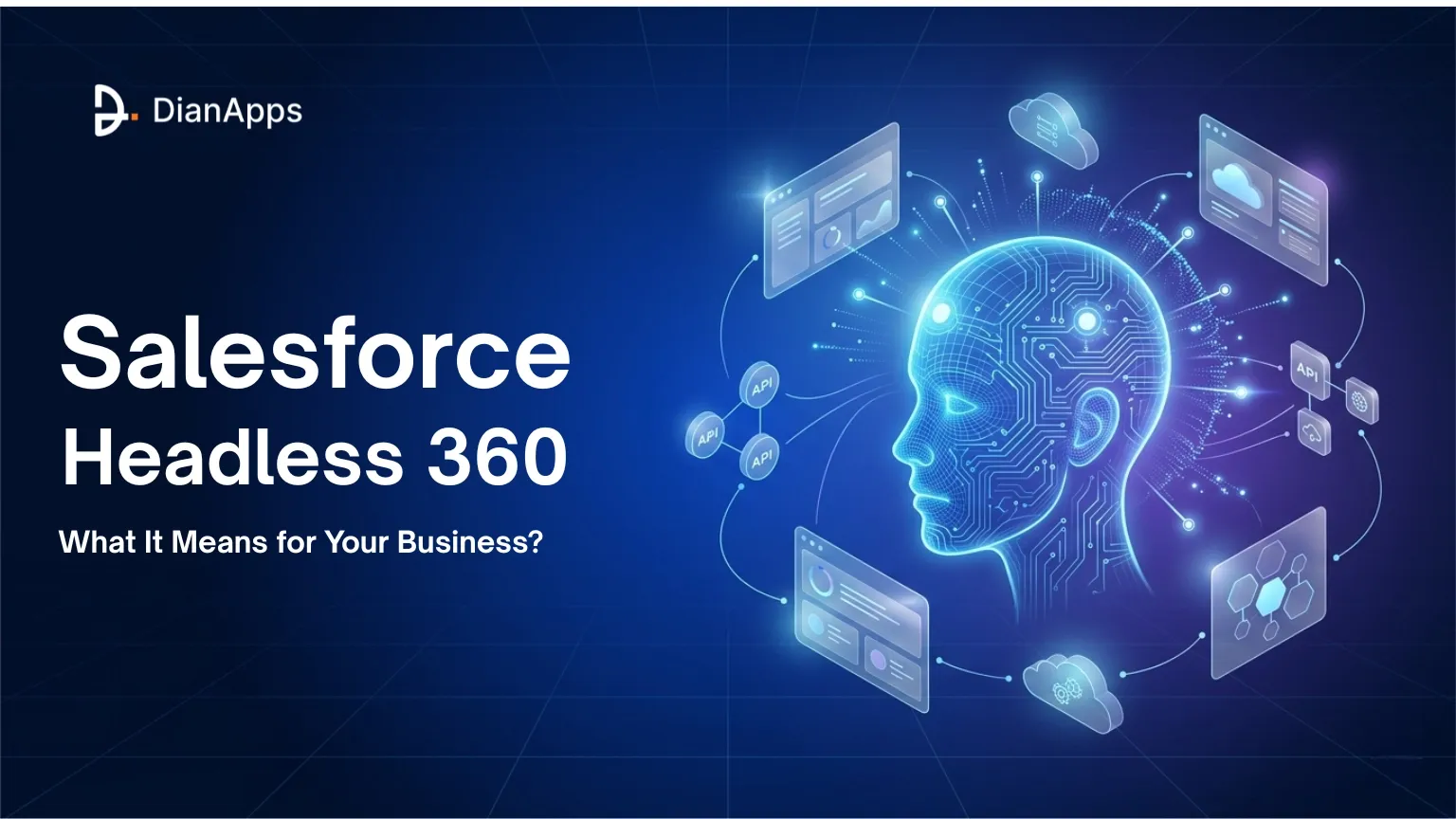
Salesforce Headless 360: What it means for your business and what to do about it
On April 15, 2026, Salesforce announced Headless 360 at TDX. The entire platform is now accessible without opening a browser. Every capability, every data object, every workflow can be operated through APIs, MCP tools, and CLI commands. This didn’t happen in a vacuum. In February 2026, $2 trillion in SaaS market cap evaporated in what analysts called the SaaSpocalypse. Salesforce’s response was sweeping. This guide covers what Headless 360 actually is, why it matters, what your business should do right now, and why working with an experienced Salesforce development company is the difference between leading this transition and scrambling to catch up.
TL;DR: Salesforce Headless 360 makes every platform capability accessible via APIs, MCP tools, and CLI. AI agents can now run Salesforce without anyone opening a browser. With Agentforce ARR hitting $800M (Salesforce Earnings, Q4 FY2026), companies need to rethink their implementation strategy. This guide covers what changed, what it means, and how to prepare.
What is Salesforce Headless 360?
Salesforce Headless 360 is the platform’s biggest architectural shift in over a decade. At TDX 2026, Salesforce opened more than 60 MCP tools and 30+ preconfigured coding skills to developers and AI agents (Salesforce Newsroom, April 2026). In plain terms, every piece of Salesforce functionality that previously required clicking through a browser now works through code, APIs, and AI agents.
That’s a fundamental change in how the platform operates.
Think of it in three layers. First, there’s the API layer. Every Salesforce capability, from creating a lead to running a complex approval workflow, is now a programmatic endpoint. Second, there’s the MCP tooling layer, which gives AI agents structured ways to interact with the platform. Third, there’s Data 360, which exposes all customer data programmatically so agents and external systems can read, write, and act on it without a UI.
The Agentforce Experience Layer adds a “build once, render everywhere” model. You build an agent interaction once, and it works across Slack, ChatGPT, Claude, Microsoft Teams, and custom apps. No rebuilding for each channel.
Why does this matter? Because the browser is no longer the bottleneck. When AI agents can operate Salesforce directly, the speed of business processes stops depending on how fast a human can click.
Component | What it does | Why it matters |
60+ MCP tools | Structured tool interfaces for AI agents | Agents can query, create, and update Salesforce objects autonomously |
30+ coding skills | Preconfigured development patterns | Faster agent and app development without starting from scratch |
Data 360 API | Full programmatic access to customer data | External systems and agents can read/write data without a UI |
Agentforce Experience Layer | Build once, render everywhere | Single agent works across Slack, ChatGPT, Claude, Teams |
CLI access | Command-line control of the platform | Developers and scripts can manage Salesforce from the terminal |
Salesforce Headless 360, announced at TDX on April 15, 2026, opens 60+ MCP tools and 30+ preconfigured coding skills to developers and AI agents (Salesforce Newsroom, April 2026). Every platform capability is now accessible without a browser, enabling AI-driven business automation at scale.
Read More: How APIs benefit your business
What is Agentforce Vibes 2.0?
Agentforce Vibes 2.0 is Salesforce’s native AI development environment, and it ships with multi-model support, including Claude Sonnet 4.5 and GPT-5 (Salesforce Newsroom, April 2026). Salesforce claims a 40% reduction in development cycle times. That number is worth watching closely as real-world data comes in.
What makes Vibes 2.0 different from other AI coding tools is full org awareness. When you start building, the system already understands your Salesforce org structure through the Salesforce Unified Catalog. It knows your custom objects, your field relationships, and your permission sets. You don’t spend the first hour explaining your data model to the AI.
The environment generates code across React, Lightning Web Components, and Apex. That cross-framework support matters because Headless 360 means you’ll be building interfaces outside of Salesforce’s native UI more often. React frontends talking to Salesforce APIs will become a common pattern.
Here’s what caught our attention: Vibes 2.0 is available in every Developer Edition at no cost. That’s a deliberate move to lower the barrier. Salesforce wants every developer experimenting with this, not just enterprise teams with big budgets. It’s an aggressive play that signals how seriously they’re taking the AI-first development model.
We’ve been building on Salesforce for years, and the shift from clicks-based configuration to API-first, AI-assisted development is the most significant change we’ve seen in how teams actually work with the platform day to day.
Agentforce Vibes 2.0 is Salesforce’s native AI development environment supporting Claude Sonnet 4.5 and GPT-5, claiming a 40% reduction in development cycle times (Salesforce Newsroom, April 2026). It ships free in every Developer Edition with full org awareness through the Salesforce Unified Catalog.
Also Read: The Future of Salesforce
Why did Salesforce make this move now?
On February 3, 2026, the S&P 500 Software Index dropped 13% in a single session. Analysts called it “Black Tuesday” for software. Roughly $2 trillion in SaaS market capitalization vanished (Bloomberg, February 2026). The trigger wasn’t earnings. It was fear.
The fear was specific. Claude Cowork and ChatGPT Agent Mode had just launched, and both could execute business workflows autonomously. Wall Street’s conclusion was immediate and brutal: if AI agents can do the work that SaaS applications do, per-seat licensing is dead. Why pay $150/user/month when an AI agent can handle the same tasks for a fraction of the cost?
Marc Benioff’s response was characteristically bold. He called himself the “SaaSquatch” who would “monster the SaaSpocalypse.” Behind the showmanship, though, Salesforce backed it up with numbers. Q4 FY2026 revenue came in at $10.7B, up 13% year-over-year (Salesforce Earnings, Q4 FY2026). Not exactly a company in freefall.
But the real strategic response was pricing. Salesforce introduced Agentic Work Units (AWUs) as a new consumption metric. Instead of charging per seat, AWUs measure actual agent work output. The platform had generated 2.4 billion AWUs to date, with 771 million in Q4 alone (Salesforce Earnings, Q4 FY2026).
This is a company that saw the threat to its business model and restructured its entire pricing philosophy in response. Constellation Research noted that Salesforce is “1-2 years ahead of peers” on agent governance and deployment infrastructure (Constellation Research, March 2026). Whether that lead holds depends on execution over the next 12 months.
The SaaSpocalypse panic was overblown in the short term, but the underlying thesis is correct. Per-seat SaaS pricing will erode over the next 3-5 years. Companies that treat Headless 360 as optional are betting against a structural shift in how software gets bought and used.
Salesforce posted $10.7B in Q4 FY2026 revenue (+13% YoY) despite the February 2026 SaaSpocalypse that wiped $2 trillion from SaaS market caps (Salesforce Earnings, Q4 FY2026). Constellation Research assessed Salesforce as “1-2 years ahead of peers” on agent governance.
What results are companies already seeing?
Agentforce ARR hit $800M in Q4 FY2026, up 169% year-over-year, with 23,000 customers and 29,000 deals closed (Salesforce Earnings, Q4 FY2026). That 50% quarter-over-quarter growth in deal volume suggests adoption is accelerating, not plateauing. The early results from specific companies are worth examining.
Pearson reported a 40% increase in customer queries resolved without human intervention after deploying Agentforce agents (Salesforce Customer Stories, 2026). That’s not a trivial improvement. It means four out of every ten customer questions that previously required a human now get handled autonomously.
PenFed Credit Union saw a 40% reduction in IT tickets, specifically password resets and account unlocks (Salesforce Customer Stories, 2026). Those are high-volume, low-complexity tasks. Exactly the kind of work that agents handle well and humans find mind-numbing.
Custom AI agents built on Slack grew 300% since January 2026 (Salesforce Newsroom, April 2026). That growth rate tells us something about where agents are being deployed. Teams want them in the tools they already use, not in a separate interface they have to remember to check.
Forrester’s analysis of well-executed Salesforce deployments found a 341% ROI over three years (Forrester Total Economic Impact, 2025). “Well-executed” is doing a lot of work in that sentence. The gap between a good implementation and a bad one isn’t 10-20%. It’s the difference between 341% ROI and negative returns.
Process | Before Agentforce | After Agentforce | Source |
Customer query resolution | Manual, agent-dependent | 40% resolved autonomously | Pearson via Salesforce |
IT ticket handling | Password resets queued for staff | 40% reduction in ticket volume | PenFed via Salesforce |
Slack-based AI agents | Minimal adoption | 300% growth since Jan 2026 | Salesforce Newsroom |
Overall Salesforce ROI | Varies widely | 341% over 3 years (well-executed) | Forrester |
Agentforce ARR reached $800M in Q4 FY2026 (+169% YoY), with 23,000 customers generating 2.4 billion Agentic Work Units (Salesforce Earnings, Q4 FY2026). Pearson and PenFed both reported 40% improvements in autonomous resolution and ticket reduction respectively.
How does Headless 360 compare to Microsoft, SAP, and Oracle?
Gartner projects that 40% of enterprise applications will feature AI agents by the end of 2026, up from less than 5% in 2025 (Gartner, 2026). The global CRM market is expected to reach $87.96B in 2026 and grow to $128.86B by 2031 (Mordor Intelligence, 2025). Every major vendor is racing to own this space. But they’re at very different stages.
Salesforce has the most complete offering right now. Sixty-plus MCP tools, multi-model AI support, hybrid consumption pricing, and a head start on agent governance. That doesn’t mean they’ll stay ahead, but the current gap is real.
Microsoft’s approach through Dynamics 365 Copilot is tightly integrated with Azure and Microsoft 365. Their API approach is partial compared to Salesforce’s full headless model. Pricing adds $30-42.50 per user on top of existing Dynamics licenses (Microsoft, 2026). The per-user add-on model feels like a transitional step rather than a long-term pricing strategy.
SAP introduced Joule Studio with emerging MCP support and an AI Units consumption model. It’s early. SAP’s strength is in ERP, not CRM, and its agent capabilities reflect that focus.
Oracle is behind in CRM agent capabilities. Their AI investments are concentrated in database and infrastructure rather than front-office automation.
Vendor | AI agent strategy | Headless/API approach | Pricing model | Analyst assessment |
Salesforce | Agentforce + 60+ MCP tools, multi-model | Full headless, CLI, API-first | Hybrid: seats + Agentic Work Units | “1-2 years ahead” (Constellation Research) |
Microsoft | Dynamics 365 Copilot, Azure AI | Partial API, browser-centric | $30-42.50/user add-on | Strong Azure integration, limited headless |
SAP | Joule Studio, emerging MCP | Emerging API layer | AI Units consumption | ERP-first, CRM agent capabilities developing |
Oracle | Minimal CRM agent presence | Traditional API layer | Per-seat licensing | Behind in front-office AI capabilities |
Is this lead sustainable? That’s the real question. Microsoft has the distribution advantage. SAP owns the ERP backbone of most large enterprises. Oracle controls the database layer. But in CRM-specific AI agent capabilities, Salesforce is ahead today, and Headless 360 extends that lead.
Gartner projects 40% of enterprise applications will feature AI agents by end of 2026, up from under 5% in 2025 (Gartner, 2026). Constellation Research rates Salesforce “1-2 years ahead of peers” on agent governance, with 60+ MCP tools compared to partial or emerging offerings from Microsoft, SAP, and Oracle.
What should your business do right now?
Companies using Agentforce are already processing 2.4 billion Agentic Work Units, with 771 million generated in Q4 alone (Salesforce Earnings, Q4 FY2026). The window to prepare is now, not next quarter. Here are six things to prioritize.
1. Audit your data quality. Agents need clean, well-structured data. If your Salesforce org is full of duplicate records, inconsistent naming conventions, and stale contacts, an AI agent will amplify those problems, not fix them. Run a data health assessment before you deploy anything. This is unglamorous work. It’s also the single biggest determinant of success.
2. Map which processes are agent-ready. Start with high-volume, rules-based work. Password resets, order status inquiries, and lead qualification against known criteria. PenFed started with IT tickets. Pearson started with customer queries. Both saw 40% improvements (Salesforce Customer Stories, 2026). Don’t try to automate complex judgment calls on day one.
3. Understand AWU economics. Model whether consumption-based pricing saves money compared to your current seat licenses. This math varies wildly depending on your user count, agent volume, and workflow complexity. If you have 500 seats but only 200 active users, consumption pricing might save you significantly. If you have 50 power users, per-seat might still make sense.
4. Upskill your team on MCP and API-first patterns. The admin-to-developer spectrum is shifting. Admins who could get by with point-and-click configuration will increasingly need to understand API calls, MCP tool configurations, and basic scripting. This isn’t about replacing admins with developers. It’s about expanding what admins can do.
5. Start with a pilot. Pick one department, one use case, one measurable outcome. Run it for 90 days. Measure the results. Then decide whether to expand. The companies getting the most from Agentforce didn’t roll it out everywhere at once. They proved value in a controlled environment first.
6. Talk to a Salesforce implementation partner that understands both the platform and AI. This is not a DIY transition. Headless 360 requires expertise in API architecture, agent lifecycle management, MCP tool development, and consumption pricing models. Getting this wrong isn’t just expensive. It sets your AI adoption back by a year or more.
Read More: Salesforce consulting vs in-house
What new skills will your team need?
The Salesforce certification program now includes 48+ credentials, but Headless 360 demands skills that didn’t exist in most Salesforce teams six months ago (Salesforce Ben, 2026). The skills gap is real, and it’s wider than most organizations realize.
MCP integration is the most immediate need. Your team needs to understand how MCP tools work, how to configure them, and how to build custom ones for your specific workflows. This isn’t theoretical. When you have 60+ MCP tools available, knowing which ones to use and how to chain them together is a practical, daily requirement.
API-first architecture design changes how solutions get planned. Instead of asking “what screens do we need?”, teams now ask “what endpoints do we need?” That’s a different way of thinking about Salesforce development. It affects everything from requirements gathering to testing.
React skills matter because headless UIs built outside Salesforce’s native interface will become common. If your team only knows Lightning Web Components, they’ll need to expand into React for customer-facing applications that consume Salesforce APIs.
Prompt engineering and agent configuration aren’t just for data scientists anymore. Configuring an Agentforce agent to handle customer inquiries requires understanding how to write effective prompts, set guardrails, and define escalation paths. It’s part technical, part business process design.
Agent lifecycle management covers testing, scoring, observability, and iteration. How do you know if an agent is performing well? What metrics define success? When should an agent escalate to a human? These questions need clear answers before you deploy.
Multi-model AI orchestration rounds out the new skill set. With Vibes 2.0 supporting Claude Sonnet 4.5 and GPT-5, teams need to understand when to use which model and how to orchestrate workflows across them.
Old Salesforce skills | New Headless 360 skills |
Declarative configuration (clicks) | MCP tool integration and configuration |
Visualforce page development | API-first architecture design |
Lightning Web Components only | React + LWC cross-framework development |
Workflow rules and Process Builder | Prompt engineering and agent configuration |
Manual testing and QA | Agent lifecycle management (scoring, observability) |
Single-platform focus | Multi-model AI orchestration |
Salesforce Headless 360 requires skills most teams didn’t have six months ago, including MCP integration, API-first architecture, prompt engineering, and agent lifecycle management. With 48+ certifications now available (Salesforce Ben, 2026), the admin-to-developer skill spectrum is shifting toward programmatic and AI-driven competencies.
Why DianApps for your Salesforce Headless 360 transition
We’re a Salesforce development company that’s been building on the platform for years. That experience matters right now because Headless 360 isn’t just a feature update. It’s a rearchitecture of how businesses use Salesforce.
We understand both sides of this transition. On one side, there’s deep Salesforce platform knowledge: custom Apex development, Lightning components, multi-cloud implementations, and data migrations. On the other hand, there’s modern AI and API architecture: MCP tool development, agent configuration, API-first design patterns, and consumption pricing strategy.
Our team works across Agentforce implementation, MCP tool development, API-first design, and agent lifecycle management. We’ve helped companies with Salesforce integration, customization, and managed services. The Headless 360 transition adds a new layer to that work, and we’ve been preparing for it.
If you’re thinking about where to start, get in touch. We’ll assess your Salesforce org for Headless 360 readiness and help you build a practical roadmap.
Conclusion
Headless 360 is the biggest architectural change Salesforce has made in its history. The platform moved from browser-first to API-first, from seat-based pricing to consumption-based AWUs, and from human-operated to agent-operated. Companies that act in the next 12-18 months will build a structural advantage. The ones that wait will spend that same time retrofitting while their competitors are already running autonomous workflows. This isn’t speculation. The 23,000 companies already on Agentforce and the $800M in ARR confirm the direction. We help businesses make this transition. Talk to us when you’re ready.
This guide was published on April 15, 2026. Statistics and product details reflect the most recent available sources at the time of writing.





Leave a Comment
Your email address will not be published. Required fields are marked *