


Quick OverviewIn Australia’s booming CRM landscape, choosing the right Salesforce development partner in Australia can define your organization’s digital success. With over 400 Salesforce partners and growing demand for cloud-CRM customization and integration, finding a partner who blends technical capability, industry experience, and local presence is essential. This guide cuts through the noise with actionable criteria, real questions to ask, and pitfalls to avoid, ensuring you align with a partner who drives strategic value and long-term ROI. |
Picture this: your sales team logs into Salesforce on Monday morning, only to find half the workflows broken, dashboards no one trusts, and custom features that looked great in demos but don’t match how your business actually works. The problem isn’t Salesforce. It’s the partner behind it.
This is a reality many Australian businesses face when they rush into choosing a Salesforce partner without a clear evaluation framework. According to recent Salesforce ecosystem data, Australia is one of the fastest-growing Salesforce markets in APAC, with demand for certified Salesforce developers and consulting partners outpacing supply across industries like finance, healthcare, logistics, and SaaS. That growth has flooded the market with options, but not all partners are created equal.
So how do you separate genuinely reliable Salesforce development partners from those who simply look good on paper? That’s exactly what this guide helps you do step by step, without guesswork.
What Is a Salesforce Development Company?
A Salesforce development company is a specialized technology partner focused on customizing, integrating, optimizing, and extending Salesforce platforms to meet business objectives. These partners support everything from initial implementations and complex automation workflows to native app development, data migrations, system integrations, and ongoing enhancement cycles. They combine certified architects, developers, administrators, and business analysts to turn CRM strategy into repeatable workflows that drive revenue and customer engagement.
In Australia’s context, where accelerated digital transformation across sectors like fintech, logistics, healthcare, and retail is fuelling CRM demand, Salesforce partners serve as indispensable engines of growth and operational agility.
Recommended Read: The Ultimate Guide to Setting Up Your Salesforce Development Environment
Why Is It Essential to Hire the Right Salesforce Development Partner?
Salesforce is not a plug-and-play tool; it’s a business operating layer. And like any operating system, its success depends entirely on how well it’s architected, customized, and adopted. Hiring the right Salesforce development partner is therefore not a technical decision; it’s a strategic one that directly influences revenue velocity, operational efficiency, and long-term scalability.
Many Australian organizations assume Salesforce will “work itself out” once licenses are purchased. In reality, Salesforce’s true value emerges only when it’s aligned tightly with business processes, customer journeys, and data flows. The right partner ensures Salesforce adapts to your business, not the other way around.
Strategic Alignment With Business Goals
A reliable Salesforce partner starts with why, not what. They don’t jump straight into configuration; they take time to understand your growth objectives, internal workflows, and future expansion plans. Whether your priority is pipeline visibility, customer retention, or cross-team collaboration, the right partner translates business goals into a scalable Salesforce roadmap. This alignment prevents short-term fixes that later turn into costly re-engineering projects.
Reduction of Implementation Risk
Salesforce implementations carry inherent risks: data loss during migration, broken automations, poor performance, or compliance gaps. Experienced partners mitigate these risks through structured discovery phases, documented architecture, and phased rollouts. They bring pattern recognition from previous projects, knowing what fails, what scales, and what should never be customized. That experience alone can save months of rework and thousands in sunk costs.
Faster Time to Value
Speed matters but only when paired with precision. The right Salesforce development partner accelerates delivery without compromising quality by leveraging proven frameworks, reusable components, and agile delivery models. This means your teams start seeing measurable value, better reporting, cleaner pipelines, and automated workflows weeks or months earlier than with trial-and-error implementations.
Higher User Adoption and Change Management
Even the most technically sound Salesforce setup fails if users don’t adopt it. A strong partner prioritizes usability, role-based dashboards, and intuitive workflows. More importantly, they plan for change management training sessions, documentation, and feedback loops so teams actually use what’s built. High adoption rates translate directly into better data quality and smarter decision-making.
Long-Term Scalability and Performance
Businesses evolve, and Salesforce must evolve with them. The wrong partner builds rigid systems that break under scale. The right one designs flexible data models, future-ready integrations, and modular automations that support growth in new teams, new regions, and new product lines without performance degradation.
Cost Efficiency Over the Lifecycle
While an experienced partner may not be the cheapest option upfront, they are almost always the most cost-effective over time. Clean architecture reduces technical debt, minimizes support tickets, and lowers the cost of future enhancements. Poor implementations, on the other hand, silently drain budgets through constant fixes and user frustration.
Access to Ongoing Expertise and Innovation
Salesforce evolves rapidly, with frequent releases and new features. A reliable partner keeps you ahead, recommending optimizations, new capabilities, and best practices proactively. Instead of reacting to platform changes, you stay positioned to leverage them strategically.
Key Factors to Consider Before Choosing a Salesforce Development Partner
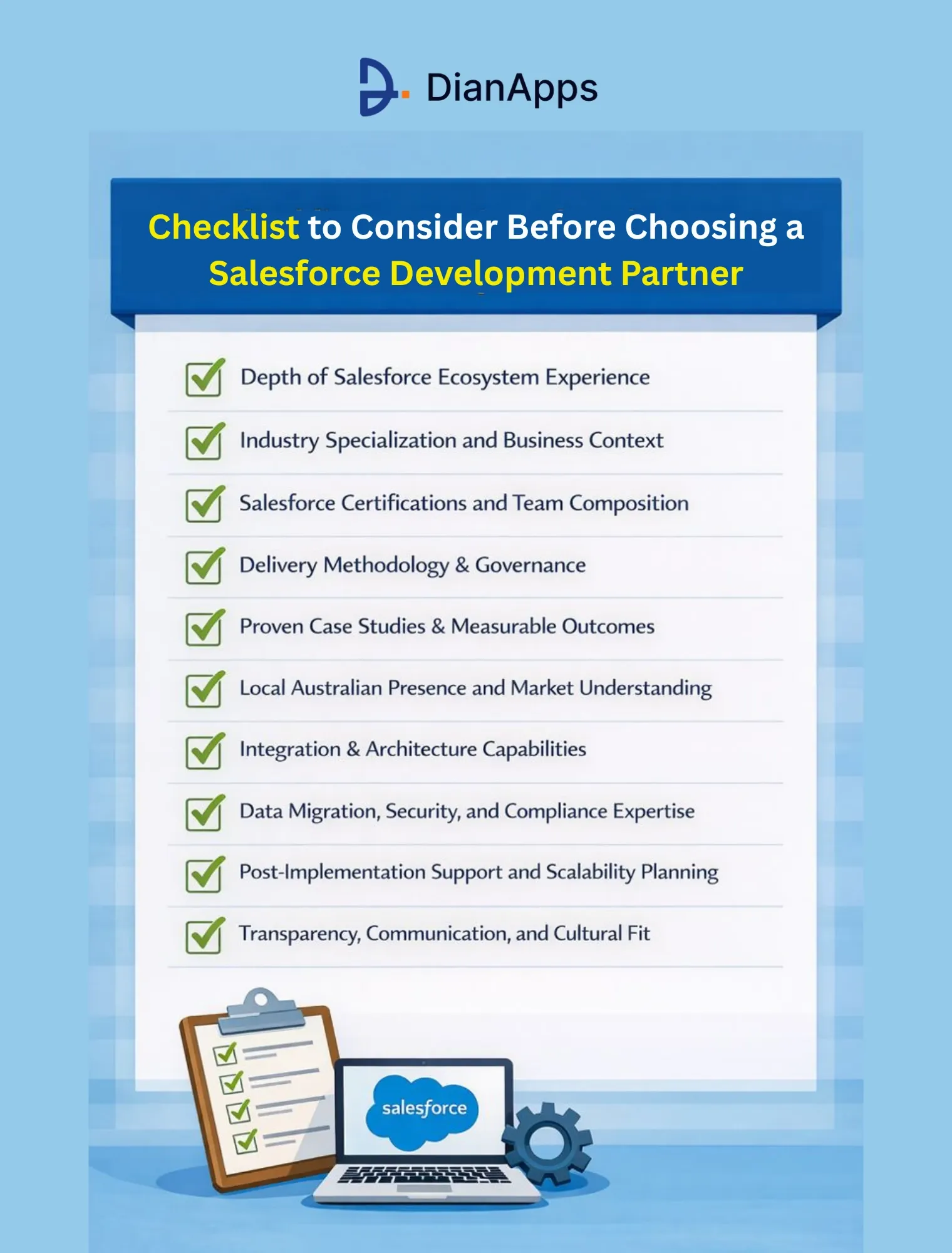
Choosing a Salesforce development partner is not about who can configure objects the fastest or offer the lowest hourly rate. It’s about who can architect a system that survives scale, complexity, and change. Below are the most critical factors Australian businesses must evaluate before shortlisting or signing any Salesforce partner.
Depth of Salesforce Ecosystem Experience
Salesforce is no longer a single CRM; it’s an ecosystem spanning Sales Cloud, Service Cloud, Experience Cloud, Marketing Cloud, Data Cloud, Industry Clouds, and custom app development. A reliable partner demonstrates hands-on experience across multiple clouds, not just surface-level familiarity.
What to look for:
- Multi-cloud implementation experience
- Proven ability to design cross-cloud data flows
- Experience handling complex permission models and role hierarchies
A partner that only works within one narrow Salesforce module may struggle as your requirements evolve.
Recommended Read: Behind the Cloud: Tech Driving Salesforce Innovation
Industry Specialization and Business Context
One of the biggest differentiators between average and high-performing Salesforce partners is industry context. Top Salesforce development partners in Australia often specialize in specific verticals such as fintech, healthcare, logistics, retail, real estate, SaaS, or professional services.
Why this matters:
- Industry-specific compliance and data security requirements
- Pre-built workflows aligned with real operational processes
- Faster discovery and fewer requirement gaps
Ask directly: What industries do you work with most, and why? Vague answers are a red flag.
Salesforce Certifications and Team Composition
Certifications alone don’t guarantee success, but a lack of them signals risk. A trustworthy Salesforce partner invests continuously in certification and upskilling.
Key roles your partner should have:
- Salesforce Certified Developers
- Salesforce Solution Architects
- Salesforce Administrators
- Business Analysts or Functional Consultants
More importantly, confirm who will actually work on your project. A strong sales pitch means little if execution is handed off to junior resources.
Recommended Read: Salesforce CRM Trends in 2026
Delivery Methodology and Governance
A reliable partner follows a structured, transparent delivery model, not ad-hoc execution.
Evaluate their approach to:
- Requirement discovery and documentation
- Sprint planning and milestone tracking
- Change request management
- Stakeholder communication cadence
Partners with mature governance frameworks reduce surprises, scope creep, and delivery delays, especially critical for enterprise-scale Salesforce implementations.
Proven Case Studies and Measurable Outcomes
Any credible Salesforce development partner should be able to demonstrate measurable business outcomes, not just technical deliverables.
Look beyond UI screenshots and ask for:
- KPIs improved post-implementation
- Adoption metrics
- Performance or efficiency gains
If a partner cannot quantify impact, they likely focused on delivery, not outcomes.
Local Australian Presence and Market Understanding
While offshore delivery models are common, having a partner with a local Australian presence adds significant value, especially for regulated industries and stakeholder-heavy projects.
Benefits include:
- Time zone alignment
- Understanding of Australian compliance and business norms
- Easier collaboration with internal teams
This is particularly relevant when evaluating Salesforce partners in Sydney, Melbourne, or across Australia.
Integration and Architecture Capabilities
Salesforce rarely operates in isolation. A strong partner understands how Salesforce fits into your broader tech ecosystem.
Assess their experience with:
- ERP and accounting system integrations
- Marketing automation platforms
- Custom APIs and middleware tools
Poor integration design is one of the leading causes of Salesforce performance and scalability issues.
Data Migration, Security, and Compliance Expertise
Data is the backbone of Salesforce. A capable partner has a clear, documented approach to:
- Data migration strategy
- Validation and reconciliation
- Data security and access controls
In Australia, where data privacy expectations are high, this capability is non-negotiable.
Post-Implementation Support and Scalability Planning
Salesforce implementation is a phase, not the finish line. A dependable partner plans for what happens after go-live.
Evaluate:
- Support models and SLAs
- Enhancement and optimization roadmap
- Ongoing performance monitoring
Partners who disappear after deployment leave businesses with technical debt and stalled growth.
Transparency, Communication, and Cultural Fit
Finally, trust matters. The right Salesforce development partner communicates clearly, challenges assumptions constructively, and works as a strategic extension of your internal team.
Signs of a strong fit:
- Honest feedback during discovery
- Clear documentation and reporting
- Willingness to say “no” when needed
Cultural alignment often determines whether the partnership thrives or quietly fails.
Essential Technical Skills to Look for While Choosing a Salesforce Development Partner
Your partner’s technical bench matters. Here’s what to prioritize:
Full-Stack Salesforce Development
They should be proficient in:
- Apex programming
- Lightning Web Components (LWC)
- Salesforce APIs and integrations
- Custom object and workflow automation
Recommended Read: The role of Apex, Visualforce, and Lightning in Salesforce development
Data Management & Security
Strong expertise in:
- Secure data models
- Large data migration tools
- Compliance frameworks
Integration Expertise
CRM rarely lives alone; partners must integrate Salesforce with:
- ERP platforms
- Marketing automation tools
- Third-party analytics systems
DevOps & Quality Assurance
Look for:
- CI/CD pipeline experience
- Automated testing strategies
- Change-set management practices
These skills ensure safer deployments and smoother release cycles.
Key Questions to Ask a Salesforce Development Expert
Before Selection
- What are your Salesforce certification counts and roles?
- Can you share relevant case studies from similar industries?
- What’s your approach to requirements gathering?
During Evaluation
- How do you handle scope changes?
- What project management methodology do you use?
- How do you ensure knowledge transfer to internal teams?
Methods to Evaluate
- Assign a small paid pilot project.
- Conduct a technical assessment call.
- Review reference checks and testimonials.
Just Before Signing the Contract
- Ask about escalation paths.
- Confirm warranty and support terms.
- Clarify deliverables, ownership, and SLAs.
Being methodical here helps avoid scope creep and budget overruns.
Mistakes to Avoid When Choosing a Salesforce Development Partner
Many Salesforce projects don’t fail because of the platform; they fail because of avoidable decision-making mistakes made before the partnership even begins. Understanding these pitfalls early can save Australian businesses months of rework, inflated costs, and lost internal trust. Below are the most common and most damaging mistakes organizations make when choosing a Salesforce development partner.
Choosing Based on Cost Instead of Value
One of the most frequent mistakes is prioritizing the lowest quote over long-term value. Salesforce implementations are complex, and aggressive underpricing often signals shortcuts, junior resources, minimal discovery, or fragile architectures.
What this leads to:
- Poorly designed data models
- Hard-coded automations that don’t scale
- Rising support and rework costs post-launch
In Salesforce projects, cheap upfront often means expensive later.
Skipping the Discovery and Strategy Phase
Some partners rush straight into configuration without thoroughly understanding your business processes. This may feel efficient at first, but it’s a critical error.
Without proper discovery:
- Salesforce ends up mirroring broken workflows
- Customization decisions lack strategic context
- Teams struggle with usability and adoption
A reliable partner invests time upfront to ask difficult questions and challenge assumptions.
Overlooking Industry Experience
Salesforce implementations are not one-size-fits-all. Ignoring industry-specific experience often results in misaligned workflows and compliance gaps.
For example:
- Financial services require strict data governance
- Healthcare demands privacy and role-based access
- Logistics needs real-time visibility and integrations
Partners without relevant industry exposure learn at your expense.
Not Verifying Certifications and Team Credentials
Another common mistake is assuming certifications are optional. While experience matters, lack of certified expertise often indicates outdated practices or limited platform knowledge.
Organizations fail when they:
- Don’t verify Salesforce certifications
- Accept vague answers about team composition
- Assume senior expertise will be available without confirmation
Always clarify who is actually delivering your project.
Ignoring Post-Implementation Support Models
Many businesses focus entirely on go-live and ignore what happens next. Salesforce is an evolving system without ongoing support; even strong implementations degrade over time.
Common oversights include:
- No defined SLAs
- Lack of performance monitoring
- No roadmap for future optimization
A partner that disappears after deployment leaves you with unmanaged technical debt.
Falling for Sales-Driven Promises
Strong marketing does not equal strong delivery. Some partners oversell capabilities during the sales phase and underdeliver during execution.
Warning signs:
- Overpromising timelines
- Avoiding technical depth in discussions
- Lack of transparency around risks
A trustworthy Salesforce partner sets realistic expectations even when the truth is uncomfortable.
Failing to Assess Communication and Governance
Poor communication is a silent project killer. Without structured governance, even technically sound teams struggle.
Mistakes here include:
- No defined communication cadence
- Lack of documentation
- Unclear escalation paths
Reliable partners operate with clarity, not chaos.
Over-Customizing Too Early
Excessive customization is one of the most underestimated risks in Salesforce projects. Businesses often request complex features before validating standard platform capabilities.
This results in:
- Slower performance
- Difficult upgrades
- Higher maintenance costs
A good partner knows when to customize and when not to.
Not Validating Real Client References
Reading testimonials is not enough. Many organizations skip direct reference checks due to time constraints.
This mistake:
- Masks delivery issues
- Hides support gaps
- Creates false confidence
Always speak to past clients, ideally in similar industries or project scopes.
Treating the Partner as a Vendor, Not a Strategic Ally
Finally, many Salesforce projects fail because the relationship is transactional rather than collaborative.
When partners are treated as order-takers:
- Strategic input is lost
- Innovation stalls
- Business alignment suffers
The most successful Salesforce initiatives treat partners as long-term collaborators, not short-term contractors.
Signs Your Salesforce Partner May Not Be the Right Fit
Even after careful selection, misalignment can surface once the project is underway. Recognizing early warning signs allows you to course-correct before timelines, budgets, and trust take a hit.
- Inconsistent or unclear communication: If updates are irregular, overly technical without context, or key decisions aren’t documented, it signals weak governance. Over time, this leads to confusion, missed expectations, and internal friction among stakeholders.
- Reactive rather than proactive behaviour: A reliable Salesforce partner anticipates risks and suggests improvements. If your partner only responds when issues escalate and rarely brings strategic recommendations, it indicates a delivery-first, not outcome-driven mindset.
- Lack of transparency in timelines and scope: When estimates keep shifting without clear justification or change-management processes, it often points to poor planning or limited experience handling complex Salesforce environments.
- Over-reliance on custom code: If standard Salesforce features are consistently ignored in favour of heavy customization, you’re likely accumulating technical debt that will hurt performance, upgrades, and long-term scalability.
- Minimal focus on user adoption: When training, documentation, and feedback loops are treated as afterthoughts, adoption suffers, undermining the entire Salesforce investment.
Final Words
Choosing the right Salesforce partner is a strategic decision that directly influences how effectively your organization scales, sells, and serves its customers. It is not just about technical execution; it is about building a system that supports long-term business goals.
A reliable Salesforce development company in Australia brings more than platform expertise. It understands local market dynamics, regulatory expectations, and the operational realities faced by Australian businesses across industries.
By evaluating partners on experience, industry alignment, delivery methodology, and post-implementation support, organizations can significantly reduce risk and avoid costly rework.
Ultimately, Salesforce's success is not defined at go-live. It is built through an ongoing partnership that continuously optimizes the platform, drives user adoption, and delivers measurable business impact over time.









Leave a Comment
Your email address will not be published. Required fields are marked *