

Here's a number that should make you uncomfortable: only 1 in 200 IT projects meet all three success criteria on time, on budget, and delivering the intended benefits (McKinsey/PMI, 2025). That's a 0.5% success rate. And 78% of those projects experience scope creep along the way.
For logistics companies, the stakes are even higher. You're not building a marketing website. You're building software that tracks shipments, manages warehouses, optimizes routes, and keeps your entire supply chain from falling apart. Pick the wrong development partner and you don't just waste money, you lose months of operational progress.
The global logistics software market hit $17.82 billion in 2025 and is on pace to reach $35.84 billion by 2033 (SNS Insider, 2026). Everyone's investing in logistics tech. But how do you pick the company that'll actually deliver?
This guide gives you a concrete framework: the questions to ask, the red flags to watch for, and the benchmarks that separate good development partners from expensive mistakes.
| TL;DR: Choose a logistics software development company with proven domain expertise, AI/ML capabilities, and transparent project management. With only 0.5% of IT projects fully succeeding and the logistics software market growing at 9.18% CAGR, the right partner can deliver 300-500% ROI within 12-24 months. The wrong one will cost you more than money (McKinsey/PMI, 2025). |
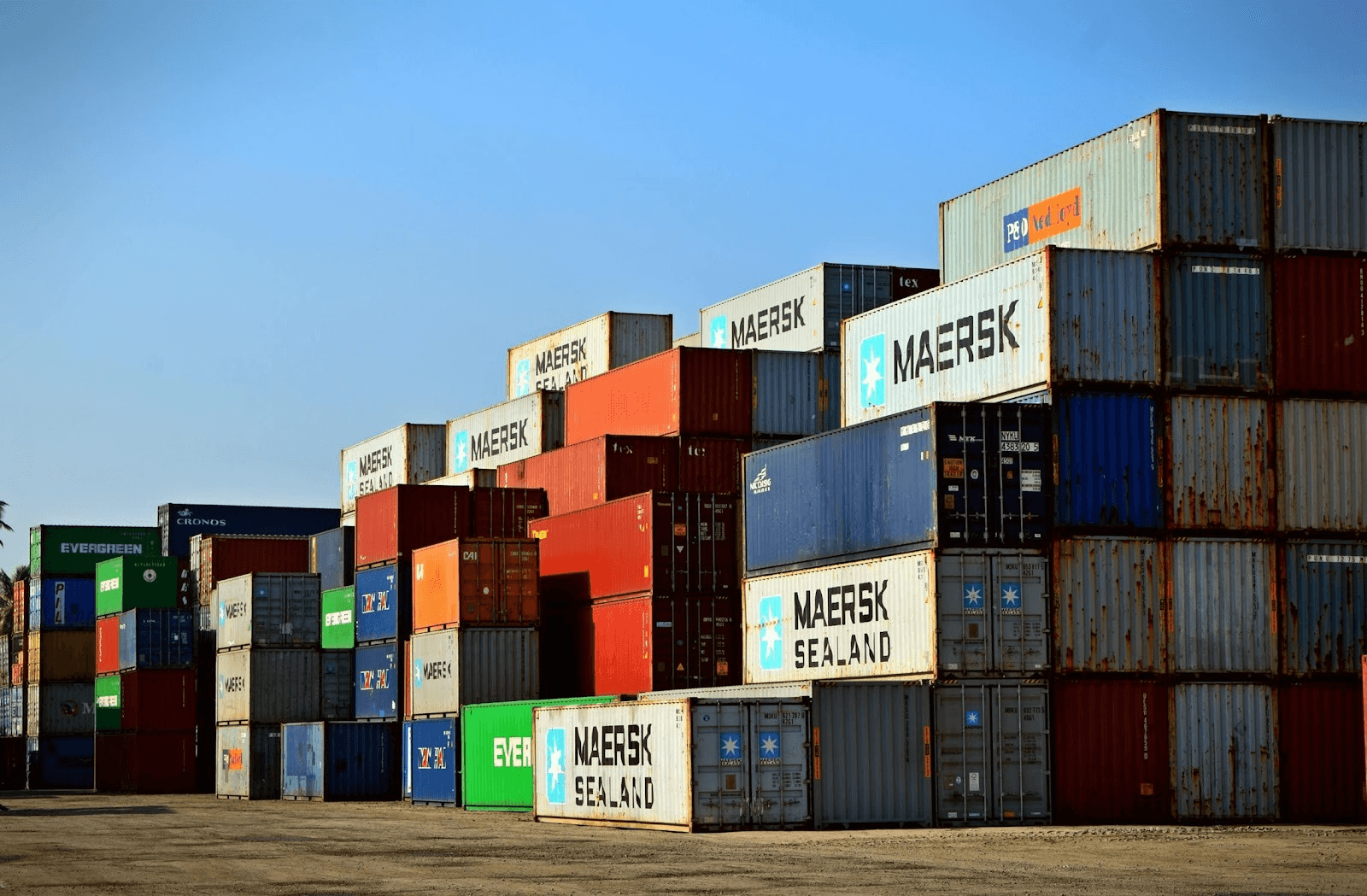
Colorful shipping containers stacked at a busy logistics port
Why Does Choosing the Right Logistics Software Partner Matter So Much?
96% of transportation leaders now use AI for planning, operations, and decision-making (Breakthrough, 2025). This isn't a future trend. It's happening right now. And if your development partner can't build AI-powered logistics tools, you're already falling behind.
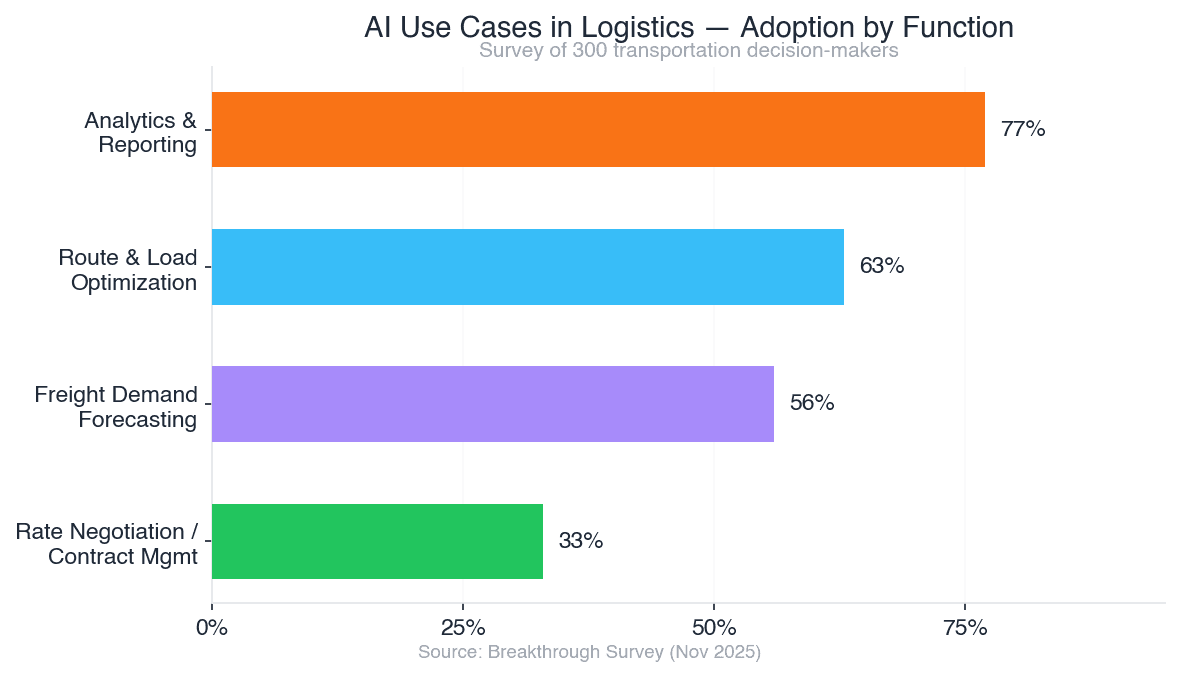
AI Use Cases in Logistics — Adoption by Function (Breakthrough, 2025)
The logistics industry runs on tight margins and tighter timelines. A warehouse management system that's two months late costs you real money - in manual labor, missed shipments, and customer churn. A route optimization tool that doesn't integrate with your existing TMS creates more problems than it solves.
Here's what makes logistics software development different from general app development:
- Regulatory complexity - Customs documentation, hazmat handling, DOT compliance, cross-border shipping rules. Your dev team needs to understand these, not just code around them.
- Real-time requirements - GPS tracking, live inventory counts, instant ETA updates. Latency kills in logistics. Your system needs to process thousands of events per second without choking.
- Integration depth - ERP systems, carrier APIs, IoT sensors, payment gateways, customs databases. A typical logistics platform touches 15-30 external systems. If your dev team hasn't built these integrations before, expect delays.
- Scale unpredictability - Peak season can triple your transaction volume overnight. Black Friday. Holiday shipping. Port backlogs. Your software needs to scale without advance notice.
Only 6% of companies have full end-to-end supply chain visibility (GEODIS). That's the gap. The right software partner helps you close it. The wrong one just burns through your budget while the gap stays open.
If you're exploring how AI is reshaping logistics operations, we've covered that in depth separately.
What Should You Look for in a Logistics Software Development Company?
The US logistics software market alone was valued at $5.75 billion in 2025, projected to reach $11.40 billion by 2033. With that much growth, dozens of development companies are slapping "logistics expertise" on their websites. Here's how to tell who actually has it.
1. Domain Expertise - Not Just Technical Skills
Ask for case studies specific to logistics. Not e-commerce. Not fintech. Logistics. A company that's built a transportation dispatch system understands driver assignment algorithms, load balancing, and compliance tracking in ways that a generalist shop never will.
Red flags: generic portfolios, no logistics-specific references, inability to name common logistics APIs or standards (EDI, API integrations with carriers like FedEx, UPS, DHL).
2. AI and Automation Capabilities
96% of shippers and logistics providers are already using generative AI for transportation management (Descartes/SAPIO, 2025). Your development partner needs hands-on experience with:
- Route optimization algorithms
- Demand forecasting models
- Computer vision for warehouse automation
- Natural language processing for document extraction (BOLs, invoices, customs forms)
- Predictive maintenance for fleet management
If they can't demo an AI feature they've actually shipped, keep looking.
3. Cloud-First Architecture
Cloud-based deployment holds 47.3% of the logistics software market share and it's growing fastest. Your partner should be building on AWS, Google Cloud, or Azure with auto-scaling, containerization, and CI/CD pipelines as defaults, not add-ons.
4. Transparent Project Management
78% of IT projects experience scope creep (PMI, 2025). Your dev partner should use Agile methodology with:
- Two-week sprint cycles with visible deliverables
- A dedicated project manager (not the lead developer wearing two hats)
- Regular demos you can actually test, not just slide decks
- Change request processes that are documented before the project starts
5. Post-Launch Support and Scalability
Logistics doesn't stop after go-live. Peak seasons, new carrier integrations, regulatory changes, your software needs ongoing maintenance. Ask about SLA guarantees, support response times, and whether the team that built your product is the same team supporting it.
| From our experience: The biggest predictor of a successful logistics software project isn't the technology stack, it's whether the dev team has someone who's actually worked in logistics. We've had supply chain consultants join client calls and catch requirements that purely technical teams would've missed entirely. |
What Are the Red Flags When Evaluating a Development Partner?
40% of freight forwarders and 3PLs are dedicating more than 25% of their 2026 budgets to technology (SPS Commerce/Logistics Viewpoints, 2025). That's serious money. Don't hand it to a company that shows any of these warning signs:
Pricing Red Flags
- Fixed-price quotes without discovery - If they quote you a hard number before understanding your operations, they're either padding the price or planning to cut corners.
- Unusually low estimates - Custom logistics software typically runs $80,000-$350,000+ depending on scope. If someone offers it for $20,000, ask what you're not getting.
- No breakdown by phase - You should see separate costs for discovery, design, development, testing, and deployment. A single lump sum hides where the money actually goes.
Process Red Flags
- No dedicated QA team - Logistics software handles financial transactions, compliance documents, and real-time tracking. "The developers test their own code" isn't acceptable.
- Waterfall methodology for complex projects - If they want to spend three months gathering requirements before writing any code, run. Logistics requirements change weekly.
- No staging environment - You need to test integrations with carrier APIs, ERP systems, and IoT devices before anything hits production.
Communication Red Flags
- Timezone gaps with no overlap - If your dev team is 12 hours ahead and there's no planned overlap window, urgent issues become 24-hour problems.
- Single point of contact - What happens when that person goes on vacation? Or quits? You should have access to at least two team leads.
For small logistics operations wondering whether custom software is even worth it, we've addressed that question in our guide on why small businesses need custom logistics software.
What ROI Can You Expect From Custom Logistics Software?
43% of transportation leaders already see measurable ROI from their AI investments, and another 34% expect returns within six months (Breakthrough, 2025). Custom logistics software isn't just a cost - it's an investment with trackable returns.
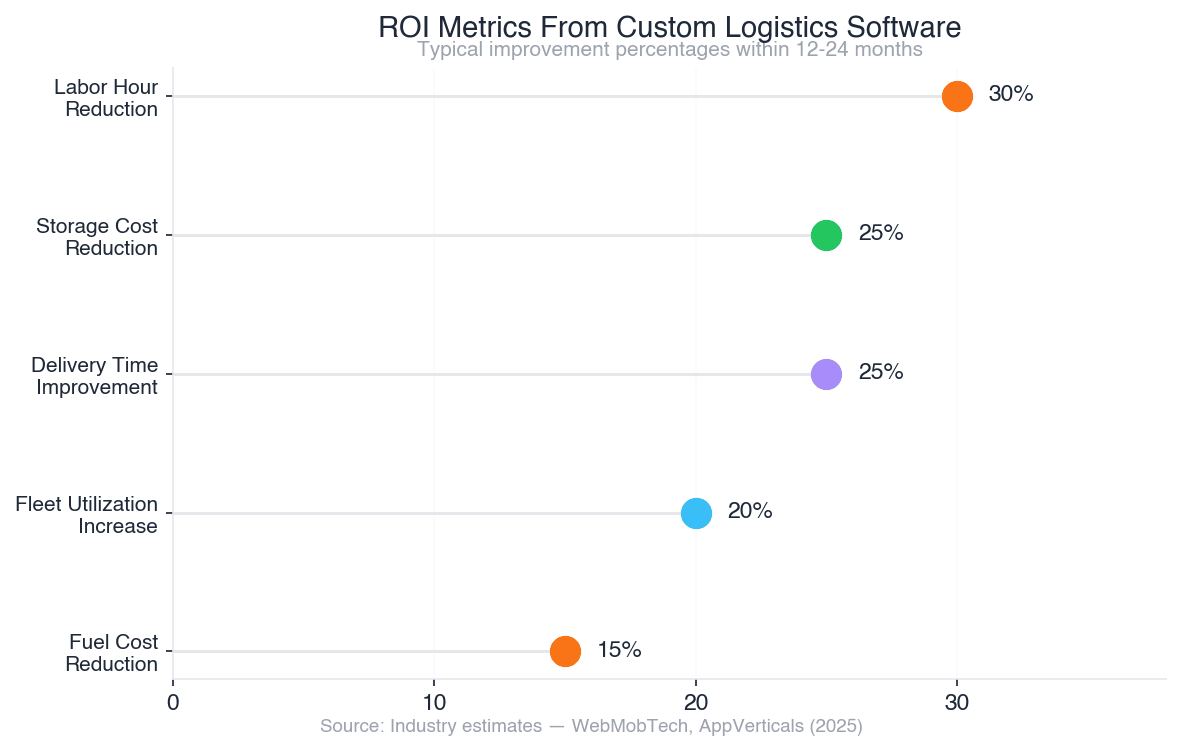
ROI Metrics From Custom Logistics Software
Here's what the numbers look like across key metrics:
| Metric | Typical Improvement |
| Fuel cost reduction (route optimization) | 15% |
| Storage cost reduction (inventory management) | 20-30% |
| Labor hour reduction (automation) | 30% |
| Delivery time improvement | 25% |
| Fleet utilization increase | 20% |
| Overall ROI (12-24 months) | 300-500% |
Industry estimates compiled from WebMobTech and AppVerticals, 2025
These aren't hypothetical. A mid-size logistics company spending $500,000 annually on fuel can save $75,000 per year through route optimization alone. Over three years, that's $225,000 from a single feature.
The 3PL market hit $1.32 trillion in 2025 and is growing to $2.14 trillion by 2030 (The Business Research Company, 2025). Whether you're a 3PL provider or a shipper working with one, custom software is how you stay competitive in a market that's nearly doubling.
To see how software specifically improves warehouse operations, check out our piece on how logistics software improves warehouse and inventory management.
What Questions Should You Ask Before Signing a Contract?
The supply chain visibility software market was valued at $3.3 billion in 2025, growing to $10.9 billion by 2034 (Global Market Insights, 2025). That growth means more companies entering the space and more chances to pick the wrong one. Here's your pre-contract checklist:
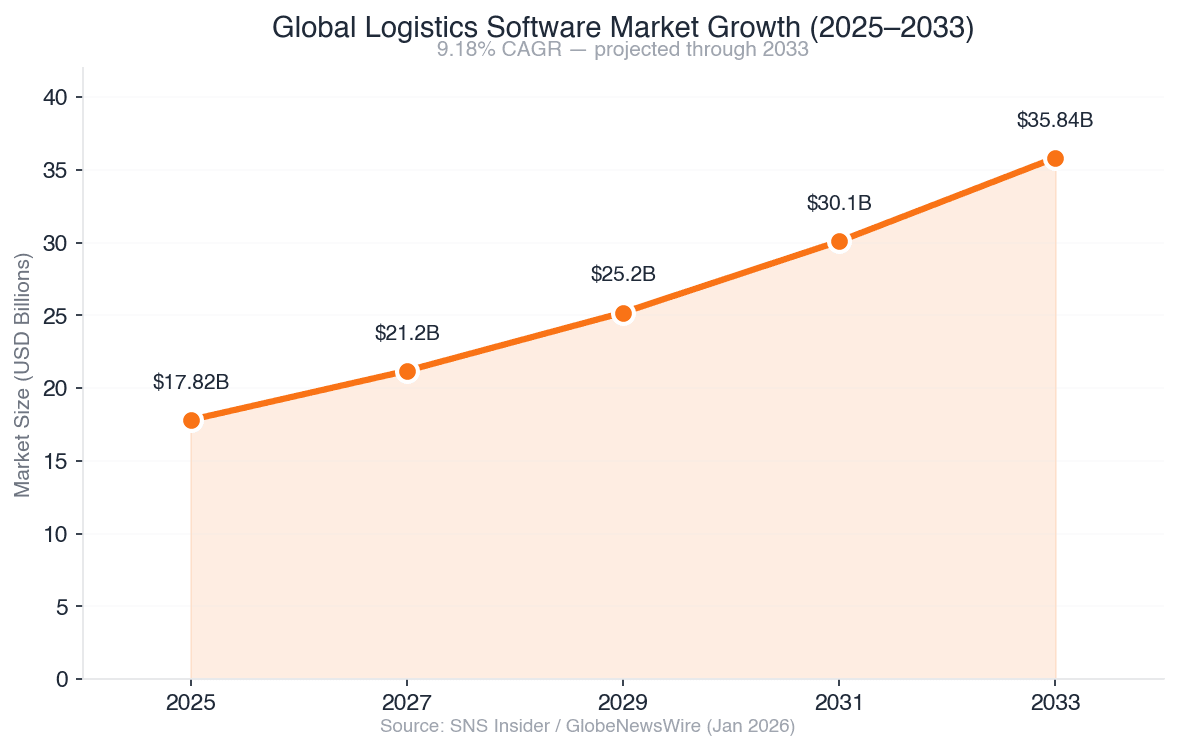
Global Logistics Software Market Growth (2025–2033)
Technical Questions
- "What logistics-specific projects have you delivered in the past two years?" Look for TMS, WMS, fleet management, or last-mile delivery platforms. Not just "supply chain dashboards."
- "How do you handle real-time data at scale?" The answer should include message queues (Kafka, RabbitMQ), event-driven architecture, and auto-scaling infrastructure.
- "What's your approach to third-party integrations?" They should name specific carrier APIs, ERP connectors, and IoT protocols they've worked with.
- "Do you build AI/ML features in-house?" If they outsource the AI piece, you'll face coordination delays and finger-pointing when things break.
Business Questions
- "Can you share references from logistics clients?" Not just testimonials on their website. Actual people you can call.
- "What happens if the project scope changes mid-build?" The answer should be a documented change request process, not "we'll figure it out."
- "Who owns the source code?" You do. Always. If they hesitate on this, walk away.
- "What does your post-launch support look like?" Get SLA specifics: response times, uptime guarantees, and whether the original team handles support.
Budget Questions
- "Can you break the project into phases with separate budgets?" Phase 1 should be an MVP you can test with real users. If they insist on building everything at once, that's a red flag.
- "What's included in the quoted price and what's not?" Third-party API fees, cloud hosting, SSL certificates, App Store fees, these add up. Get them in writing.
| Our advice: We always recommend starting with a 2-4 week paid discovery phase before committing to full development. It lets both sides test the working relationship, refine requirements, and catch misalignments before they become expensive problems. |
Why DianApps Is the Best Logistics Software Development Company for Your Business
We've shipped logistics software for fleet operators, 3PL providers, last-mile delivery startups, and warehouse operations across the US. We're not a generalist shop that happens to take logistics projects. This is what we do.
What Sets Us Apart
- Logistics-first engineering - Our team includes developers who've built transportation dispatch systems, warehouse management platforms, and AI-powered route optimization tools. We know the difference between a BOL and a POD, and our code reflects that.
- AI and automation built in - We integrate machine learning models for demand forecasting, route planning, and predictive maintenance directly into our builds. Not as an afterthought. From sprint one.
- US based time zones - As a logistics software development company in US, we work in your time zone. Same-day responses. No overnight communication gaps. Face-to-face meetings when you need them.
- Full lifecycle support - We don't disappear after launch. Our clients get dedicated support teams, monthly performance reviews, and proactive infrastructure monitoring.
- Proven ROI - We've helped logistics companies cut fuel costs by 15%, reduce manual processing by 30%, and improve delivery accuracy significantly. We track these numbers because our clients track them too.
Our Logistics Software Stack
We build on proven technologies: React Native and Flutter for mobile, Node.js and Python for backend, PostgreSQL and MongoDB for data, and AWS/GCP for cloud infrastructure. Every project gets CI/CD pipelines, automated testing, and staging environments from day one.
Whether you need a logistics app to grow your transportation business or a complete supply chain platform, we've done it before. As a trusted custom software development company, we bring the same rigor to every project - logistics or otherwise.
Conclusion
Choosing a logistics software development company is one of the most consequential technology decisions your business will make. With only 0.5% of IT projects fully succeeding and logistics software investments growing at 9.18% CAGR, the margin for error is thin and the cost of getting it wrong is enormous.
Here's what to prioritize:
- Domain expertise over general coding skills: logistics has unique requirements that generalists consistently miss
- AI capabilities as a baseline: 96% of transportation leaders already use AI; your partner needs to build it, not bolt it on
- Transparent processes: Agile sprints, visible deliverables, documented change management
- Phased delivery: MVP first, then expand based on real data and user feedback
- Post-launch commitment: The partner who builds it should be the partner who supports it
The logistics companies that get their software right don't just save money, they turn technology into a competitive advantage. The ones that don't are still tracking shipments in spreadsheets while their competitors automate.









Leave a Comment
Your email address will not be published. Required fields are marked *