















 0 comments





Quick Summary:
|
Here’s a frustrating situation most business owners know too well.
You buy a software subscription. You spend weeks configuring it. You train your team. And then, three months in, you hit a wall the tool can’t handle your approval workflow, won’t talk to your CRM, and the vendor’s answer to every support ticket is: ‘that feature is on our roadmap for Q4.’
Sound familiar?
This is exactly why thousands of companies, from scrappy startups to well-established 500 enterprises, are eliminating generic tools and choosing custom software development instead.
But before you plan to build a custom software, your mind must be bombarded with multiple questions, like what is custom software development, really? Is it only for big companies with massive budgets? How does it actually work? And is it right for your business?
This blog answers all of that plainly, without the jargon. By the end, you’ll know the types, see real-world examples, understand the actual benefits, and know exactly when it makes sense to build rather than buy.
However, to get a complete strategic overview, see our full Custom Software Development Guide. Also, remember that if you want to build a scalable and efficient software, you must definitely get in touch with a custom software development company.
Custom software development is the practice of building software from scratch or heavily from the ground up to solve the specific problems of one organization.
It’s not a template. It’s not a white-label product. It’s not a pre-built SaaS tool you configure. It’s software where every screen, every workflow, and every integration was designed with your business in mind.
You’ll also hear it called bespoke software development, custom-made software, or purpose-built software. Same thing.
A quick analogy: think of the difference between buying a suit off the rack versus having one made by a tailor. Both cover you. But only one was built for you.
According to research and market research, the global custom software development market is estimated to be USD 44.2 billion in 2025 and is projected to hit 213.4 billion by 2035. That’s not a trend, that’s a signal. Businesses are voting with their budgets, and they’re choosing software that fits.
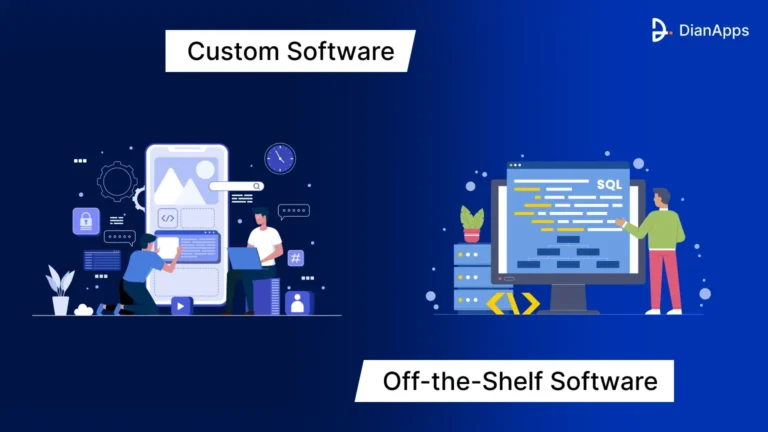
Custom Software vs. Off-the-Shelf Software
Before we go further, let’s clear up the comparison that every business owner eventually faces.
| Features | Custom Software | Off-the-Shelf Software |
| Fit to your business | Built exactly around your workflows | You adapt your workflows to it |
| Upfront Cost | Higher you’re funding the build | Lower subscription or one-time fee |
| Long-term Cost | Lower no per-seat fees that compound | Ongoing licensing, seat-based pricing |
| Scalability | Designed to scale with your growth | Limited by the vendor’s roadmap |
| Ownership | 100% yours full control | Licensed vendor owns the product |
| Security | Architecture designed for your risk profile | Widely deployed = wider attack surface |
| Integrations | Connects to whatever you need | Limited to vendor-approved integrations |
| Time to launch | 3–9 months typically | Days to weeks |
Neither is universally better. Off-the-shelf wins when speed matters and your needs are standard. Custom wins when you’re trying to build something that competitors can’t copy and generic tools can’t support.
Recommended Read: Top Software Development Tools Developers Swear By in 2026
7 Types of Custom Software Development
Custom software isn’t one thing; it’s a category. Here are the seven main types you should know about.
Enterprise Software
Think ERP systems, CRM platforms, HR management tools, and workflow automation, but built for your exact processes, not SAP’s idea of what your processes should look like.
A manufacturing company might need an ERP that connects factory floor IoT sensors to procurement and finance. No off-the-shelf ERP does that out of the box.
Custom Web Application Development
These are browser-based tools, customer portals, internal dashboards, SaaS platforms, or booking systems. Accessible from anywhere, easy to update, no installation required.
A logistics company, for instance, might build a web portal where clients track their shipments in real time, tied directly into their dispatch system.
Custom Mobile App Development
iOS, Android, or both. These range from customer-facing apps (think banking, healthcare, retail) to internal apps for field teams, drivers, and warehouse staff.
Recommended Read: MVP in Software Development – Why is it essential and how can businesses approach it?
Cloud-Based Software
Software built to run on cloud infrastructure, AWS, Azure, GCP, rather than on-premise servers. This gives you auto-scaling, global access, and lower infrastructure overhead. Most modern custom software is cloud-native by default.
Custom E-Commerce Platforms
When Shopify’s limits start costing you conversions, companies build their own. Custom e-commerce software includes tailored storefronts, AI-powered product recommendations, custom checkout flows, and inventory systems that actually match how your warehouse works.
Healthcare & FinTech Software
Regulated industries have compliance requirements, such as HIPAA, PCI DSS, and SOC 2, that generic tools often half-handle. Custom software in these sectors covers telemedicine platforms, EHR systems, digital banking apps, fraud detection engines, and investment platforms.
Custom API & Integration Development
Sometimes the gap isn’t a missing app, it’s that your existing apps don’t talk to each other. Custom API development builds the plumbing that connects your CRM to your ERP to your data warehouse to your reporting tool.
10 Real-World Examples of Custom Software
Here’s where it gets concrete. These aren’t hypothetical; they’re illustrations of how custom software solves actual business problems.
- Netflix: Their recommendation engine isn’t a plugin. It’s a custom-built AI system that analyzes viewing patterns across 260M subscribers and surfaces the right content to the right person. That engine is a core business asset.
- Uber: The dispatch algorithm matching drivers to riders in real time, at scale, across 70+ countries, was built from scratch. No existing software does that.
- Amazon: Their warehouse management system tracks billions of inventory units across hundreds of fulfillment centers. It was custom-built because nothing on the market could handle that volume.
- A regional bank: Needed a fraud detection system that flagged unusual transactions in under 200ms while staying compliant with FDIC rules. Off-the-shelf flagged too many false positives and tanked customer satisfaction.
- A mid-sized hospital network: Built a custom EHR platform that integrated patient records, billing, and telehealth appointments in one system. The off-the-shelf alternative required three separate tools and a full-time integration manager.
- An online retailer: Replaced Shopify with a custom storefront after product catalog complexity grew to 800,000 SKUs. Page load times dropped by 60%, and cart abandonment fell.
- A logistics firm: Custom route optimization software cut delivery costs by 18% in the first year by factoring in real-time traffic, driver hours, and fuel costs, something no SaaS tool combined.
- An EdTech startup: Built a custom LMS with adaptive learning paths that adjusted quiz difficulty based on student performance. No existing LMS offered this level of personalization.
- A manufacturing company: Custom predictive maintenance software analyzed sensor data from production equipment and sent maintenance alerts before failures occurred, reducing downtime by 23%.
- A real estate platform: Built a custom property-matching algorithm that connected buyers with listings based on commute time, school ratings, and neighborhood growth data, not just price and bedrooms.
8 Benefits of Custom Software Development
Let’s go beyond the obvious “it fits your business” talking point. Here are the real, tangible benefits that move the needle.
It Does Exactly What You Need, Nothing More, Nothing Less
Off-the-shelf software is built for the average user. Your business isn’t average. Custom software eliminates features you’ll never use while building exactly the features you’ll use every day.
It Scales Without Breaking
Generic tools hit walls. They slow down when you add users. They require expensive upgrades to unlock capacity. Custom software is architected from day one to handle your growth trajectory, whether that’s 10x users or 100x data.
Security Built Around Your Risk Profile
Off-the-shelf software has a massive target on its back. Hackers study popular platforms and find vulnerabilities. Custom software has a unique codebase, custom authentication flows, and security measures designed around your specific compliance requirements (HIPAA, SOC 2, GDPR).
Everything Talks to Everything
Your custom system can connect to your CRM, your ERP, your payment gateway, and your analytics stack through custom APIs built exactly for your setup. No more copy-pasting data between tools or paying for expensive middleware.
Lower Total Cost of Ownership Over Time
Yes, the upfront cost is higher. But when you’re not paying $200 per seat per month, and you’re not hiring someone to manage integrations that keep breaking, the math flips. Most companies break even within 18–36 months.
Competitive Advantage You Can Actually Defend
When your core business process is powered by proprietary software, your competitors can’t copy it. They can reverse-engineer your pricing. They can copy your branding. They cannot copy your tech stack.
You Own It Completely
No vendor can discontinue your product. No pricing change can price you out. No update can remove a feature your team relies on. You own the code, the IP, and the future of the product.
Support That Knows Your System
With custom software, your development partner knows your system inside out. When something breaks at 2 am, there’s no ticket queue or offshore support team. There’s a team that built the thing.
The Custom Software Development Process: 6 Phases
People often think custom software development is a black box. You hand someone a wish list and six months later, software appears. That’s not how it works. Here’s what a professional development process actually looks like and what you should expect at each stage.
Phase 1: Discovery & Requirements: Your team and the dev team sit down (usually over 1–2 weeks) to map your workflows, define what the software needs to do, who uses it, and what success looks like. This phase prevents 90% of project failures.
- Phase 2: System Design & Architecture: The tech team decides the stack, designs the database structure, and produces UI/UX wireframes. You review and approve before anyone writes code.
Phase 3: Development (Agile Sprints): Code gets written in 2-week sprints. You see working features regularly, not at the end of six months. Feedback is incorporated as you go. Agile development methodology plays an important role in delivering end-to-end feature updates.
Phase 4: Quality Assurance & Testing: Functional testing, performance testing, security scanning, and user acceptance testing (UAT). Nothing ships without passing this phase.
Phase 5: Deployment & Integration: The software goes live. Data migrates from old systems. Your team gets trained. The go-live is a planned event, not a surprise.
- Phase 6: Maintenance & Improvement: Software isn’t finished when it ships. Bugs get fixed, new features get added, performance gets optimized. The best dev relationships are long-term.
When Should Your Business Choose Custom Software?
Custom software isn’t always the answer. Here’s an honest breakdown of when it makes sense and when it doesn’t.
Go custom when:
- Your workflows are complex enough that you’re spending significant time on manual workarounds
- You’re paying for multiple SaaS tools that still don’t cover your full process
- You operate in a regulated industry with compliance requirements that most tools don’t fully satisfy
- A unique process or algorithm is core to your competitive advantage
- You’re scaling fast, and your current tools are becoming a bottleneck
- Your per-seat licensing costs are approaching (or exceeding) what a build would cost
Stick with off-the-shelf when:
- Your needs are genuinely standard, and common tools handle them well
- You need to launch in under 30 days
- Your budget is under $15,000
- The problem you’re solving has already been solved well by an existing product
Recommended Read: How Custom Software Development Can Benefit Your Business?
Industries That Rely on Custom Software Development
Custom software isn’t niche. These seven industries have adopted it as a core operational necessity.
| Industry | What Custom Software Does For Them |
| Healthcare | EHR platforms, telehealth apps, patient management systems, HIPAA-compliant data handling |
| Finance & Banking | Fraud detection, digital banking apps, algorithmic trading, compliance automation |
| Retail & E-commerce | Custom storefronts, inventory management, AI-powered recommendations, loyalty programs |
| Logistics | Route optimization, fleet management, warehouse systems, and real-time shipment tracking |
| Manufacturing | ERP integration, predictive maintenance, IoT-connected production monitoring |
| EdTech | LMS platforms, adaptive learning, virtual classrooms, performance analytics |
| Real Estate | Property management, AI matching, virtual tours, lead management CRM |
How Much Does Custom Software Development Cost?
This question deserves a straight answer, even if the real answer is “it depends.”
| Project Type | Typical Cost Range | Timeline |
| Small / Simple App | $15,000 – $50,000 | 2-4 months |
| Mid-Market Business Tool | $50,000 – $150,000 | 4–7 months |
| Enterprise Platform | $150,000 – $500,000+ | 7–14 months |
Key cost drivers: team location (US-based vs. nearshore vs. offshore), number of features, integrations required, compliance complexity, and post-launch support scope.
Final Thoughts
Custom software development isn’t a luxury; it has now become a strategic decision. The question isn’t whether your business can afford to build custom software; it’s whether you can afford to keep bending your operations around tools that were never built for you.
The businesses winning in their industries right now aren’t all using better sales tactics or bigger marketing budgets. Many of them are winning because they have built technology that their competitors simply don’t have access to.
That’s the real value of custom software. Not just that it fits. But it gives you something defensible. So, finally, it has been clearly defined that if you are looking for personalized software, you must go with custom software development.
Frequently Asked Questions
 0 comments








Leave a Comment
Your email address will not be published. Required fields are marked *