

Quick Overview:Want to build your first Android app tailored for a New York business? Here's the no-BS roadmap:
|
Building Android Apps for New York Businesses
When was the last time you made a purchase, booked a service, or checked your finances without reaching for your phone? Running a business in New York City, your customers are asking that same question every day, and the answer is increasingly Never.
Here's the number that makes that real: the NYC tech ecosystem now sits at $621 billion in value, home to over 25,000 tech-enabled startups, and the city raised $17.7 billion in venture funding in 2024 alone, a 74% jump from the previous year.
New York isn't just a business city anymore. It's one of the world's most active digital product markets, and the companies investing in Android app development today are the ones owning their customer relationships tomorrow.
If you've been circling the idea of building an Android app for your business but aren't sure where to start, what it costs, how long it takes, or what compliance requirements your app needs to meet in New York, this guide is your starting point.
Building Android App Development Services for NYC business typically requires 8 to 18 weeks for an MVP and $25,000 to $500,000+ for a full-scale product, depending on complexity, industry, and team.
Every app handling New York resident data must meet NY SHIELD Act safeguards, and sector-specific builds, healthcare, fintech, e-commerce, carry additional compliance requirements.
A proper planning phase before development begins is the single most effective way to control both timeline and budget.
Why Android Makes Sense for New York Businesses

Android holds over 72% of the global smartphone market share, and in a city as diverse as New York, 8.3 million people, 200+ languages spoken, spread across five boroughs with wildly different demographics, that reach matters.
Android's accessibility across a broad range of device price points means your app is reachable by the hourly worker in the Bronx, the tourist in Midtown, and the enterprise executive in Lower Manhattan.
iOS captures a higher average revenue per user in premium markets, but Android captures more of the city.
That said, the platform decision is not just about market share numbers. It's about who your user actually is and how they access digital services. For most NYC businesses, Android is either the primary platform or runs alongside iOS, and the industries driving the highest demand for custom Android development services right now reflect exactly that.
Fintech and Financial Services
New York holds the #1 fintech startup ecosystem in the US, with nearly 4,000 fintech startups and over $46 billion in VC funding between 2014 and 2023.
Banks, payment platforms, trading tools, and budgeting apps are all categories where Android development is not a nice-to-have, it's table stakes.
When 55% of US consumers now manage their bank accounts primarily through a mobile app, the question is not whether your fintech product needs an Android version.
It's whether yours is good enough to earn a place on someone's home screen.
Healthcare and Health Tech
New York health tech companies raised $2.95 billion across 87 deals through Q3 2024, the highest funding total since 2021.
Clinical workflow apps, patient communication tools, telehealth platforms, and care coordination systems are all running on Android, particularly at the frontline staff level where Android devices dominate in hospital environments.
Building for healthcare in NYC also means building for HIPAA compliance from day one, which shapes architecture decisions well before any code is written.
Find the top healthcare software development companies in the USA.
Real Estate and PropTech
New York's real estate market is a product category unto itself. Property search apps, virtual tour platforms, broker tools, lease management systems, and investment dashboards all represent active development categories for NYC-based companies.
The complexity of the New York real estate market, co-ops, condos, commercial leases, and short-term rentals, creates specific workflow requirements that off-the-shelf solutions rarely handle well.
Android App Development Services for NYC business for these workflows are increasingly how the city's leading real estate firms are differentiating.
Retail, Food, and On-Demand Services
Mobile now drives 70% of all online retail sales globally. In a city where "I'll just order it" is a reflex, and where food delivery, on-demand services, and local commerce apps are part of daily infrastructure, Android-first development for retail and hospitality businesses is one of the most active categories in NYC right now.
If your business has a physical or transactional relationship with customers, an Android app is not a future investment, it's a present one.
We helped Uber Eats build their food delivery platform with end-to-end app development services and a feature pack. Here’s the case study of Uber Eats you should not.
The Planning Questions Most NYC Founders Skip
Most app projects that go over budget or over timeline do not fail because of bad development. They fail because of bad planning. The decisions you make or avoid before a single line of code is written determine more about your final cost than any other factor.
Here are the questions that matter most.
Who exactly is your Android user, and what are they trying to do?
New York is not a monolithic market. A consumer app targeting restaurant workers in Queens has different UX requirements, connectivity assumptions, and device profiles than an enterprise tool used by finance professionals in Midtown.
The more precisely you can describe your user, their device, their context, their level of digital fluency, and the problem they're trying to solve in the 90 seconds they have, the better every downstream decision becomes. User research is not a luxury for funded startups. It's a cost-saving exercise for everyone.
What does this app do that your current solution does not?
Before you define features, define the gap. What is your customer doing today to solve this problem, spreadsheets, phone calls, a competitor's app, nothing? Your Android app's job is to close that gap better than any alternative.
When this question is answered clearly before development starts, scope stays manageable, MVP decisions become obvious, and you spend money on features users actually need rather than features that sound impressive in a product brief.
Looking to build a fully-functional MVP within 30 days? You are not being unreasonable, you can totally get it done, you just need the right steps, read the complete guide to get started.
Do you need Android-only or are you building for both platforms?
If your budget allows it and your audience spans both iOS and Android users, cross-platform development with Flutter or React Native app development lets you cover both from a single codebase, typically at 30-42% lower cost than two separate native builds.
Android App Development Services for NYC business apps. This is the right starting point. Native Android-only makes sense when your app needs deep hardware access, runs in an Android-specific device environment (like a kiosk or point-of-sale system), or requires very specific performance characteristics.
Outside those scenarios, cross-platform is almost always the smarter economic decision in 2026.
Read the 8 crucial fundamentals of Android app development.
What is your launch scope, and what goes on the roadmap?
One of the most reliable ways to cut your initial development cost without cutting quality is to be ruthless about what goes into version one.
List every feature you want, then run each one through a single test: can your user get the core value from the app without it? If yes, it's a roadmap feature. If no, it stays in the MVP.
Most feature lists can be trimmed by 30-40% through this exercise alone, and the apps that launch lean almost always reach version two faster than the ones that tried to launch complete.
Have you accounted for the compliance requirements specific to New York?
This is the question almost no one asks, and the one that creates the most expensive surprises later. New York has specific data protection legislation that applies to any business handling the personal data of New York residents, regardless of where the business itself is incorporated or based.
The NY SHIELD Act requires companies to maintain reasonable data security safeguards and to notify the Attorney General within 30 days of a qualifying breach.
Penalties reach $5,000 per violation and up to $250,000 for failure to properly notify. For healthcare apps, HIPAA is non-negotiable.
For fintech products, PCI-DSS governs payment data. These are not afterthoughts, they are architectural decisions that need to be made in the planning phase, not the post-launch patch queue.
The Android App Development Lifecycle for NYC Projects
Understanding what actually happens between "we want to build an app" and "the app is live on Google Play" is one of the most useful things a non-technical founder or product manager can do.
It removes the mystery from the process, helps you set realistic expectations with your team and stakeholders, and gives you a framework for evaluating the quality of your development partner's process.
Here is the full lifecycle for Android App Development Services for NYC business, from the first discovery conversation to the ongoing post-launch cycle that keeps your app relevant.
Build you own app with these simple yet powerfully steps.
# | Stage | Duration | Key Activities |
01 | Discovery & Planning | 2–4 weeks | Define business goals, user research, competitor analysis, compliance check (NY SHIELD), feature scope, platform decision |
02 | UI/UX Design | 3–5 weeks | Wireframes → prototypes → design system → usability testing → stakeholder sign-off |
03 | Architecture & Setup | 1–2 weeks | Tech stack selection, backend architecture, API design, CI/CD pipeline, Android Studio environment |
04 | Frontend Development | 6–10 weeks | Kotlin/Jetpack Compose UI, screen flows, animations, offline support, accessibility (WCAG 2.1) |
05 | Backend Development | 6–10 weeks | REST/GraphQL APIs, database design, authentication, push notifications, third-party integrations |
06 | QA & Testing | 3–5 weeks | Unit, integration, UI, performance, security testing · Device fragmentation testing · Beta release |
07 | Launch & Deployment | 1–2 weeks | Google Play Store submission, staged rollout, App Store Optimization (ASO), monitoring setup |
08 | Post-Launch & Growth | Ongoing | Bug fixes, OS updates, feature iteration, user feedback loops, analytics review, scaling infrastructure |
A few things are worth highlighting in this process.
- First, discovery is not a formality, it is the stage where most of the real decisions get made. A partner who skips this phase or rushes through it in a single call is a partner who will be coming back to you with scope change requests in week six.
- Second, the lifecycle is not strictly linear. Testing begins in development, not after it. Design decisions get revisited when engineering constraints emerge. The best teams run these stages in overlapping sprints rather than sequential gates.
- Third, and this is specific to New York projects, compliance review happens at the discovery stage, not after the app is built. Any Android app collecting personal data from New York users needs its security architecture designed from the ground up, not bolted on before launch.
Android App Development Costs for New York Businesses
The honest range for building an Android app in New York in 2026 is $25,000 to $ 500,000 or more.
That gap is not vague, it reflects the genuine difference in what those numbers buy.
Here is what to expect at each level, with NYC-specific context built in.
NYC-based agencies typically run 25-30% above national averages due to talent market rates and operating costs, so these figures reflect what you would realistically pay working with a team that has New York market experience.
App Type | NYC Cost Range | Timeline | Tech Stack | Best For |
Simple MVP | $25,000–$65,000 | 2–4 months | Kotlin, Firebase | Idea validation, early-stage startups |
Service / Booking App | $65,000–$130,000 | 4–6 months | Kotlin, Node.js, Stripe | Retail, hospitality, wellness |
Fintech / Healthcare | $130,000–$280,000 | 6–10 months | Kotlin, HIPAA/PCI arch. | Finance, health, legal platforms |
Enterprise / AI-Powered | $280,000–$500,000+ | 10–18 months | Kotlin, ML, custom APIs | Large organizations, SaaS scale-ups |
A few things the table does not fully capture:
- First, compliance adds cost, a fintech or healthcare app at the $65,000-$130,000 build level might run $40,000–$80,000 higher once HIPAA or PCI-DSS architecture is properly implemented.
- Second, NYC market rates vary based on whether you work with a local agency, a US-based remote team, or an offshore partner with US-market experience.
Working with an experienced offshore mobile app development partner, such as DianApps, can reduce your development costs by 40–60% while maintaining the quality, compliance awareness, and communication standards you expect from a local team.
What actually moves the number
- Feature complexity is still the biggest lever, the difference between a simple authentication and dashboard app and one with real-time data sync, AI recommendations, and multi-role user management is measured in hundreds of development hours.
- Design investment is the second most significant factor and the most commonly underestimated, custom UI systems, branded interactions, and accessibility compliance (increasingly important for apps serving NYC's diverse population) add meaningfully to budget but pay back in retention.
- Integration depth, how many third-party systems your app needs to connect to, determines backend complexity. Each API integration, whether it's Stripe, Salesforce, an EHR system, or a custom logistics platform, adds development time and ongoing maintenance overhead.
The costs most founders miss
Your development quote covers the build.
- It does not cover Google Play Store fees ($25 one-time)
- Cloud infrastructure ($200–$2,000/month at scale)
- Annual maintenance (plan for 15–20% of your build cost every year)
- QA testing (10–15% of build cost)
- App Store Optimization work that determines whether your app is discoverable once it's live.
Planning for these from the start is the difference between a product that sustains itself and one that becomes an unexpected budget line six months after launch.
The NYC Compliance Layer Your Android App Cannot Ignore
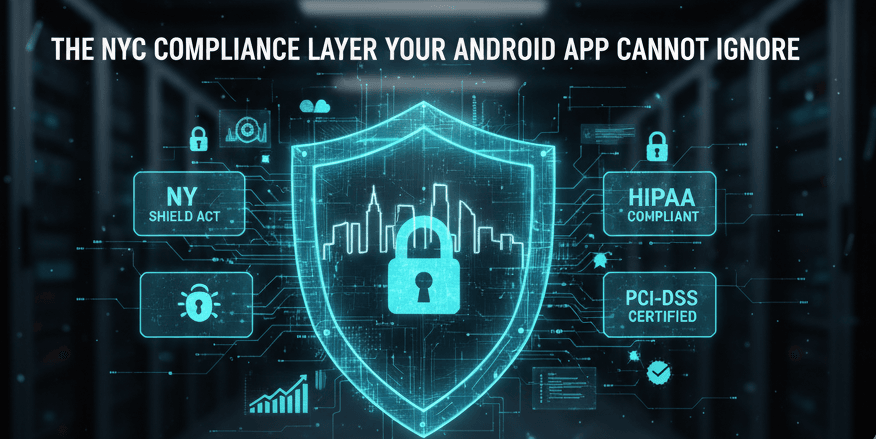
This is the section you will not find in most Android development guides, and it is the one New York business owners most need to read.
The NY SHIELD Act (Stop Hacks and Improve Electronic Data Security Act) hits any person or business handling computerized data with New York residents' private info, no matter your HQ.
If your Android app grabs names, emails, phone numbers, financials, health data, or biometrics from NY users, it applies.
Key requirements in action:
- Administrative safeguards: Assign data security roles and train employees.
- Technical safeguards: Encrypt data, secure authentication, run regular risk assessments.
- Physical safeguards: Control data access.
Breach? Notify the NY Attorney General within 30 days. Penalties: Up to $5,000 per violation ($250,000 cap for notification fails).
Healthcare apps? HIPAA demands encryption, audit logs, access controls, and BAAs for third parties handling PHI. Payment apps? PCI-DSS rules card data, dodge it by tokenizing via Stripe or Braintree. EU users? GDPR enforces consent, deletion rights, and processing docs.
Build compliance upfront: Predictable costs. Retrofit post-breach? Chaos.
At DianApps, every NYC-facing Android project kicks off with a compliance discovery session. We map your data flows to regs before architecture locks in, saving you the biggest headaches.
How to Choose an Android Development Partner for Your NYC Business
The number of Android app development companies claiming to serve New York businesses has grown significantly. That makes the selection decision harder, not easier.
Here is what actually matters when evaluating a development partner for a New York-facing project.
They understand the market, not just the technology
An Android app for a New York business is not just a technical deliverable, it is a product that needs to work for New York users, meet New York compliance requirements, and compete in New York's digital market.
A development partner worth working with will ask about your users, your industry, and your regulatory context before they ask about your preferred tech stack. If the first conversation is mostly about frameworks and timelines and not at all about your business, that is a useful data point.
Their process includes discovery before development
Any agency that is ready to give you a fixed quote after a 30-minute call has not done the work required to give you an accurate one.
A serious development partner will run a structured discovery phase, typically two to four weeks, that maps your user flows, defines technical architecture, identifies compliance requirements, and locks scope before development begins.
This process typically costs money, but it is money that comes back to you through fewer surprises, tighter timelines, and a final product that is closer to what you actually needed.
They have built in your industry or a closely adjacent one
Android development for a fintech platform and Android development for a healthcare app involve fundamentally different architectural decisions.
The data models are different, the security requirements are different, the third-party integrations are different, and the compliance obligations are different.
A partner with genuine experience in your industry will make better decisions faster, and will flag the problems they have already seen before you pay to discover them for the first time.
They can demonstrate post-launch ownership
An app is not a project with a finish line. It is a product with a lifecycle. The partner who builds your app is ideally also the partner who maintains it, updates it for new Android OS versions, responds to user-reported issues, and helps you plan the feature roadmap.
Ask specifically about post-launch SLAs, maintenance retainer structures, and how they handle emergency issues after handoff. The answer will tell you a lot about whether they think of you as a project or a long-term client.
Bonus read: Why adopt SDLC vs Agile development life cycle for your project?
Why DianApps for Android App Development in New York?
DianApps has built Android applications for businesses across fintech, healthcare, retail, and enterprise categories, including clients based in the US and UK.
Our team combines senior Kotlin engineers, compliance-aware architects, and product-focused designers at rates that make enterprise-quality development accessible for growth-stage NYC companies.
We run a structured discovery phase on every project, which means you get an accurate estimate, a locked scope, and a development partner who understands your business before writing a line of code.
If you're planning an Android app for your New York business, hire us for Android app development services.
Final Thoughts
New York's digital economy is moving fast. The businesses that will own their categories in 2026 and beyond are not necessarily the ones with the biggest budgets, they are the ones that planned well, built lean, and shipped something their users actually wanted to use.
An Android app is not a finish line. It is a starting point for a product relationship with your customer that compounds over time.
The planning decisions you make in the first four weeks of a project, platform choice, scope discipline, compliance architecture, and partner selection determine more about your eventual outcome than anything that happens during development.
Get those right, and the rest becomes execution. Get them wrong, and no development team in the world will fully fix what was broken at the planning stage.
If you're ready to plan your Android app properly, see the kind of products we build at Android app development services in New York, or reach out to the DianApps team to start the conversation about your project.
We'd rather give you an honest assessment early than a pleasant-sounding estimate that becomes a problem later.






Leave a Comment
Your email address will not be published. Required fields are marked *