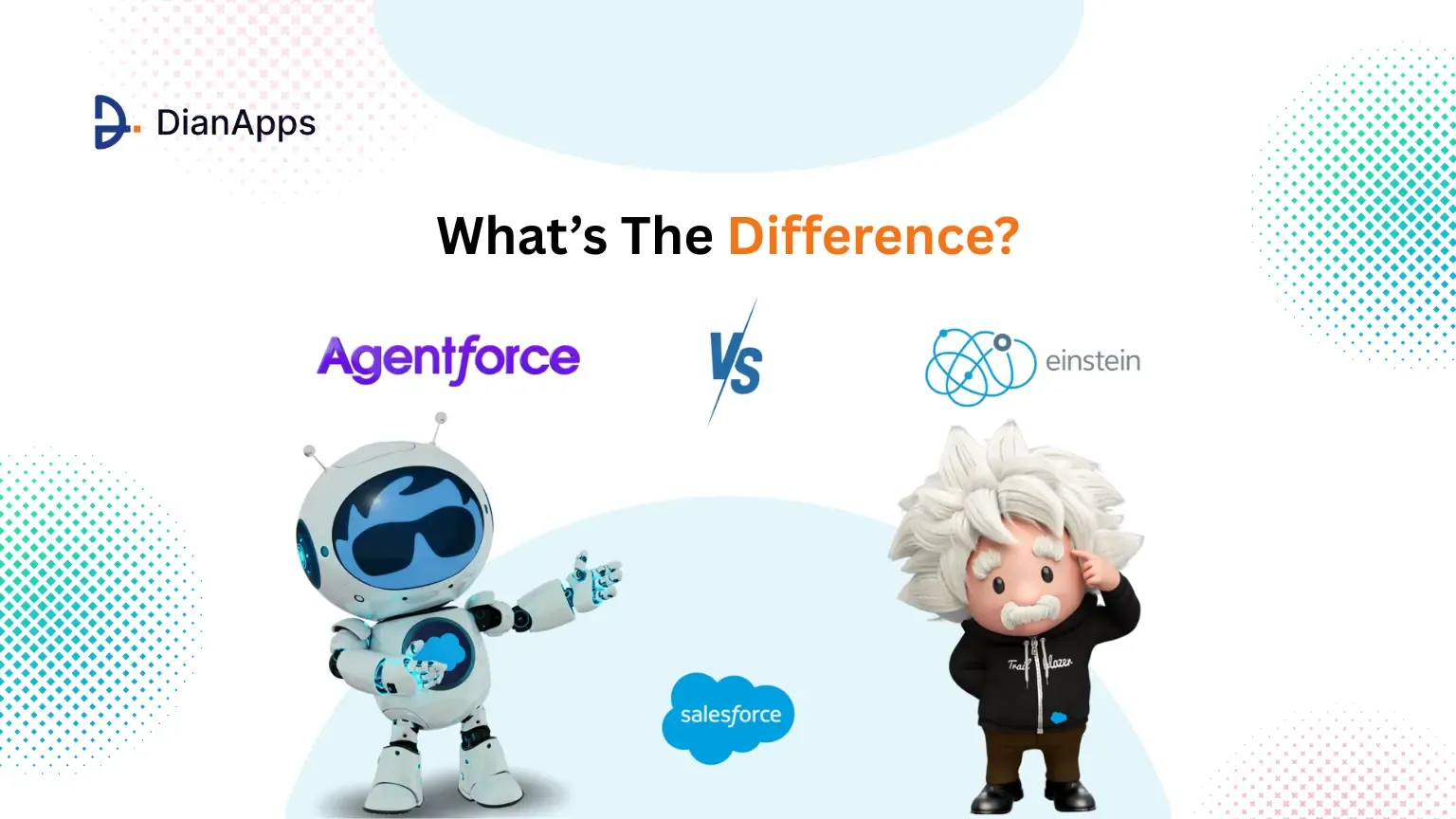
Agentforce vs Einstein: What’s the Difference?
Key Takeaways:
- Einstein has been inside Salesforce since 2016. It reads your data and helps your team make smarter decisions, but a human still takes every action.
- Agentforce launched in late 2024. You give it a goal, it works out the steps, and then it goes ahead and does the job by itself.
- The biggest gap between the two is who acts. Einstein gives you advice. Agentforce gets things done.
- Einstein works best with clean, structured CRM data. Agentforce can also handle messy stuff, such as emails, PDFs, call recordings, and chat logs.
- They are not rivals. Agentforce actually uses Einstein’s insights as a starting point. One thinks, the other acts.
- Both tools sit inside the Einstein Trust Layer, so your data stays private and is never used to train outside AI models.
- Getting expert Salesforce development services on board from day one makes a big difference, especially when setting up Agentforce.
- For most businesses, the smartest move is using both tools together, not picking one over the other.
If you have been working with Salesforce lately, you have probably heard the names Einstein and Agentforce come up a lot. Sometimes in the same sentence. Sometimes with very little explanation of what each one actually does.
So the question is fair: are these two different names for the same thing? Is one replacing the other? And which one does your business actually need?
The short answer is: they are different tools built for different jobs. Einstein helps your team think more clearly. Agentforce helps your business move faster on its own. And when you bring both together with the right Salesforce development services behind you, the way your Salesforce platform works can completely change.
This blog breaks it all down in simple terms. No technical jargon. No confusing comparisons. Just a clear, honest look at what each tool does, where it fits, and how you can get the most out of both.
What is Salesforce Agentforce?
Agentforce is Salesforce’s autonomous AI agent platform. That word autonomous is the one that matters most. These AI agents do not wait for someone to ask them to do something. You give them a goal, set some rules for what they can and cannot do, and they go figure out the rest.
Think of it like hiring a very capable assistant who works around the clock. You do not have to tell them every little step. You just say what needs to happen, and they handle it.
Agentforce was released in late 2024 and runs on something Salesforce calls the Atlas Reasoning Engine. This engine lets agents think through problems step by step, decide what actions to take, carry those actions out, and then check if the result was right. If something went off track, the agent adjusts. That loop is what makes it genuinely autonomous.
Key Features of Agentforce
- Atlas Reasoning Engine: Lets agents think through problems, plan steps, and self-correct when something goes wrong.
- Autonomous Task Execution: Agents carry out full workflows without needing a human to trigger each step.
- Unstructured Data Processing: Can read and understand emails, PDFs, call notes, chat logs not just CRM fields.
- Agent Builder: A no-code tool that lets admins design agents, set their rules, and define what they can do.
- Cross-Platform Operation: Works across Sales Cloud, Service Cloud, Marketing Cloud, and beyond all in one flow.
- Custom Actions & Integrations: Connect agents to third-party tools, APIs, or custom business logic.
- Einstein Trust Layer: Keeps data private. Nothing is stored or used to train external AI models.
- Performance Logging: Every agent action is logged so you can see exactly what happened and why.
What Agentforce Can Do for Your Business
Salesforce Agentforce is built for the kind of work that repeats itself every day the stuff that takes time but follows a clear pattern. Here are a few real examples:
- Sales teams: Agentforce can monitor every deal in the pipeline, spot ones that have gone quiet, write personalized follow-up messages, send them at the right time, and log the replies back into Salesforce all without a rep lifting a finger.
- Service teams: An agent can pick up incoming support requests, check the customer’s history, send a first response, and either resolve the issue or hand it to a human when it gets complex.
- Marketing teams: Agents can manage outreach sequences, track engagement, personalize messages based on behavior, and adjust campaign timing automatically.
- Internal operations: Agents can update records, trigger workflows, route tasks to the right people, and flag anything that needs human attention.
Pros of Agentforce
- Works 24/7 without breaks or delays
- Handles high-volume, repetitive tasks better than any human team can
- Gets smarter over time as it learns from each interaction
- Reduces the manual work your team has to do on routine tasks
- Can work across multiple Salesforce products in a single workflow
- Fully auditable you can see every action the agent took
Cons of Agentforce
- Initial setup needs care. A poorly configured agent will perform poorly.
- Works best when the workflow is clear and repeatable. Highly unpredictable situations still need humans.
- Needs good, consistent data to reason from. Messy or incomplete data limits what agents can do.
- Usage-based pricing can add up quickly at high volumes.
- Complex multi-system agents benefit from an experienced Salesforce developer to set them up properly.
What is Salesforce Einstein?
Einstein has been part of Salesforce since 2016. It is the AI layer built into the platform that helps your team make better decisions by surfacing useful information at the right moment.
If Agentforce is the hands that get things done, Einstein is the brain that figures out what should happen. It reads your CRM data, spots patterns, and brings the right insights to the surface but it always waits for a human to decide what to do next.
Einstein is not one single tool. It sits across different Salesforce products and works differently in each one. You will find it in Sales Cloud, Service Cloud, Marketing Cloud, and more. Each version is built for the job that product does.
Key Features of Salesforce Einstein
- Predictive Lead Scoring: Scores each lead based on how likely they are to convert, so reps know where to focus.
- Deal Health Alerts: Flags deals that are going cold or showing signs of risk before it is too late.
- Send-Time Optimization: Picks the best time to send an email to each contact based on their past behavior.
- Content Personalization: Suggests what content to show different audience segments in campaigns.
- Einstein Copilot: A conversational AI inside Salesforce. Ask it questions in plain English and get smart answers.
- Churn Prediction: Identifies which customers are likely to leave so your team can step in early.
- Opportunity Insights: Surfaces the most important signals on any deal, so reps can act on the right things.
- Data Quality Monitoring: Spots gaps and inconsistencies in your CRM data that might affect predictions.
Recommended Read: Einstein GPT: The Future of AI-Powered Customer Relationship Management
What Einstein Can Do for Your Business
Einstein is most useful when your team is sitting on a lot of data but struggling to turn it into action. It does that translation work for you:
- Sales teams get clearer lead prioritization, deal risk signals, and opportunity insights so reps spend time on the right things.
- Service teams get smarter case routing, faster resolution suggestions, and visibility into which customers need urgent attention.
- Marketing teams get personalized campaign recommendations, better send times, and more relevant content for each audience segment.
- Leadership gets better forecasts, cleaner pipeline visibility, and data-driven signals instead of gut-feel decisions.
Pros of Salesforce Einstein
- Works with data your team already has in Salesforce no big setup needed
- Surfaces insights inside the products your team already uses every day
- Improves decision-making without changing how people work
- Einstein Copilot makes it easy for anyone to ask data questions in plain English
- Proven at scale Einstein powers over a trillion predictions every week across Salesforce
Cons of Salesforce Einstein
- Needs clean, well-organized data to give reliable predictions. Bad data in, bad insights out.
- Every action still needs a human. Einstein does not do anything by itself.
- Works within the boundaries of each Salesforce product. It does not move across clouds the way Agentforce does.
- For complex predictive models, some setup and data preparation is still required.
Agentforce vs Einstein: Side-by-Side Comparison
Still not sure which one fits your situation? This table lays it all out in one place.
| Factors | Salesforce Einstein | Salesforce Agentforce |
|---|---|---|
| What it does | Analyzes data and surfaces insights for humans to act on | Completes tasks and workflows on its own, without waiting to be asked |
| Who acts on it | Your team Einstein informs, humans decide | The agent it reasons, decides, and acts independently |
| Data it Uses | Structured CRM data (fields, records, history) | Both structured and unstructured (emails, PDFs, calls, chat logs) |
| How it fits your workflow | Embedded in specific Salesforce products | Works across the whole Salesforce platform in one workflow |
| Customization | Configurable within each product's settings | Fully customizable via Agent Builder build agents from the ground up |
| Human involvement | Needed at every step | Needed only when you set it up or when the agent flags an exception |
| Best For | Teams that need better data-driven decisions | Teams that need high-volume, repetitive work handled automatically |
| Available Since | 2016 | Late 2024 |
| Works Together | Yes Agentforce uses Einstein's insights as inputs | Yes acts on signals Einstein generates |
| Security | Einstein Trust Layer | Einstein Trust Layer (same shared framework) |
How Einstein and Agentforce Work Together
A lot of people think they have to choose between these two tools. They do not.
Einstein and Agentforce are built to work side by side. Einstein handles the thinking. Agentforce handles the doing. Together, they create a loop where your Salesforce platform is constantly analyzing what is happening and acting on it without needing your team to drive every step.
Here is a real example. Say you want to reduce customer churn. Einstein’s churn prediction model flags which accounts are at risk. An Agentforce agent picks up those signals, checks the account history, writes a personalized message to each at-risk customer, sends it through the right channel, and logs the response back into Salesforce. Your team gets notified only if the conversation needs a real human judgment call.
What took hours of manual work now runs in the background, every day, without anyone asking it to. That is what using both tools together actually looks like.
Recommended Read: Salesforce Implementation: A Step-By-Step Guide
Which One Should You Start With?
The honest answer is: it depends on where your biggest gap is right now.
| Your Situation | Start With |
|---|---|
| Your team has lots of data but struggles to act on it | Einstein surface better insights from what you already have |
| Your reps spend too much time on follow-ups and routine tasks | Agentforce automate the repetitive work so reps focus on what matters |
| Your pipeline has too many deals to track manually | Agentforce agents monitor and act on every deal around the clock |
| Your campaigns feel generic and do not convert well | Einstein use predictive personalization to make campaigns more relevant |
| You want your whole Salesforce setup to run more independently | Both use Einstein for intelligence, Agentforce for execution |
| You are just getting started with AI in Salesforce | Einstein lower barrier to entry, works with your existing setup |
One thing worth noting: businesses that bring in professional Salesforce development services at this stage get results faster. The quality of how Agentforce is configured the rules you set, the workflows you define, and the guardrails you put in place has a direct impact on how well it performs in the real world. Getting it right from the start saves a lot of time and frustration later.
A Real Scenario: What This Looks Like in Practice
Let’s make this concrete with something most B2B sales teams know very well.
You have 200 open deals in your pipeline. Your team can realistically give close attention to maybe 30 or 40 at a time. The other 160 get checked when someone remembers to check them.
With Einstein alone: your reps get a clear picture of which deals have the highest close probability and which ones are showing risk signals. They know where to focus. But the follow-up still depends on someone doing it.
Add Agentforce: an agent runs in the background all day, every day. Any deal that has gone seven days without activity gets a personalized follow-up written based on that deal’s history, sent at the right time, with the response logged back into Salesforce automatically. If a reply comes in that needs a human, the agent flags it. Everything else, it handles.
Your reps stop managing a leaking pipeline. They start hearing from it only when something genuinely needs them. That is the combination at work.
Is Your Data Safe?
This is something people ask a lot, and rightfully so.
Both Einstein and Agentforce run inside the Einstein Trust Layer Salesforce’s built-in security and governance framework for AI. Here is what that means in practice:
- Your data is never stored or used to train third-party AI models.
- Personally identifiable information is masked before it reaches any AI system.
- You get a full audit log of every AI action — so you always know what happened and why.
- All AI interactions comply with Salesforce’s enterprise security and data privacy standards.
For enterprise teams with serious data governance requirements, this built-in framework is one of the strongest reasons to keep your AI tools inside the Salesforce ecosystem rather than layering in external AI solutions that do not have these controls.
Final Words
Einstein made Salesforce smarter. Agentforce makes it capable of running more of the work on its own.
Einstein gives your team better information to act on. Agentforce acts on that information without waiting to be asked.
For businesses that want to get the most out of their Salesforce investment, the question is no longer whether to use AI. It is about how to use both tools together in a way that fits how your team actually works.
Whether you are just getting started with Einstein or ready to design your first Agentforce agent, the right Salesforce development services partner can help you do it properly from day one.
 0
0