















 0 comments





Here’s a number that should stop you mid-scroll: Salesforce reported that Agentforce handled 72% of customer inquiries autonomously during its first major enterprise rollouts, without a single human agent stepping in (Salesforce, 2025). Not escalated. Not partially answered. Fully resolved.
If your support team is still routing tickets by hand, updating CRM records after every call, and burning agent hours on questions your knowledge base already answers, Agentforce represents a shift you can’t afford to ignore. This isn’t another chatbot dressed up with a new name. It’s a genuinely different architecture, one where AI agents don’t just respond to prompts, they reason, act, and close the loop inside your Salesforce org.
In this post, we’ll break down exactly what Agentforce is, how it works under the hood, where it fits inside Salesforce Service Cloud and beyond, and what it actually means for businesses considering Salesforce implementation or optimization in 2026.
TL;DR: Agentforce is Salesforce’s autonomous AI agent platform, launched in late 2024 and rapidly adopted through 2025-2026. Unlike Einstein Bots, Agentforce agents can reason across multi-step tasks, access real-time CRM data, take actions (not just respond), and escalate with full context. According to Salesforce’s own data, early deployments resolved over 70% of customer cases without human intervention. For companies investing in Salesforce consulting or implementation, Agentforce is now a core capability, not an add-on.
What Exactly Is Agentforce, And How Is It Different from Einstein Bots?
Agentforce is Salesforce’s platform for building and deploying autonomous AI agents that can complete multi-step tasks across the entire customer lifecycle. The keyword is autonomous. Where traditional chatbots (including Einstein Bots) follow a script, Agentforce agents reason through a problem and decide what to do next.
Salesforce positioned Agentforce as the “third wave of AI” at Dreamforce 2024, the first wave being predictive analytics, the second being generative copilots, and the third being action-taking agents (Salesforce Dreamforce, 2024).
Here’s the practical difference:
| Feature | Einstein Bot | Agentforce |
|---|---|---|
| Conversation style | Rule-based decision tree | Reasoning-based, adaptive |
| CRM data access | Read-only, limited | Full read/write access via Actions |
| Task execution | Redirect to agent or form | Can complete tasks end-to-end |
| Context retention | Within the session only | Persistent, cross-channel |
| Escalation quality | Loses context on handoff | Full conversation context passed |
| Setup complexity | Flow-based, no-code | Low-code with Agent Builder |
| Primary use case | FAQ deflection | Full case resolution |
The distinction matters practically. An Einstein Bot tells a customer their order status. An Agentforce agent checks the order status, identifies a delivery delay, proactively applies a discount per your business rules, sends a confirmation email, and updates the case record. Same query. Completely different outcome.
What we’re seeing: Businesses that approach Agentforce as a “better chatbot” consistently underutilize it. The real ROI shows up when agents are given permission to take actions, update records, trigger flows, create cases, rather than just reply.
How Does Agentforce Actually Work Inside Salesforce?
Agentforce runs on the Atlas Reasoning Engine, Salesforce’s proprietary LLM orchestration layer built on top of its Data Cloud platform. This is what separates it architecturally from a wrapper around ChatGPT or a third-party integration.
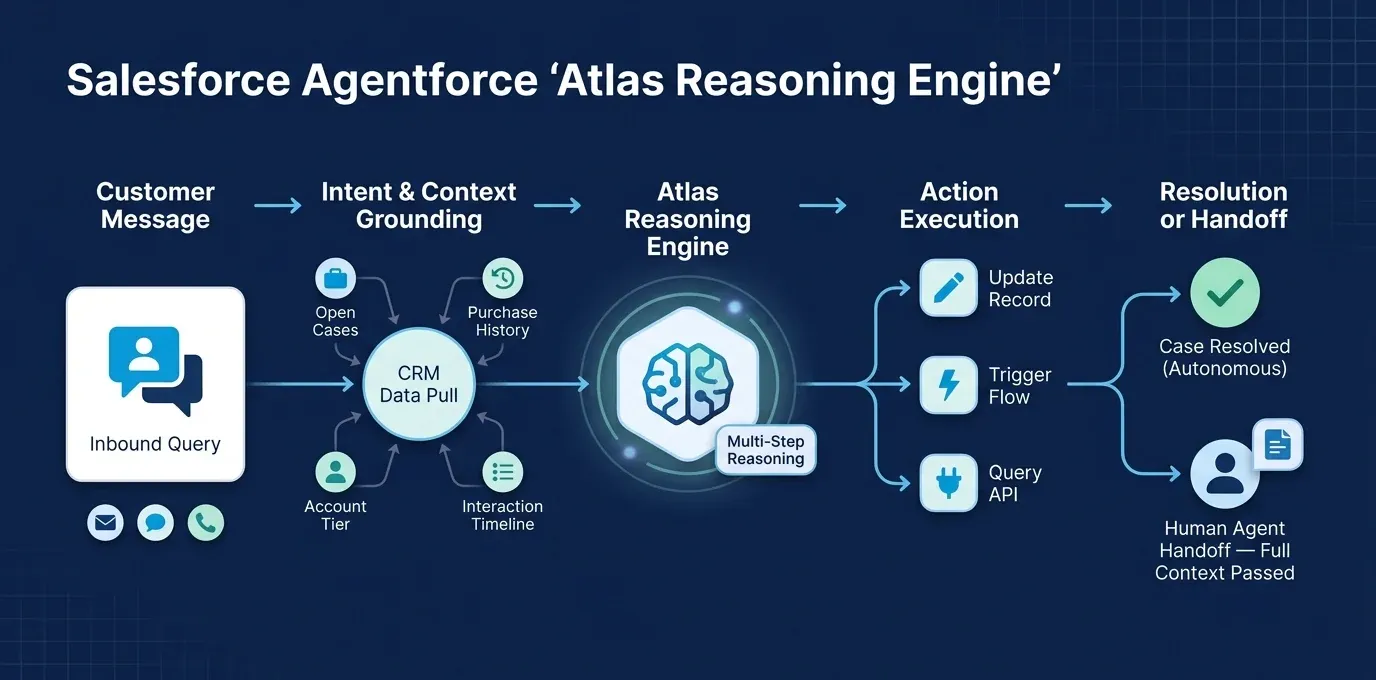
When a customer sends a message, here’s the simplified flow:
Step 1: Intent and Context Grounding
The agent doesn’t just read the message, it pulls context from across your Salesforce org. Open cases, purchase history, account tier, and recent interactions. This grounding happens before the agent forms any response, which is why Agentforce answers feel far more relevant than generic bot replies.
Step 2: Reasoning and Action Planning
The Atlas Reasoning Engine then determines what needs to happen to actually solve the problem. It breaks the resolution into sub-tasks and maps each one to an available Action, a Salesforce-native operation like querying an object, updating a record, or triggering a Flow.
Step 3: Action Execution
Agentforce doesn’t just talk about doing something, it does it. This is where the platform is genuinely different. Actions are pre-built or custom-configured connectors to Salesforce data, external APIs, or automation flows. The agent executes them directly, within the guardrails you set.
Step 4: Human Handoff (When Needed)
When a case exceeds the agent’s configured scope, anything requiring judgment, empathy-heavy situations, or policy exceptions, Agentforce escalates with full context. The human agent sees the entire conversation, actions taken, and the current case state. No re-explaining from scratch.
According to Salesforce’s Trust Layer documentation, every agent action runs through configurable guardrails, toxicity filters, and data masking policies before execution (Salesforce Trust Layer, 2025). This addresses the biggest concern enterprise CIOs raise about agentic AI: “What happens when it does something wrong?”
Based on implementation patterns observed in enterprise Salesforce consulting engagements, companies that define clear Action boundaries at the start, rather than trying to give agents maximum permissions, see faster deployment timelines and higher business stakeholder confidence.
Where Does Agentforce Live in the Salesforce Ecosystem?
Agentforce isn’t a separate product you bolt on. It’s woven into the existing Salesforce platform, which is either convenient or slightly confusing depending on how familiar you are with the Salesforce product map. Let me clear it up.
Agentforce in Service Cloud
This is the most common starting point. In Service Cloud, Agentforce agents handle inbound support volume, triage cases, answer product questions, and process routine requests like password resets, order modifications, and return initiations. If you’re already on Service Cloud, Agentforce is a natural next layer, not a replacement of what you have.
Agentforce in Sales Cloud
Less talked about, but genuinely useful. Agentforce agents in Sales Cloud can qualify inbound leads, handle initial discovery questions, schedule follow-ups, and update opportunity records after calls. Sales reps see a warm-transferred lead with full interaction history rather than a cold inbound form submission.
Agentforce and Data Cloud
The depth of Agentforce’s answers depends entirely on what data it can access. Without Data Cloud, agents work only with what’s in your standard Salesforce objects. With Data Cloud, agents can pull unified customer profiles, behavioral data, and third-party signals. The difference in response quality is significant.
Agentforce and MuleSoft
For companies with complex backend systems, ERPs, legacy databases, custom APIs, MuleSoft integration lets Agentforce reach outside the Salesforce ecosystem entirely. An agent can check a warehouse management system, pull inventory status from an ERP, and answer a customer’s availability question without a human touching the process.
Companies working with a Salesforce consulting company to implement Agentforce typically start with Service Cloud, get a defined set of Actions working reliably, then expand to adjacent clouds over 6-12 months. Trying to do everything at once is the most common mistake.
What Real Business Results Look Like with Agentforce
Let’s talk numbers. Pilot programs and early production deployments are generating enough data now to move past marketing claims.
Salesforce shared that Wiley, the academic publishing company, deployed Agentforce and achieved a 40% increase in case deflection during peak enrollment periods, with the agent resolving common student support queries that previously required specialist intervention (Salesforce Customer Stories, 2025).
OpenTable reportedly reduced average handle time for reservation-related queries by 27% after enabling Agentforce to handle modification and cancellation requests autonomously.
Here’s a realistic performance framework from enterprise deployments:
| Metric | Typical Range (Year 1) | Notes |
|---|---|---|
| Autonomous resolution rate | 50–75% | Higher for transactional queries |
| Average handle time reduction | 20–35% | On escalated cases |
| CSAT on agent-resolved cases | Comparable or higher | Key: proper escalation guardrails |
| Time to first response | Near-zero | 24/7 without staffing cost |
| Agent onboarding time (new cases) | Weeks → Days | Agents learn from resolved cases |
These numbers aren’t guaranteed. They depend heavily on the quality of your data, the clarity of your Action definitions, and how well your team is trained to work alongside the agents.
What the numbers don’t show: The highest-value outcome from Agentforce in several deployments hasn’t been cost savings, it’s been consistency. Human agents are brilliant and inconsistent. Agentforce is average but perfectly consistent. For many support orgs, consistent and good beats brilliant but variable.
Building Agentforce Agents: What the Setup Actually Involves
One of the most honest things Salesforce said at World Tour 2025 was that Agentforce has a low floor but a high ceiling. You can get a basic agent live in days. Getting it to reliably handle complex cases takes months of iteration.
Here’s what the build process actually looks like:
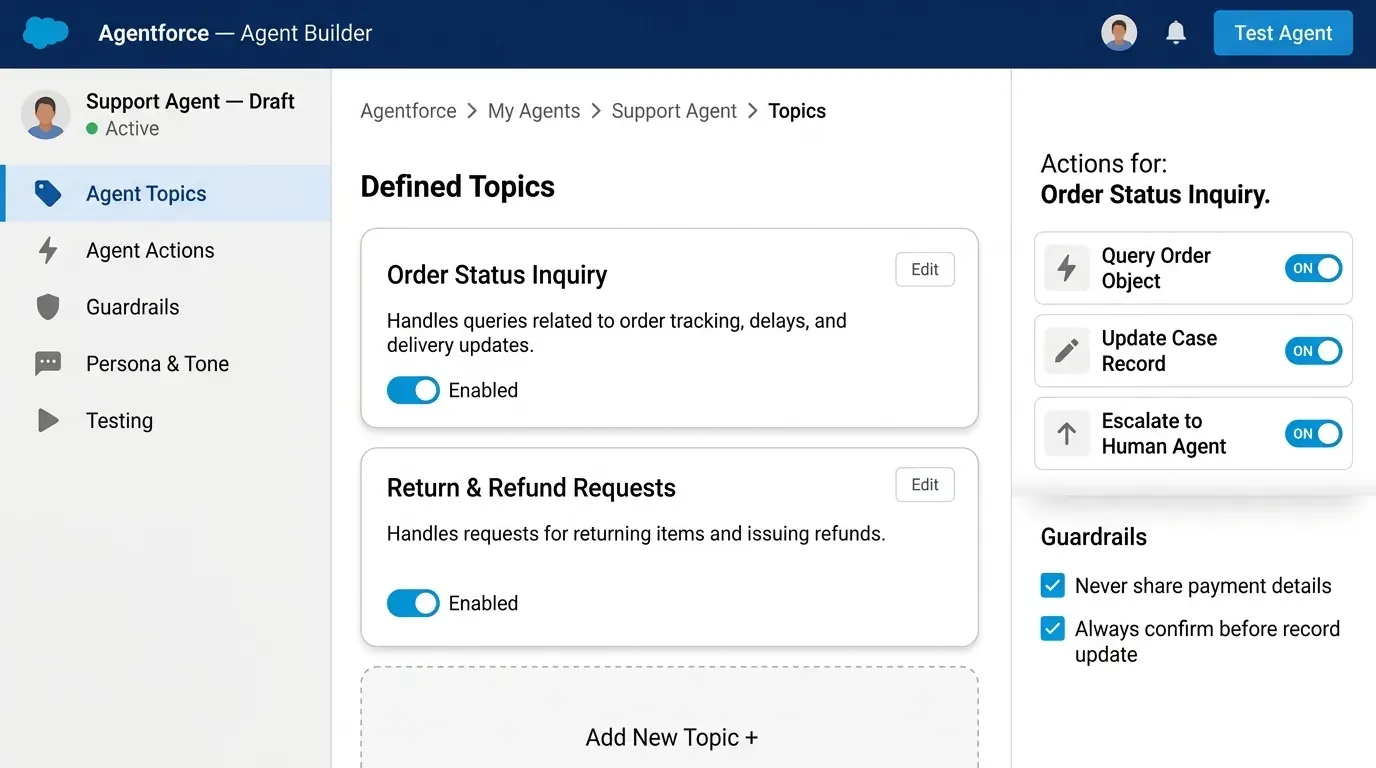
Agent Builder
This is the primary configuration interface. No traditional coding required, but you do need to understand your Salesforce data model well. Agent Builder lets you define:
- Agent topics, What domains or subjects does the agent handle
- Agent actions, What the agent is allowed to do (query, update, trigger, escalate)
- Guardrails, What the agent must never do, even if asked
- Persona and tone, How the agent communicates
Prompt Builder
Agentforce’s behavior is shaped by instructions you write in natural language. Prompt Builder is where you create, test, and refine the instructions that govern how the agent reasons. This is part art, part science, vague instructions produce vague agent behavior.
Testing and Evaluation
Salesforce provides a conversation simulator inside Agent Builder that lets you test agent responses against sample queries. Before going live, you should test against at minimum 100-200 representative queries from your actual support history.
For companies without in-house Salesforce expertise, this is where professional Salesforce development services become genuinely valuable. The configuration is low-code, but experience with data modeling, flow architecture, and prompt engineering meaningfully affects how well the agent performs.
Common Mistakes When Implementing Agentforce
Real talk: the early Agentforce deployments that struggled had predictable failure patterns. Here’s what not to do.
Giving the agent too much scope too early. Agents given access to 15 action types from day one consistently underperform compared to agents given 3-4 well-defined actions and expanded carefully. Start narrow.
Skipping data quality work. Agentforce pulls from your CRM data. If your account records are incomplete, if case histories are in free-text notes, if product descriptions are inconsistent, the agent will produce inconsistent answers. Garbage in, garbage out still applies.
Setting unrealistic CSAT expectations. Customers who get fast, accurate answers from an AI generally rate the experience positively. Customers who feel they’re talking to a bot that’s stalling tend to leave low scores. The framing matters. Transparency about AI involvement, when combined with actual resolution, produces better outcomes than pretending the agent is human.
Under-investing in the escalation path. Ironically, the human handoff is where many Agentforce deployments lose the most value. If the agent resolves a case in 2 minutes and then the human follow-up takes 45, the total experience suffers. The escalation workflow needs as much design attention as the agent itself.
Is Agentforce Right for Your Business in 2026?
Not every business needs Agentforce today. But there are some clear signals that it’s worth a serious conversation with your Salesforce consulting company.
You’re a strong candidate if:
- Your support team handles more than 500 cases per month
- More than 40% of your cases are transactional or information-lookup in nature
- You’re already on Salesforce Service Cloud (deployment is significantly simpler)
- You have reasonably clean CRM data
- You’re seeing growing support volume that isn’t matched by headcount budget
You should wait (or invest in prerequisites first) if:
- Your Salesforce org has messy or incomplete data
- You haven’t defined your escalation workflows for human agents
- Your customer base has a very low tolerance for non-human support
The honest answer for most mid-size businesses is: you’re probably closer to ready than you think, but the ROI depends on getting the fundamentals right first.
Conclusion:
Agentforce isn’t the future of customer support. It’s the present for the companies that have already deployed it, and they’re quietly building a competitive advantage in response speed, support coverage, and cost efficiency.
The businesses that will benefit most aren’t those chasing the technology; they’re the ones that pair Agentforce’s capabilities with clean data, clear processes, and a thoughtful escalation design. That combination turns a promising platform into genuinely transformative support operations.
If you’re running on Salesforce and haven’t had a serious conversation about Agentforce yet, the right time was six months ago. The second-best time is now.
Ready to explore what Agentforce could do for your business? DianApps offers end-to-end Salesforce implementation services, from initial org assessment to full Agentforce deployment. Talk to our team and get a no-fluff evaluation of where you stand.
 0 comments






Leave a Comment
Your email address will not be published. Required fields are marked *