















 0 comments
AI Overview:
|
Metaverse gaming didn’t disappear. It has evolved.
What used to be simple multiplayer sessions is turning into persistent digital worlds where players hang out, build identities, create content, and come back daily. Games are shifting from “something you play” to places you exist in.
And here’s the real shift: this isn’t happening in VR, first it’s happening on mobile. Today, with digital expansion, smartphones have become a primary gateway to these connected virtual spaces because that’s the exact place where accessibility, daily engagement, and scalability exist.
In the end, tech has caught up. Large, shared worlds are growing feasible for business with the help of cross-platform engines, quicker networks, and integrated digital economy. A few years ago, it sounded futuristic, but it’s now becoming increasingly standard design thought.
That’s the reason why 2026 is considered a turning point. Metaverse-style gaming is moving from experiment to expectation.
In this blog, you will get to explore the best metaverse gaming platforms that are currently leading in the gaming market,
- Roblox
- Fortnite
- The Sandbox
- Decentraland
- Othersie
and we will also get o see what these platforms reveal about the future of game development.
What Is Metaverse Gaming in 2026?
Let’s clear the confusion first because “metaverse” has been stretched to mean everything and nothing.
With gaming being a continuously expanding industry, in 2026, gaming platforms aren’t just considered multiplayer games with big maps. They are social, persistent, and economy-driven digital worlds where gameplay is considered one essential part of the experience. In this evolving ecosystem, storage performance has become just as important as graphics and processing power, and many gamers now rely on a gaming desktop hard drive to ensure faster load times, smoother updates, and reliable game data management across large-scale online environments.
Here comes the easiest way to understand the difference.
Traditional online games are built around sessions.
Metaverse-style games are built around presence.
In a regular multiplayer game, the world pauses when you leave. Matches reset. Progress is mostly personal.
In a metaverse gaming platform, the world keeps moving. Events happen. Players build spaces. Virtual goods circulate. Communities form whether you’re logged on or not. The game seems less like an ongoing series of games and more like a dynamic online culture.
Everything gets changed with this determination, even how money gets generated and content is produced.
Recommended Read: What is Metaverse and Where is it Headed?
Key Traits of a True Metaverse Gaming Platform
Not every large online game qualifies. A real metaverse gaming platform usually includes:
- Persistent Worlds: The views and the environment of the gameplay continue to evolve as time passes, not just round by round.
- Player Identity & Social Presence: In the gameplay, everything matters, and most importantly, shared experiences, social hubs, and avatars matter a lot.
- User-Generated Content (UGC): Gaming players aren’t just considered normal consumers; they are considered an important source that helps build the world, create experiences, or design items.
- Digital Economies: There are some factors that are built into the platform, such as currencies, creator monetization, and virtual goods.
- Cross-Platform Access: Game experience can be easily delivered on PC, mobile, and sometimes console players share the same ecosystem.
The platform begins to feel like “just a game” when all these elements are integrated. It has become a virtual destination.
Why This Definition Matters for Businesses?
This shift isn’t just semantic it directly affects how games must be designed.
Building for a metaverse-style platform means thinking beyond levels and mechanics. Developers need scalable backend systems, long-term content strategies, social architecture, and economic balancing from day one. Mobile optimization becomes critical because that’s where most users enter and return daily.
Understanding what truly makes a metaverse gaming platform is the foundation for evaluating which ones are leading in 2026 and why they matter for the future of game development.
Next, let’s look at why this category is accelerating now, and why timing has never been more important.
Recommended Read: Metaverse Game Development Cost In USA; Globally
Top 5 Metaverse Gaming Platforms You Need to Know in 2026
These platforms provide more than simply well-known games. These are living communities that show the social, technological, and economic evolution of metaverse gaming. Each one shows an alternate framework of how lasting digital realms can be constructed and scaled.
| Platform | Core Strength | Primary Focus | Mobile Support | Ideal For |
| Roblox | Creator Ecosystem | UGC & social worlds | Strong | Indie creators & studios |
| Fortnite | Live events & entertainment | Social + gameplay | Moderate | Brands & live experiences |
| The Sandbox | Digital ownership | Creator Economies | Limited | Virtual real estate & creators |
| Decentraland | Social environments | Community & events | Limited | Virtual events & exhibitions |
| Othersie | High-fidelity worlds | Immersion & scale | Emerging | AAA-scale metaverse visions |
Roblox – The Creator-Powered Metaverse
If you move on to finding one of the platforms that has already started operating like a large-scale metaverse, then Roblox is considered the right choice.
Instead of a single one-game platform, Roblox is considered an ecosystem of millions of user-created experiences, connected through an avatar system, digital economy, and a shared identity. Some players don’t just consume content; they design virtual items, create social spaces, build games, and even earn revenue inside the platform.
One of the factors that makes this gaming platform more powerful is the compounding effect of the user-generated content. Every creator that comes in contact adds more value and enhances experiences, which leads to attracting creators and players. This flywheel has helped the platform to transform into a huge, persistent system of virtual environments accessible across devices, most particularly mobile.
Why it matters in 2026?
- One of the strongest creator economies in gaming
- Deep mobile engagement is driving daily usage
- Persistent social spaces beyond individual games
- Scalable model powered by player creativity
For developers and studios, this platform proves that giving users creation tools can drive longer-term growth than shipping standalone titles alone.
Fortnite – From Game to Entertainment Metaverse
What started out as a battle royale game has developed into something much more. Fortnite has evolved into a social and entertainment platform where users can explore creator-built islands, take part in story-driven world events, attend live concerts, and interact in real time across devices.
Brands, companies, and independent producers may create interactive experiences within the broader ecosystem because of to its Creative style and developer tools. Instead of developing separate games, designers can build realms that live inside an obviously established player community.
The key aspect of this platform is its cross-platform functionality. As mobile, console, and PC users share the same experience and events, strengthening the idea of a unified digital world rather than the fragmented versions.
Why it matters in 2026?
- Large-scale live events are redefining in-game engagement
- Strong cross-platform infrastructure
- Creator tools expanding the content universe
- Blending of gaming, social interaction, and entertainment
This platform demonstrates how metaverse gaming can merge play, culture, and community into one continuous experience.
The Sandbox – Gaming Meets Digital Ownership
The Sandboxis completely a different kind and angle of metaverse gaming, which is focused heavily on creator-driven economies and user ownership.
Experiences, digital assets, and interactive spaces that other people can explore and engage with can all be created by players and creators. The platform has evolved over time, moving away from its initial speculative narratives and toward more useful creator ecosystems, branded connections, and interactive experiences.
Additionally, its voxel-based style encourages experimentation and involvement from a broad creative base and not just professional studios, making creation of content more accessible.
Why it matters in 2026?
- Emphasis on user-created worlds and experiences
- Strong brand collaborations within virtual spaces
- Digital asset ecosystems enabling creator monetization
- A blend of gaming mechanics with virtual real estate concepts
It highlights how metaverse platforms can function as interactive marketplaces, not just entertainment products.
Decentraland – A Social-First Virtual World
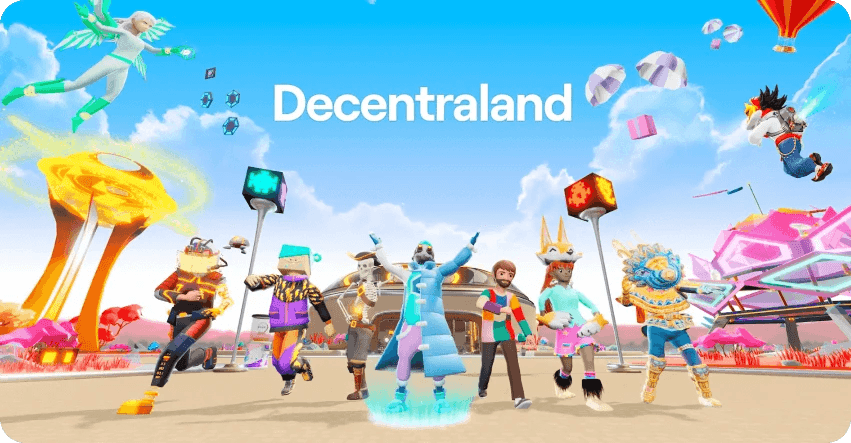
The concept of permanent, user-owned virtual environments gained wide acceptance through Decentraland.
This gaming platform is well-known for its branded areas, neighbourhoods built by the community, online exhibits, and community events. Instead of counting primarily on standard gameplay loops, that aspect leans into research, online shopping, and social engagement.
Though its software architecture has experienced scalability problems in recent years, its importance lies in illustrating how virtual locations may serve as online social hubs where community, business, and culture converge.
Why it matters in 2026?
- Persistent, shared social environments
- Community-driven development model
- Virtual events and branded experiences
- Early blueprint for user-controlled digital spaces
It remains a key example of how virtual worlds can operate more like online cities than traditional games.
Otherside – The Push Toward High-Fidelity Metaverse Worlds
Building expansive, immersive settings that can accommodate enormous numbers of participants in shared experiences is Otherside’s main objective.
The idea behind it tends toward highly realistic worlds that integrate gameplay, exploration, and social interactions with a concentration on interoperability and large virtual settings. The platform embodies the goal of creating metaverse-style experiences that are more profound, immersive, and closer to AAA production characteristics.
The upper echelon of online gaming is moving in the direction of richer worlds, wider shared moments, and a smoother integration of identity, surroundings, and interaction.
Of all these, AR and VR tend to have the biggest impact on both the experience and the budget, since they power the immersive, 360-degree worlds players expect from the metaverse. This is why many studios bring in a partner with dedicated AR/VR development services to handle spatial mapping, 3D modeling, and headset compatibility without blowing up the timeline.
Why it matters in 2026?
- Focus on massive concurrent multiplayer experiences
- Rich, immersive environment design
- Ambitions for interoperability between digital assets
- A step toward high-end, large-scale metaverse worlds
It reflects where metaverse gaming could go as technology continues to scale: bigger worlds, deeper immersion, and broader shared experiences.
Recommended Read: How to Make Your Own Gaming App
What These Platforms Mean for Game Businesses in 2026?
Studying metaverse gaming platforms isn’t just interesting; it’s strategic.
Metaverse gaming platforms aren’t just considered a very interesting aspect; they’re more of a strategic aspect. These ecosystems reveal how the rules of game development are changing easily. The studios that adapt to this new model early are the ones that are building longer-lasting player communities, more defensible game ecosystems, and stronger revenue systems.
Here are some of the pointers that need to be understood by the game businesses:
Games Are Becoming Platforms, Not Products
Traditional games are launched, updated, and eventually replaced. However, Metaverse-style games are built to expand continuously.
So, now the goal no longer just remains to ship a polished gameplay segment. It’s considered a foundation where new content, events, player connections, and economies can grow over time. This shifts the development thinking approach from long-term ecosystem to short-term release planning.
For studios, this factor means that we are prioritizing scalable systems over one-time features.
Social Architecture Now Drives Retention
Gameplay is still considered an important matter, but social connection is becoming the bigger retention driver.
Players stay longer in games where they have:
- Persistent friend groups
- Shared spaces to meet
- Identity customization
- Community-driven events
This means that rather than adding social systems after the fact, developers must design them from the start. Worlds must be not only interactive; they must feel inhabited.
Monetization Is Shifting Toward Ecosystems
Seasonal passes and one-time purchases are no longer considered the larger model.
Metaverse-style platforms are building:
- Creator marketplaces
- Virtual goods economies
- Event-based monetization
- User-to-user commerce
This creates multiple revenue streams instead of a single funnel. But it also increases complexity; economies must be balanced, secure, and scalable.
Mobile Is the Daily Engagement Engine
Whenever high-end experiences exist on PC / console systems, mobile works as the regular touchpoint.
Using their phones, players check in, interact with others, trade, modify, and take part in events. Due to this, mobile optimization is not merely an optional feature but of great importance for expansion and retention.
The daily involvement loop, which metaverse ecosystems rely on, is lost when games are created without thinking about mobile devices.
Backend Infrastructure Is Now a Core Differentiator
As games evolve into persistent worlds, backend systems move from supporting role to central pillar.
Studios need:
- Real-time multiplayer synchronization
- Scalable cloud architecture
- Persistent player data systems
- Secure in-game economies
Technical depth directly impacts user experience. Lag, downtime, or instability can break immersion and damage long-term retention.
Recommended Read: Complete Guide on Mobile Game App Development Process
How to Build a Metaverse-Ready Mobile Game?
Building a metaverse-style game isn’t just about adding avatars or a big map. It requires designing a system that can grow, scale, and stay alive long after launch.
Here’s what that actually involves.
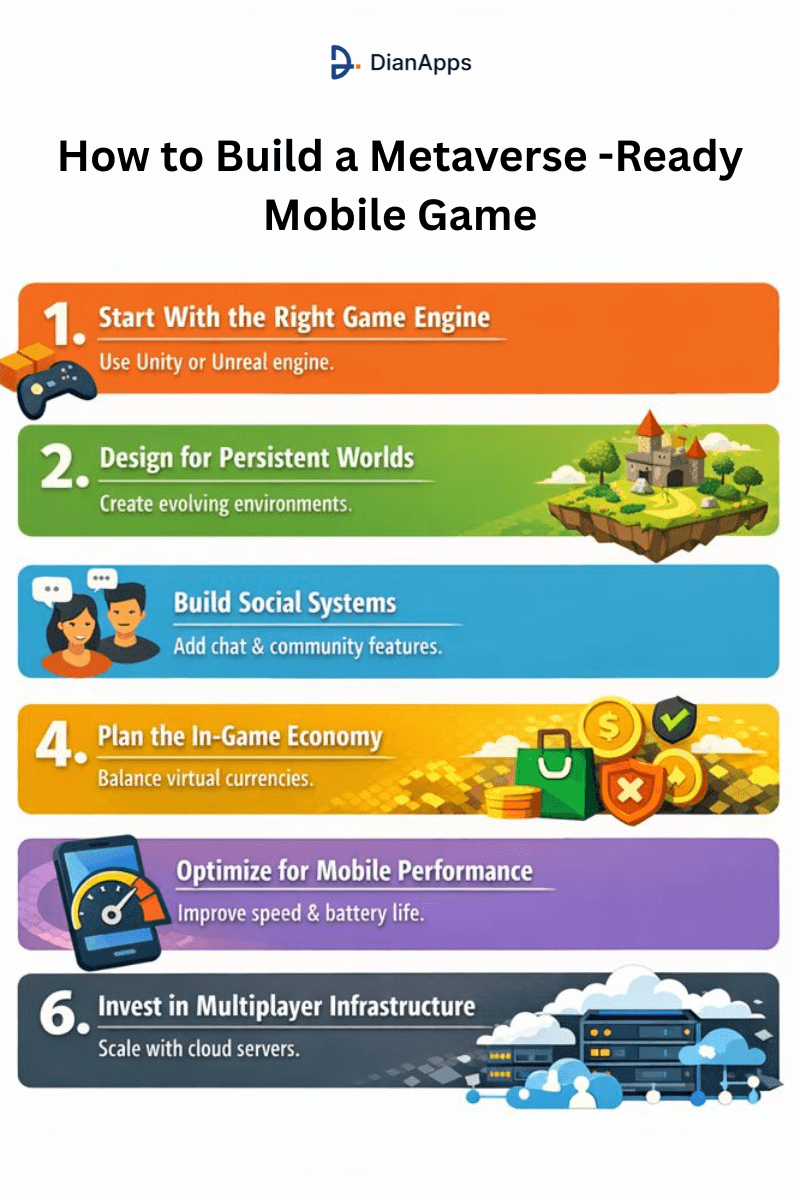
1. Start With the Right Game Engine
Your engine choice shapes everything visuals, scalability, cross-platform support, and development speed.
Modern metaverse games are typically built using engines like Unity or Unreal Engine, because they support:
- Real-time multiplayer environments
- Cross-platform deployment (mobile, PC, console)
- Advanced rendering and world-building tools
- Large developer ecosystems
Choosing the wrong engine early can limit expansion later.
2. Design for Persistent Worlds From Day One
Metaverse games don’t reset every session. That means your backend must support:
- Ongoing world states
- Player-owned spaces and assets
- Continuous events and updates
- Long-term content expansion
Recommended Read- Designing for the Metaverse in UI/UX
This requires database architecture and server logic built for persistence, not just match-based gameplay.
3. Build Social Systems Into the Core Experience
Chat, friends lists, avatars, and shared hubs aren’t “extra features” anymore. They are central to retention.
Strong metaverse-style games include:
- Social lobbies and meeting spaces
- Avatar customization systems
- Community events and activities
- Group-based gameplay or creation
Players stay where they feel connected not just entertained.
4. Plan the In-Game Economy Carefully
Digital economies can drive massive engagement, but they must be balanced and secure.
Key considerations include:
- Virtual currencies and item systems
- Player trading or marketplaces
- Creator monetization tools
- Anti-fraud and asset protection mechanisms
Poorly designed economies lead to inflation, imbalance, or exploitation, all of which can hurt long-term growth.
5. Optimize for Mobile Performance Without Sacrificing Depth
Mobile is where daily engagement happens, so performance matters just as much as features.
This involves:
- Efficient asset loading
- Network optimization for real-time interactions
- Scalable graphics settings
- Battery and memory management
A metaverse game that drains devices or lags under load will struggle to retain users, no matter how ambitious the world is.
6. Invest in Scalable Multiplayer Infrastructure
Metaverse environments must handle large numbers of concurrent users interacting in real time.
This means building or integrating:
- Cloud-based server architecture
- Load balancing systems
- Real-time synchronization services
- Tools for live updates and events
Scalability isn’t a future problem, it’s a launch requirement.
Final Words
Metaverse gaming isn’t a distant concept anymore. It’s actively reshaping how games are designed, how players engage, and how digital economies operate.
The platforms leading in 2026 show a clear direction: games are becoming persistent social ecosystems, not just entertainment products. Players expect shared worlds, ongoing identities, creator-driven content, and smooth access across devices, especially mobile.
For studios and businesses, this shift changes the development mindset entirely. Success no longer depends only on compelling gameplay. It depends on building scalable worlds, sustainable economies, and social systems that keep players invested long after launch.
That level of complexity requires more than creativity. It requires strong technical foundations, cross-platform thinking, and long-term architectural planning, particularly on mobile, where daily interaction happens.
The opportunity is massive for teams that move early and build strategically. Metaverse-style games have the potential to drive deeper engagement, longer player lifecycles, and entirely new revenue models compared to traditional titles.
The key takeaway is simple: the metaverse era of gaming isn’t coming next, it’s already unfolding. The studios that treat it as an infrastructure shift rather than a trend will be the ones shaping the next generation of interactive experiences.
And as this space continues to evolve, the demand for mobile game app development services enhance, and scalable multiplayer ecosystems will only grow.
 0 comments










Leave a Comment
Your email address will not be published. Required fields are marked *