

TL;DR: The Salesforce services market will reach $25.7B by 2029, growing at a 15.2% CAGR. This guide walks you through partner tiers, certifications, pricing benchmarks, and red flags — everything you need to pick a Salesforce development company that actually delivers results. |
What Is a Salesforce Development Company?
Over 150,000 companies worldwide run their operations on Salesforce. A Salesforce development company is a specialized firm that builds, customizes, and maintains Salesforce solutions — from initial implementation to ongoing optimization — so businesses can extract real value from the platform.
These firms aren't just writing code. They're bridging the gap between what Salesforce offers out of the box and what your business actually needs. That could mean custom Apex development, third-party integrations, data migrations, or building entirely new apps on the Salesforce platform.
Think of it this way. Salesforce gives you the engine. A development company tunes that engine to your exact specifications. Without that tuning, you're paying enterprise prices for software that works like a spreadsheet.
How They Differ from General IT Firms?
General IT consultancies spread their attention across dozens of platforms. A dedicated Salesforce development company focuses exclusively on the Salesforce ecosystem — Sales Cloud, Service Cloud, Marketing Cloud, Data Cloud, and the growing Agentforce AI suite.
That specialization matters. Salesforce now offers 48+ professional certifications across 9 categories (Salesforce Ben, 2026). A general firm rarely holds more than a handful. Specialized partners typically maintain deep certification coverage across multiple clouds and hold official partner status with Salesforce.
Citation Capsule: A Salesforce development company is a specialized firm focused exclusively on the Salesforce ecosystem. With 150,000+ companies using Salesforce globally and 48+ available certifications, these partners bring focused expertise that general IT consultancies can't match.
Why Does Hiring a Salesforce Development Partner Matter?
Salesforce commands 20.7% of the global CRM market — earning $5B+ more than the next four competitors combined. Hiring a qualified development partner isn't optional if you want to capture the full return on that investment. Companies that do it right see an average 70% ROI within 13 months.
The Ecosystem Is Massive — and Growing
The Salesforce ecosystem is projected to generate $1.6 trillion in new business revenues and create 9.3 million jobs by 2026. That's not a niche market. It's an entire economy built around one platform.
And the services market reflects that scale. Salesforce professional services hit $14.61B in 2025 and are projected to reach $25.7B by 2029 at a 15.2% CAGR. More money flowing into the ecosystem means more partners to choose from — and more room for bad ones to hide.
Also Read: Salesforce vs Microsoft Dynamics: CRM Comparison For 2026
What Happens Without a Qualified Partner
We've seen this pattern play out repeatedly. A company buys Salesforce licenses, assigns the rollout to an internal IT team that's never configured Sales Cloud, and six months later nobody trusts the data. Adoption stalls. Reports are useless. Leadership blames the platform.
The problem was never Salesforce. It was an implementation without expertise. A qualified development partner prevents these failures by bringing battle-tested processes, certified specialists, and knowledge of what actually works across industries.
90% of Fortune 500 companies use Salesforce. They don't wing the implementation. Neither should you.
Citation Capsule: Salesforce holds 20.7% of the global CRM market and earns $5B+ more in CRM revenue than the next four competitors combined. Companies working with qualified partners see an average 70% ROI within 13 months.
What Services Do Salesforce Development Companies Offer?
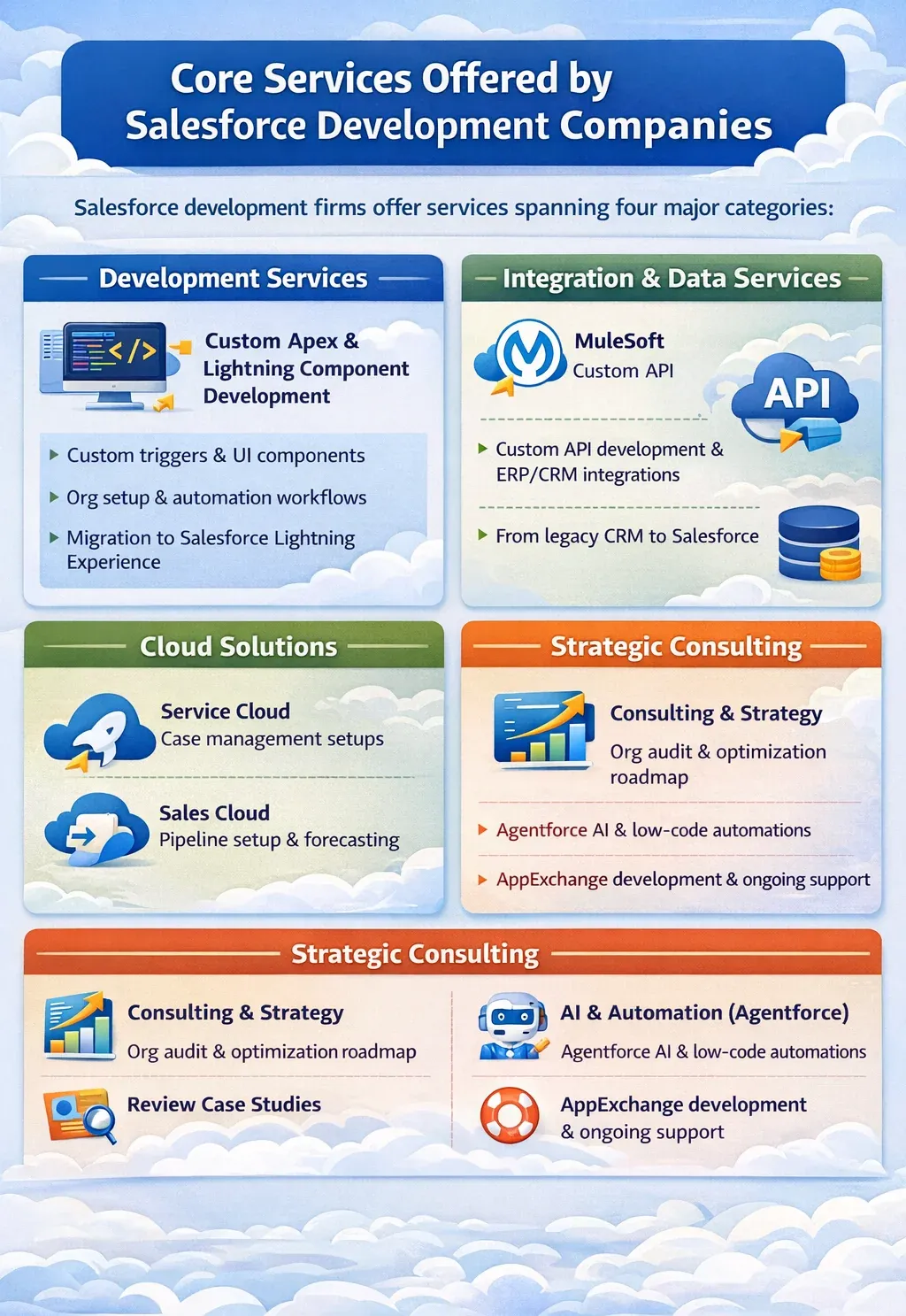
Salesforce generated $37.9B in FY2025 revenue with 11% year-over-year growth. That growth has spawned a wide ecosystem of specialized services. A capable Salesforce development company typically offers 10-15 distinct service lines, grouped into four main categories.
Core Development Services
Custom Development (Apex and LWC) is the backbone of most engagements. Developers write Apex code and build Lightning Web Components to extend Salesforce beyond its default capabilities. Custom triggers, batch processes, and UI components all fall here.
Implementation and Configuration covers the initial setup — org configuration, user roles, page layouts, workflows, and validation rules. This is where most projects start. Getting it right sets the foundation for everything else.
Lightning Migration moves organizations from Classic to the Lightning Experience. It sounds simple. It rarely is. Custom Visualforce pages, JavaScript buttons, and third-party integrations all need reworking.
Integration and Data Services
Integration (MuleSoft and APIs) connects Salesforce to your existing tech stack. ERP systems, marketing platforms, custom databases — MuleSoft and REST/SOAP APIs make the data flow. Salesforce's $6.5B acquisition of MuleSoft signaled how seriously they take this.
Data Migration is the least glamorous service and arguably the most important. Moving data from legacy CRMs, spreadsheets, or homegrown databases into Salesforce requires careful mapping, deduplication, and validation.
Cloud-Specific Solutions
The major clouds each require specialized knowledge:
| Cloud | FY2024 Revenue | Primary Use Case |
| Service Cloud | $8.25B | Customer support and case management |
| Sales Cloud | $7.58B | Pipeline management and forecasting |
| Marketing & Commerce Cloud | $4.91B | Campaign automation and digital storefront |
| Data Cloud & Analytics | $1.2B ARR (120%+ YoY growth) | Unified customer data profiles |
Marketing Cloud alone delivers a 3-year ROI of 299% but only if it's configured correctly. That's where a specialized partner earns their fee.
Strategic and Ongoing Services
Consulting and strategy happen before any code gets written. A good partner audits your current processes, identifies gaps, and maps Salesforce features to business outcomes.
AppExchange Development builds custom apps for the Salesforce marketplace. With 6,233 apps listed as of December 2025 — a 10% year-over-year increase — the opportunity for ISVs is real.
AI and Automation (Agentforce) is the fastest-growing service area. Partners are now building autonomous AI agents that handle customer interactions, qualify leads, and resolve support tickets without human intervention.
Managed Services and Support provides ongoing administration, bug fixes, and optimization after go-live. Most companies need this. Few plan for it.
Citation Capsule: Salesforce development companies offer services spanning four categories: core development, integration, cloud-specific solutions, and strategic consulting. Marketing Cloud delivers a 299% three-year ROI, but achieving that return requires properly configured implementation by certified professionals.
How Do You Evaluate Salesforce Partner Certifications?
Salesforce offers 48+ professional certifications across 9 categories. These certifications aren't vanity badges — they're the most reliable proxy for technical competence when evaluating a Salesforce development company. A partner's certification portfolio tells you exactly where their strengths lie.
Must-Have Certifications
Not all 48 certifications carry equal weight. Here are the ones that matter most when you're hiring a development partner:
For Basic Projects:
- Salesforce Administrator — proves competency in core platform configuration
- Platform App Builder — validates ability to build custom apps using clicks, not code
For Custom Development:
- Platform Developer I and II — confirms Apex and Visualforce coding skills
- Developer II is significantly harder to earn. It signals senior-level capability.
For Cloud Implementations:
- Sales Cloud Consultant — specialized in pipeline and forecasting setup
- Service Cloud Consultant — focused on case management and omnichannel support
- Marketing Cloud Consultant — email studio, journey builder, and campaign configuration
Advanced Architecture Certifications
Application Architect and System Architect certifications indicate someone who can design solutions across multiple clouds. These are mid-tier architecture credentials that require passing multiple prerequisite exams.
The Certified Technical Architect (CTA) sits at the top. It's Salesforce's most difficult certification — a grueling review board examination. Fewer than 500 people worldwide hold it. If a partner firm employs CTAs, that's a strong signal.
Emerging Certifications Worth Watching
Data Cloud Consultant certification is gaining importance fast. With Data Cloud ARR hitting $1.2B and growing 120%+ year-over-year, this certification validates expertise in unified data profiles and zero-copy architecture.
AI Associate and AI Specialist certifications cover Salesforce's Agentforce platform. As 93% of IT leaders plan to deploy autonomous AI agents within two years, these certifications will become table stakes for partners.
Here's something most guides won't tell you: certification count alone is misleading. A firm with 200 certifications spread across 300 employees is less capable than a firm with 80 certifications held by 40 deeply specialized consultants. Ask for the certifications-per-consultant ratio, not just the total count.
Citation Capsule: Salesforce offers 48+ professional certifications across 9 categories. The Certified Technical Architect (CTA) is the highest credential, held by fewer than 500 professionals globally. Partners with high certifications-per-consultant ratios demonstrate deeper expertise than firms with inflated totals.
What Are Salesforce Partner Tiers and Why Do They Matter?
The Salesforce partner program uses a four-tier system — Base, Ridge, Crest, and Summit — to classify consulting partners by performance, innovation, and customer success. With IDC projecting 4.2 million new Salesforce jobs by 2026, the partner ecosystem is expanding rapidly, and tier placement helps you separate proven firms from newcomers.
Also Read: What is Salesforce ERP? Benefits & More
The Four Partner Tiers Explained
| Tier | Level | Key Requirements | What It Tells You |
| Base | Entry-level | Registered partnership | New to the ecosystem; limited track record |
| Ridge | Growth stage | Demonstrated sales performance | Gaining traction; some proven engagements |
| Crest | Established | Strong metrics across categories | Reliable partner; eligible for Marketing Development Funds |
| Summit | Highest tier | Top scores in Innovation, Growth, Customer Success, Impact | Elite partner; Salesforce's most trusted firms |
How Summit Scoring Works
Summit partners are scored across four weighted dimensions:
- Innovation (25%) — adoption and deployment of new Salesforce features
- Growth (25%) — revenue expansion and new customer acquisition
- Customer Success (30%) — customer satisfaction scores and project outcomes
- Impact (20%) — community contributions and social responsibility
Notice that Customer Success carries the heaviest weight at 30%. That's deliberate. Salesforce wants its top partners measured primarily by results, not just revenue.
Should You Only Hire Summit Partners?
Not necessarily. Summit partners tend to be larger firms with higher rates. For a mid-complexity implementation running $25,000 to $100,000, a Crest-tier partner with relevant industry experience might deliver better value than a Summit partner whose sweet spot is $500K+ enterprise deals.
What matters more than tier alone is the match between your project scope and the partner's proven expertise. Ask for case studies in your industry and at your project scale.
Citation Capsule: Salesforce classifies partners into four tiers — Base, Ridge, Crest, and Summit — with Summit requiring top performance across Innovation (25%), Growth (25%), Customer Success (30%), and Impact (20%). Customer Success carries the highest weighting, signaling Salesforce's emphasis on outcome-driven partnerships.
How Much Does Salesforce Development Cost in 2026?
US-based senior Salesforce developers and architects charge between $150 and $250 per hour, while offshore alternatives in India range from $25 to $60 per hour. Understanding these pricing benchmarks is the difference between getting fair value and overpaying by 40% or more.
Also Read: The cost of Hiring a Salesforce developer: What to Expect
Hourly Rates by Role and Region
The gap between US and offshore rates is dramatic — but so are the trade-offs. A US senior architect at $200/hr brings native English communication, timezone overlap, and deep familiarity with North American compliance requirements. An offshore developer at $42/hr may require more project management overhead.
Project-Based Pricing
| Project Type | Price Range | What's Included |
| Basic Customization | $5,000 – $25,000 | Page layouts, workflows, reports, dashboards |
| Mid-Complexity Implementation | $25,000 – $100,000 | Multi-cloud setup, integrations, data migration |
| Enterprise Implementation | $100,000 – $500,000+ | Full org buildout, custom development, multi-department rollout |
What Drives Cost Up
Several factors push implementations toward the higher end. Custom Apex development is inherently more expensive than point-and-click configuration. Multi-cloud projects spanning Sales, Service, and Marketing Cloud multiply complexity. And legacy data migration with poor data quality can add 20-30% to project timelines.
From reviewing dozens of published engagement summaries, we've found that the single biggest cost driver isn't technical complexity — it's scope creep caused by unclear requirements. Companies that invest in a proper discovery phase before signing a development contract consistently spend 15-25% less overall.
Citation Capsule: US-based senior Salesforce developers charge $150–$250/hr, while Indian counterparts charge $25–$60/hr. Enterprise implementations typically range from $100K to $500K+, with unclear requirements and scope creep being the top cost drivers.
What Salesforce Trends Should You Watch in 2026?
Salesforce's FY2026 revenue is projected at approximately $41.5B, driven largely by AI and data innovation. Any Salesforce development company you hire in 2026 needs to demonstrate expertise in these six trends — or they're already behind.
Also Read: Salesforce CRM Trends in 2026
Agentforce and Agentic AI
This is the biggest shift in the Salesforce ecosystem since Lightning. Agentforce lets businesses deploy autonomous AI agents that handle customer interactions, qualify leads, and resolve service cases without human intervention.
The numbers tell the story. The agentic AI market was valued at $7.38B in 2024 and is projected to reach $47.1B by 2030. Within Salesforce specifically, Agentforce crossed $100M+ ARR in its first year. Meanwhile, 93% of IT leaders say they plan to deploy autonomous agents within two years.
What does this mean for partner selection? Ask potential partners whether they've deployed Agentforce in production environments. Not demos. Production.
Data Cloud and Zero-Copy Architecture
Data Cloud reached $1.2B in ARR during Q2 FY2026 with 120%+ year-over-year growth. It unifies customer data from every source into a single profile — without requiring data duplication.
The zero-copy architecture is particularly significant. Instead of moving data between systems, Data Cloud connects directly to external data lakes. Your Salesforce development company should understand how to architect these connections.
Industry-Specific Clouds
Salesforce now offers purpose-built solutions for Financial Services, Healthcare, Manufacturing, and Retail. These industry clouds come with pre-configured data models, workflows, and compliance features.
If you're in a regulated industry, ask potential partners about their industry cloud experience. Generic Salesforce skills won't cut it for healthcare HIPAA requirements or financial services compliance.
MuleSoft Agent Fabric
Salesforce's $6.5B acquisition of MuleSoft continues to pay dividends. Agent Fabric extends MuleSoft's integration capabilities to AI agents, enabling them to access data and trigger actions across your entire tech stack.
This composable architecture means AI agents aren't trapped inside Salesforce. They can pull data from your ERP, update your data warehouse, and trigger workflows in third-party tools.
Slack as the AI Collaboration Hub
After the $27.7B Slack acquisition, Salesforce is positioning Slack as the front-end for AI-powered collaboration. Agentforce agents now surface directly in Slack channels, giving teams conversational access to Salesforce data.
Low-Code and Flow Automation
Not every solution requires custom Apex code. Salesforce's Flow Builder and low-code tools let administrators build complex automations without developers. A good partner knows when to code — and when to use clicks instead.
Citation Capsule: Salesforce's FY2026 revenue is projected at $41.5B. The dominant trends are Agentforce (agentic AI), Data Cloud ($1.2B ARR, 120%+ growth), industry-specific clouds, and MuleSoft Agent Fabric for composable AI architecture.
Red Flags When Choosing a Salesforce Development Company
With the Salesforce services market worth $14.61B in 2025, the barrier to entry for calling yourself a "Salesforce partner" is remarkably low. Here are nine warning signs that a firm can't deliver what they promise.
1. No Verifiable Certifications
Ask for certification documentation tied to named individuals. If a firm claims "200+ certifications" but can't tell you which consultants hold which credentials, that's a problem. Certifications belong to people, not companies. When those people leave, the certifications leave with them.
2. No Industry-Specific Case Studies
A firm that's built Sales Cloud implementations for retail clients isn't automatically qualified to configure Financial Services Cloud for a bank. Customer distribution varies significantly across the ecosystem — services (34.3%), finance (15.5%), retail (13.9%), transportation (13.6%), and manufacturing (11%). Demand case studies in your vertical.
3. One-Size-Fits-All Pricing
Every legitimate Salesforce project requires a discovery phase before pricing. If a firm quotes a fixed price after a single call, they're either underscoping the work or planning to upsell you later. Both scenarios end badly.
4. No Salesforce Partner Tier Listed
If a company can't tell you whether they're Base, Ridge, Crest, or Summit, they may not be an official partner at all. Check the Salesforce AppExchange partner directory to verify.
5. Overreliance on Custom Code
The best Salesforce partners exhaust declarative (clicks-not-code) options before writing custom Apex. If a partner's first instinct is always custom development, your maintenance costs will skyrocket. Every line of custom code needs testing, documentation, and ongoing support.
6. No Change Management Plan
Technology adoption fails without user buy-in. A Salesforce development company that only talks about technical configuration — and never mentions training, documentation, or adoption tracking — is setting you up for low utilization.
7. Vague Timelines with No Milestones
"We'll have it done in three to six months" isn't a timeline. It's a guess. Demand phase-gated project plans with specific deliverables, review checkpoints, and acceptance criteria at each stage.
8. No Post-Go-Live Support Plan
Launching Salesforce is the beginning, not the end. If a partner doesn't offer managed services and ongoing support, you'll scramble to find help when the first production issue hits. And it will hit.
9. They Don't Ask About Your Business Goals
The biggest red flag of all? A firm that jumps straight to technical requirements without understanding your business objectives. Technology exists to serve strategy. A partner that doesn't grasp this will build you something technically impressive and practically useless.
We've noticed a pattern: the most problematic Salesforce implementations aren't caused by bad developers. They're caused by partners who optimize for technical complexity instead of business outcomes. The best firms ask "what does success look like?" before they ask "what cloud do you need?"
How to Make Your Final Decision: A Selection Framework
With 20+ million members in the Trailblazer Community and thousands of consulting firms competing for your business, a structured evaluation process beats gut instinct every time. Here's a step-by-step framework for selecting the right Salesforce development company.
Step 1: Define Your Requirements Before You Talk to Anyone
Write down your business objectives, current pain points, user count, timeline, and budget range. Bring this document to every partner conversation. It forces consistency and makes comparisons meaningful.
Step 2: Shortlist 3-5 Partners
Filter by Salesforce partner tier, relevant certifications, industry experience, and geographic fit. The Salesforce AppExchange partner directory is a good starting point. Clutch, G2, and client referrals add additional validation.
Step 3: Request Detailed Proposals
Ask each shortlisted partner for a written proposal that includes scope, timeline, team composition (with named consultants and their certifications), pricing structure, and assumptions. Compare them side-by-side.
Step 4: Check References Carefully
Don't just ask for references — ask for references from projects similar to yours in scope, industry, and complexity. Ask those references two key questions: "Would you hire them again?" and "What would you change about the engagement?"
Step 5: Evaluate the Discovery Process
The best partners will push back on your initial requirements. They'll ask hard questions about your data quality, user adoption plans, and long-term roadmap. If a partner agrees to everything without challenge, that's a yellow flag.
Step 6: Negotiate the Contract
Key terms to watch: intellectual property ownership, milestone-based payment schedules, scope change procedures, SLAs for ongoing support, and exit clauses. Never pay more than 20-30% upfront.
Scoring Rubric
Use this weighted scoring framework for final evaluation:
| Criteria | Weight | What to Assess |
| Certifications and Team | 25% | Relevant certs, team stability, named resources |
| Industry Experience | 20% | Case studies, vertical expertise, domain knowledge |
| Technical Approach | 20% | Architecture decisions, code vs. configuration balance |
| Communication and Process | 15% | Discovery quality, project management methodology |
| Pricing and Value | 10% | Total cost, transparency, payment terms |
| References | 10% | Client satisfaction, project outcomes |
Based on analyzing publicly available Salesforce AppExchange reviews, we've found that communication quality is the #1 predictor of a 5-star review — more than technical skill, pricing, or timeline adherence. Partners that over-communicate consistently outperform technically superior firms that under-communicate.
Citation Capsule: A structured evaluation framework should weight Certifications and Team (25%), Industry Experience (20%), and Technical Approach (20%) as the top three selection criteria. The Salesforce Trailblazer Community spans 20+ million members, so verifiable references and case studies are essential differentiators.




Leave a Comment
Your email address will not be published. Required fields are marked *