















 0 comments
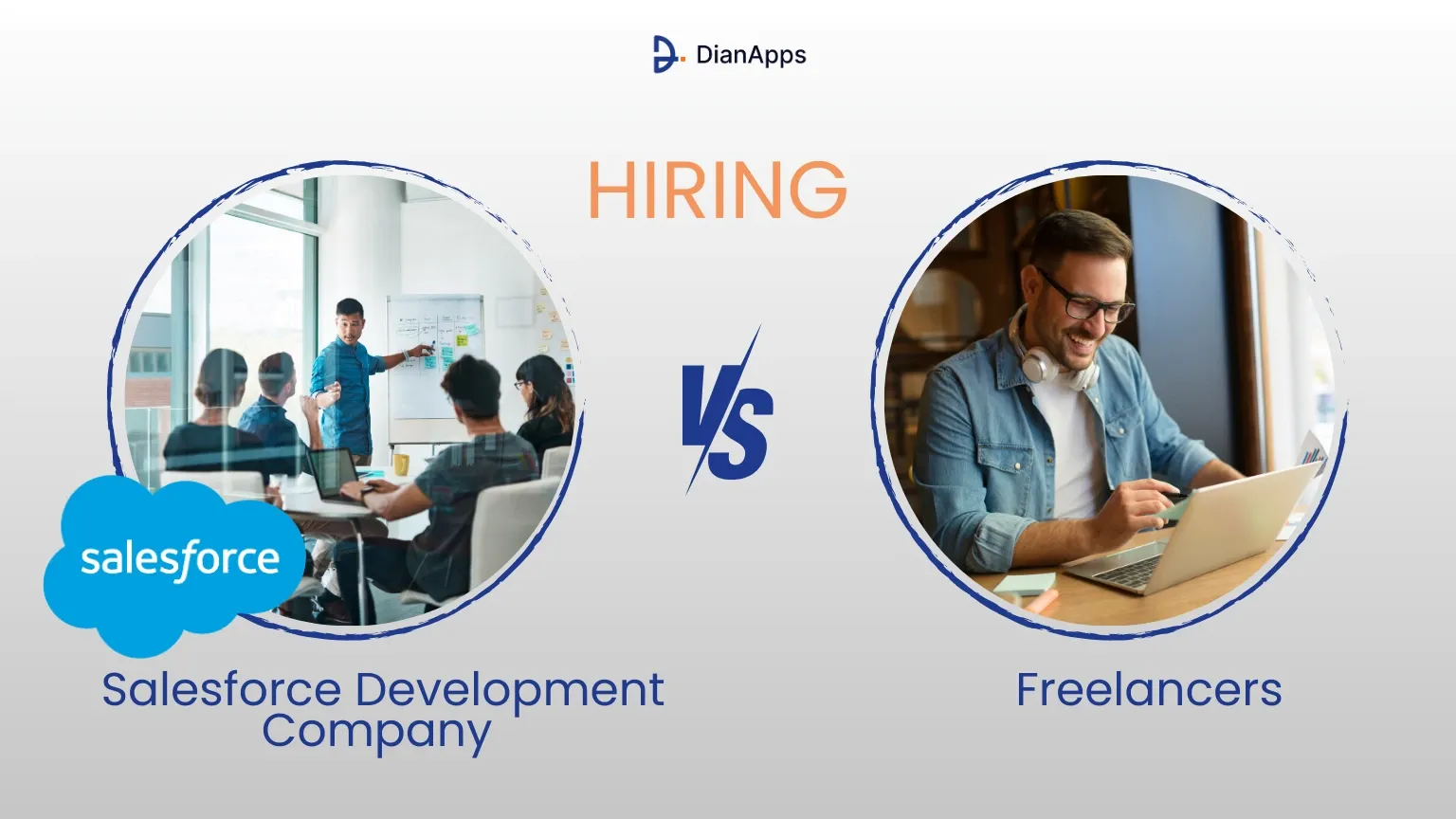
Quick SummaryFreelancers
Salesforce Development Company
If Salesforce is core to your business, hire a Salesforce Development agency (especially one with USA market experience). |
Salesforce today isn’t just a CRM. It’s the backbone of how sales teams close, how service teams scale, and how leadership tracks growth in real time.
So here’s the real question: who should build and manage it for you?
A freelancer who works fast and cheap?
Or a Salesforce Development Company that thinks in systems, security, and scale?
At first glance, the choice looks like a cost decision. In reality, it’s a risk and ROI decision. One wrong architectural call can slow your teams, break automations, or turn Salesforce into an expensive reporting tool.
If your Salesforce org touches revenue, customer data, or growth plans, this decision matters more than you think.
Let’s break down what you truly gain (and lose) with each option.
Hiring Freelance Salesforce Developers
Hiring freelance Salesforce developers is often the first route businesses explore, especially when speed and cost are top of mind. If you’re dealing with a limited scope, a tight timeline, or a short-term Salesforce requirement, freelancers can feel like a quick win. They usually come in for a specific task: building a Flow, fixing an Apex issue, customizing objects, or creating reports and dashboards.
However, Salesforce is rarely static. What starts as a “small change” often grows into automations, integrations, user roles, and data dependencies. That’s where the freelancer model needs a closer look because the decision impacts not just delivery, but long-term stability of your Salesforce org.
Let’s break it down clearly.
Pros of Hiring Freelance Salesforce Developers
1. Lower upfront cost
Freelancers typically charge less than a Salesforce Development service provider, making them attractive for startups or businesses with limited budgets. You pay only for the work needed, no long-term commitment, no overhead costs.
2. Quick start and flexibility
Most freelancers can jump in quickly. There’s minimal onboarding, fewer formal processes, and faster turnaround for small tasks or urgent fixes.
3. Ideal for short-term or isolated requirements
If you need a one-time customization, report setup, or a minor enhancement that doesn’t affect the core architecture, a freelancer can get it done efficiently.
Cons of Hiring Freelance Salesforce Developers
1. Single point of dependency
One freelancer usually owns everything development, logic, deployment, and support. If they become unavailable or leave midway, your Salesforce system can come to a halt with no backup in place.
2. Limited architectural and strategic thinking
Freelancers often focus on completing the assigned task, not on how it impacts scalability, performance, or future integrations. This can lead to hard-coded solutions and technical debt.
3. Inconsistent documentation and governance
Documentation, version control, and deployment best practices are often skipped. Over time, this makes Salesforce harder to manage and riskier to scale.
4. Security and compliance risks
For businesses handling sensitive customer data, especially those working with US clients, freelancers may lack experience with enterprise-grade security standards, role hierarchies, and compliance requirements.
5. Not built for long-term growth
As your Salesforce usage expands, managing multiple freelancers or repeatedly onboarding new ones becomes inefficient and costly.
Hiring a Salesforce Development Company
When Salesforce becomes more than a setup exercise when it starts driving sales performance, customer experience, analytics, and automation, the hiring approach needs to mature. This is where a Salesforce Development Company steps in. Instead of solving isolated problems, a company looks at Salesforce as a long-term business platform that must scale, stay secure, and evolve with your organization.
A Salesforce Development Company doesn’t just execute requirements. It challenges assumptions, designs architecture, and aligns Salesforce with your growth roadmap. For businesses operating at scale or targeting global markets like the US, this approach isn’t a luxury; it’s a necessity.
Let’s break down why?
Pros of Hiring a Salesforce Development Company
1. End-to-end Salesforce expertise
A Salesforce Development Company brings a cross-functional team to the table architects, certified developers, admins, QA engineers, and project managers. This ensures that every layer of your Salesforce org, from data model to automation to integrations, is built cohesively rather than in silos.
2. Architecture-first and scalable solutions
Unlike task-based development, companies design Salesforce with future growth in mind. This includes clean data structures, reusable components, optimized automations, and integration-ready architecture, reducing rework as your business scales.
3. Strong governance, security, and compliance
For companies serving enterprise clients or operating in regulated markets, security is non-negotiable. A Salesforce Development Company follows best practices for access control, data security, audit trails, and compliance, critical for Salesforce Development Company USA engagements.
4. Reliable delivery and accountability
With defined processes, sprint planning, QA cycles, and documentation, delivery becomes predictable. You’re not dependent on one individual; you have a team accountable for timelines, quality, and long-term support.
5. Long-term cost efficiency
While the initial investment is higher, the reduction in bugs, downtime, rework, and performance issues significantly lowers the total cost of ownership over time.
Cons of Hiring a Salesforce Development Company
1. Higher upfront cost
Compared to freelancers, a Salesforce Development Company requires a larger initial budget, which may not suit very small or short-term projects.
2. Structured processes may feel slower initially
Agile workflows, documentation, and testing can seem slower than ad-hoc development but they exist to prevent costly failures in production.
Salesforce Development Company vs Freelancers: Quick Comparison
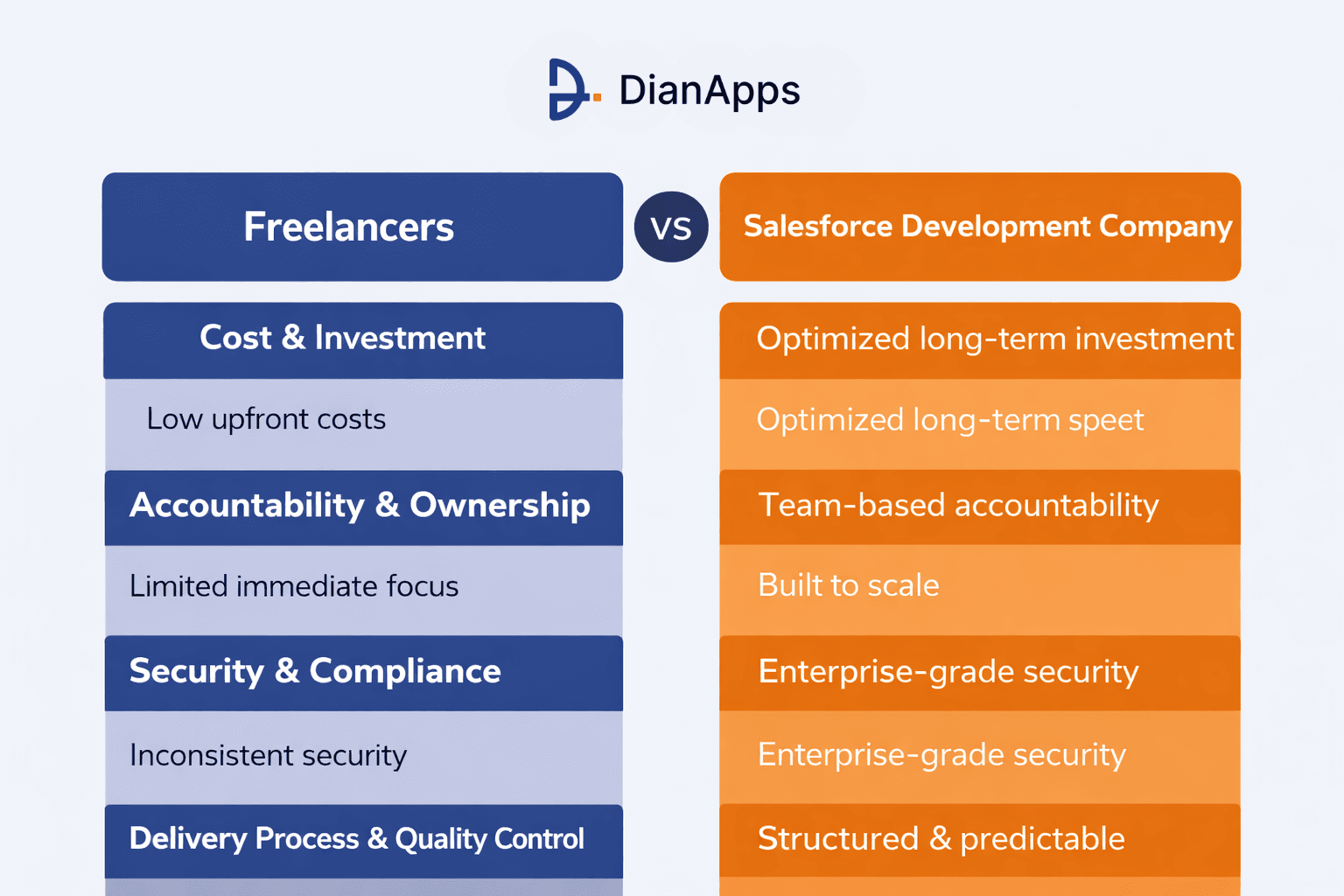
Choosing between a freelance Salesforce developer and a Salesforce Development agency isn’t just a hiring decision; it’s a strategic one. The right choice directly impacts how stable your Salesforce org is today and how well it supports your business tomorrow. While both options can deliver results, they operate in very different ways. Below is a clear, side-by-side comparison across the areas that matter most when Salesforce is tied to revenue, customer data, and long-term growth.
1. Cost & Investment
Freelancers often win on initial cost. Their hourly or short-term pricing feels budget-friendly, especially for early-stage companies or limited scopes. However, this approach rarely accounts for future changes, scale, or technical debt. As new features, fixes, or integrations arise, costs can quietly stack up.
A Salesforce Development Company involves a higher upfront investment, but that cost includes planning, architecture, testing, and future-proofing. Over time, this reduces rework and delivers better value per dollar spent.
2. Accountability & Ownership
With freelancers, accountability lies with one individual. If they are unavailable, overbooked, or move on, progress slows or stops altogether. There’s little protection against continuity risks.
A Salesforce Development Company distributes ownership across a team. Processes, documentation, and shared responsibility ensure that delivery doesn’t depend on a single person, making execution far more reliable.
3. Scalability & Long-Term Readiness
Freelancers usually focus on solving the immediate problem. While this works short-term, solutions may not be designed to handle growth, additional users, or complex workflows.
A Salesforce Development Company plans for scale from day one, with clean data models, flexible automations, and integration-ready architecture that grows with your business.
4. Security & Compliance
Freelancers may apply basic security controls but often lack experience with enterprise-grade or US-specific compliance standards. This increases the risk of data exposure.
A Salesforce Development Company follows strict security frameworks, role-based access, audit readiness, and compliance best practices, especially important for Salesforce Development Company USA engagements.
5. Delivery Process & Quality Control
Freelancer delivery is often informal, with limited testing, minimal documentation, and rapid deployments. This speeds things up but increases production risks.
A Salesforce Development Company uses structured delivery models, QA cycles, and deployment governance to ensure stable, high-quality releases.
6. Support, Maintenance & Continuity
Freelancers provide support based on availability, which can be unpredictable. Knowledge transfer is often weak.
A Salesforce Development Company offers ongoing support, clear documentation, and long-term maintenance, ensuring Salesforce remains reliable as your business evolves.
Recommended Read: Salesforce Consulting vs. In-House Development: Which is Right for Your Business?
When Freelancers Make Sense
Freelancers can be a practical choice when Salesforce plays a limited or supporting role in your business. In these scenarios, speed and cost efficiency matter more than long-term architecture.
One-time small fixes
If the requirement is isolated, such as tweaking a report, fixing a Flow error, or adding a validation rule, a freelancer can resolve it quickly without heavy processes or overhead.
Very early-stage MVP
For startups experimenting with Salesforce for the first time, freelancers help validate ideas without large upfront investment. At this stage, flexibility matters more than scale.
Non-core Salesforce usage
When Salesforce is used as a basic CRM rather than a revenue-driving or operations-critical system, freelancers can handle routine customization and maintenance efficiently.
Recommended Read: Salesforce CRM Trends in 2026
When a Salesforce Development Company Is the Right Move
When Salesforce becomes a strategic platform, not just a tool, the delivery model must evolve. This is where a Salesforce Development Company adds real value.
Salesforce is business-critical
If sales, customer success, analytics, or automation depend on Salesforce, stability and scalability become non-negotiable. A company ensures Salesforce grows with your business, not against it.
Multi-cloud implementations
Implementing Sales Cloud, Service Cloud, Marketing Cloud, or CPQ together requires coordinated architecture and governance, something a Salesforce Development Company is built to handle.
Integrations with ERP, payment, or data platforms
Complex integrations demand deep technical expertise, security planning, and long-term maintenance. Companies ensure integrations are reliable, secure, and scalable.
Scaling teams and operations
As users, workflows, and data volumes increase, Salesforce must stay performant. A Salesforce Development Company designs systems that scale smoothly without constant rework.
USA or global compliance requirements
For businesses serving US or global markets, compliance, data security, and audit readiness are critical. A Salesforce Development Company USA partner ensures these standards are met from day one.
Why DianApps as Your Salesforce Development Company
At DianApps, Salesforce isn’t treated as a feature set; it’s treated as a business system. Every decision we make is anchored in scalability, performance, and measurable outcomes. Here’s what sets us apart as a Salesforce Development Agency, including for Salesforce Development Company USA clients:
- Architecture built for scale: We design Salesforce orgs that grow with your business, clean data models, flexible automation, and future-ready architecture that avoids rework as users, workflows, and integrations expand.
- Performance-first implementation: From optimized Apex to efficient Flows and integrations, we ensure your Salesforce instance stays fast, reliable, and responsive even at scale.
- Adoption-driven design: Salesforce only delivers value when teams actually use it. We focus on intuitive user experiences, role-based workflows, and clear reporting that drive daily adoption.
- Accountable delivery, not ad-hoc execution: Our structured delivery model ensures predictable timelines, documented solutions, quality assurance, and long-term support with no single-point dependency.
- Certified Salesforce experts: Our team includes certified developers, admins, and architects with hands-on experience across Sales Cloud, Service Cloud, integrations, and custom development.
- Proven delivery frameworks: We follow battle-tested methodologies that balance agility with governance, ensuring speed without sacrificing stability.
- Industry-specific Salesforce implementations: From startups to enterprises, we tailor Salesforce solutions to real business workflows, not generic templates.
- USA and global compliance readiness: For Salesforce Development Company USA clients, we align with enterprise security, data protection, and compliance best practices from day one.
- Transparent communication and visibility: Clear updates, shared roadmaps, and honest conversations so stakeholders always know where the project stands.
- Business-aligned outcomes: Our focus is simple: make Salesforce work for your business goals, not the other way around.
Here are some additional pointers that will help you understand why DianApps is the ideal choice for a Salesforce Development Company.
Final Words
Choosing between freelancers and a Salesforce App Development Company ultimately comes down to how seriously Salesforce sits in your business stack.
If your needs are small, temporary, or experimental, freelancers can help you move quickly. But once Salesforce starts influencing revenue, customer experience, data decisions, or operational efficiency, shortcuts become expensive mistakes.
A Salesforce Development Company brings structure, accountability, and long-term thinking, ensuring your Salesforce org doesn’t just function, but scales, performs, and delivers measurable ROI.
At DianApps, we partner with businesses that see Salesforce as a growth platform, not a checklist item. If you’re building for scale, compliance, and long-term impact, especially in the USA or global markets, the right partner makes all the difference.
Build fast if you must.
Build right if you want to win.
Frequently Asked Questions
 0 comments








Leave a Comment
Your email address will not be published. Required fields are marked *