

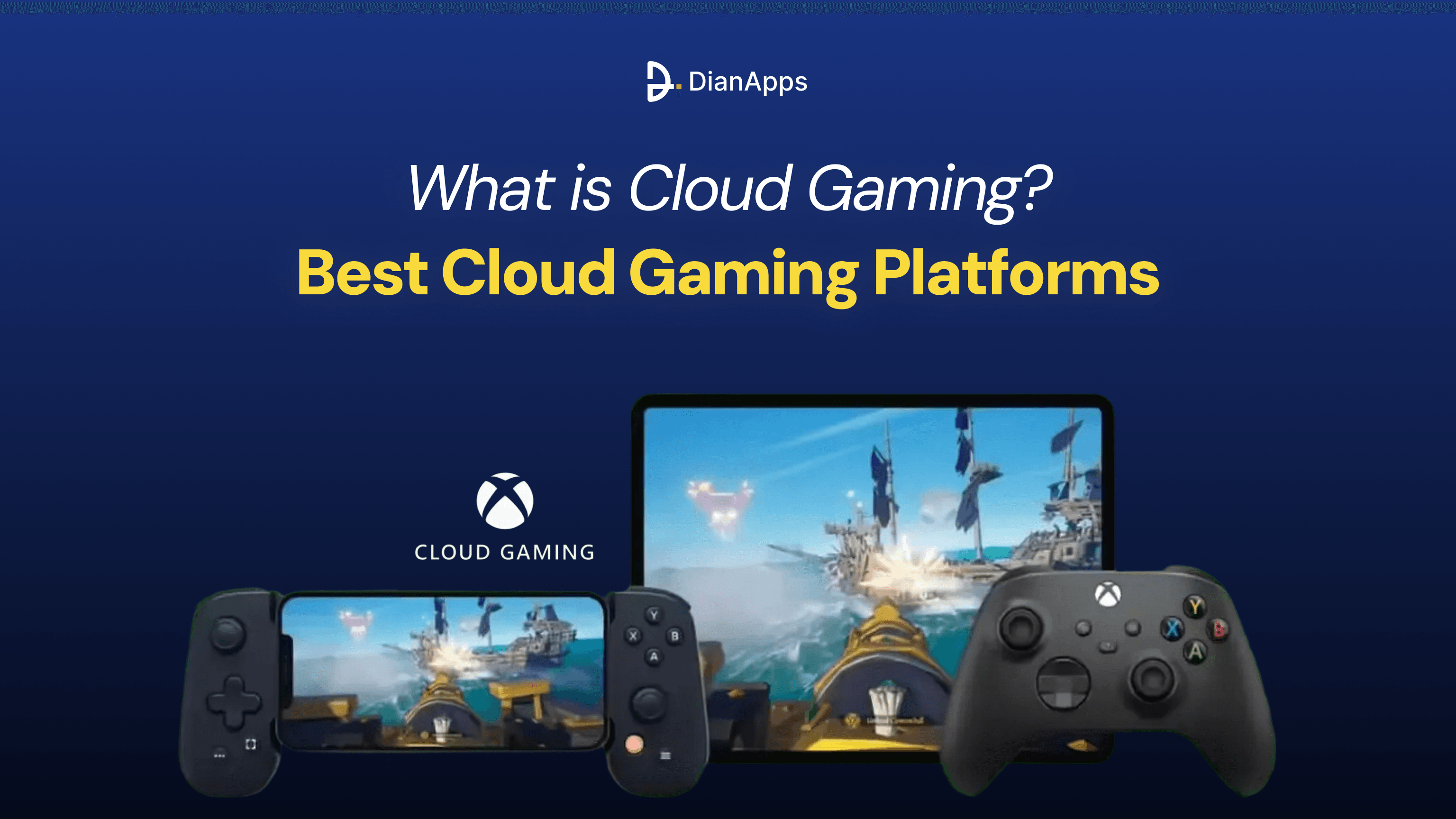
Instead of enjoying video games on local hardware, users can play them on remote servers via cloud gaming platforms. Similar to Netflix, but interactive, games are produced in the cloud and broadcast live to the device you're using.
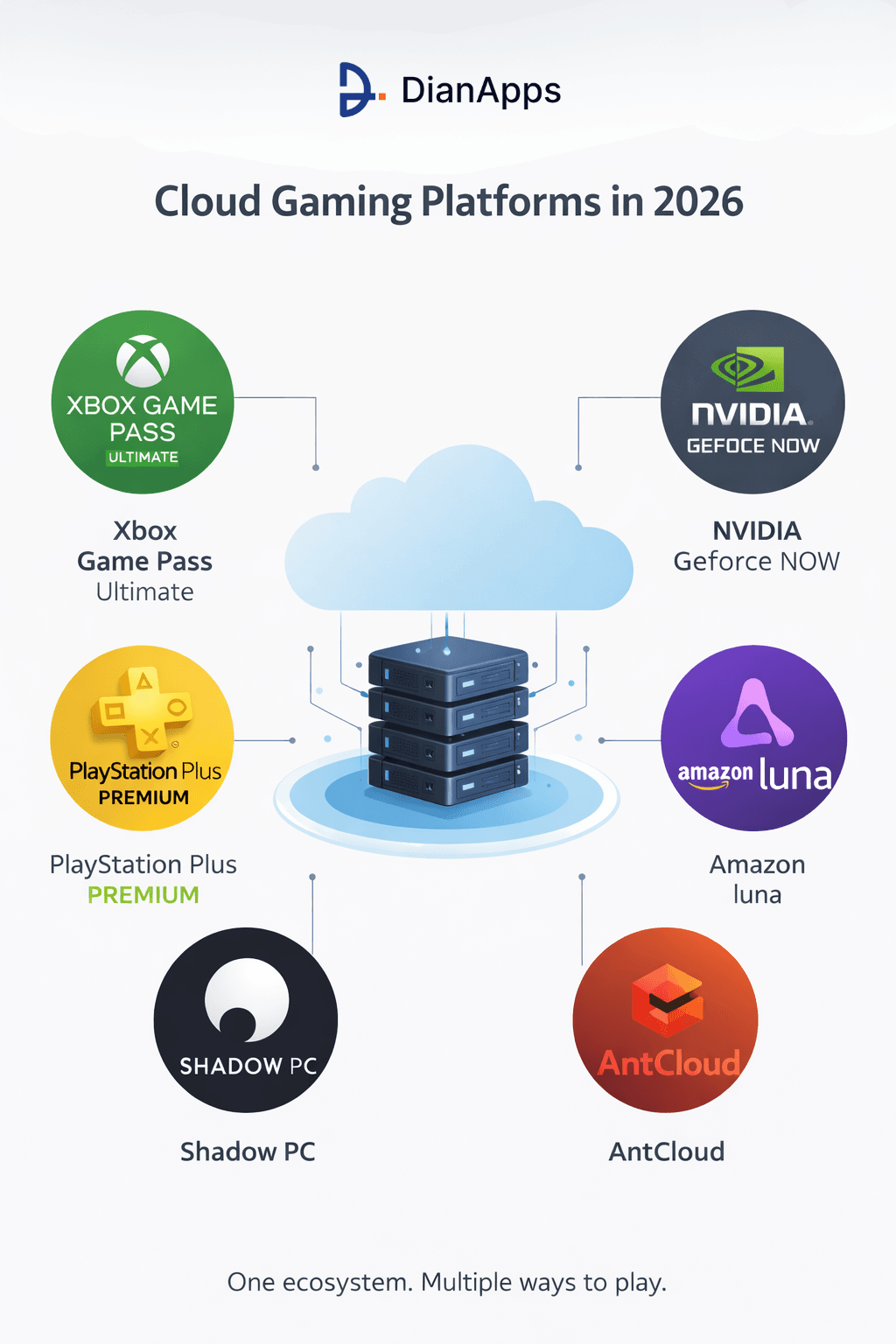
Quick Summary: Cloud gaming allows players to stream games directly from powerful cloud servers without needing consoles or high-end PCs. Games run remotely, while users play on phones, laptops, tablets, or smart TVs using a stable internet connection. Popular cloud gaming platforms like Xbox Game Pass Ultimate, NVIDIA GeForce Now, PlayStation Plus Premium, Amazon Luna, Shadow PC, and AntCloud offer different experiences based on performance, accessibility, and control. Together, these platforms highlight how cloud gaming is reshaping modern gaming with flexibility, instant access, and cross-device play. |
Not long ago, playing high-quality games meant owning a powerful console or a pricey gaming PC. Today, that rule is quietly breaking. Cloud gaming platforms are changing the way people discover, play, and even think about games by removing hardware from the equation altogether.
So, what are cloud gaming platforms, really? In simple terms, they let you stream games the same way you stream movies. The heavy lifting happens on remote servers, while your phone, laptop, or TV becomes the window into the game. No installs. No updates. Just tap and play.
This shift is bigger than convenience. It’s reshaping player expectations. Gamers now want instant access, cross-device continuity, and freedom from hardware upgrades. When a console-level game runs smoothly on a smartphone, it changes how we define “gaming setups” altogether.
That’s why this evolution matters not just to players, but to the industry behind the scenes. Every mobile game app development company is being pushed to rethink how games are built, designing for cloud readiness, streaming performance, and global scalability from day one.
Cloud gaming isn’t a trend people are testing anymore. It’s a direction the industry is committing to. And in 2026, understanding how cloud gaming platforms work is the difference between keeping up and falling behind.
What Are Cloud Gaming Platforms?
Cloud gaming platforms are considered services that let you stream video games directly from remote servers instead of buying your own devices to run them. However, in such platforms, games are processed in the cloud, while your screen simply displays the live gameplay experiences and sends your input back in real time.
In simple words, cloud gaming platforms simply eliminate the need for consoles or high-end PCs and make gaming experiences possible on everyday devices, tablets, smart TVs, and phones with the help of a stable internet connection.
Cloud Gaming vs Traditional Gaming
Aspect | Traditional Gaming (Console / PC) | Cloud Gaming Platforms |
Hardware Requirement | Dedicated console or high-end PC | Any compatible device |
Upfront Cost | High (hardware + accessories) | Low to none |
Game Installation | Required (often large files) | Not Required |
Updates & Patches | Manual Downloads | Automatic |
Profitability | Limited to one device | Play anywhere |
Performance Dependency | Device Hardware | Internet quality |
Game Ownership | Full Ownership | Subscription or access-based |
Scalability | Hardware-bound | Cloud-scaled |
Maintenance | Repairs, upgrades | Managed by the provider |
Entry Barrier | High | Very Low |
Recommended Read: Cloud Gaming & Cross‑Platform Play: The Future of Mobile Games
How Do Cloud Gaming Platforms Work?
Cloud-gaming platforms highly rely on a combination of high-speed networks, real-time streamlining, and powerful remote server technologies to deliver gameplay to users without running the game on the local center. Here’s how the process of cloud gaming platforms works behind the scenes.
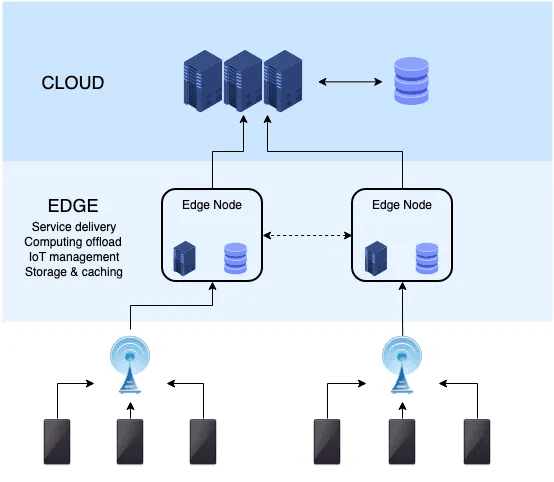
Game runs on cloud servers
Cloud games are highly executed on high-performance servers equipped with CPUs and GPUs in data centers. These services highly handle graphics rendering, AI logic, physics, and everything else that would normally tax a local machine.
Video stream is sent to your device
Then, once a game is successfully rendered, the output is compressed into a live video stream and transmitted to your device. Then your screen behaves like a live window into the game running elsewhere.
Player inputs travel back instantly
Every tap and click, or controller movement, made by users is sent directly back to the server in real time. The server then immediately processes those inputs and updates the game state immediately.
Low latency keeps gameplay responsive
The speed of transferring this round-trip input to the server to the screen is called latency. However, platforms can easily reduce latency with the help of edge servers, optimized network routing, and adaptive streaming.
Internet quality shapes the experience
Raw speed is not equally essential as a consistent, low-jitter connection. Faster networks, such as 5G and fiber, greatly improve responsiveness and visual quality.
Recommended Read: Cloud Gaming : Everything You Need to Know to Get Started
Why Latency Matters?
Latency, in simple words, can be explained as the tiny delay between the moment you press a button and the moment the game quickly responds on the screen. In cloud gaming, it also includes the time it takes for you to give input to travel to a server, get processed, and return information as a video frame.
For the game that works on a slower pace, even small delays may go unnoticed. But in a fast paced games such as competitive titles, racing games, shooters, or sports sims, anything above 50 milliseconds can definitely feel off. In such situations, movements lose precision, reactions feel late, and immersion breaks. That’s why in cloud gaming, latency is considered the real game changer, not graphics.
The Technology Making Cloud Gaming Viable in 2026
Edge computing
By bringing game servers closer to players, responses are greatly shortened and the physical distance that data must travel is reduced.
5G and fiber-based internet
Smoother streams are produced by faster speeds and less jitter, particularly on wireless networks where online game use is increasing the quickest.
AI-driven compression for videos
Even in situations that move rapidly, intelligent reduction maintains the appearance while utilizing less bandwidth.
Bitrate streaming that adapts
During gaming, the broadcast adapts in real time to network circumstances, avoiding unexpected interruptions or disruptions.
Top Cloud Gaming Platforms in 2026
Cloud gaming consoles are going to cease to be experimental extensions to traditional gaming by 2026. Each of these fully operational ecosystems has been customized to specific types of gamers. Nowadays, the real difference is in the way content is displayed, the level of user control, and the consistency of platform functionality across regions.
Xbox Game Pass Ultimate
Best for: Gamers who want instant access to premium titles
Why it works
The Xbox Cloud gaming platform is one of the most advanced gaming platforms with one of the strongest subscription libraries across the industry. Day one sees the launch of first-party releases, and Azure's extensive global cloud architecture helps ensure reliable performance across all supported regions. For gamers who wish to move between devices without worrying about compatibility or saving information, the platform works especially well.
Where it falls short
It’s one of the feature rotating catalog showcase that games can leave the platform, which limits long-term ownership. However, streaming quality while maintaining reliability is still difficult compared to running games locally on high-end hardware.
Strategic takeaway
It is the most popular cloud gaming platform since it is made in order to be both readily available and scalable.
NVIDIA GeForce Now
Best for: PC gamers who prioritize performance and visual quality
Why it stands out
NVIDIA is now focused on raw performance by giving permission to players to stream games they already won. To bring experience to the users of the locally powered gaming PC is through High-end RTX servers that enable advanced graphics features like high frame rates and ray tracing. And the core strength of this platform is Latency optimization.
Limitations
To unlock the best experience in this gaming experience, you require a premium tier, and game availability for users is dependent on publisher support. This experience also assumes that users already have a PC game library.
Strategic takeaway
This platform proves that cloud gaming doesn’t have to mean visual compromise.
PlayStation Plus Premium
Best for: PlayStation loyalists and franchise fans
Strengths
Cloud access to a carefully selected selection of PlayStation games, including exclusives and classics, is offered via PlayStation Plus Premium. The experience is easy to become used to and requires little onboarding for current PlayStation users.
Limitations
In comparison to competitors, cloud streaming accessibility varies by country, and compatibility with devices is more constrained. Sony continues to put content over infrastructure in its cloud approach.
Strategic takeaway
A strong value proposition for fans of the PlayStation ecosystem, with room to evolve on the cloud side.
Amazon Luna
Best for: Casual gamers and Amazon ecosystem users
Where it shines
Amazon Luna's channel-based subscription strategy places an extreme value on simplicity. Access and discovery are made simple by integration into Twitch and Fire TV, especially for customers who are already involved in the Amazon ecosystem.
Where it doesn’t
The gaming system keeps expanding geographically, and the selection of titles has decreased. Gamers who are competitive or focused on results are not its intended demographic.
Strategic takeaway
Luna prioritizes convenience and accessibility over depth and customization.
Shadow PC
Best for: Users who want full control and flexibility
Why it different
Shadow PC provides a full Windows setting in the cloud, enabling users to use non-gaming programs, install any game, and apply changes. It makes it difficult to differentiate between cloud computing and cloud gaming.
Trade-offs
For casual gamers, a more complicated setup and higher price point may be too much for them to handle. The availability of regional computers has an important effect on performance, in addition.
Strategic takeaway
Ideal for power users who want freedom rather than a curated experience.
AntCloud
Best for: Infrastructure-led cloud gaming in APAC markets
Strengths
AntCloud emphasizes backend performance and scalability, using Alibaba Cloud's infrastructure to help with extensive streaming operations, especially in the Asian and Pacific regions.
Limitations
It is less accessible to regular players because of its lack of a unified gaming setting and global consumer visibility.
Strategic takeaway
AntCloud is shaping the foundation of cloud gaming rather than competing at the consumer interface level.
Recommended Read: A Comprehensive Guide on How to Make a Game App
Cloud Gaming Market Growth Stats You Must Know
The market for cloud gaming is still growing rapidly on a worldwide scale. Improved network infrastructure, traditional console subscription fatigue, and the emergence of cross-device gaming habits are the primary drivers of growth.
The market for cloud gaming is expected to reach multibillion dollars by 2026, with a double-digit yearly expansion rate continuing to stay steady. Mobile-first gamers and areas with extensive 5G and fiber access are seeing the fastest rates of user uptake. Crucially, growth is now driven by use instead of hype and is no longer speculative.
Retention is the most notable feature. Cloud gamers often stick with it, using it as a regular fallback alternative or as their main platform alongside their consoles or PCs.
Cloud Gaming Pros and Cons
Although cloud gaming systems provide accessibility and convenience, they also come with trade-offs that gamers ought to be aware of before making a complete investment. This is a straightforward, experience-based assessment of what is effective and what remains in development.
Pros of Cloud Gaming Platforms
Here, you must definitely have a questions is cloud gaming really considered the future of the gaming industry, and if yes, then what benefits does it provide? So, in this section, you will come across the benefits of cloud gaming:
No expensive hardware required
Consoles and costly PCs are no longer needed for cloud gaming. Because players can access excellent games on common devices, gaming becomes more accessible, and the barrier to entry decreases significantly.
Instant access to games
You do not have to wait for corrections, updates, or downloads. Since games start almost instantly, it's easier to join for short periods or try out new games without investing.
Play anywhere, switch devices easily
Running games on the cloud allows you to switch between devices easily. Without losing your progress, you may begin play on a laptop, proceed on a mobile device, and end on a TV.
Subscription-friendly pricing
A great deal of platforms provide recurring fees that include access to multiple games, eliminating the requirement to buy separate games and increasing the predictable nature of gaming expenses.
Cons of Cloud Gaming Platforms
Strong dependence on internet quality
Even slight instability in connection can affect gameplay. Latency, packet loss, or jitter can quickly turn a smooth experience into a frustrating one.
Latency-sensitive gameplay limitations
Local hardware continues to feel better in fast-paced competitive games. Cloud gaming hasn't completely eradicated response-time problems for professional-level play, despite advances in technology.
Limited ownership and control
Most platforms provide access rather than ownership. Games can rotate out of libraries, and users have little control over long-term availability.
Regional performance differences
Near data centers, cloud gaming works well. Regardless of platform workmanship, efficiency could differ across regions with insufficient infrastructure.
The Future of Cloud Gaming Platforms to 2030 and beyond
Early adoption of cloud gaming is giving the opportunity for long-term infrastructure. The emphasis is moving toward more intelligent streaming, complete immersion, and deeper ecosystem connections as platforms and networks advance. These advances are going to impact how games are developed and played in decades to come.
AI-driven optimization becomes standard
Artificial intelligence will power smarter streaming, reduce latency through predictive input handling, and personalize gameplay experiences in real time.
VR and AR lean on the cloud
High-fidelity immersive games will rely on cloud rendering, allowing VR and AR experiences to run smoothly on lightweight, affordable devices.
Rise of cloud-exclusive games
Developers will release titles designed only for cloud environments, enabling massive worlds, persistent gameplay, and server-side computation.
Telecoms become ecosystem partners
Cloud gaming will be bundled with 5G and broadband plans, using edge data centers to deliver faster, more consistent performance.
This section presents the future of cloud technology in the gaming industry.
Final Words
Cloud gaming platforms are now influencing the way individuals access and enjoy modern games, going beyond simple experimentation. Simple, streaming interactions across common devices are making it possible to do things that formerly needed costly gear.
The reliability, scalability, and popularity of cloud gaming are increasing as infrastructure becomes better and latency keeps decreasing. While creators get greater creative and technological options, players gain freedom and immediate access.
This change necessitates a cloud-first mentality that puts performance, universal delivery, and future scalability first for any mobile application development company associated with gaming. Although cloud gaming is obviously changing expectations, it might not completely replace traditional gaming in the not-so-distant future. The use of cloud computing will be the basis of gaming in the future, and this transition is currently in progress.
FAQs
What are cloud gaming platforms?
Cloud gaming platforms let you stream games from remote servers instead of running them on your own device. The game is processed in the cloud, and you play it in real time on phones, laptops, tablets, or smart TVs using an internet connection.
Do cloud gaming platforms require high-speed internet?
Yes, a stable internet connection is essential. While most platforms work at 15–20 Mbps, the best experience comes with faster speeds and low latency, especially for action or multiplayer games.
Can cloud gaming replace consoles or gaming PCs?
For many casual and mainstream gamers, yes. However, competitive players and creators may still prefer local hardware for maximum control and ultra-low latency.
Are cloud gaming platforms worth it in 2026?
They are worth it for users who value convenience, flexibility, and instant access. As infrastructure improves, cloud gaming continues to close the gap with traditional setups.
Can mobile devices handle cloud gaming?
Absolutely. Since the processing happens on cloud servers, even mid-range smartphones can run high-quality games smoothly.
How does cloud gaming impact game development?
It pushes studios and every mobile app development company toward cloud-ready design, focusing on streaming optimization, scalability, and cross-device compatibility.







Leave a Comment
Your email address will not be published. Required fields are marked *