

Key Takeaways
|
AI Software Development in the UAE in 2026: Process, Costs & Features
Where AI Software Development in the UAE Stands in 2026?
By 2026, most enterprise leaders in the UAE have moved past the excitement phase. They have seen AI pilots. Some of them worked. Some of them fell apart in production, quietly, expensively, and in ways that were hard to explain to the board. What has replaced the excitement is something more useful: discipline.
The market numbers still make headlines. According to The Report Cubes, the UAE AI market is projected to grow at a CAGR of 45.90% between 2026 and 2034, reaching USD 221.38 billion, a figure that signals a move from cautious experimentation to deep, enterprise-wide deployment.
But those numbers tell you about the market's ambition. They don't tell you what it actually takes to build AI software that holds up in this environment.
The UAE is ranked #1 globally for AI adoption, 64% of the working-age population is actively using AI tools.
Microsoft Global AI Economy Institute, January 2026
That number, 64%, puts the UAE more than three percentage points ahead of Singapore, the second-ranked country. It is not an accident.
As Microsoft's Global AI Economy Institute notes, the UAE's lead was built deliberately, starting in 2017 when it appointed the world's first Minister of State for Artificial Intelligence. By the time generative AI became a global conversation, the UAE already had a foundation in place.
This guide is for enterprise leaders, founders, and technology teams evaluating AI software development in the UAE in 2026. It covers the real process, verified costs, critical features, active challenges, and the questions most vendors will not volunteer answers to.
What AI Software Development Actually Means for UAE Enterprises Today?
In practice, AI software development inside UAE enterprises rarely starts with a technology decision. It starts with a system that is already under strain. A reporting process that cannot keep up with volume.
A customer workflow that depends too heavily on individual human judgment. A risk decision loop that breaks when throughput increases.
This operational context shapes how AI gets built in the UAE. Teams are not building standalone AI products and hoping the business will organize around them.
They are embedding intelligence directly into existing enterprise systems, ERP extensions, operations dashboards, customer service platforms, compliance tools, and the work is far more demanding than it appears from the outside.
The categories of AI software currently being built across the UAE enterprise market include:
- Predictive analytics systems: revenue forecasting, demand planning, real estate valuation, risk scoring. These represent the most established AI use case in the UAE's financial services and logistics sectors.
- Arabic NLP and multilingual AI: customer service agents, document processing, regulatory reporting in Arabic. Gulf dialect support is a distinct capability from standard Arabic NLP and requires separate model work.
- Computer vision: smart surveillance, manufacturing quality control, retail footfall analytics, construction safety monitoring.
- Intelligent workflow automation: KYC and AML processing, invoice validation, insurance claims handling, HR document review. These are the highest-ROI deployments for mid-market UAE enterprises.
- AI software development agents: autonomous coding tools such as GitHub Copilot, Claude Code, and Cursor, used not to build AI products but to accelerate the development process itself. These are changing how software gets built, and what it costs.
What stands out across all these categories is the level of organizational coordination required. Engineering teams in the UAE are no longer working in isolation. Legal, compliance, security, and operations are regularly involved from the earliest stages, sometimes before a single line of code is written.
This is where compliant AI software development stops being a marketing phrase and becomes a genuine design constraint.
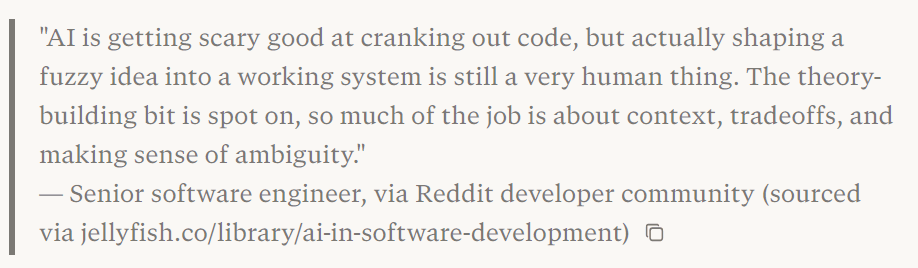
That observation captures something that UAE enterprises are learning in production: the value of AI in software development lies in accelerating implementation, not in replacing the architectural and compliance judgment that governs what gets built.
The more AI agents write, the more a senior human needs to review, validate, and course-correct.
Also read: The Top Artificial Intelligence Companies
The AI Software Development Process in the UAE: Stage by Stage
Generic software development lifecycles do not capture what AI projects actually involve. The following stages reflect how enterprise AI development plays out in the UAE's compliance-sensitive, integration-heavy market.
Stage 1: Discovery and Problem Definition (2 to 4 Weeks)
This is where the majority of UAE AI projects are set up to fail, not through poor execution, but through premature commitment. Leadership wants to see progress. Boards want demo-ready results. The pressure to skip careful problem framing and move directly to building is consistent and understandable.
A genuine discovery engagement answers three questions before anything is scoped.
First: does your existing data actually support the AI system you are imagining? Second: where is that data stored, and is it compliant with the PDPL? Third: what does failure look like in production, and who in the organization owns it when it happens?
Teams that skip this phase almost always encounter it retrospectively, at significantly higher cost, and at a point where structural rebuilding is the only option.
Stage 2: Data Audit and Preparation (3 to 8 Weeks)
The unglamorous engine of every AI project. In the UAE, this stage is complicated by a market reality: many established enterprises have years of valuable operational data that was never collected for machine learning.
It is split across Arabic and English. It lives in legacy systems with no modern API access. It contains inconsistencies that are harmless for human operators but fatal for model training.
Through 2026, Gartner predicts that 60% of AI projects will be abandoned because organizations lack AI-ready data.
This stage is where budget expansions originate in most UAE AI engagements. Organizations that enter discovery with clean, labeled, compliant data can reduce Phase 1 costs by 30 to 40 percent. Organizations whose data lives across three legacy ERPs, two formats, and a library of unprocessed PDFs are paying to fix infrastructure before they build anything.
Stage 3: Model Selection and Architecture (2 to 3 Weeks)
Three real paths exist here. Fine-tuning an existing foundation model, faster, cheaper, appropriate for most UAE enterprise use cases.
Training from scratch, rare, expensive, reserved for proprietary datasets where no existing model comes close. API-based inference, wrapping models from providers such as OpenAI or Anthropic, the fastest path to a working product, but with ongoing operating costs and data handling considerations that carry PDPL implications.
For Arabic language applications, this decision is more complex. The Falcon model from TII (Technology Innovation Institute) in Abu Dhabi is one of the most capable Arabic-language foundation models available.
Understanding its dialect coverage, fine-tuning accessibility, and deployment trade-offs before committing to an architecture is time well spent.
Stage 4: Development and System Integration (8 to 20 Weeks)
The build phase. AI development agents are increasingly embedded in development workflows and are producing measurable results.
Stack Overflow's 2025 Developer Survey, found that 84% of developers now use AI tools, up from 76% the previous year, with 51% of professional developers relying on them daily. However, 46% report not fully trusting the output, a number that carries real weight when you are building for regulated enterprise environments.
System integration with existing ERP, CRM, and legacy platforms is the consistent bottleneck regardless of how advanced the AI tooling is. A well-built machine learning model connected to a poorly documented legacy API creates a maintenance risk that compounds over time.
Stage 5: PDPL Compliance, Testing, and Security Review (3 to 5 Weeks)
Non-negotiable, and systematically underestimated by teams entering the UAE market from outside.
Federal Decree-Law No. 45 of 2021 on Personal Data Protection (PDPL) is now in active enforcement by the UAE Data Office. The law establishes obligations around lawful processing, purpose limitation, data residency, and individual rights including the right to erasure. For AI systems, this means:
- Training data must be collected and processed on a lawful basis with documented justification
- Data Protection Impact Assessments (DPIAs) are mandatory under Article 21 for AI systems processing sensitive data at scale
- Organizations handling high-risk data must appoint a qualified Data Protection Officer
- Administrative fines range from AED 50,000 to AED 1,000,000 for violations, with criminal liability possible for severe breaches
A non-compliant data architecture is not a documentation problem. It typically requires structural rebuilding. Budget for legal review alongside technical review from the very beginning of the project.
Stage 6: Deployment, MLOps, and Ongoing Operations (Ongoing)
Launching is the beginning of the project, not the conclusion. This is the most consistently under-budgeted phase in UAE AI development, and the primary reason production systems degrade quietly after launch.
Production AI systems experience model drift, the gradual erosion of accuracy as real-world data patterns shift away from training conditions. Without monitoring infrastructure, automated retraining triggers, and defined human review processes, even well-built systems silently deteriorate. Budget 15 to 25 percent of initial build cost per year for sustained MLOps operations.
For practical timeline guidance: a focused, single-function MVP with clean data takes 12 to 18 weeks. A mid-complexity production system with integration and compliance work takes 6 to 9 months. A full enterprise AI platform with multi-department rollout takes 12 to 18 months or more.
Also read: Generative AI in enterprise app development.
AI Software Development Costs in the UAE in 2026
The quoted cost range for AI software development in the UAE, from AED 146,900 to AED 1,469,000 (approximately $40,000 to $400,000), reflects genuine market variation, not vendor inconsistency.
The difference between the low end and the high end is almost always explained by data readiness, integration complexity, compliance requirements, and the scope of ongoing operations.
Project Type | Cost (AED) | Cost (USD) | Timeline |
|---|---|---|---|
AI Chatbot / Conversational Layer | AED 70,000 – 180,000 | $19,000 – $49,000 | 6–12 Weeks |
Intelligent Workflow Automation (KYC, Claims, Invoice) | AED 150,000 – 350,000 | $41,000 – $95,000 | 8–16 Weeks |
Predictive Analytics System | AED 250,000 – 600,000 | $68,000 – $163,000 | 3–6 Months |
Arabic NLP / Multilingual AI | AED 350,000 – 800,000 | $95,000 – $218,000 | 4–8 Months |
Computer Vision Application | AED 400,000 – 1,000,000 | $109,000 – $272,000 | 5–9 Months |
Full-Scale Enterprise AI Platform | AED 750,000 – 1,800,000+ | $204,000 – $490,000+ | 9–18+ Months |
What Actually Drives Cost Variation?
- Data readiness is the most significant and least discussed cost driver in UAE AI projects. Organizations with clean, labeled, structured data that is already PDPL-compliant can enter model development immediately.
- Organizations with legacy, unstructured, or multi-format data, which describes the majority of established UAE enterprises, pay for infrastructure remediation before any AI work begins. This single factor accounts for most budget overruns in the market.
- Arabic language and dialect support adds meaningful cost to any consumer-facing application. Gulf Arabic dialect capability is not a feature you add after the fact.
- It is an architectural decision that affects training data selection, model choice, and evaluation methodology. Teams that plan for this from the start pay considerably less than those who retrofit it.
- PDPL compliance is a structural cost, not a documentation overhead. Depending on project scope and sector, legal review, DPIA completion, DPO consultation, and secure data residency configuration can add AED 30,000 to AED 150,000 to a project budget. Healthcare and financial services applications are consistently at the high end of this range.
- Cloud infrastructure choices have long-term budget implications. AWS UAE North, Azure UAE, and G42 all offer data-residency-compliant hosting options that were not available in the UAE a few years ago.
- GPU compute for model training is expensive on any platform. Organizations that underestimate ongoing cloud costs tend to face budget pressure at the six-month operational mark.
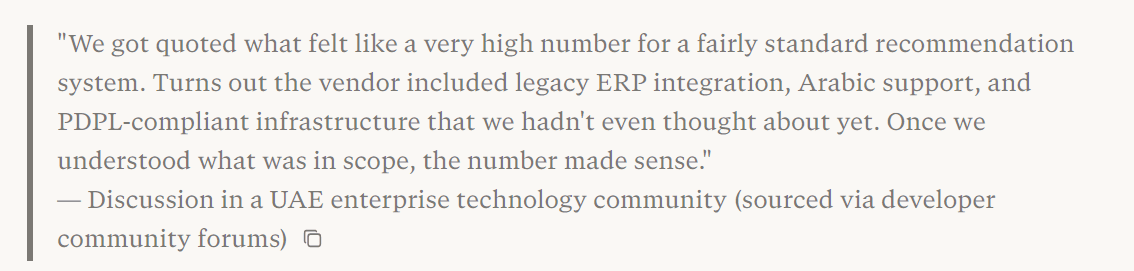
That framing is worth carrying into any AI vendor conversation. The question to ask is not whether the number seems right. The question is what the number is buying, specifically, which stages of the process, which compliance layers, and which ongoing operations are included.
Key Features of AI Software Built for the UAE Market
Feature lists for AI software are often generic. What matters for the UAE market is a specific set of capabilities that do not always appear in vendor proposals but consistently determine whether a system survives production.
Arabic Language and Dialect Support
Modern Standard Arabic and Gulf Arabic are not interchangeable in NLP applications. Consumer-facing AI in the UAE encounters Emirati and mixed-dialect input in real usage. Models trained primarily on formal written Arabic frequently underperform in production against actual user conversations. Dialect support needs to be tested explicitly at the architecture stage, not discovered post-launch.
PDPL-Native Architecture
Consent management, audit trails, data minimization by design, and the technical capability to fulfill right-to-erasure requests need to be engineered into the system from the start.
PDPL compliance that is added after architecture decisions have been made is expensive, structurally incomplete, and creates ongoing legal exposure.
As of 2026, enforcement by the UAE Data Office is active, and PDPL compliance is no longer a planning consideration, it is an operational requirement.
Explainability and Interpretability
Regulators, internal audit functions, and increasingly well-informed enterprise boards require that AI decisions, particularly in lending, hiring, insurance underwriting, and government service delivery, can be explained in plain language.
Black-box models face adoption resistance in regulated UAE sectors and are unlikely to clear compliance review for high-stakes applications. Explainability needs to be part of the model architecture, not a post-hoc reporting layer.
Multi-Cloud and Data Residency Flexibility
Many UAE enterprises, particularly in government, defense, and financial services, have explicit policies governing which cloud platforms can hold sensitive data.
AI systems need to be deployable across G42, AWS UAE North, and Azure UAE without requiring architectural rebuilds.
Systems that are locked to a single non-compliant cloud environment routinely fail compliance review at the worst possible moment in a project timeline.
Human-in-the-Loop Workflows
Full automation is rarely the right first deployment for UAE enterprise AI in 2026. Systems that route low-confidence outputs to human reviewers, require sign-off for consequential decisions, and provide clear escalation paths face significantly less internal resistance and far smoother regulatory review than systems designed for full autonomy from launch.
Edge AI for Field Applications
Logistics, construction, utilities, and government field operations in the UAE frequently operate in environments where reliable cloud connectivity cannot be assumed.
On-device inference that functions without a live cloud connection is increasingly specified in project requirements for industrial and smart-city applications.
AI Software Development Agents: What Is Changing in How Software Gets Built
The meaning of "software development using AI" has shifted materially in the past two years. It now describes two distinct things: building products with AI capabilities, and using AI agents to accelerate the development process itself.
The second category is changing the economics of software projects in ways that most cost estimates have not fully absorbed.
Tools such as GitHub Copilot, Claude Code, and Cursor are actively used in UAE development teams and are producing real results.
Stack Overflow's 2025 survey found that 90% of software teams now use AI coding tools, a 61% increase from just a year earlier. Development teams using agentic pipelines consistently report 20 to 40 percent faster initial build times on well-defined, modular features.
The gains are real. So are the risks.
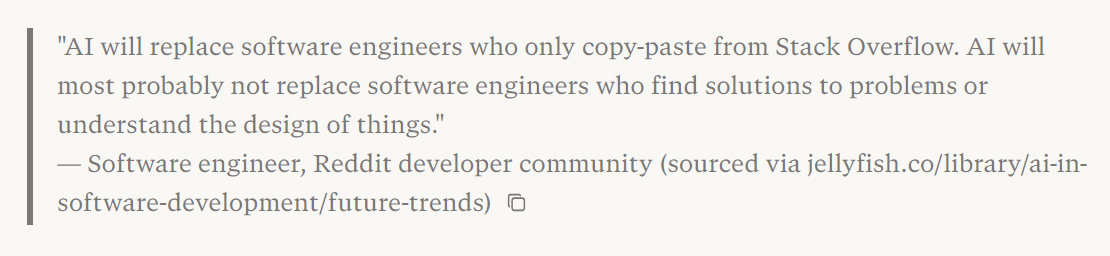
That distinction, between implementation and design judgment, is exactly where UAE enterprises need to pay attention. AI agents produce code efficiently. They do not understand PDPL. They do not flag that a data processing pipeline needs a DPIA.
They do not know that a particular API integration may violate data residency requirements. In the UAE's regulated, compliance-critical environment, the value of senior engineering oversight increases as AI agents become more capable, not less.
AI vs Software Engineering: The Accurate Picture
The "AI vs software engineering" framing misrepresents what is actually happening. AI agents are absorbing the 60 to 70 percent of development work that was always implementation and boilerplate. The 30 to 40 percent that requires judgment, system coherence, compliance awareness, and business context understanding remains deeply human.
For IT and software engineering roles, employment has declined 6% for workers aged 22–25, while increasing 9% for workers aged 35–49. Hiring is shifting toward experience, not away from engineers.
UAE enterprises restructuring their development teams are moving in a consistent direction: fewer junior developers writing boilerplate, more senior engineers directing and validating agentic workflows, and growing demand for MLOps and compliance specialist functions.
The engineering workforce is not shrinking. It is shifting toward the capabilities that AI cannot replicate.
AI Software Development Challenges in the UAE: The Honest Assessment
The challenges that most significantly affect AI project outcomes in the UAE are organizational and infrastructural, not technical. Understanding them before committing to a build is one of the most valuable things an enterprise leader can do.
Data That Exists But Is Not AI-Ready
The single most common project killer in the UAE market. Organizations have operational data, sometimes decades of it. But it was collected for operational purposes, not for machine learning. It is inconsistently labeled.
It mixes Arabic and English in ways that create data pipeline complexity. It is siloed across departments that have legitimate reasons not to share it. It lives in formats that predate modern data engineering.
80% of AI projects fail, twice the failure rate of traditional IT projects. Data quality and readiness is the leading root cause across all major research surveys.
The uncomfortable discovery engagement conversation, "before we can build what you want, we need to spend three months on your data infrastructure," is the one that separates good vendors from ones who will take your budget and deliver a system that fails quietly in production.
PDPL Compliance That Goes Deeper Than Most Teams Expect
Federal Decree-Law No. 45 of 2021 affects training data selection, model inference pipelines, user consent flows, and data deletion protocols. For healthcare and HR AI tools especially, a non-compliant architecture means structural rebuilding, not patch documentation.
UAE legal compliance guidance published in 2025 and 2026, now explicitly includes AI bias assessment, explainability requirements, and profiling risk considerations within DPIA processes. This is not optional, and it is not a checkbox.
A Talent Combination That Is Genuinely Scarce
There are experienced ML engineers in Dubai. There are Arabic NLP specialists. There are compliance lawyers who understand PDPL.
There are system architects who know UAE enterprise integration patterns. Finding a vendor, or building a team, that holds all four capabilities simultaneously is difficult and expensive.
Projects that source these disciplines separately and try to integrate them during delivery typically face the most significant timeline and budget expansions.
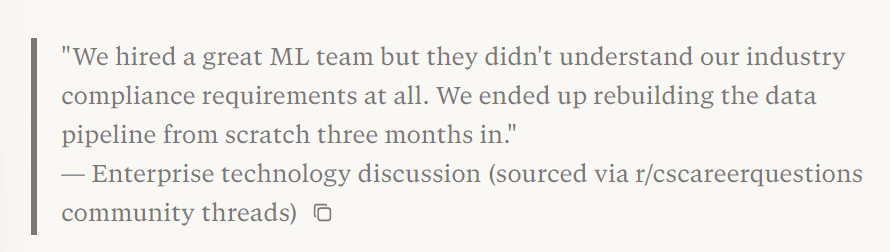
Legacy System Integration, The Consistent Bottleneck
Most UAE enterprises are not building AI on greenfield infrastructure. They are deploying AI on top of banking cores from the early 2000s, ERP systems with minimal or undocumented APIs, and data warehouses designed for quarterly reporting rather than real-time inference.
The AI model is frequently the least problematic component of the project. The integration layer, connecting that model to systems that were never designed to receive its outputs, is where timelines and budgets consistently expand.
The Production Gap: What Holding Up Over Time Actually Requires
The gap between a successful launch and reliable operation at scale, six months later, is larger than most project plans acknowledge.
S&P Global's 2025 enterprise research found that 42% of companies abandoned most of their AI initiatives in 2025, up from 17% the previous year. Among those that did reach production, model drift, data pipeline failures, and organizational resistance caused many systems to degrade silently.
Sustainable AI in production requires monitoring infrastructure, defined retraining schedules, human review processes for edge cases, and clear organizational ownership. None of this appears automatically at launch. It must be designed and budgeted for explicitly.
Organizational Readiness: The Challenge No Vendor Can Solve for You
The technology is almost always the easier problem. Getting business units to change workflows around an AI system, training operational staff to work alongside automated decision-making, and managing genuine human resistance to systems that influence outcomes people previously controlled, this is slow, difficult work that cannot be delivered by any development team.
Research from McKinsey's 2025 AI survey found that organizations reporting significant financial returns from AI are twice as likely to have redesigned end-to-end workflows before selecting modeling techniques, not after. The organizational work comes first.
Benefits of AI Software Development for UAE Enterprises
When AI software development is approached with appropriate rigor, the benefits for UAE enterprises are substantive. They appear not in isolation but across systems, workflows, and business outcomes.
Operational efficiency at scale:
AI-powered automation in KYC, claims, invoice processing, and compliance reporting eliminates manual bottlenecks that grow linearly with business volume. Enterprises that automate these workflows report processing time reductions of 40 to 70 percent on well-defined tasks.
Decision quality under pressure:
Predictive analytics systems that surface risk, demand, or maintenance signals earlier than traditional reporting allow enterprises to act before problems compound. In UAE financial services and logistics, this capability translates directly to measurable loss reduction.
Customer experience at Arabic-speaking scale:
Multilingual AI that handles Gulf Arabic dialect input allows UAE enterprises to serve their core customer base in the language those customers actually use, not the language that is easiest to build for. This is a genuine competitive differentiator in consumer-facing sectors.
Compliance efficiency:
AI systems built to monitor regulatory exposure, flag anomalies, and generate audit-ready documentation reduce the human resource overhead of compliance in sectors such as banking, insurance, and healthcare.
Compounding returns over time:
Unlike traditional software, AI systems improve as more data accumulates and model retraining incorporates production feedback. Organizations that invest in AI infrastructure early build compounding advantages that are difficult for later entrants to replicate quickly.
How to Choose an AI Software Development Partner in the UAE?
The market has no shortage of vendors claiming AI capability. The following criteria separate demonstrated competence from positioning.
- Ask specifically about PDPL track record. Not whether they are familiar with UAE data protection law, ask whether they have built and deployed a PDPL-compliant AI system into production, and whether you can speak with the client. If the question causes hesitation, treat it as a significant signal.
- Request production references, not demo references. Any vendor can produce a controlled demonstration. Ask to speak with a client whose AI system has been running in production for 12 or more months. Ask that client specifically what went wrong and how it was managed. The answer will tell you more than any proposal document.
- Test Arabic NLP capability explicitly if your application requires it. Do not accept "we handle Arabic" as a response. Ask for examples of dialect-specific model performance. Ask how the system handles code-switching between Arabic and English in real user input. Ask how labeled training data for Gulf Arabic was sourced.
- Evaluate their MLOps posture directly. Does the vendor have a post-launch monitoring plan with defined SLAs for model performance degradation? Or do they hand over the code and issue a maintenance contract that does not include proactive monitoring?
- Understand data handling practices during development. Where does your training data reside during the engagement? Who has access to it? Is it stored on infrastructure that meets UAE data residency requirements? These questions matter for PDPL compliance before any production system is built.
The Bottom Line on AI Software Development in the UAE in 2026
The UAE is one of the most genuinely prepared markets in the world for enterprise AI software development. The infrastructure is real. The policy framework is clear. The government demand is significant and sustained. And the talent pool is deeper than it was two years ago.
What the market cannot compensate for is wishful thinking about timelines, data quality, compliance requirements, and what production actually demands.
The enterprises succeeding here in 2026 are the ones treating AI development as a disciplined engineering practice, not a shortcut to transformation.
If you are evaluating an AI project right now, the most valuable investment you can make before signing any development contract is a properly scoped discovery engagement. Audit your data honestly. Define your problem precisely.
Get compliance requirements on the table early. Everything else, vendor, tech stack, architecture, follows from getting that foundation right.
DianApps is an AI-first digital product development company with a presence in the UAE, USA, Australia, Canada, and India.
With over 8 years of experience, 450+ projects delivered, and a team of 150+ technologists, we build AI-integrated software that holds up in the real world, not just in the demo. Talk to our team.
Frequently Asked Questions
How much does AI software development cost in Dubai in 2026?
Realistic budgets range from AED 70,000 for simple chatbot implementations to AED 1,800,000 and above for full enterprise AI platforms. Most mid-complexity projects with compliance requirements and system integration land between AED 300,000 and AED 700,000 all-in. Ongoing MLOps adds 15 to 25 percent of build cost annually.
How long does AI software development take in the UAE?
A single-function MVP with clean data: 12 to 18 weeks. A mid-complexity production system: 6 to 9 months. A full enterprise AI platform: 12 to 18 months minimum. Discovery and data preparation phases are routinely underestimated and represent the most common source of timeline expansion.
What is the difference between AI software development and traditional software development?
Traditional software follows deterministic logic, the same input always produces the same output, and the system does not change unless a developer changes it. AI software is probabilistic, learns from data, and produces outputs that can evolve over time as the underlying data changes. The development process, team composition, testing methodology, and maintenance model are fundamentally different. An AI system cannot be managed the same way as a conventional application.
Is PDPL compliance required for AI software in the UAE?
Yes. Federal Decree-Law No. 45 of 2021 on Personal Data Protection applies to any AI system that processes personal data of UAE residents, including training data, model inference outputs, and user interaction logs. The UAE Data Office is in active enforcement as of 2025. Administrative fines range from AED 50,000 to AED 1,000,000 for violations, with criminal liability possible for serious breaches.
What are AI software development agents and how are they used in UAE projects?
AI software development agents, such as GitHub Copilot, Claude Code, and Cursor, are autonomous tools that generate, review, test, and refactor code with minimal human instruction. UAE development teams using these tools report 20 to 40 percent faster build times on well-scoped features. They require experienced engineering oversight, particularly for compliance-sensitive and architecturally complex work where context and judgment cannot be automated.
Which sectors in the UAE are seeing the most AI software development activity?
Financial services leads in terms of both investment volume and deployment maturity, with AI applied to fraud detection, credit scoring, and compliance automation. Healthcare is growing rapidly in predictive diagnostics and patient workflow management. Logistics and supply chain is a major growth area for computer vision and demand forecasting. Government services continue to be a significant anchor client for Arabic-language NLP and smart city AI applications. Real estate is accelerating adoption of predictive valuation models.
Is AI software development a good investment for UAE SMEs?
It depends on whether you have a specific operational problem, accessible and structured data, and realistic return on investment expectations. For SMEs with these conditions, a focused MVP is a reasonable starting point. For those exploring AI without a defined problem, starting with a discovery engagement, a scoped, time-limited audit of your data and use case, is a far better use of budget than committing to a build without validated foundations.









Leave a Comment
Your email address will not be published. Required fields are marked *