

Salesforce Einstein AI: What It Actually Does and Whether You Need It (2026 Guide)
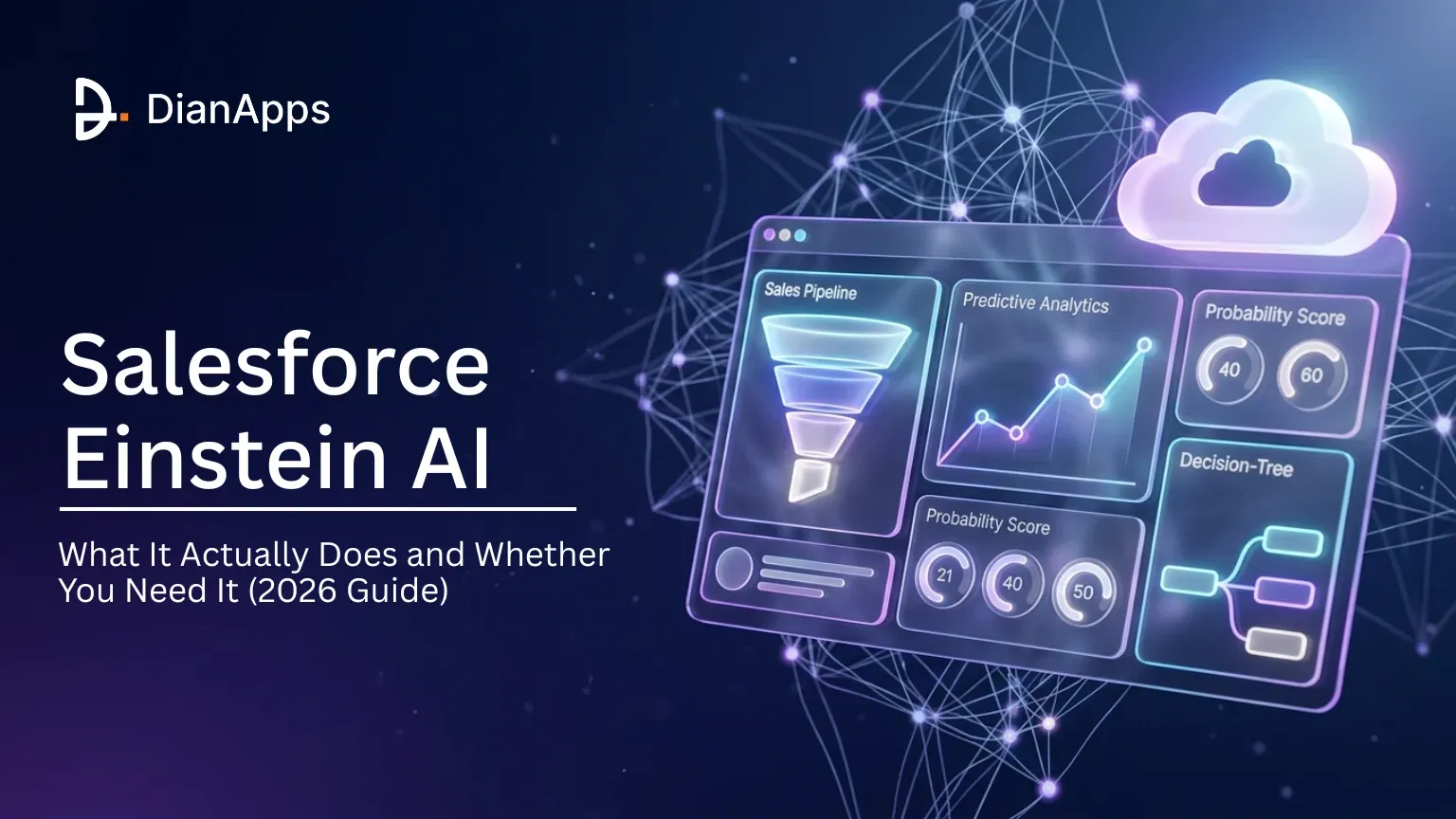
Abstract visualization of artificial intelligence neural networks with glowing blue and purple connection nodes representing machine learning predictions
Einstein AI has been part of Salesforce since 2016. But the 2025-2026 updates changed everything. What started as basic lead scoring and predictive analytics has evolved into autonomous agents that can handle entire customer service conversations, coach sales reps in real time, and execute multi-step workflows without human intervention.
Salesforce reports that Einstein now delivers over 1 trillion predictions per week across its platform (Salesforce Newsroom, 2025). That’s a staggering number. It’s also meaningless unless those predictions actually help your team close deals, resolve cases faster, or stop wasting time on manual data entry.
We’ve deployed Einstein across Sales Cloud, Service Cloud, and Marketing Cloud for over 15 clients. Here’s what actually works vs. what’s marketing hype.
TL;DR: Salesforce Einstein AI is a suite of prediction, automation, and agent capabilities built into every major Salesforce Cloud. It processes 1 trillion+ predictions weekly (Salesforce Newsroom, 2025). Core features like lead scoring and case classification deliver strong ROI for orgs with 10,000+ records. Agentforce, the autonomous agent layer, is powerful but expensive at $2/conversation. Start with Einstein Activity Capture (free) and scale from there.
What Is Salesforce Einstein AI? (The Non-Marketing Answer)
Salesforce’s AI platform now spans 17 distinct product capabilities across its core Clouds, up from 6 at its 2016 launch (Salesforce Ben, 2026). In plain terms, Einstein is a collection of AI features — not a single product — embedded directly into the Salesforce platform to handle predictions, recommendations, automation, and autonomous task execution.
Here’s where most explanations go wrong. They treat Einstein as one thing. It’s not.
Einstein is a branding umbrella that covers everything from a simple lead score (a number next to a lead record) to a fully autonomous AI agent that can resolve a customer’s billing dispute across multiple systems. The range is enormous. So is the price gap between the two ends.
The Four Layers of Einstein
Think of Salesforce Einstein AI in four layers — each one building on the previous:
Layer 1: Predictions. Einstein analyzes your CRM data and generates scores, forecasts, and recommendations. Lead scoring, opportunity insights, forecasting accuracy. This is the original Einstein from 2016, and it still works well.
Layer 2: Automation. Einstein triggers actions based on those predictions. Auto-routing cases to the right agent, suggesting next best actions for reps, and optimizing email send times. Less manual work, faster responses.
Layer 3: Copilot. Natural language interaction with your CRM. Ask “show me all open opportunities over $100K closing this quarter” and get an answer without writing a SOQL query. Copilot summarizes records, drafts emails, and generates action items from meeting notes.
Layer 4: Agentforce. Autonomous AI agents that handle multi-step tasks end-to-end. A customer asks about a refund. The agent checks the order, verifies the policy, processes the return, and sends a confirmation — without a human touching it.
We’ve found that most orgs get the best initial ROI from Layers 1 and 2. Copilot is useful but still maturing. Agentforce is genuinely impressive. It’s also genuinely expensive.
Salesforce Einstein AI spans 17 distinct capabilities across multiple Clouds, processing over 1 trillion predictions weekly (Salesforce Newsroom, 2025). The platform operates in four layers — predictions, automation, Copilot natural language interaction, and Agentforce autonomous agents — each escalating in complexity and cost.
Which Einstein Features Actually Matter in 2026?
Einstein’s feature set has expanded significantly — Salesforce added 7 new AI capabilities in the Spring ’26 release alone (Salesforce Release Notes, 2026). But not every feature deserves your attention or budget. Here’s what we’ve seen deliver real results, organized by Cloud.
Sales Cloud Einstein
Sales Cloud is where Einstein has the longest track record and the most mature features.
Feature | What It Does | Minimum Data Needed | Our Assessment |
Lead Scoring | Ranks leads by conversion likelihood | 400+ converted leads | High ROI — measurable impact on conversion rates |
Opportunity Insights | Flags deals at risk, suggests actions | 200+ closed opportunities | Useful if reps actually check it |
Einstein Forecasting | AI-adjusted revenue forecasts | 2 years of pipeline data | Significantly better than manual forecasting |
Activity Capture | Auto-logs emails and calendar events | None (works immediately) | Must-have. Free in many editions. Start here. |
Email Insights | Sentiment analysis on email threads | Active email integration | Nice-to-have, not essential |
Einstein Prediction Builder sounds impressive until you realize it needs 400+ records minimum to train. For small orgs, that’s a real barrier. And not just 400 records, 400 records with the specific outcome you’re trying to predict. If you’ve only closed 150 deals, lead scoring won’t work for you yet.
But Activity Capture? Zero requirements. It just works. Every email, every meeting, is automatically logged to the right contact and opportunity. We recommend starting there for every single client.
Service Cloud Einstein
Service Cloud Einstein shines in high-volume support environments.
Feature | What It Does | Best For | Our Assessment |
Case Classification | Auto-categorizes and routes incoming cases | 5,000+ cases/month | Reduces manual triage by 30-40% |
Article Recommendations | Suggests knowledge articles to agents | Robust knowledge base | Only works if your KB is well-maintained |
Reply Recommendations | Suggests agent responses based on history | 1,000+ resolved cases | Speeds up response time significantly |
Next Best Action | Recommends optimal actions during case handling | Defined business rules | Requires Strategy Builder setup |
Real talk: Case Classification is the standout. If your support team handles thousands of tickets monthly, auto-routing alone can save 15-20 hours of manual triage per week. We’ve seen that number firsthand across three Service Cloud implementations.
In one deployment for a mid-market SaaS company, Einstein Case Classification reduced average case routing time from 12 minutes to under 45 seconds, a 94% reduction. Agent handle time dropped 18% within 60 days.
Marketing Cloud Einstein
Marketing Cloud’s AI features are focused on timing and targeting.
Feature | What It Does | Our Assessment |
Send Time Optimization | Predicts optimal email delivery time per contact | Reliable 10-15% open rate lift |
Engagement Scoring | Scores contacts by engagement likelihood | Good for list segmentation |
Content Recommendations | Suggests products/content per subscriber | Needs e-commerce data integration |
Journey Optimization | Auto-selects best journey paths | Requires significant journey volume |
Send Time Optimization is the easiest win in Marketing Cloud. It requires almost no configuration and consistently delivers results. Engagement Scoring is a close second.
Einstein Copilot
Copilot became a standard feature across Enterprise editions in late 2025. Here’s what it can actually do:
Natural language CRM queries. Ask questions in English. Get data without SOQL.
Record summarization. Summarize an account’s entire history in 30 seconds.
Action generation. “Create a follow-up task for this opportunity” — done.
Email drafting. Context-aware email drafts pulled from CRM data.
And here’s what it can’t do well yet: complex multi-object queries, custom object reasoning, and anything requiring deep business logic. Copilot works best for standard objects and common workflows. The moment you need it to understand your custom Apex triggers or complex Flow logic, it struggles.
Agentforce: The Big 2025-2026 Addition
Agentforce is Salesforce’s bet against ChatGPT and Claude integrations. It’s autonomous AI agents that handle multi-step tasks, customer service resolution, sales coaching, IT helpdesk automation, and order management.
Since its launch, over 10,000 organizations have deployed Agentforce agents (Salesforce Earnings Call Q4 FY2026, February 2026). That’s rapid adoption for an enterprise product less than a year old.
Here’s where it gets interesting. Agentforce agents don’t just respond to queries; they take action. An Agentforce service agent can look up an order, check a return policy, initiate a refund, update the case record, and email the customer. All without a human.
But, and this is important, Agentforce agents need careful guardrails. You define topics, actions, and escalation rules. Without proper configuration, an agent can take actions you didn’t intend. We always recommend deploying in a sandbox first with clearly scoped use cases.
Agentforce has been deployed by over 10,000 organizations since its late-2025 launch (Salesforce Earnings Call Q4 FY2026, February 2026). These autonomous AI agents handle multi-step tasks including customer service resolution, sales coaching, and IT helpdesk automation — representing Salesforce’s answer to standalone AI integrations.
What Does Einstein AI Actually Cost?
Salesforce’s AI pricing is notoriously confusing. Companies spend an average of $3.71 in customization and services for every $1 spent on Salesforce licenses (Nucleus Research, 2024). Einstein adds another layer to that cost. Here’s the honest breakdown.
Einstein Pricing Breakdown (2026)
Feature Tier | What’s Included | Cost | Notes |
Einstein (Basic) | Activity Capture, basic lead scoring | Included in Enterprise+ | Limited functionality |
Einstein 1 (Full Suite) | All predictions, Copilot, advanced analytics | ~$60/user/month add-on | Required for most useful features |
Einstein for Service | Case classification, article recs, reply suggestions | ~$50/user/month add-on | Service Cloud specific |
Agentforce | Autonomous AI agents | $2/conversation | Consumption-based billing |
Data Cloud Credits | Data unification and enrichment | Varies by volume | Separate from Einstein pricing |
The Hidden Costs Nobody Talks About
The license fees are just the start. Here’s what else you’ll pay:
Implementation. Configuring Einstein properly requires a Salesforce development team that understands your data model, business rules, and integration points. Budget 40-80 hours minimum for a single Cloud deployment.
Data preparation. Einstein is only as good as your data. If your CRM has duplicate records, missing fields, and inconsistent formatting, you’ll need a data cleanup project first. That’s typically 20-60 hours depending on org size.
Training. Your team needs to understand what Einstein’s scores mean and how to act on them. A lead score of 85 is useless if reps don’t know the threshold for prioritization.
Ongoing tuning. Prediction models need regular evaluation. Are they still accurate? Has your business changed? We typically recommend quarterly model reviews.
Fair warning: Agentforce’s $2/conversation pricing looks cheap until you scale it. A support team handling 10,000 conversations per month? That’s $20,000/month just for Agentforce. On top of Service Cloud licenses. On top of Einstein licenses. It adds up fast.
Companies spend an average of $3.71 in customization for every $1 on Salesforce licenses (Nucleus Research, 2024). Einstein 1’s full suite costs approximately $60/user/month as an add-on, while Agentforce uses consumption-based pricing at $2 per conversation — costs that scale quickly at enterprise volume.
Does Your Org Actually Need Einstein?
Only 25% of Salesforce customers actively use Einstein’s AI features beyond basic Activity Capture, according to a 2025 survey of Salesforce administrators (Salesforce Ben Admin Survey, 2025). That tells you something. Not every org needs this, and not every org that buys it actually uses it.
You Probably Need Einstein If:
- You have 10,000+ records with clean, consistent data. Einstein’s prediction models need volume to work accurately.
- Your sales cycle is complex. Multiple touchpoints, long timelines, many stakeholders. Einstein Forecasting and Opportunity Insights genuinely help here.
- You run high-volume support. Over 5,000 cases/month makes Case Classification and auto-routing worth the investment.
- Your team is data-driven. If your reps already use dashboards and act on metrics, they’ll adopt Einstein recommendations. If they don’t? They won’t start now.
- You’ve already invested in Data Cloud. Einstein performs dramatically better with unified customer profiles.
You Probably Don’t Need Einstein If:
- Under 1,000 records. Not enough data to train prediction models. Period.
- Simple pipeline with 2-3 stages. You don’t need AI to tell you a deal in the “Verbal Commit” stage is likely to close.
- Your team won’t adopt it. The best AI features are worthless if nobody checks the scores or follows the recommendations.
- Budget is already stretched. Einstein is powerful. It’s also an additional cost on top of already-expensive Salesforce licenses. Don’t buy it because it sounds cool.
- Your data is a mess. Duplicates everywhere, fields half-filled, no data governance. Fix that first.
Here’s something the Salesforce sales team won’t tell you: for many mid-market companies with 500-2,000 Salesforce users, the ROI calculation for Einstein 1 at $60/user/month doesn’t work out. That’s $360,000-$1.44M per year in additional licensing alone, before implementation. Unless you can tie Einstein directly to increased pipeline velocity or reduced support costs that exceed that number, the math doesn’t hold. We’ve seen companies get better results from a well-configured Flow automation strategy at zero additional license cost.
Only 25% of Salesforce customers actively use Einstein AI features beyond basic Activity Capture (Salesforce Ben Admin Survey, 2025). Organizations with fewer than 1,000 records, simple sales pipelines, or limited budgets often see better returns from well-configured Flow automations than from Einstein’s paid AI features.
How Do You Implement Einstein Without Breaking Your Org?
Salesforce reports that organizations following a phased Einstein rollout see 32% higher user adoption compared to full-suite deployments (Salesforce Success Center, 2025). That aligns with what we’ve experienced. Rushing Einstein into production across all Clouds simultaneously is a recipe for wasted budget and frustrated users.
Step 1: Start with Einstein Activity Capture
No cost in most Enterprise editions. No configuration complexity. Just turn it on. Activity Capture automatically logs emails, calendar events, and contacts from Gmail or Outlook into Salesforce. Your reps stop manually logging activities, which most of them aren’t doing anyway.
This builds trust in AI-powered features before you ask your team to act on predictions.
Step 2: Enable Lead Scoring (With Enough Data)
You need at minimum 400 converted leads and 400 non-converted leads in the past two years. If you have that, enable Einstein Lead Scoring. Review the model’s factors, make sure they make sense for your business. Sometimes Einstein latches onto fields that correlate with conversion but aren’t causally meaningful.
We once saw a model that heavily weighted “Lead Source = Partner Referral”, which was accurate but already obvious to the sales team. The real value comes when Einstein surfaces non-obvious patterns.
Step 3: Deploy Copilot for Admins First
Don’t roll Copilot out to your entire sales floor on day one. Start with admins and power users. Let them test natural language queries, record summarization, and action generation. Document what works and what doesn’t. Create a “Copilot playbook” with example prompts that actually produce useful results.
Then expand to a pilot group of 10-15 reps. Gather feedback. Iterate. Then go wider.
Step 4: Test Agentforce in Sandbox
Pick 3-5 specific use cases. Common starting points:
Password reset requests
Order status inquiries
Appointment scheduling
Basic account information updates
FAQ-type product questions
Build the agent in the sandbox. Define topics, actions, and critically, escalation paths. Every Agentforce agent needs clear rules for when to hand off to a human. Test with internal users playing the customer role before going live.
Step 5: Measure ROI After 90 Days
Don’t evaluate Einstein after two weeks. Give it 90 days to accumulate enough prediction data, let users build habits, and let the models refine themselves. Then measure:
Lead conversion rate change (before vs. after scoring)
Average case handling time (before vs. after classification)
Forecast accuracy improvement
Time saved on manual data entry (Activity Capture)
Agentforce containment rate (% of conversations resolved without human escalation)
If the numbers don’t justify the cost after 90 days, scale back. There’s no shame in turning off features that aren’t working for your org.
Organizations following a phased Einstein rollout see 32% higher user adoption compared to full-suite deployments (Salesforce Success Center, 2025). Starting with zero-cost Activity Capture, then enabling lead scoring with 400+ records, and testing Agentforce in the sandbox before production, delivers the most reliable implementation path.
How Does Einstein Compare to Third-Party AI Tools?
The global AI market is projected to reach $826.7B by 2030, growing at a 28.5% CAGR (Grand View Research, 2025). Within that market, Salesforce isn’t the only option for AI-powered CRM intelligence. Here’s how Einstein stacks up.
Einstein vs. GPT-4/ChatGPT Integration (via API)
Factor | Einstein | GPT-4 API Integration |
CRM Data Access | Native, reads Salesforce data directly | Requires a custom API build |
Setup Complexity | Low (configuration) | High (development) |
Customization | Limited to Salesforce’s framework | Nearly unlimited |
Cost Model | Per-user licensing | Per-token consumption |
Maintenance | Salesforce-managed | You maintain it |
Best For | Standard CRM predictions | Complex text generation, custom models |
Einstein vs. Claude (Anthropic) Integration
Claude’s strength is in reasoning, long-context understanding, and nuanced text generation. Some orgs are building Claude-powered integrations via Salesforce’s API framework to handle tasks Einstein can’t, like analyzing 50-page contracts attached to opportunities or generating detailed proposal drafts from CRM data.
But those integrations require custom Apex development, API management, and ongoing maintenance. Einstein’s advantage is that it’s already there, already connected, already secured within your Salesforce trust boundary.
Einstein vs. Standalone ML Tools (DataRobot, H2O.ai)
For orgs with data science teams, tools like DataRobot and H2O.ai offer far more flexibility in model building. You can train custom models on data from multiple sources, not just Salesforce. But you also need to build the integration pipeline, manage model deployment, and handle the infrastructure.
When to Use What
Use Einstein when: - Your AI needs are CRM-centric (lead scoring, case routing, forecasting) - You want minimal development effort - Your data lives primarily in Salesforce - You need Salesforce’s trust and compliance framework
Use third-party AI when: - You need custom models trained on non-Salesforce data - Your use case involves complex document analysis or generation - You have a data science team that can build and maintain integrations - You want model transparency and control over training data
And some orgs use both. That’s fine. Einstein handles CRM predictions natively, while a GPT-4 or Claude integration handles complex generative tasks. They’re not mutually exclusive.
The global AI market is projected to reach $826.7B by 2030 at a 28.5% CAGR (Grand View Research, 2025). Einstein excels at native Salesforce CRM predictions with minimal setup, while third-party tools like GPT-4 and Claude offer superior flexibility for custom models and complex document analysis tasks.
Making the Right Call on Einstein
Salesforce Einstein AI is a mature, capable set of tools, with real constraints. The prediction features work well for orgs with enough data. Copilot is useful and improving. Agentforce is the most exciting addition in years, and it’s genuinely changing how enterprises handle customer interactions.
The honest take? Start small. Turn on Activity Capture today. Enable lead scoring when you have the data. Test Copilot with your admin team. Pilot Agentforce in a sandbox with clear use cases and guardrails. Measure everything after 90 days.
Don’t buy the full Einstein 1 suite because a Salesforce AE made it sound essential during renewal season. Buy the features that solve a specific, measurable problem for your team.
If you’re considering Einstein for your Salesforce org, we can assess which features will actually deliver ROI for your specific setup. Our team has deployed Einstein across 15+ implementations; we know what works, what doesn’t, and where the budget traps are. Reach out for a Salesforce consulting conversation.




Leave a Comment
Your email address will not be published. Required fields are marked *