

Quick Summary:
|
Your Website Has 0.05 Seconds to Make an Impression. Is It Making the Right One?
That's not a metaphor. A publication by ResearchGate confirmed that users form a visual judgment about your website in 50 milliseconds. Before they even read your headline, before they see what you offer, before they even register your brand name. Just a gut reaction to what they see, and a split-second decision about whether to stay or leave.
For most US businesses, that moment is happening hundreds of times a day, and a large chunk of those visitors are leaving. Not because the product is wrong. Not because the price is off. Because the site didn't make value in that first half-second, and nothing that came after could undo it.
That's the real importance of web design in 2026. It's not about having a site that looks nice. It's about having one that earns trust fast enough to keep people around long enough to convert. If you want to build an attractive site, get in touch with a web development company in the US like DianApps. This blog covers the web design and development trends US businesses are acting on right now, what they are, why they matter, what they cost, and how to know if your site is already falling behind.
Your Website Is Either Working for You or Against You
Most business owners think of their website as a digital brochure, something to point people toward when they need to verify they're legit. That framing is costing them.
The data tells a different story. Businesses that treat their website as a sales and trust engine, not just a presence marker, see dramatically different outcomes. Good UX design alone can lift conversion rates by up to 400%. Slow-loading websites cost US retailers $2.6 billion in lost eCommerce sales every single year. And 88% of users won't come back after a bad experience, meaning you often get one shot.
Here's what's happening besides that: web design and development trends in 2026 are no longer primarily aesthetic. They're functional. The trends that matter most are the ones that make your site faster, clearer, more trustworthy, and more useful to the specific person who just landed on it. Everything else is used for visual appearance. Basically, that’s considered a lens through which you evaluate what follows.
Top Web Design Trends US Businesses Are Adopting in 2026
These aren't ranked by visual appearance. They're ranked by business impact, starting with the ones that affect your traffic, leads, and revenue most directly.
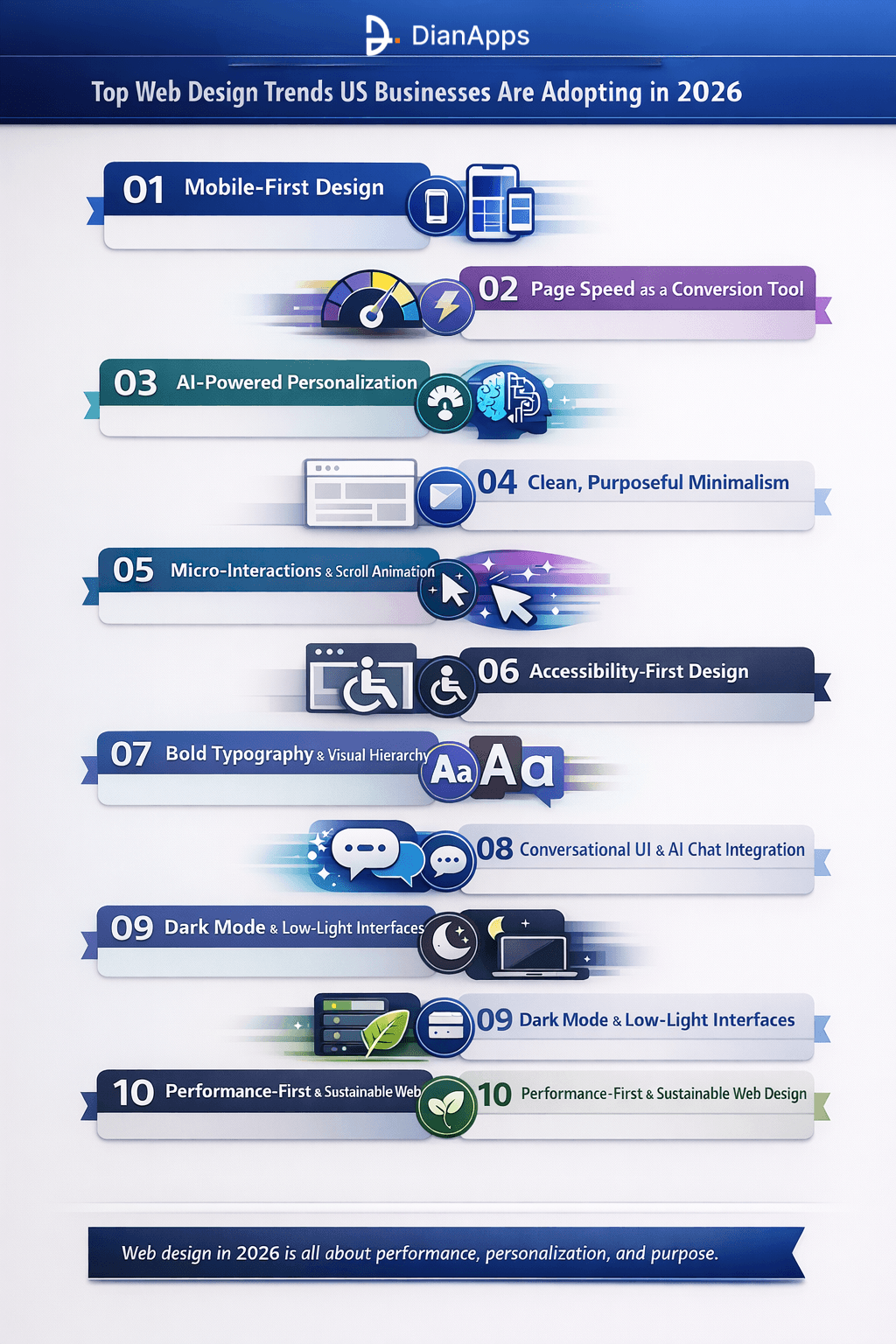
1. Mobile-First Design: The Non-Negotiable Starting Point
Mobile traffic now accounts for 64.35% of all web visits worldwide, and that number only climbs. The question isn't whether your site should be mobile-friendly; it's whether it was actually designed for mobile from the ground up or just squeezed into a smaller screen after the fact. There's a big difference, and users feel it immediately.
Mobile-first indexing delivered by Google simply means your rankings are determined by how your site performs on mobile, not primarily on desktop. If your website navigation seems cluttered on a phone, your text is difficult to read or see, or your CTAs are too small to tap comfortably. In such a situation, you are definitely losing both conversions and search visibility simultaneously.
According to BrightLocal research, 61% of US internet users say they have a higher opinion of businesses with mobile-friendly websites. And 57% say they won't recommend a business with a poorly designed mobile site. That's word-of-mouth revenue walking out the door.
2. Page Speed as a Conversion Tool
Page Speed in terms of lead generation isn’t considered as a technical metric; instead, it is more of a revenue metric. 53% of mobile users leave an application or a page if it takes more than three seconds to load. The average load time of the top 10 Google results is 1.65 seconds. And if your site is still standing at four or five seconds, you are not just annoying users, you are actively transferring your leads to the business that ranks below you.
Google’s framework used for measuring real-world page experience is Core Web Vitals, which directly influences your page ranking. Some of the important terms like LCP (Largest Contentful Paint), CLS (Cumulative Layout Shift), and INP (Interaction to Next Paint) aren’t just considered as developer jargon. These are the signals that decide whether Google should send traffic to your site or not.
To increase the chances of driving web traffic through Google, most of the US businesses invest in SEO and page speed optimization to solve their technical challenges. Every 100ms improvement in load time has been shown to increase conversion rates meaningfully. That’s not considered a design trend, but it’s more of a mathematical aspect.
3. AI-Powered Personalization
Amazon does it. Netflix does it. And Spotify built a feature around AI-driven personalization. And with this, AI-driven personalization has now become accessible for all businesses that don’t come in Fortine 500 companies.
What this AI-driven personalization often looks like, a returning customer finds products or services customized based on their previous search behavior. Also, a user coming redirected from any specific campaigns often lands on a landing page that completely matches their intent. It also ensures that the chatbot greets first-time visitors with context-aware options instead of a generic pop-up message. None of this requires custom AI build tools that integrate directly into modern CMS platforms, which now handle much of it.
93% of web designers are already using AI tools in their workflow. For US businesses, the competitive signal is clear: personalization is moving from luxury to expectation. Users who encounter irrelevant, one-size-fits-all experiences simply leave, and 66% of them say they'll abandon a purchase if the UX isn't personalized.
4. Clean, Purposeful Minimalism
There's been a quiet but significant shift happening in the design community. After a few years of scroll-jacking, heavy animation, and maximalist layouts fighting for attention, the businesses seeing the strongest engagement metrics in 2026 are going the other direction.
84.6% of users prefer a clean design over a cluttered one. Not minimal in a cold, sterile way but intentional. White space that guides the eye. Typography that sets a clear hierarchy. Every element on the page serves a specific function.
Simple designs aged better, load faster, and convert better, which is a practical benefit. A neat, organized webpage from 2023 still seems current in 2026. An animation-heavy, trend-chasing website from the same year can feel aged after 18 months.
5. Micro-Interactions and Scroll-Triggered Animation
This is where conversion psychology and design come combined. A button that shifts color as you hover over it, a form field that reacts when you begin typing, or a progress bar that keeps you going through a checkout are instances of small, responsive moments that let a user know their action was recorded. While they are minor, they raise participation and reduce uncertainty.
At the page level, scroll-triggered animations have the same impact by revealing material as the user moves across it rather than showing it all at once. When done properly, they lead users through an experience. Done poorly, they're just slow. The line between the two is restraint and performance optimization. Every animation needs to be tested against page load impact before it goes live.
6. Accessibility-First Design
This is considered one of the most undervalued competitive advantages in US web design right now. 94.8% of homepages currently fail basic WCAG (Web Content Accessibility Guidelines) compliance. In a country where the ADA actively applies to digital properties and where lawsuits over website accessibility continue to rise, that's both a legal and a business risk.
But beyond compliance, accessible design is just good design. High contrast ratios help every user in bright sunlight. Clear heading structure helps screen readers and search engines alike. Keyboard navigability benefits power users and assistive technology users equally. Sites that prioritize accessibility consistently see better SEO performance, lower bounce rates, and broader audience reach.
For any US UI/UX Design service company worth working with, accessibility isn't an add-on; it's baked into the build from day one.
7. Bold Typography and Visual Hierarchy
In 2026, typography plays an important role in structuring work more than a few years back. With a minimalistic website to dominating layouts, user choice has changed the weight of communicating brand personality, urgency, and hierarchy has shifted onto type choices. Large, expressive headline fonts paired with clean, readable body text are replacing elaborate graphic elements as the primary visual statement on high-performing homepages.
There is a simple business logic that users generally spend an average of 2.6 seconds scanning a webpage before their eyes settle on a dominant element. That element is always considered to be a headline as it is bold and attractive. So, never keep your headline weak, small, or visually indistinct from everything around it, you are losing the most important second of your visitor’s attention.
8. Conversational UI and AI Chat Integration
There are 153 million voice assistant users in the US. AI-powered chat tools are saving businesses $2 billion annually in support costs. And 63% of US consumers are now open to interacting with a chatbot for initial inquiries.
Conversational UI, whether that's an AI chatbot, a live chat widget, or voice-navigable elements, is moving from nice-to-have to expected for businesses in competitive service categories. The key distinction between effective and annoying implementation is intent. A chat widget that opens uninvited with a generic greeting is noise. A chat interface that appears contextually after a user has spent 45 seconds on a pricing page is useful.
For US businesses in professional services, healthcare, legal, and SaaS, well-implemented conversational UI can meaningfully reduce sales cycle length by qualifying intent before a human ever gets involved.
9. Dark Mode and Low-Light Interface Options
Although dark mode is not a unique function, it is projected to become a regular feature in 2026 instead of a premium distinguishing feature. The decreased strain on the eyes is acknowledged by those who spend a lot of time on displays. The battery savings are beneficial to mobile users. A well-designed dark mode also provides companies with a second appearance that might seem more modern and high-end than the brightly colored version.
The practical consideration for US businesses: dark mode needs to be designed deliberately, not just CSS-inverted. Remember that the colors that often work well with white backgrounds look harsh or lose contrast on dark ones. So, if you are planning your customized dark theme, make sure to get this design passed, not just a filter on top of your existing palette.
10. Performance-First and Sustainable Web Design
This one shows up last on most trend lists and gets treated as a future consideration, but it shouldn’t be. The better optimized code used in the website directly links with faster load times, better Core Web Vitals scores, lower hosting costs, and better SEO performance. That's not sustainability as a brand value, that's just efficient engineering with measurable business outcomes.
For US businesses choosing between vendors, this is an under-asked question: does your agency write clean, optimized code, or does it rely on bloated page builders that ship 300KB of unused CSS on every page? The difference shows up in every performance metric that matters.
Recommended Read: How to Choose a Web Design and Development Company as a Pro?
The Web Design Trend Lifecycle: When Should You Act?
One of the most practical and common questions asked by most of the US businesses while analyzing this web design trend list is: which of these trends needs to be adopted instantly, and which ones can wait?
The answer to this question depends on where each trend stands in your business lifecycle. As every web design trend needs to pass through six predictable stages, and the businesses that win aren’t always the first movers. They are considered the ones who adopted any stage before the early adoption phase, when the trend was only validated, not saturated.
The Web Design Trend Lifecycle | ||
| Stage | Phase Name | What’s Happening |
| 01 | Emergence | Early adopters & design studios introduce the trend. Seen on award sites and portfolios. |
| 02 | Validation | Tech press and industry blogs cover it. Developer tools begin supporting it natively. |
| 03 | Early Adoption | Forward-thinking US businesses integrate it. First measurable UX and conversion data appear. |
| 04 | Mainstream | The majority of new web builds include it. Templates and platforms adopt it as the default. |
| 05 | Saturation | It's everywhere. Differentiation fades. Users start to expect it as table stakes. |
| 06 | Evolution | The trend either becomes a design standard or gets replaced by the next cycle. |
How do web design trends in 2026 fit the development curve well? Factors that were earlier on the saturation stage have now become baseline standard factors, such as mobile-first, accessibility, and page speed. Ignore them, and you're behind, not just average. AI personalization, conversational UI, and performance-first design are in early adoption to mainstream high-leverage moves right now.
Bold typography and dark mode are currently in mainstream saturation, meaning they differentiate less but are expected. Sustainable design is at validation; early movers will be ahead of the curve in 12-18 months.
What Does It Actually Cost to Build a Great Business Website in the US?
This is the question that gets the most vague answers online. "It depends" is technically true but completely unhelpful when you're trying to budget. Here's what the market actually looks like in 2026, across business type and vendor model.
Web Design & Development Cost Guide for US Businesses (2026) | ||||
| Business Type | Scope | Freelancer | Agency (US) | Annual Upkeep |
| Startup/Solo | 3-5 pages, lead gen | $1,500 - $4,000 | $5,000 - $12,000 | $1,500 – $3,000/yr |
| Small Business | 8-18 pages, CMS, basic SEO | $2,500 - $8,000 | $8,000 - $20,000 | $2,000 – $5,000/yr |
| E-commerce | Product catalog, checkout, UX | $5,000 - $15,000 | $15,000 - $35,000 | $3,000 – $7,000/yr |
| Mid-Market/B2B | Custom design, integrations | $8,000 - $20,000 | $25,000 - $60,000 | $5,000 – $12,000/yr |
| Enterprise | Multi-system, compliance, scale | $15,000 - $40,000 | $60,000 - $150,000 | $10,000+/yr |
A few things worth noting from the data above. First, the gap between freelancer and agency pricing isn't just a markup it reflects scope. An agency brings strategy, UX research, dedicated QA, project management, and post-launch support into the same engagement. A freelancer is often excellent at execution but may not have the bandwidth for all of that simultaneously.
Second, the annual upkeep cost is the one most businesses forget to budget. A site that's beautifully built but poorly maintained starts degrading in performance, security, and SEO value within 12–18 months. Budget for it from day one.
Third, if you're a US small business and someone is quoting you under $2,000 for a full custom build ask a lot of follow-up questions. That number typically means templates with minimal customization, no real UX strategy, and minimal ongoing support. Sometimes that's fine for your stage. Often it means a rebuild 18 months later that costs twice as much.
Recommended Read: Essential Checklist to Consider Before Redesigning Your Website
Signs Your Website Is Already Losing You Business
Not every business needs a full rebuild. But some sites have problems that no amount of tweaking will fix. Here are the signals worth paying attention to:
- High bounce rate (above 70%) on pages that should be engaging. If people are landing and leaving immediately, either your design isn't matching their expectations or the page loads too slowly to hold them.
- Not mobile-responsive. If you have to pinch to zoom on your own homepage, you're failing 64% of your visitors on the first interaction.
- No clear call-to-action. 70% of small business websites have no CTA on the homepage. If a visitor can't immediately identify what you want them to do next, they won't do anything.
- Competitors are outranking you on local search. Page speed, Core Web Vitals, and mobile-first indexing are all design and development decisions. If you're losing ground in search, your site build is part of the story.
- Your site is more than 3 years old and has never been redesigned. The average redesign cycle for competitive US businesses is now 1.5–2.5 years. Design standards, browser capabilities, and user expectations all shift faster than most businesses realize.
- It doesn't reflect your current brand or service offering. If your site still talks about services you no longer lead with, or represents a brand identity from two years ago, the trust gap it creates with serious prospects is real.
Finding the Right Website Development Company in the US
The difference between a website that looks good and one that actually generates leads, ranks in search, and builds trust with your target audience isn't a design preference; it's a strategic decision about who builds it and how they approach the work.
At DianApps, we work with US businesses across industries to build websites that treat design and performance as the same conversation. That means every build starts with your business goals, not a template, and every design decision is traced back to a user behavior or conversion outcome we're trying to influence.
Whether you're building from scratch, scaling a platform that's outgrown its current site, or finally ready to replace a site that's been quietly underperforming for year's the right time to have that conversation is before you've already missed the opportunity.









Leave a Comment
Your email address will not be published. Required fields are marked *