

Quick Summary:
|
So, Which One Is Actually Worth Your Money?
Imagine it's 11 PM and you're sitting in front of a Notion doc with your startup idea, and the one tab you keep flicking back to is a pricing page. Shopify on one side, a custom development quote on the other. You know you need to move fast, but you also know that making the wrong call could end up costing you months & tens of thousands of dollars down the line.
This is a situation that thousands of US founders find themselves in every year. And the truth is, there is no magic bullet. The right choice all depends on what you're building, how quickly you need to get going, and where you plan to be in 18 months.
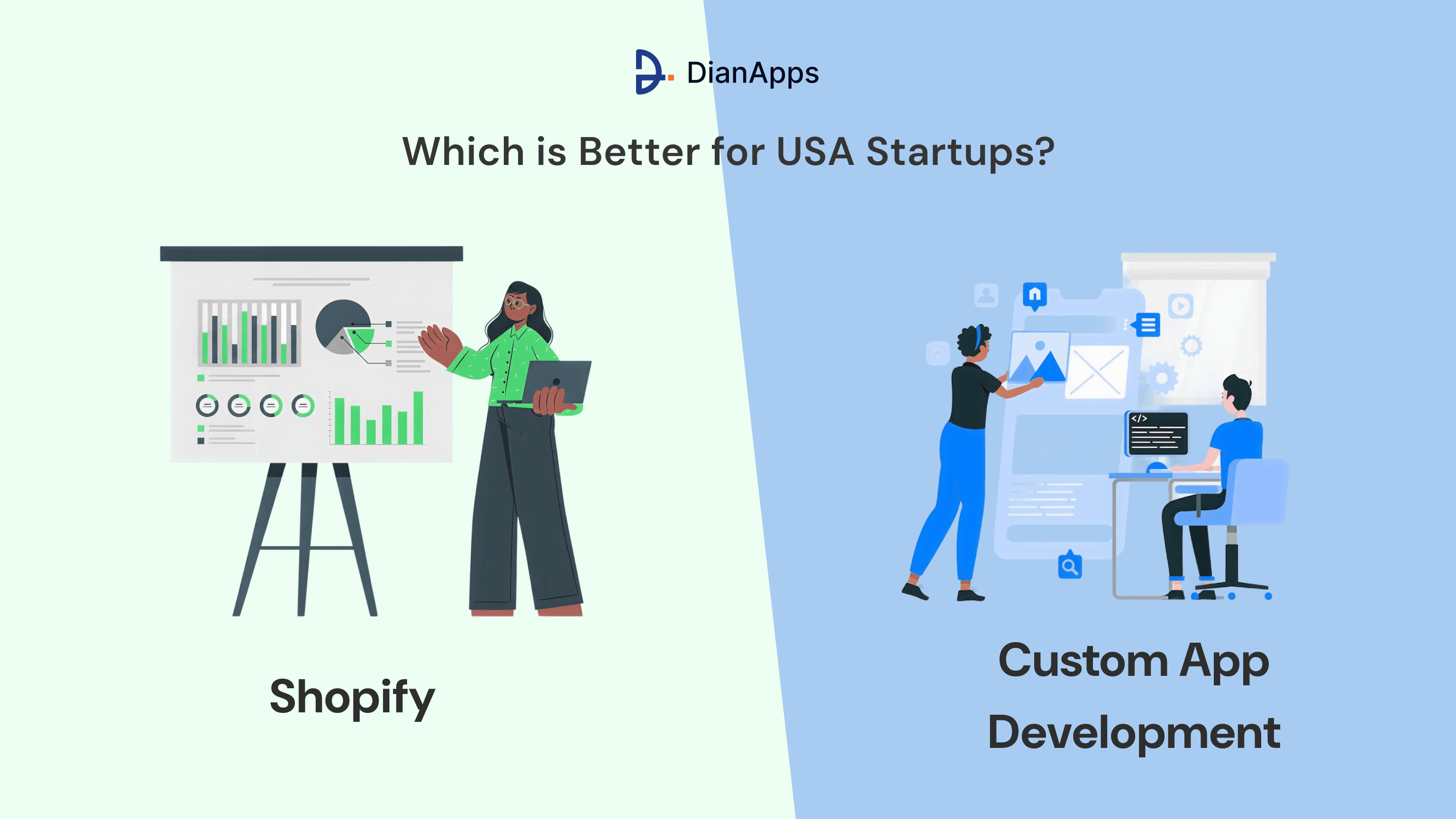
Shopify vs Custom App Development
This blog is here to help you figure out which is the right platform for your business. No fluff, no vendor bias, just a clear, honest breakdown of when Shopify is the way to go, when custom development is the smarter choice, and how to work out which one fits your startup's situation right now.
What Shopify Really Is, And What It Isn’t?
Shopify is, without a doubt, one of the most successful platform businesses ever built. And by successful, I mean over $3.67 billion in Q4 2025 revenue with a 31% year-over-year growth rate. They have 12,000+ apps in their marketplace, and for a founder who needs to get a product store up and running in a matter of weeks, it delivers.
But let's be honest here, Shopify is a platform built to serve millions of merchants at once. That's both its strength & its limitation. It's been optimised for the average use case, which means the moment your business needs workflows, logic, or a user experience that goes beyond standard e-commerce, you're either forcing your product to fit the platform or paying developers to fight against it.
Where Shopify really earns its reputation?
- You can go from zero to a fully functional store in under a week
- Hosting, security & PCI compliance are all taken care of for you
- The app marketplace covers a huge range of needs without needing custom code
- Lower barrier to entry is perfect for testing your product-market fit fast
Where it starts to struggle under pressure?
- Those pesky transaction fees on non-Shopify payments can eat into your margins (0.5-2% per sale)
- Checkout customisation is limited, even on Shopify Plus
- Vendor lock-in is a real thing. Your data, design, and logic are locked inside their walls
- Shopify Plus costs $2,000+ per month, a high recurring cost at scale
- Complex integrations often require multiple paid apps that don't play nicely together
It's not that the platform is broken; it's just not built for every business. And I'd wager that a lot of US founders discover that too late.
Recommended Read: Magento, Shopify, or WooCommerce? Which is the Best E-commerce Platform?
What Custom App Development Actually Looks Like in 2026?
The old image of custom development, six-figure budgets, 18-month timelines, and a team of 20 engineers is pretty outdated these days. Especially with the right custom software development company.
Modern custom development is all about the MVP-first approach. You scope tightly, build what matters, launch & iterate. A well-defined MVP from a quality partner like DianApps typically takes 3-6 months & costs between $25,000 and $75,000. Complex platforms will run higher, but the return on what you're building is well worth it.
More importantly, what you get is yours to keep. Fully. No monthly fees eating into your margins, no platform deciding what's possible in your checkout, no app marketplace dependency. Your codebase is a valuable asset on your cap table, not a liability.
What custom development unlocks?
- Building any workflow, logic or user experience you can even come up with
- Blistering performance on mobile and web, matched exactly to what your users need
- Seamless API connections with any system, from ERPs to CRMs, payment providers and logistics companies
- A product that really stands out as your core differentiator
What you’re signing up for?
- A bit of a longer initial timeframe compared to just launching on Shopify
- A higher upfront cost (though in the long run it might be comparable to a 3-year horizon)
- You'll need a solid, reliable development partner, not some freelancer from a marketplace you can't trust
- Ongoing maintenance and infrastructure ownership
None of those are deal-breakers. They're just trade-offs that are worth knowing upfront.
The Framework: How to Actually Decide?
Here's a simple way to think about it: stop trying to decide which one is better, period, and start asking which is better for where you are right now.
Go with Shopify if:
- You’re selling physical products with a standard checkout flow
- You need to launch and test demand in under 60 days
- Your startup budget is under $15K
- You don’t have unique backend logic, compliance needs, or multi-vendor requirements
- You’re in the idea validation stage, and pivots are still on the table
Go with custom development if:
- You’re building a marketplace, SaaS product, subscription platform, or any multi-sided business
- Your model involves dynamic pricing, custom workflows, or complex user roles
- You’re operating in a regulated space: healthtech, fintech, legaltech
- You’re raising capital soon and need a proprietary, defensible tech stack
- You’ve already validated demand on Shopify and are ready to scale past what it allows
Recommended Read: How Custom Software Development Can Benefit Your Business
The hybrid approach is more common than people admit
Launch on Shopify to get traction fast. Use it as a market validation tool. Once you've got real customers and real revenue, migrate to a custom platform that's built to scale. DianApps has helped multiple US startups navigate this transition, preserving SEO equity, migrating customer data cleanly, and unlocking features the founders had been waiting months to build.
Three Real Scenarios That Make This Concrete
- The D2C Brand in Los Angeles: A streetwear startup with only a handful of SKUs and a strong visual brand. They needed a standard checkout and straightforward logistics, so Shopify, with a custom-designed theme, was the way to go. They launched fast, tested their audiences, and hit $400k ARR before needing anything more sophisticated.
- The B2B Marketplace in New York: A startup connecting freelance designers with enterprise clients. They needed dynamic project quoting, milestone-based payments, and escrow logic. No platform handles this. Custom development from day one was the only way to go, and 18 months in, they're closing enterprise deals that wouldn't have been possible on any off-the-shelf platform.
- The HealthTech App in Austin: A telehealth startup with HIPAA compliance requirements, EHR integrations, and a patient-facing app. No platform handles this. Custom is the only viable starting point, full stop.
The Performance Factor Nobody Talks About
Here's something that directly affects your Google rankings and often gets completely ignored in this debate: Shopify stores share the same infrastructure as hundreds of thousands of other merchants. Your Core Web Vitals are partly at the mercy of that shared platform.
Custom-built apps, especially those built on modern stacks like Next.js, often outperform Shopify stores on page speed, LCP, and mobile performance scores. These are ranking signals that Google weighs heavily. For startups investing in organic search as a growth channel, this performance gap compounds over time into a real competitive advantage.
Final Words
Shopify is a genuinely great product for the right use case. Custom software development is the smarter long-term investment for the right kind of startup. The founders who get this wrong aren't bad business people; they just decided without having a clear framework to think it through.
If you're still not sure which path fits your business, that's actually a totally normal place to start. What matters most is getting clarity before you commit because the cost of getting it wrong isn't just money, it's time, momentum, and the opportunity cost of building on a foundation that's just not right for you.
DianApps works with US-based startups at exactly this decision point. Whether you're ready to build, planning to migrate, or still working out the scope, the right conversation is a 30-minute call away.
FAQs
Is Shopify worth it for a startup with complex inventory needs?
Mostly not long-term. Shopify does standard inventory well, but once you're dealing with multi-location stock, custom bundling logic, or B2B wholesale tiers, you'll find yourself patching together paid apps that don't fully work together. Custom development handles complex inventory natively, without all the workarounds.
How much does custom app development cost for a US startup in 2026?
The cost of a focused MVP (minimum viable product) with a decent partner usually falls in the range of $25,000 to $75,000, and it'll take you 3-6 months to get it up and running. If you are building something a bit more advanced, a complex platform, marketplace, or fintech/healthtech product, the bill will likely be $100,000 to $250,000+. And yeah, that sounds like a lot, but don't forget all the money you'll be throwing at Shopify Plus fees plus developer costs to fight with those limitations for 3 whole years.
Can you migrate from Shopify to a custom platform without losing SEO?
Yes, you can. And it gets done fairly regularly. The secret ingredient here is proper planning when migrating: making sure to keep the same URL structure, set up 301 redirects, transfer all your metadata & resubmit your sitemap. If done correctly (and that's a big if), you can actually see an improvement in your search rankings within 60-90 days, or at least you won't lose your rank.
Do investors prefer Shopify or custom-built platforms?
Guess it depends on where the startup is at. At the early stages, Shopify traction can be a killer indicator that the market is hungry for your product. But once you hit Series A and beyond, investors in the US are way more interested in founders who own their tech outright. A custom-built platform says a lot about your company it screams 'we can do things our own way' & 'we really know our product inside & out'.
What’s the best tech stack for a custom eCommerce startup in the US?
This really depends on the use case for your business, but some pretty popular stacks include using React or Next.js up front, then going with something like Node.js or Django on the backend, and using something like PostgreSQL or MongoDB to hold all your data. And don't forget cloud infrastructure on AWS or Google Cloud to scale your business as soon as you launch. A good partner, like DianApps, will sit down with you, get an understanding of your specific product requirements, and suggest a stack that actually fits the no one-size-fits-all solutions needed.
How long does it take to build a custom app from scratch?
If you're building a tightly scoped MVP, with a good team behind it, you can have something live in about 3-4 months. A full-featured platform with all the bells & whistles, on the other hand, could take 5-8 months, and it all depends on the scope, integration complexities & how quickly your founding team can make up their minds on what features to include in the build.







Leave a Comment
Your email address will not be published. Required fields are marked *