

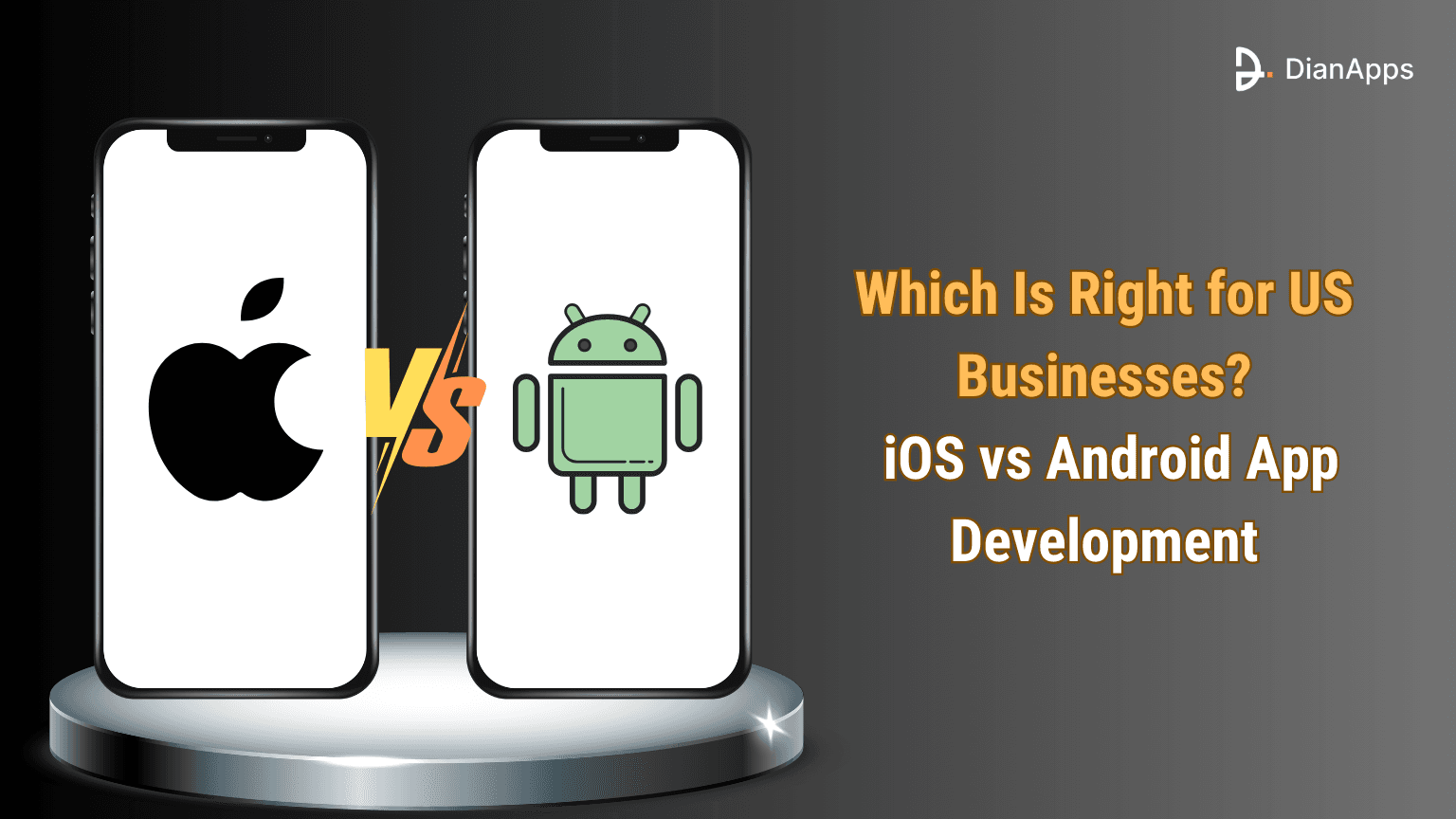
In 2025, the mobile operating system landscape continues to evolve, with Android maintaining a dominant global market share of approximately 71% to 75%, while iOS holds around 25% to 30% (Statista). Entrepreneurs and businesses aiming to maximize returns are increasingly turning to mobile app development as a strategic avenue to boost customer engagement, increase profitability, and enhance customer retention.
At DianApps, our experts provide up-to-date guidance on mobile app development for both iOS and Android, sharing insights to help you make informed decisions aligned with the latest market trends.
This comprehensive guide explores the key differences in iOS and Android app development as of 2025-2026, empowering you to choose the platform that best suits your unique business needs and goals. Whether your focus is on expanding customer engagement, increasing revenues, or improving retention, both iOS and Android platforms offer substantial and evolving benefits.
If you seek a thorough understanding of developing for iOS and Android in the current mobile landscape, our specialists at DianApps are ready to assist you in navigating this journey for optimal business performance in mobile app development.
iOS vs Android App Development USA: A Mobile App Development Comparison
Introduction to Mobile App Development
Mobile app development involves designing, building, and deploying software applications specifically for mobile devices such as smartphones and tablets. As demand for mobile apps surges, businesses and developers face the critical decision of focusing on Android apps, iOS apps, or both. Each platform presents unique opportunities and challenges that must be understood to ensure a successful app development journey.
iOS app development primarily uses Swift and Objective-C programming languages, with Swift as the modern standard. Android app development relies mainly on Java and Kotlin, with Kotlin now the preferred language for Android development.
Android and iOS development differ fundamentally in programming languages, development tools, and distribution channels through their respective app stores. Android apps are typically built using Java or Kotlin and developed in Google's official IDE, Android Studio, while iOS apps are created with Swift or Objective-C using Apple’s Xcode. iOS development requires an initial investment in Mac hardware and a $99 annual developer fee, whereas Android has a lower entry barrier with a one-time $25 developer fee and can be developed on various platforms including Windows. These distinctions influence the technical aspects of mobile app development, resources required, and the potential reach of your app.
Choosing the right platform—whether Android, iOS, or both—depends on your target audience, business goals, and available development resources. For example, if your primary users are iOS enthusiasts, focusing on iOS development may align better with your objectives. Conversely, if you aim to reach a broader global audience, combining Android and iOS development might be the optimal strategy. Understanding these key differences will help you make informed decisions and set your mobile app up for success in the competitive app store landscape.
| Aspect | iOS App Development | Android App Development |
|---|---|---|
| Market Share in USA | Approximately 58%–60% of smartphone users | Approximately 40%–42% of smartphone users |
| Programming Languages | Swift (modern standard), Objective-C | Kotlin (preferred), Java |
| Development Environment | Xcode (macOS only) | Android Studio (cross-platform) |
| Device Variety | Limited number of Apple devices, consistent hardware | Wide range of devices from multiple manufacturers |
| Development Complexity | Lower complexity due to fewer device types and OS versions | Higher complexity due to device fragmentation and multiple OS versions |
| Development Cost | Generally faster and more cost-effective development | Longer development and testing cycles, potentially higher costs |
| App Store Review Process | Strict, with reviews typically within 24 hours | Faster and more flexible, updates often approved within hours to a day |
| User Demographics | Premium users with higher disposable income, strong brand loyalty | Broader audience including emerging markets, more price-sensitive users |
| Monetization | Higher revenue per user, strong in-app purchase and subscription spending | Ad-supported revenue models dominate, larger user base |
| Security | Highly secure, closed ecosystem, consistent updates | Improved security but more vulnerable due to open-source nature and sideloading |
| Design Guidelines | Human Interface Guidelines, minimalistic and consistent UI | Material Design, customizable but varied UI across devices |
| App Performance | Optimized due to controlled hardware and software | Varies due to diverse hardware and OS versions |
| Integration with Devices | Seamless integration with Apple Watch and other Apple devices | Broad device support but requires extensive compatibility testing |
| Developer Fees | $99 annual fee, requires Mac hardware | One-time $25 fee, development possible on various platforms |
| Update and Maintenance | Faster updates due to uniform hardware and OS | Slower updates, more testing required across devices |
1. Market share of iOS and Android apps
The mobile application market in 2025-2026 remains dominated by Android and iOS, which together account for nearly all smartphones worldwide. Android holds a commanding global market share of around 71% to 75%, supported by a wide variety of devices and strong presence in emerging markets. In contrast, iOS maintains about 25% to 30% of the global market but enjoys higher concentration in affluent regions such as the US and Europe. iOS apps tend to attract premium users with higher disposable income, especially in the U.S. and Canada.
In the U.S., iOS market share is approximately 58%–60% as of early 2026, with iOS accounting for about 58.44% of smartphone users and Android holding 41.28%. Notably, nearly 87% of teenagers in the U.S. own an iPhone, highlighting iOS dominance among Gen Z. iOS users tend to have higher disposable income and are more likely to spend on premium apps compared to Android users.
Despite Android’s global lead, iOS remains a strong contender, particularly in markets like the UK and US, where users appreciate its visually appealing interface and reliable performance. As we look ahead, global mobile app spending is projected to reach $161 billion on the Apple App Store and $72 billion on the Google Play Store. iOS users are expected to account for about 68.6% of all consumer spending on mobile apps in 2025. In 2024, global in-app purchase, subscription, and paid app revenue across iOS and Google Play reached $150 billion, with iOS capturing a greater share. iOS users also exhibit higher brand loyalty and are less likely to switch platforms compared to Android users, and they typically show higher engagement, spending about 9 more hours per month on apps than Android users.
This data underscores the importance of considering both platforms carefully. Whether targeting iOS or Android users, understanding market share and user preferences is vital for making strategic development decisions.
2. Programming Language
Android and iOS development utilize distinct programming languages. For iOS, apps are coded primarily in Swift and Objective-C, with Swift being the modern standard and preferred language. Android development primarily relies on Java and Kotlin, with Kotlin now the favored choice due to its modern syntax and interoperability with Java.
Understanding these language distinctions is crucial when choosing between iOS and Android development, as they influence tech stack choices, developer availability, and app performance.
3. Development Environment
The development environments for iOS and Android differ significantly. Android developers use Android Studio, Google's official IDE for Android development, offering cross-platform support, readability, and a comprehensive suite of tools for creation and debugging.
iOS developers rely on Apple’s Xcode, the primary IDE for iOS app development, which runs exclusively on macOS. Xcode provides extensive bug-fixing tools, a user-friendly interface, and seamless integration with Apple devices.
Apple controls both hardware and software for iOS devices, ensuring a consistent development environment compared to the fragmented Android ecosystem. This consistency often leads to faster development and easier maintenance for iOS apps.
Choosing between these environments depends on developer preferences, project requirements, and available resources.
4. App Design Considerations for iOS and Android
Design differences between iOS and Android are pronounced, reflecting their unique user interface and experience philosophies. iOS design emphasizes simplicity, minimalism, and intuitive navigation, adhering strictly to Apple’s Human Interface Guidelines. This results in a standardized, polished aesthetic that reduces design complexity and ensures consistency across devices. The minimum tappable area on iOS is 44px.
Android embraces Material Design, which encourages bold colors, responsive animations, and customization flexibility, leading to varied app designs across devices. The minimum tappable area on Android is 48px.
Adhering to platform-specific design guidelines is critical, as users expect familiar visual languages. Different teams often handle iOS and Android UI/UX to meet these expectations, ensuring optimal user satisfaction.
5. Security and Privacy Features
Security remains a cornerstone of both platforms. iOS is renowned for its robust security measures, including a strict app review process and features like App Tracking Transparency, which requires user consent before tracking across apps and websites. Apple’s closed-source ecosystem and regular OS updates contribute to a secure and trustworthy platform.
Android has significantly improved its security with features such as Google Play Protect, advanced permission controls, and enhanced malware detection in recent versions. However, its open-source nature and the ability to sideload apps increase vulnerability risks, especially in markets where third-party app stores are common.
For apps handling sensitive data in healthcare, finance, or government sectors, iOS is often the preferred platform due to its stringent security and privacy controls.
6. Complexity of Development
Android app development is inherently more complex due to the wide variety of devices, screen sizes, and hardware configurations. This device fragmentation requires extensive testing and optimization, often resulting in longer development times and higher costs.
Conversely, iOS development benefits from a controlled ecosystem with fewer devices and consistent hardware, allowing for faster development cycles, simplified testing, and cost efficiencies.
7. Integration with Third-Party Devices
Developing apps that connect with external devices requires consideration of platform-specific tools. iOS offers frameworks like Core Bluetooth and seamless integration with Apple Watch and WatchOS, facilitating consistent experiences across Apple devices.
Android provides the Android Open Accessory Development Kit (ADK) for USB and Bluetooth connections, supporting a broad range of devices but requiring more extensive compatibility testing due to hardware diversity.
Thorough testing on actual devices is essential for both platforms to ensure reliable third-party device integration.
8. App Development Cost for iOS vs. Android
Cost differences between iOS and Android app development depend on multiple factors. Android’s device fragmentation necessitates longer development and testing phases, which can increase costs by up to 40% compared to iOS.
iOS development requires an annual Apple developer fee of $99, along with the cost of Mac hardware. Android developers pay a one-time $25 fee and can develop on various platforms including Windows.
Overall, while base development costs are comparable, Android projects may incur higher expenses due to complexity and testing requirements.
9. Performance Optimization for iOS and Android Apps
iOS apps generally exhibit superior performance optimization due to Apple’s closed ecosystem and stringent app review process, which maintains high quality standards before apps reach the App Store.
Android’s diverse device landscape presents challenges for optimization, leading to potential performance variations. Developers must tailor apps to accommodate varying hardware and OS versions to ensure smooth user experiences.
10. App Store Distribution and Approval
Both platforms require app store review before apps become publicly available. Apple’s App Store has a strict review process, typically completing submissions within 24 hours but occasionally taking longer for complex apps. The App Store enforces comprehensive standards for quality, security, and user experience, which can lead to longer approval times.
Google Play Store offers a faster and more flexible publishing process, with most updates approved within hours to a day. Android apps can also be distributed through third-party app stores, expanding reach but potentially complicating discoverability.
Understanding these nuances is critical for planning app launch timelines and update cycles.
11. Monetization Strategies and User Behavior
iOS users tend to have higher purchasing power, spending more on apps and in-app purchases. In the U.S., iOS users spend an average of $140 annually on apps, compared to $69 for Android users. The average iPhone user spends about $12.77 per app, while the average Android user spends around $6.19.
Android’s larger user base favors ad-supported revenue models, particularly in gaming, news, and entertainment categories. Ad monetization remains a key driver for Android apps, compensating for lower per-user spending.
Matching monetization models to platform-specific user behavior is essential for maximizing revenue.
Conclusion
In 2025-2026, the choice between iOS and Android app development in the USA hinges on your business goals, target audience, budget, and desired features. Android offers unparalleled global reach and flexibility, ideal for mass adoption and ad-supported models. iOS provides a more controlled environment with higher revenue potential per user, superior security, and a consistent user experience, making it attractive for premium markets.
Many businesses adopt a phased approach, starting with one platform based on strategic priorities and expanding to the other, or leverage cross-platform frameworks to balance cost and reach.
At DianApps, we guide you through these decisions with expert insights and tailored solutions to help you succeed in the dynamic mobile app market.
Contact our mobile app development company today to start your journey in iOS and Android app development.
Frequently Asked Questions (FAQ):
What is the market share of iOS vs Android app development in the USA?
iOS holds about 58%–60% of the smartphone market in the USA, while Android accounts for approximately 40%–42%, making both platforms vital for app developers targeting US users.
Which platform should I choose for app development in the USA, iOS or Android?
The choice depends on your target audience and business goals. iOS is preferred for premium users and higher revenue potential, while Android offers broader reach, especially in emerging markets.
What programming languages are used for iOS and Android app development?
iOS apps are primarily developed using Swift and Objective-C, while Android apps use Kotlin and Java, with Kotlin now being the preferred language.
How do development costs compare between iOS and Android apps in the USA?
iOS app development is generally faster and more cost-effective due to fewer devices and consistent hardware, whereas Android development may require more time and testing because of device fragmentation.
How do app store review processes differ between Apple App Store and Google Play Store?
Apple’s App Store has a stricter review process, usually completing within 24 hours, while Google Play Store offers faster and more flexible reviews, often approving updates within hours to a day.
Which platform offers better monetization opportunities in the USA?
iOS users tend to spend more on apps and in-app purchases, making it better for direct revenue. Android’s larger user base favors ad-supported models for monetization.
Are there differences in app security between iOS and Android development?
Yes, iOS provides a highly secure, closed ecosystem with consistent updates, while Android, being open-source, has improved security but remains more vulnerable, especially with sideloaded apps.







Leave a Comment
Your email address will not be published. Required fields are marked *