















 0 comments





AI OverviewChoosing between a custom website and a template depends on how critical your website is to growth, branding, and scalability. Templates offer speed and affordability for simple or early-stage needs, while custom websites deliver flexibility, performance, integrations, and long-term value. Businesses with complex user journeys, differentiated offerings, or growth ambitions benefit more from custom builds. The right choice isn’t about cost it’s about alignment with business goals, user expectations, and future readiness. |
At first glance, templates feel efficient. They’re fast, familiar, and cost-effective. Custom websites, on the other hand, promise flexibility, scalability, and differentiation but come with higher upfront effort. The real issue isn’t cost or speed. It’s alignment. Alignment with your growth goals, user expectations, and long-term business model.
Recent studies show that users form an opinion about a website in under 0.05 seconds, and nearly 75% judge a business’s credibility based on design alone. That makes your choice foundational, not cosmetic.
Whether you’re a startup validating ideas or an enterprise scaling digital operations, understanding this decision matters. And a seasoned website development company will tell you the answer depends less on trends and more on intent.
Let’s break it down.
Understanding Custom Website Development
Custom website development refers to building a website from the ground up designed, structured, and coded specifically for a business’s unique requirements. Nothing is pre-boxed. Nothing is assumed. Every component is intentional.
This approach starts with discovery: understanding business goals, user journeys, conversion paths, and technical requirements. Designers then create bespoke interfaces aligned with brand identity, while developers engineer the backend to support performance, integrations, and scalability.
According to industry data, businesses using tailored digital platforms report up to 35% higher conversion rates compared to off-the-shelf solutions. Why? Because custom websites are built around how users actually behave, not how templates assume they should.
Custom development also enables architectural flexibility. You’re not restricted by theme limitations, plugin conflicts, or rigid layouts. Instead, the website evolves as the business evolves.
In essence, a custom website is not a cost, it’s a digital asset designed to compound value over time.
Recommended Read: How To Choose A Website Development Company?
Key Advantages of a Custom Website
Tailored User Experience
Custom websites are designed around real user behavior. Navigation, content flow, and interaction patterns are mapped to how your audience thinks and acts. This leads to better engagement and lower bounce rates.
Scalable Architecture
As your business grows, your website can grow with it new features, integrations, or traffic spikes don’t require rebuilding from scratch.
Brand Differentiation
Templates are shared. Custom designs are not. A bespoke site ensures your brand doesn’t look like a hundred others in your category.
Performance Optimization
Custom builds remove unnecessary code bloat. Faster load times directly impact SEO rankings and conversion rates. Google reports that a 1-second delay can reduce conversions by 20%.
Advanced Integrations
CRMs, ERPs, marketing automation, analytics tools custom websites can integrate smoothly without workaround plugins.
Limitations of Custom Website Development
Higher Initial Investment
Custom development requires more planning, design, and engineering, meaning higher upfront costs.
Longer Development Timelines
A fully custom site can take weeks or months depending on complexity, which may not suit urgent launches.
Dependency on Skilled Teams
Ongoing maintenance and upgrades require experienced developers, not just drag-and-drop editors.
Despite these limitations, businesses focused on long-term ROI often view custom development as strategic infrastructure rather than an expense.
Technologies and Platforms Commonly Used in Custom Websites
Modern custom websites are built using reliable, future-ready technologies and website development frameworks:
- Frontend: React, Next.js, Vue.js for dynamic and responsive interfaces
- Backend: Node.js, Laravel, Django for scalable server logic
- CMS: Headless systems like Strapi, Contentful, Sanity
- Databases: PostgreSQL, MongoDB, MySQL
- Hosting: AWS, Google Cloud, Vercel for high availability and performance
- Security: Custom authentication layers, role-based access, encrypted data flows
This tech stack allows businesses to build websites that function more like products than static pages.
What Is a Website Template?
A website template is a pre-designed layout built for mass use. It comes with predefined structures, design elements, and functionalities that can be customized to a limited extent usually via a CMS like WordPress, Shopify, or Wix. It can also be known as zero-code website development.
Templates are designed for speed. You select a theme, adjust branding, add content, and publish. For many small businesses, this approach lowers the barrier to entry into the digital space.
Template-based websites power nearly 60% of small business sites globally, largely due to affordability and ease of use. They work well when requirements are simple and differentiation is not critical.
However, templates are built for averages not specifics. And that trade-off becomes more visible as businesses scale.
Advantages of Using Website Templates
Faster Time to Launch
Website templates enable rapid deployment, allowing businesses to go live within days ideal for MVPs, time-sensitive campaigns, or validating ideas without long development cycles or technical dependencies.
Cost-Effective Setup
Templates significantly reduce upfront design and development costs, making them a practical option for startups and small businesses operating within limited budgets or prioritizing short-term digital presence.
Ease of Management
Most templates are built on user-friendly CMS platforms, enabling non-technical teams to manage content, images, and basic layouts without relying on developers for everyday updates.
Pre-Built Functionalities
Templates often include ready-made features like contact forms, blogs, galleries, and SEO plugins, eliminating the need to build foundational components from scratch.
Drawbacks of Website Templates
Limited Customization Capabilities
Templates restrict design and functional flexibility, making it difficult to implement unique user experiences, complex workflows, or custom business logic without heavy modifications or compromises.
Performance and Speed Issues
Many templates carry excessive code, scripts, and plugins, which negatively impact page load speed directly affecting SEO rankings, user engagement, and overall website performance.
Generic Brand Representation
Using widely available templates increases the risk of visual similarity with competitors, weakening brand differentiation and making it harder to establish a strong, memorable digital identity.
Scalability Constraints
As business requirements grow, templates often struggle to support advanced features or higher traffic, leading to technical limitations, patchwork fixes, or costly rebuilds later.
Custom Website vs Template: Core Differences Explained
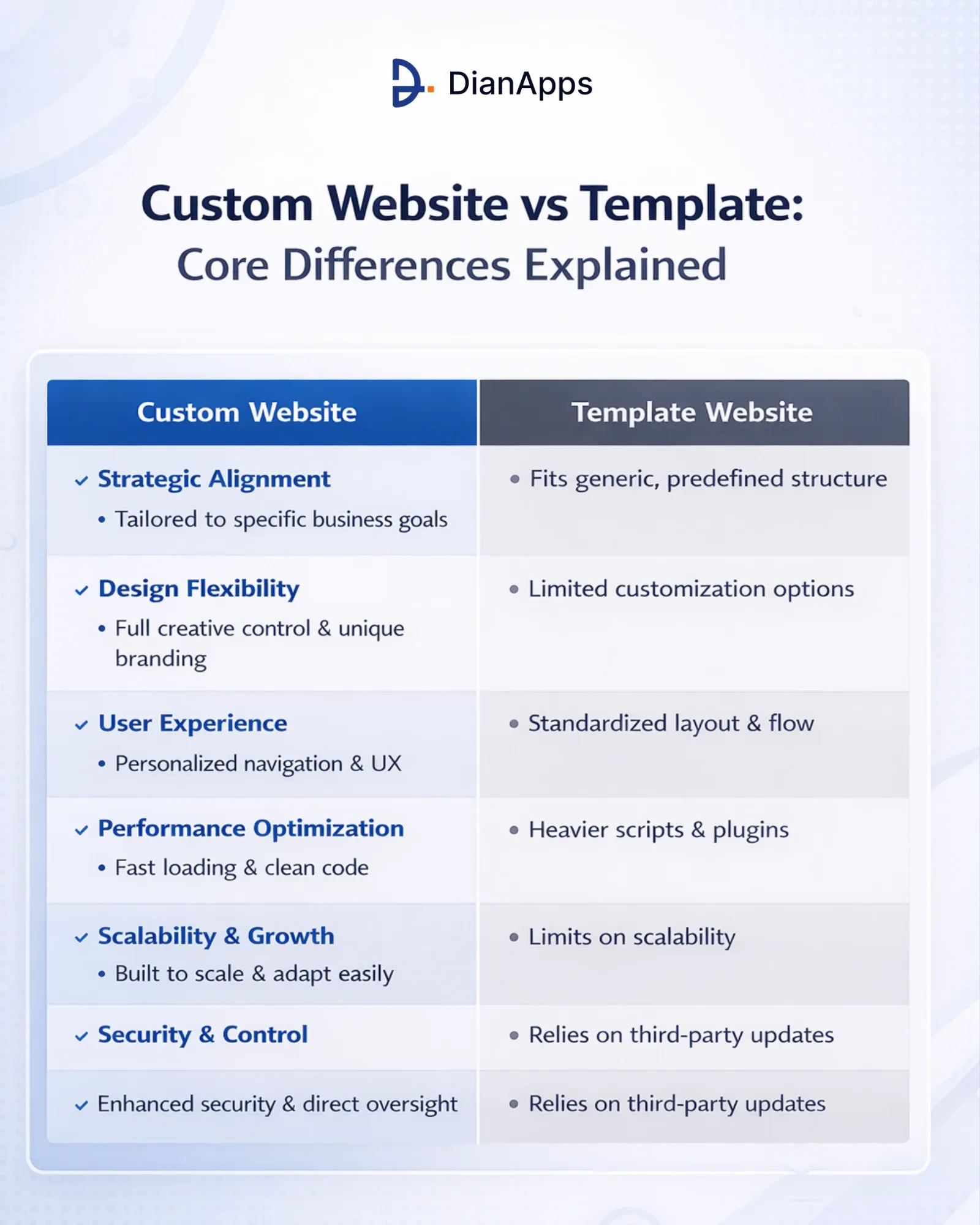
This comparison goes beyond cost and speed. Understanding how custom websites and templates differ across strategy, experience, performance, and scalability helps businesses choose an approach that aligns with both immediate needs and long-term growth goals.
Strategic Alignment with Business Goals
A custom website is built around specific business objectives such as lead generation, onboarding, product adoption, or enterprise integrations. Every layout, interaction, and feature is designed to support measurable outcomes and long-term strategy.
A website template, in contrast, is designed for general use. While it can support basic goals, it often requires businesses to adjust their strategy to fit the template’s predefined structure rather than the other way around.
Design Flexibility and Brand Identity
A custom website provides complete creative freedom, enabling brands to define their visual language, layout patterns, and digital personality. This ensures consistency across channels and helps brands stand out in competitive markets.
A website template offers limited customization options. Since many businesses use the same themes, visual similarity becomes inevitable, making it harder to establish a distinct and memorable brand presence.
User Experience and Navigation Flow
A custom website is designed using user behavior analysis, allowing navigation and content flow to mirror how users actually interact with the product or service. This leads to higher engagement and smoother conversion paths.
A website template follows a fixed navigation model intended to suit most users. While functional, it may not reflect unique user journeys, especially for businesses with complex offerings or diverse audiences.
Performance and Technical Optimization
A custom website is optimized at the code level, ensuring faster load times, cleaner architecture, and improved Core Web Vitals. This directly impacts search visibility, usability, and conversion performance.
A website template often includes excess scripts, plugins, and unused features. These elements can slow down performance, particularly as additional tools are layered on over time.
Scalability and Future Readiness
A custom website is built to evolve, supporting new features, integrations, and traffic growth without structural limitations. This makes it suitable for businesses planning long-term digital expansion.
A website template may work well initially but often struggles as requirements grow. Scaling usually involves workarounds or rebuilding, increasing long-term costs and operational friction.
Security, Control, and Maintenance
A custom website allows greater control over security protocols, access permissions, and compliance standards. Maintenance is planned and aligned with business priorities rather than external update cycles.
A website template relies heavily on third-party themes and plugins for updates and security patches. This dependency increases vulnerability risks and limits control over system changes.
When a Custom Website Makes Sense?
You have complex user journeys
When users move through multiple touchpoints research, comparison, onboarding, or personalization a custom website allows precise control over navigation, logic, and interactions, ensuring the experience feels intuitive rather than fragmented or forced.
Differentiate your product or service
If what you offer isn’t generic, your website shouldn’t be either. Custom development allows you to showcase value propositions, workflows, and storytelling that templates often fail to communicate effectively.
You expect rapid growth
Businesses planning to scale need infrastructure that grows with them. Custom websites support evolving features, higher traffic, and system upgrades without requiring frequent structural overhauls or performance compromises.
Integrations are business-critical
When your website must connect with CRMs, analytics platforms, marketing automation, or internal tools, custom development ensures smooth data flow without reliance on unstable third-party plugins.
Brand perception directly impacts revenue
In competitive markets, brand trust influences buying decisions. Custom websites help establish credibility through unique design, consistency, and refined user experiences that reinforce brand authority.
Recommended Read: Comprehensive Guide on Website Design and Development Cost
When a Template Is the Smarter Choice?
You’re testing a new idea
Templates are ideal for early-stage validation. They allow businesses to launch quickly, gather user feedback, and test market demand without committing to heavy upfront investment.
Budget and timelines are tight
When speed and cost efficiency are priorities, templates deliver a functional digital presence with minimal resources, making them suitable for short-term goals or limited-scope projects.
Requirements are straightforward
For businesses needing basic pages such as services, contact information, or blogs templates provide sufficient structure without unnecessary complexity or customization overhead.
Final Words
So before you decide, pause and ask yourself what role is your website really playing? Is it just a placeholder on the internet, or expect to attract, engage, and convert users every single day? That answer changes everything.
Templates help you move fast and test waters. Custom websites help you build depth, trust, and long-term momentum. Neither choice is wrong but choosing without clarity almost always is. Your website should reflect how ambitious your business is, not how convenient the shortcut looks.
If growth, differentiation, and experience are on the table, partnering with a forward-thinking frontend development company can help turn your website into a living product, not a static asset. Build something that evolves, adapts, and performs because in the digital world, standing still is the fastest way to fall behind.
Frequently Asked Questions
 0 comments











Leave a Comment
Your email address will not be published. Required fields are marked *