

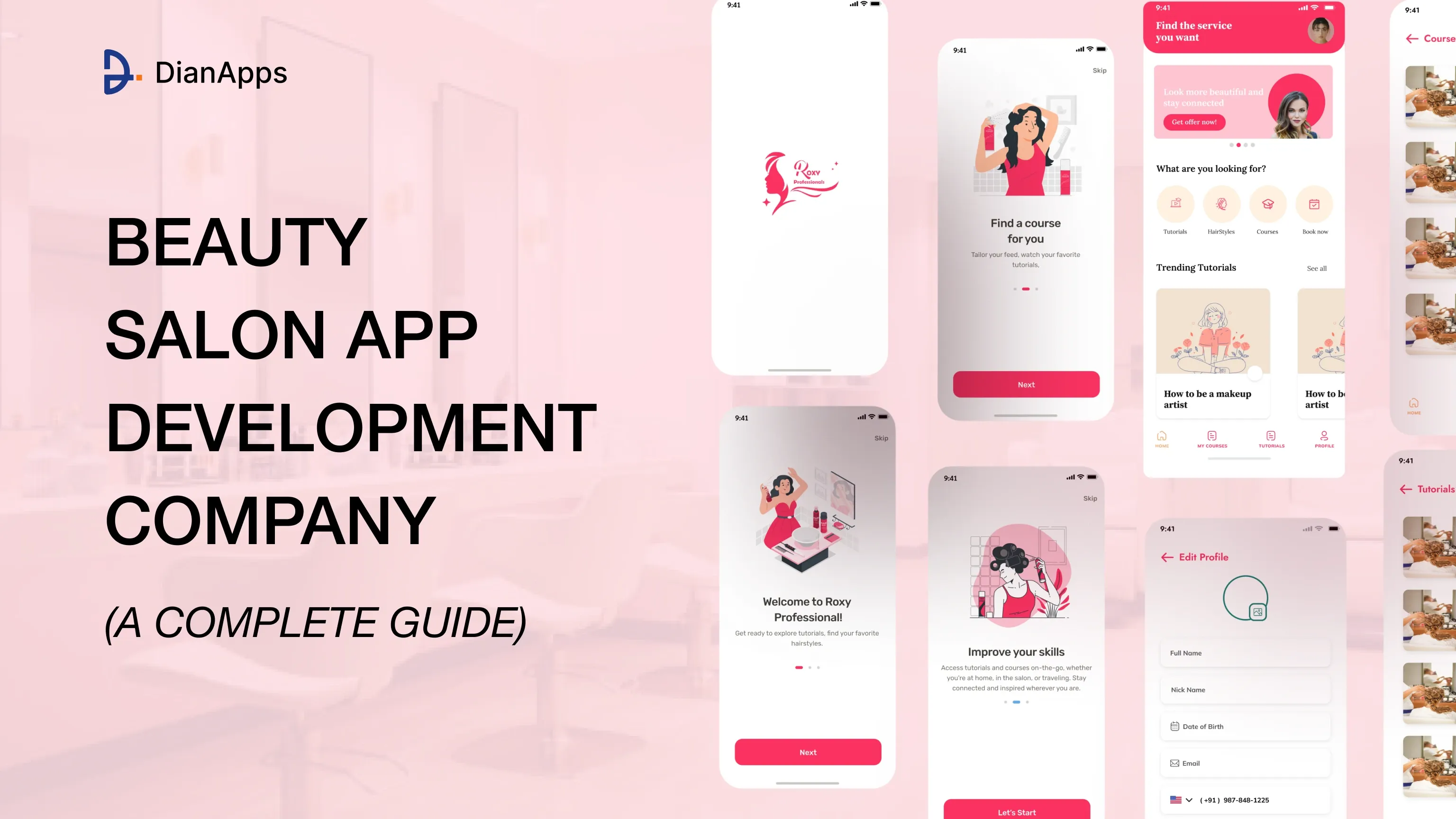
Overview:
|
The Salon That Couldn't Keep Up
Picture this. It's a packed Friday afternoon. Your receptionist has three people holding on two phone lines, a walk-in is waiting at the front desk, and somewhere in your Instagram DMs are four more appointment requests from earlier this morning, unseen, unanswered.
By the time you get to them, two of those clients have already booked with the salon down the street.
This isn't a story about bad management. It's a story about infrastructure in mobile app development solutions. The beauty industry has, for most of its history, run on charm, word-of-mouth, and handwritten appointment books.
But consumer expectations have moved well ahead of that model. And the companies building apps for salons are quietly becoming one of the most important players in the future of how beauty services work.
"Salons that invest in their own digital infrastructure today are not catching up with trends, they are setting them."
In this blog, we go deep on the beauty salon app development company landscape. We cover what's driving demand, what these companies actually build, what the market data says, and how to think about ROI when you're sitting across the table from a development team asking for a six-figure budget.
The Market Picture: Why This Industry Is Exploding
Global Beauty Services: A Multi-Hundred-Billion-Dollar Opportunity
The global beauty services market, encompassing hair salons, nail studios, spas, skin clinics, and barber shops, has grown consistently for the past decade, with only a brief dip during 2020. Since the pandemic, not only has the industry bounced back, it has accelerated, buoyed by a renewed consumer focus on self-care and personal presentation.
The numbers tell a compelling story. What was a $138 billion industry in 2021 is on a trajectory to surpass $250 billion by 2028. That growth isn't coming from people suddenly getting more haircuts, it's coming from higher average spend per visit, driven largely by digital convenience.
When booking is easy and frictionless, people book more often. When loyalty programs remind them they have points to spend, they come back sooner. App technology is, in a very direct sense, inflating the size of this market.
Global Beauty Services Market: 2021–2028
Year | Market Size | YoY Growth | Primary Demand Driver |
|---|---|---|---|
2021 | $138.4B | — | Post-lockdown surge in bookings |
2022 | $151.9B | 9.7% | Explosion in on-demand beauty services |
2023 | $164.3B | 8.2% | App-first consumer habit formation |
2024 | $178.6B | 8.7% | AI integration begins mainstream adoption |
2025 | $194.8B | 9.1% | AR try-on and hyper-personalisation rise |
2026 (Est.) | $212.3B | 9.0% | Subscription-based salon models expand |
2028 (Proj.) | $251.0B | 8.8% | Platform consolidation & global scale |
The Mobile Shift Is No Longer Optional
Here's the statistic that should get every salon owner's attention: 67% of clients now prefer to book beauty appointments through an app or website rather than by phone. Among clients under 35, that number jumps to 84%.
More strikingly, 43% of all bookings now happen outside of business hours, between 8 PM and midnight, when no receptionist is available to answer the phone.
What this means in practice is that a salon without a digital booking solution is structurally invisible to a growing segment of its market. It's not that clients dislike calling, it's that they have simply stopped doing it as a default behaviour. They open an app first. If your salon isn't in that app, you don't exist in that moment of intent.
Also read: Essential Strategies for Optimizing App Store Visibility
The App Development Market Is Catching Up
Recognising this gap, a wave of companies specialising in beauty and wellness app development has emerged over the past five years. Some are broad-scope on-demand app development service providers with dedicated beauty verticals.
Others are specialist firms that exclusively serve salon and spa businesses. The market for their services is growing in parallel with the industry it serves, and has attracted significant venture capital and private equity attention as a result.
The total addressable market for beauty and wellness software, including apps, scheduling platforms, POS systems, and CRM tools, was estimated at $4.6 billion in 2024 and is projected to reach $9.8 billion by 2029, representing a compound annual growth rate of approximately 16.3%.
Eight Market Trends Shaping Beauty App Development Right Now
Understanding what drives demand in this space requires a look at both the technology side and the consumer behaviour side. The trends below are not speculative, they are already showing up in deployment data, investment patterns, and consumer research.
Market Trend | Growth Window | Key Data Point | Priority |
|---|---|---|---|
Mobile-First Booking | 2022–2026 | 89% of Gen Z prefer app booking | Critical |
AI-Powered Recommendations | 2024–2028 | +29% upsell rate reported | High |
AR Virtual Try-On | 2025–2030 | 14% adoption, fastest-growing segment | Emerging |
Loyalty & Gamification | 2023–2027 | 3x repeat visit rate improvement | High |
Contactless & In-App Payments | 2021–2026 | +22% avg. ticket size | Critical |
Real-Time Staff Scheduling | 2023–2027 | Reduces admin time by 38% | High |
Automated Reminder Systems | 2022–2026 | -40% no-show rate | Critical |
Data Analytics Dashboards | 2024–2029 | Adopted by 61% of multi-location chains | Emerging |
Trend 1: Mobile-First Booking Is the New Baseline
This is no longer a trend in the emerging sense, it is table stakes. Any serious beauty salon app development company will tell you that the core of every engagement they take on is getting the booking experience right. Three taps from opening the app to confirming an appointment.
That is the benchmark the best apps are designed around. Anything more and you are creating drop-off. Anything less and you're probably cutting corners on data collection or confirmation logic.
The companies doing this best are those that have obsessed over the UX of booking for years, who have watched session recordings, run A/B tests on button placement, and genuinely understand why a client in the middle of her commute should be able to rebook her balayage in under ninety seconds.
Trend 2: AI Is Moving from Novelty to Infrastructure
Artificial intelligence in salon apps started as a novelty, smart recommendation engines that suggested add-on services based on what you'd booked before. But it's maturing quickly. The most forward-thinking development companies are now building AI-powered app development tools into scheduling logic, predictive no-show detection, dynamic pricing suggestions, and automated rebooking flows.
The ROI here is real. Salons using AI-powered rebooking prompts, messages sent to clients at the statistically optimal moment to nudge a return visit, are seeing meaningful lifts in rebooking rates.
The technology behind this is not exotic. What it requires is a development partner who understands how to integrate machine learning models into an app backend without over-engineering it.
Also read: Machine learning for developers guide.
Trend 3: AR Try-On Is the Fastest-Growing Differentiator
Augmented reality hair colour simulation, the ability to point your phone's camera at your face and see what you'd look like with a different shade, cut, or style, was a curiosity two years ago.
It is now one of the most cited reasons clients choose one salon's app over another's when both are otherwise comparable.
The technology has become dramatically more accessible for development teams, thanks to platforms like Google's ARCore and Apple's ARKit.
Adoption is still only at 14% across salon apps, which makes this an enormous differentiator for early movers. The development companies leading in this space have built modular AR components that can be licensed or customised, reducing both build time and cost significantly.
Trend 4:Loyalty Is the Retention Engine
A client who uses a salon's loyalty app visits 3x more frequently than one who doesn't, that single statistic has sent a wave of demand through the development industry.
Salon owners who once viewed loyalty programs as complicated to implement now have development partners who can build a fully functional points-and-rewards system in a matter of weeks as part of a broader app build.
The sophistication here has increased considerably. Beyond simple punch-card digital equivalents, leading apps now feature tiered loyalty programs, birthday rewards, referral bonuses, and gamified milestone achievements. The goal is to make the client feel genuinely recognised, not just tracked.
What Beauty Salon App Development Companies Actually Build
There's a common misconception that hiring a beauty salon app development company means getting a booking calendar and not much else. The reality of what a comprehensive salon app encompasses is considerably more interesting, and more strategically important.
App Feature | Category | Adoption | Business Impact |
|---|---|---|---|
Smart Appointment Booking | Must-Have | 89% | +34% revenue |
Push Notifications & Reminders | Must-Have | 76% | -40% no-shows |
Customer Style History & Profiles | High Value | 68% | +28% retention |
In-App Payments & Tipping | Must-Have | 58% | +22% avg ticket |
Loyalty Rewards & Referrals | High Value | 61% | 3x repeat visits |
Staff & Commission Management | Operational | 54% | -38% admin time |
Inventory Tracking | Operational | 41% | 15% cost reduction |
AI Service Recommendations | Growth Feature | 31% | +18% upsell rate |
AR Virtual Try-On | Differentiator | 14% | +29% conversion |
Analytics & Revenue Dashboard | Growth Feature | 47% | Data-led decisions |
The Client-Facing Experience
From the client's perspective, a well-built salon app does the following things invisibly and beautifully. It shows real-time availability. It remembers their preferred stylist, their usual services, and any notes from last time, allergies, style preferences, the fact that they always want coffee when they arrive.
It sends a reminder 24 hours before their appointment and again two hours before. It lets them pay in-app, tip their stylist, and rebook their next visit before they've even left the chair.
This sounds straightforward. Building it well, with a backend that handles scheduling conflicts, time-zone aware reminders, split-tip calculations, and integration with payment gateways, is a genuinely complex engineering challenge. The development companies who've done it dozens of times have a meaningful advantage over those approaching it fresh.
The Salon Operations Layer
Behind the scenes, a great salon app also transforms how the business runs. Stylists can see their full day's schedule before leaving home. Managers can view occupancy across multiple chairs, or multiple locations, from a single dashboard.
Commission calculations that used to require an hour of spreadsheet work at the end of each week can be generated automatically. Inventory alerts notify the purchasing manager when product stock for a high-turnover service drops below a set threshold.
These operational features are often what separates the salons that grow from those that plateau. When the administrative burden decreases, owners and managers can spend more time on the things that actually build a business: hiring, training, client relationships, and marketing.
The Data Intelligence Layer
The most sophisticated salon apps being built today go beyond scheduling and payments to deliver genuine business intelligence. Revenue per stylist. Average client lifetime value. Churn rates by service category.
Which promotional campaign drove the most first-time bookings. This is the layer that takes a salon from reactive to proactive, from responding to yesterday's numbers to making decisions based on tomorrow's trends.
Not every salon needs this level of sophistication on day one. But the best enterprise-grade software development solutions build with this layer in mind from the start, ensuring the data architecture supports it when the business is ready to scale.
How to Choose a Beauty Salon App Development Company
The market for beauty app development is large enough now that the quality variation is significant. There are companies doing genuinely excellent work, and companies selling generic solutions with a fresh coat of pink paint. Knowing the difference matters enormously, particularly when you're committing a meaningful budget.
Domain Knowledge vs. Technical Skill: You Need Both
Technical skill is table stakes. Every credible development company can write clean code. What separates the best partners is their understanding of the beauty business itself.
- Do they know that a colorist's appointment blocks need to account for processing time during which the stylist is free?
- Do they understand that a nail studio's scheduling logic is fundamentally different from a hair salon's because services can often be stacked across two techs simultaneously?
- Do they know what commission structures look like in this industry, and how complex a payout calculation can get in a high-volume salon?
When you're evaluating potential partners, ask specific operational questions. Watch how they respond. The companies with genuine domain knowledge will answer fluently and ask follow-up questions. The generalists will pivot to talking about their tech stack.
Portfolio Depth Over Portfolio Size
A development company showing thirty completed apps across industries tells you much less than one showing eight salon-specific apps with measurable outcomes. Ask to see before-and-after metrics where available. Ask to speak with clients directly. Ask what went wrong during a build and how they handled it, because things always go wrong, and the response to problems is often more revealing than the quality of the deliverable itself.
Post-Launch Commitment
Apps are not delivered and forgotten. Every major iOS and Android update, released annually by Apple and Google, introduces the potential for interface regressions, performance issues, and occasionally broken core functionality. Your payment gateway provider will deprecate API versions. Your notification infrastructure will need maintenance. The relationship with your development partner doesn't end at launch; it restructures into an ongoing support engagement. Make sure your contract reflects this, and make sure the team you're evaluating has a credible answer for what post-launch support looks like in practice.
Transparency on Cost and Timeline
Beware of quoted numbers that arrive faster than the conversations that should precede them. A development company that sends you a cost estimate within 24 hours of an introductory call has not done the discovery work required to give you an accurate number. Discovery takes time because the requirements that drive cost, number of platforms, complexity of scheduling logic, integration points with existing POS or CRM systems, level of custom design, are not visible until you've had detailed conversations about your business.
Also read: Why DianApps is an Ideal Choice for Enterprise Software Development
The Cost Conversation: What Should You Expect to Pay?
Budget is always the point where salon owners either get excited or shut down. Let's be honest about the numbers and what they represent.
Solution Type | Cost Range (USD) | Timeline | Ideal For |
|---|---|---|---|
White-Label Template | $5K – $15K | 4–8 weeks | Boutique salons, solo stylists |
Semi-Custom App | $20K – $50K | 3–5 months | Growing local chains (3–10 locs) |
Fully Custom (iOS + Android) | $60K – $150K | 6–12 months | Established brands, franchises |
Enterprise SaaS Platform | $150K – $500K+ | 12–24 months | National / global salon networks |
Note: Annual maintenance typically adds 15–20% of initial build cost. Costs vary by region, team seniority, and feature complexity.
The White-Label Path
For independent salons and boutique studios, the white-label path is often the most sensible starting point. A reputable development company with a white-label platform can deploy a fully branded, functional app in a matter of weeks.
The customisation is real, your logo, your colour palette, your service menu, even if the underlying engine is shared with other clients. The limitations are equally real: you can't add features that weren't built into the platform, and you're dependent on the platform's roadmap for future development.
The strategic question is whether you'll outgrow it. If you're a single-location studio with fifty regular clients, probably not. If you're building toward a franchise or a regional chain, the white-label route may slow you down within eighteen months.
The Custom Build Case
Custom development is expensive because it's bespoke. Every feature is built to your exact specification. The scheduling logic reflects your specific service types and staff structure. The loyalty program rewards whatever you want to reward. The data architecture is designed with your growth trajectory in mind. You own the codebase.
The return on that investment tends to materialise in three ways.
- First, operational efficiency, the time your staff saves on administrative tasks.
- Second, client retention, the lift in rebooking rates and loyalty program engagement.
- Third, competitive differentiation, an app experience that clients consistently reference when recommending your salon to friends.
Quantifying all three for your specific business, before you commit to a budget, is the exercise every good development partner should help you through.
Read the complete app development cost breakdown here.
The Demand Story: Why Now Is the Right Moment
Consumer Behaviour Has Already Shifted: Permanently
The pandemic accelerated a decade of digital adoption into a single year. Clients who had never booked anything online were suddenly ordering groceries, consulting doctors, and managing their finances through apps. That shift did not reverse when the world reopened.
It entrenched. A consumer who books appointments digitally today will not willingly go back to phone calls. The salons that haven't adapted yet are not holding steady, they are slowly losing ground to competitors who have.
The Competition Is Already Building
This is not a category where you have years to deliberate. The data consistently shows that 52% of clients would switch salons for a materially better app experience.
That is a customer acquisition opportunity for every salon with a great app, and a customer attrition risk for every salon without one. The medium-term trajectory is clear: app-enabled salons will consolidate market share from those operating on traditional infrastructure.
The Technology Is More Accessible Than Ever
Cross-platform development frameworks like React Native mean that a single codebase now runs on both iOS and Android, halving development time and cost compared to native development five years ago.
Payment infrastructure, push notification services, and AI recommendation engines are available as modular, well-documented APIs. A good development company today can build what would have taken twice the time and budget in 2019.
"The right question is no longer whether your salon needs an app. It is whether you can afford to wait any longer to have one."
Final Thoughts: What This All Means for Your Business
The beauty salon app development industry exists because a real gap emerged between what consumers expect from their service experiences and what most salons are technically equipped to deliver.
Closing that gap is the work these companies do, and the market data makes clear that the salons closing it are performing measurably better across every metric that matters, revenue per seat, client retention, average booking frequency, and operational efficiency.
Choosing the leading AI-powered development companies is not primarily a technology decision. It is a business decision, one that requires you to think clearly about where your salon is today, where you want it to be in three years, and what kind of client experience you want to be known for. The technical questions matter, but they come second.
Start by mapping the friction in your current booking and client experience. Talk to your front desk staff about what takes the most time. Ask your loyal clients what would make coming back even easier. That conversation, not a feature checklist, is the brief you bring to a development partner worth working with.
The market is growing. The technology is ready. The consumer expectation is set. What's left is the decision to move.







Leave a Comment
Your email address will not be published. Required fields are marked *